Air Quality Compliance Testing in California: 2026 Latest News, Updates, Pros, Cons & How EES Helps Industries
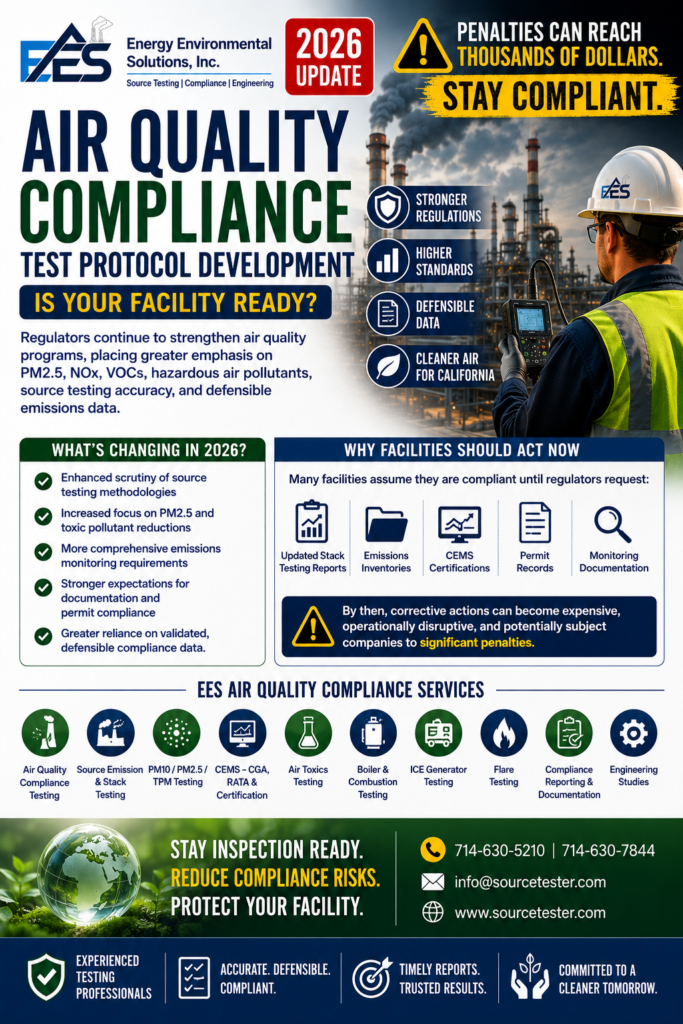
California continues to maintain some of the most demanding air-quality requirements in the United States. For industrial and commercial facilities, Air Quality Compliance Testing is increasingly important because regulators are relying on measured emissions data to verify that permitted equipment and processes are operating within applicable limits.
One important clarification: there is no single California-wide “Air Quality Compliance Testing” rule that requires every facility to conduct the same test. Testing obligations generally come from a facility’s applicable air district rules, permits, state requirements, federal requirements, source-specific regulations and compliance schedules. South Coast AQMD, San Joaquin Valley APCD, Bay Area AQMD and other California air districts administer many of these requirements locally.
The regulatory environment is particularly active in 2026, with new and amended rules, source-testing requirements, toxic-air-contaminant controls, particulate-matter requirements and increased regulatory attention to emissions monitoring.
2026 Latest California Air Quality Compliance Testing Updates
1. South Coast AQMD continues expanding source-testing activity
South Coast AQMD’s 2026 planning documents specifically identify continued source testing, source-test protocol and report evaluations, CEMS certifications, laboratory approval reviews and source-test observations as ongoing regulatory activities. The District also anticipates increased source-test evaluation volume associated with the transition away from RECLAIM and permit-streamlining efforts.
This is an important signal for industrial facilities: source testing is not becoming less important—it is becoming a more integrated part of regulatory compliance.
2. New and amended air-quality rules are creating additional testing needs
South Coast AQMD’s 2026 rulemaking activity includes amendments involving toxic air contaminants, particulate matter, visible emissions, coatings, aerospace operations and combustion equipment. For example, Proposed Amended Rule 1401 addresses New Source Review of Toxic Air Contaminants, including updates to toxic compounds and health values.
On June 5, 2026, South Coast AQMD also adopted amendments involving Rule 401 Visible Emissions, Rule 404 Particulate Matter—Concentration, and Rule 405 Solid Particulate Matter—Weight, alongside other rule changes.
For facilities, every rule amendment can potentially change what must be measured, how emissions are demonstrated and what documentation must be maintained.
3. Source-test protocols remain critical
South Coast AQMD maintains specific technical procedures for source testing and laboratory analysis. Its Methods & Procedures program provides procedures for ambient-air laboratory methods and source-testing methods to help regulated facilities comply with applicable regulations and policies.
This means a facility cannot simply hire any contractor to perform an informal emissions measurement and assume that it satisfies a regulatory testing requirement.
The test method, sampling location, operating condition, equipment configuration, QA/QC, calculations and reporting format can all matter.
4. 2026 compliance deadlines are increasing testing pressure
South Coast AQMD’s 2026 compliance-deadline guidance includes multiple rules with testing, certification or implementation requirements. One example is the Chrome ATCM/Rule 1469 program, where certain facilities had to complete source testing to demonstrate compliance with January 1, 2026 requirements, with subsequent testing required every two calendar years.
This illustrates a broader trend:
Regulatory deadline → Required testing → Verified emissions → Documentation → Compliance determination
Why Is Air Quality Compliance Testing Important in California?
Air-quality regulations are ultimately about controlling actual emissions—not simply assuming that equipment is operating correctly.
A boiler might appear to be operating normally while producing excessive NOx. A thermal oxidizer may be running at the correct temperature while failing to achieve its required VOC destruction efficiency. A baghouse can appear operational while allowing excessive particulate matter emissions. A process may have changed since its last source test, making an old compliance result less representative of current conditions.
That is why compliance testing provides something regulators and facility owners both need:
Measured evidence.
Testing can establish actual emissions of pollutants such as:
- NOx
- CO
- SOx
- VOC
- PM10
- PM2.5
- Total Particulate Matter
- Toxic air contaminants
- Metals
- Hexavalent chromium
- Dioxins/furans
- Ammonia
- Hydrogen chloride
- Other regulated pollutants
The exact pollutants depend on the source, permit and applicable regulation.
Is Air Quality Compliance Testing Compulsory?
The answer depends on the facility.
This distinction is extremely important for SEO content as well as regulatory accuracy.
California does not impose one universal testing schedule on every industrial facility.
Instead, testing may become mandatory because of:
Air district rule + facility permit + equipment type + emissions limit + operating conditions + applicable federal/state regulation
For example, a facility may have a permit condition requiring annual testing, while another source may require testing every three years, every two years or only after a modification.
Some facilities may also have:
- Continuous Emissions Monitoring Systems (CEMS)
- Periodic monitoring
- Portable analyzer requirements
- Performance testing
- Source testing
- Compliance demonstrations
- Laboratory analysis
- RATA
- CGA
- Visible-emissions evaluations
Therefore, the first question should always be:
“What does my facility’s permit and applicable air-district rule require?”
Major Areas Covered by Air Quality Compliance Testing
NOx Testing
NOx testing is especially important for combustion equipment such as:
- Boilers
- Process heaters
- Furnaces
- Ovens
- Engines
- Turbines
- Thermal oxidizers
NOx remains a major regulatory focus in Southern California because of its contribution to ozone formation.
VOC Testing
VOC testing is commonly associated with:
- Coating operations
- Printing
- Solvent processes
- Chemical manufacturing
- Storage and loading operations
- Thermal oxidizers
- RTOs
- Process exhaust systems
VOC destruction-efficiency testing can be particularly important when a facility relies on an air-pollution-control device to meet an emission limit.
Particulate Matter Testing
PM testing can involve:
- Total PM
- PM10
- PM2.5
- Filterable PM
- Condensable PM
California’s 2026 regulatory activity includes continued attention to particulate matter. South Coast AQMD adopted amendments involving Rules 404 and 405 on June 5, 2026.
Air Toxics Testing
Facilities handling toxic substances may need testing for pollutants such as:
- Metals
- Hexavalent chromium
- Dioxins/furans
- Specific toxic organic compounds
- Acid gases
South Coast AQMD’s 2026 Rule 1401 activity demonstrates continued regulatory attention to toxic air contaminants and health-based thresholds.
Visible Emissions Evaluation
Visible emissions can provide an important indication of particulate or combustion-related problems.
South Coast AQMD adopted amendments involving Rule 401 Visible Emissions in June 2026, demonstrating that visible-emission requirements remain an active part of the regulatory framework.
The 2026 Regulatory Environment: Pros & Cons
Pros of Stronger Compliance Testing
Better Air Quality
More accurate emissions measurement can help regulators identify sources that are exceeding applicable limits.
Greater Accountability
Testing creates documented evidence rather than relying entirely on assumptions or estimates.
Early Problem Detection
Testing can reveal equipment problems before they become major compliance issues.
Better Process Optimization
Emissions testing can help operators understand how burner settings, operating conditions and control equipment affect emissions.
Stronger Regulatory Defensibility
A properly conducted source test can provide valuable documentation during inspections, audits or permit reviews.
Improved Community Confidence
Reliable emissions data can help demonstrate that facilities are actively managing environmental performance.
Cons and Challenges
Testing Costs
Professional source testing can require specialized personnel, equipment, laboratories and engineering resources.
Production Downtime
Some tests must be performed at specific operating loads or conditions, which may require coordination with production.
Complex Test Protocols
Different pollutants and equipment types require different methods.
Potential Equipment Modifications
If testing identifies noncompliance, a facility may need burner adjustments, pollution-control upgrades or process modifications.
Documentation Burden
Facilities must maintain accurate:
- Test reports
- Operating data
- Calibration records
- Maintenance records
- Permit information
- Corrective-action documentation
Regulatory Changes
A facility that complied with an older requirement may need to adjust its testing program after a rule or permit amendment.
What Happens If a Source Test Fails?
A failed source test should not simply be ignored.
Depending on the applicable rule and permit, the facility may need to:
- Investigate the cause.
- Notify the appropriate agency when required.
- Correct the equipment or process.
- Perform additional testing.
- Submit revised documentation.
- Demonstrate compliance within the required timeframe.
South Coast AQMD records from 2026 illustrate that source-test deadlines can become significant compliance matters. For example, a refinery case involved a required annual source test and the need for a variance because operating conditions prevented testing by the regulatory deadline.
The lesson?
Don’t wait until the testing deadline to discover that your equipment cannot reach the required operating condition.
Why Source-Test Protocol Development Matters
One of the most overlooked areas of emissions compliance is test protocol development.
A successful source test starts well before the testing team arrives at the facility.
A protocol may need to address:
Applicable rule → Test method → Sampling location → Operating conditions → Production rate → Fuel/process parameters → QA/QC → Analytical method → Calculations → Reporting
If the protocol does not accurately reflect the applicable regulation or equipment configuration, the resulting test can create avoidable problems.
South Coast AQMD specifically maintains source-testing procedures and guidance for regulated facilities.
Why 2026 Is a Good Year to Review Your Compliance Program
The regulatory environment is changing quickly.
Facilities should review their testing programs whenever there is:
- A new permit
- Permit modification
- Equipment replacement
- Burner replacement
- Process modification
- Fuel change
- Production increase
- Pollution-control-device modification
- Rule amendment
- New pollutant requirement
- Testing deadline
The South Coast AQMD 2026 rulemaking agenda demonstrates how active this process is, including changes affecting toxic air contaminants, aerospace operations, wood-product coatings and other stationary-source categories.
How EES Helps Industries With Air Quality Compliance Testing
Energy Environmental Solutions, Inc. (EES) can help industrial facilities manage the technical side of emissions compliance.
SourceTester.com — Energy Environmental Solutions, Inc.
1. Source Testing
EES can provide emissions testing for applicable industrial and commercial sources.
2. Compliance Test Protocol Development
EES can help develop test protocols based on the applicable:
- Rule
- Permit
- Test method
- Equipment
- Operating condition
- Pollutant
3. NOx Testing
Support for boilers, heaters, furnaces, engines and other combustion sources.
4. VOC Testing
Testing support for VOC-emitting processes and control devices.
5. PM10 / PM2.5 / Total PM Testing
Testing support for particulate-emitting industrial processes.
6. Air Toxics Testing
Support for applicable multimetal, hexavalent chromium, dioxin/furan and other toxic-air-contaminant testing programs.
7. CEMS Support
EES can support facilities with applicable continuous emissions monitoring requirements.
8. RATA & CGA
For applicable CEMS programs, EES can assist with:
RATA — Relative Accuracy Test Audit
CGA — Cylinder Gas Audit
9. Destruction Efficiency Testing
For thermal oxidizers, RTOs and other control devices, EES can support testing to determine whether the system is achieving the required destruction/removal efficiency.
10. Regulatory Documentation
A technically correct test is only part of compliance. EES can assist with the documentation and reporting associated with testing.
Industries That Can Benefit From Compliance Testing
Air-quality compliance testing can be relevant to:
- Manufacturing plants
- Chemical facilities
- Food-processing plants
- Pharmaceutical facilities
- Aerospace facilities
- Automotive operations
- Metal-processing facilities
- Petroleum/refining operations
- Power and energy facilities
- Waste-management facilities
- Landfills
- Printing operations
- Coating operations
- Textile facilities
- Plastics manufacturing
- Commercial facilities
- Hospitals and institutions
The actual testing requirement depends on the applicable air district, permit and equipment.
2026 Air Quality Compliance Checklist
Before your next regulatory deadline, ask:
☑ What air district regulates my facility?
☑ What rules apply to my equipment?
☑ What pollutants must be tested?
☑ When was the last source test?
☑ When is the next test due?
☑ Is my source-test protocol current?
☑ Has my equipment or process changed?
☑ Does my permit require additional testing?
☑ Is CEMS/RATA/CGA applicable?
☑ Are my testing records complete?
☑ Are upcoming 2026–2027 rule changes likely to affect my facility?
If you cannot answer these questions confidently, a compliance review should be considered before the next testing deadline.
Why Businesses Should Act Before the Deadline
Waiting until the last minute can create unnecessary risk.
A source test may require:
Protocol preparation → Agency review → Scheduling → Production coordination → Testing → Laboratory analysis → Engineering calculations → Report preparation → Agency submission/review
Some facilities also need advance notification to the air district.
For example, South Coast AQMD’s Chrome ATCM/Rule 1469 advisory recommends submitting source-test protocols sufficiently in advance and states that certain facilities must provide advance notification before testing.
Smart compliance strategy:
Plan early. Test correctly. Document everything.
The Bottom Line
California’s air-quality compliance environment in 2026 is becoming increasingly data-driven and source-specific.
Regulators are continuing to develop and amend rules affecting NOx, VOCs, particulate matter, toxic air contaminants, visible emissions and other pollutants, while maintaining source-test protocols, CEMS evaluations and compliance monitoring programs.
The biggest mistake an industrial facility can make is assuming that “no visible problem” means “no compliance problem.”
Emissions need to be measured against the applicable regulatory requirements.
Your emissions data is your compliance evidence.
If your facility has an upcoming testing deadline, a new permit, modified equipment or concerns about emissions performance, now is the time to review the testing program.
Need Air Quality Compliance Testing in California?
EES helps industries with:
Air Quality Compliance Testing | Air Emissions Testing | Source Testing | Stack Testing | NOx Testing | VOC Testing | PM10 Testing | PM2.5 Testing | Total PM Testing | Air Toxics Testing | Hex Chrome Testing | Dioxin/Furan Testing | Boiler Testing | Rule 1146 Testing | Rule 1147 Testing | Rule 1146.2 Testing | Thermal Oxidizer Testing | RTO Testing | Destruction Efficiency | CEMS | RATA | CGA | Compliance Test Protocol Development
Measure Emissions. Verify Compliance. Protect Your Operations.
Energy Environmental Solutions, Inc. (EES)
Phone: 714-630-5210 | 714-630-7844
Email: info@sourcetester.com
Website: www.sourcetester.org