RTO Testing in California (2026): Latest Updates, Pros, Cons & How EES Helps Industries Stay Compliant
California’s industrial air-quality requirements continue to evolve in 2026, making Regenerative Thermal Oxidizer (RTO) testing an important compliance consideration for facilities using RTOs to control VOCs and other air pollutants.
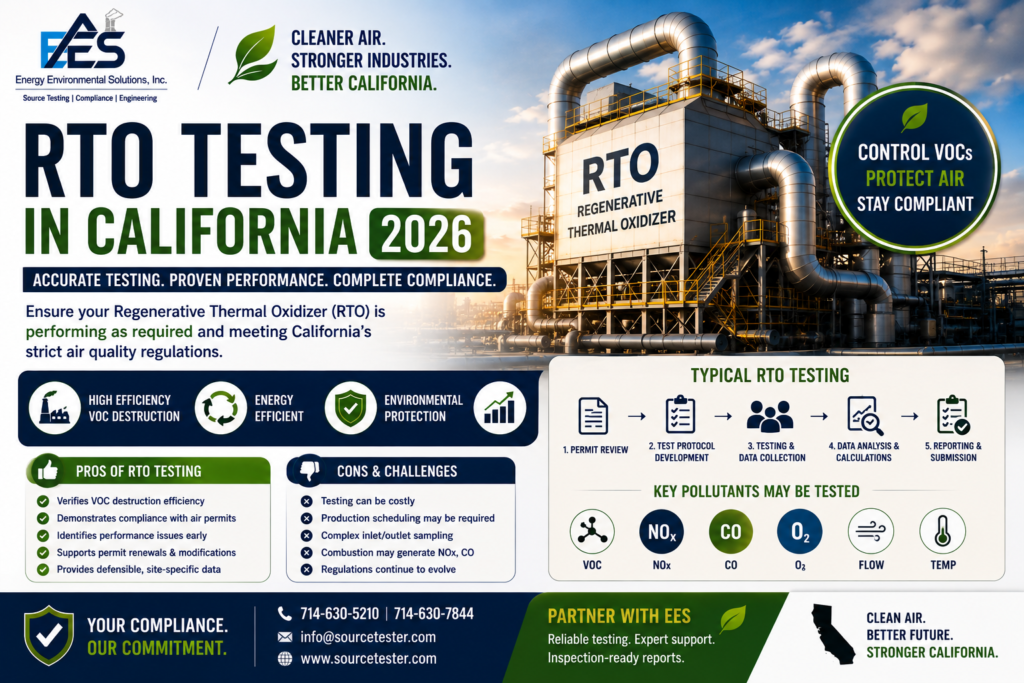
An RTO is a sophisticated air-pollution control device that uses ceramic heat-recovery media and high-temperature oxidation to destroy combustible pollutants. But installing an RTO does not automatically prove compliance. Facilities may need source testing, operating-condition verification, continuous monitoring, and documentation demonstrating that the system is achieving the performance required by its permit or applicable regulations.
Recent California regulatory activity reinforces this point. South Coast AQMD continues developing and updating rules involving VOC emissions, NOx, toxic air contaminants, particulate matter, monitoring, and New Source Review. Its 2026 work also includes proposed amendments affecting industrial combustion equipment and air-quality controls.
For facilities operating RTOs, this makes proactive testing and compliance planning increasingly valuable.
Energy Environmental Solutions, Inc. (EES) helps industries with RTO Testing, Thermal Oxidizer Testing, VOC Testing, Source & Stack Testing, NOx & CO Testing, CEMS, RATA, CGA, Compliance Test Protocol Development, Engineering Studies, and Regulatory Reporting.
What Is RTO Testing?
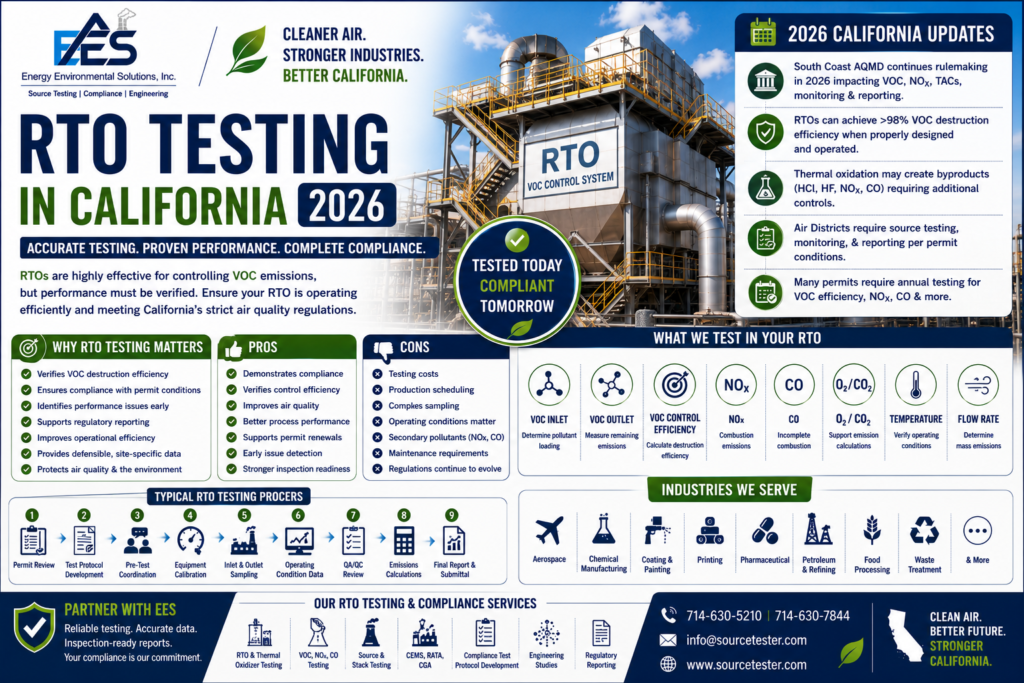
RTO testing evaluates the performance and emissions of a Regenerative Thermal Oxidizer under specified operating conditions.
RTOs are commonly used to control VOC emissions from processes such as:
- Coating and painting
- Chemical manufacturing
- Printing
- Solvent-based operations
- Aerospace manufacturing
- Food and industrial processing
- Pharmaceutical manufacturing
- Petroleum operations
- Waste treatment
- Other VOC-generating industrial processes
An RTO generally uses ceramic heat-exchange media to recover heat from the oxidized exhaust and transfer that heat to incoming process gas. This can make the technology highly energy-efficient compared with some conventional thermal oxidizer configurations.
However, the RTO must operate correctly. Testing can help determine whether the system is meeting applicable VOC destruction/control requirements and whether combustion-related emissions such as NOx and CO remain within applicable limits.
Is RTO Testing Compulsory in California?
This is an important distinction.
RTO testing is not automatically compulsory for every facility in California simply because the facility owns an RTO.
Testing requirements depend on factors such as:
- Facility location
- Air District
- Permit conditions
- Applicable rules
- Type of process
- Pollutants being controlled
- RTO design
- Required control efficiency
- Operating conditions
- Federal requirements
- State requirements
- Testing provisions in the facility’s permit
For example, a current San Joaquin Valley Air Pollution Control District permit for a facility using an RTO requires source testing of NOx, VOC at the RTO inlet, VOC at the RTO outlet, and VOC control efficiency within 60 days of startup and annually thereafter. The permit also specifies EPA/ARB test methods, advance notification, an approved source-test plan, and reporting requirements.
This is why facilities should review their individual permit and applicable Air District requirements rather than assuming that one statewide testing schedule applies to every RTO.
Latest California RTO Updates in 2026
1. Air District Rulemaking Remains Active
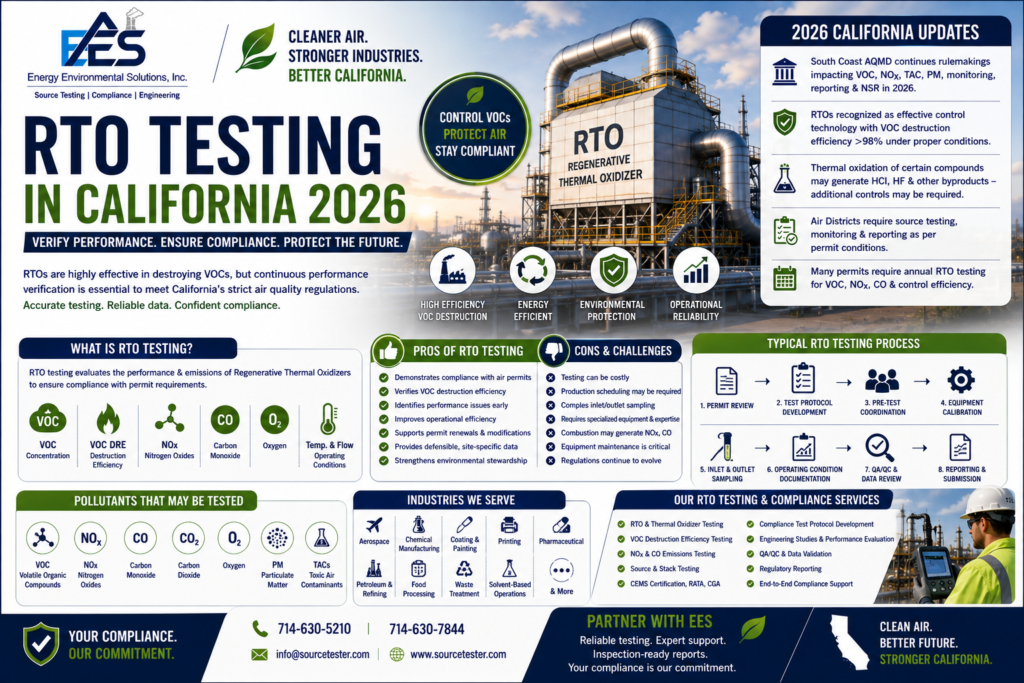
South Coast AQMD’s 2026 rulemaking agenda shows substantial ongoing regulatory activity involving industrial emissions. Proposed amendments include rules covering NOx from industrial boilers and process heaters, toxic air contaminants, particulate matter, monitoring, reporting, recordkeeping, and New Source Review.
For RTO operators, this matters because an RTO can control VOC emissions while its combustion process may also affect other pollutants.
A compliance program therefore needs to consider the whole emission profile, not only VOC destruction efficiency.
2. South Coast AQMD Continues Evaluating Thermal Oxidizers
A March 2026 South Coast AQMD staff report evaluating controls for aerospace coating operations discusses thermal oxidizers as a technology capable of achieving high destruction efficiencies for applicable VOC and toxic compounds.
The report also highlights an important limitation: thermal oxidation of certain chlorinated and fluorinated compounds can generate HCl and HF, potentially requiring additional scrubbing equipment. South Coast AQMD concluded that thermal oxidation was not the most practical control option for most of the aerospace coating applications evaluated in that particular rulemaking.
What does this mean for RTO operators?
The best control strategy depends on the specific pollutants in the process stream. A high destruction efficiency for VOCs does not necessarily mean the technology is optimal for every chemical mixture.
3. RTOs Remain an Established VOC Control Technology
South Coast AQMD’s BACT materials continue to recognize thermal oxidizers, including RTOs, as established control technologies for certain applications. The District’s BACT records include a regenerative thermal oxidizer determination for a metal-coating operation.
The District has also historically identified RTOs as BACT for certain VOC-control applications.
This means RTO technology remains relevant—but the required performance level is application-specific.
4. RTOs Can Have Strict Operating Conditions
A recent Valley Air District permit provides a useful real-world example.
The permit requires the RTO to operate with:
- Minimum combustion-chamber temperature of 1,400°F
- Minimum retention time of 0.5 seconds
- Continuous temperature monitoring
- Annual source testing
- Approved testing methods
- Advance notification
- An approved source-test plan
- Regulatory reporting
The permit also establishes pollutant-specific emission limits and requires testing of VOC control efficiency.
This illustrates why RTO testing is more than collecting a stack sample. Operating conditions and documentation can be just as important.
What Does RTO Testing Typically Measure?
Depending on the applicable permit and test protocol, an RTO testing program may evaluate:
| Parameter | Purpose |
|---|---|
| VOC Inlet | Determines pollutant loading entering the RTO |
| VOC Outlet | Determines VOC remaining after treatment |
| VOC Control Efficiency | Evaluates RTO destruction/control performance |
| NOx | Measures combustion-related nitrogen oxide emissions |
| CO | Evaluates incomplete combustion |
| O₂ | Supports emissions calculations and correction |
| CO₂ | Supports combustion/emissions calculations |
| Flow Rate | Used to calculate mass emissions |
| Temperature | Verifies required operating conditions |
| Moisture | Supports concentration and mass calculations |
| Fuel Characteristics | May be required for emissions calculations |
The actual parameters and methods should be established from the applicable permit, Air District requirements, and approved test protocol.
How RTO Testing Works
A typical compliance project may involve several stages.
1. Permit Review
The testing team first reviews the facility’s permit and applicable regulatory requirements.
2. Test Protocol Development
A detailed protocol identifies sampling locations, methods, operating conditions, test runs, QA/QC requirements, and calculations.
3. Pre-Test Coordination
Testing is scheduled around representative production conditions.
4. Equipment Calibration
Sampling and measurement equipment is checked and calibrated according to applicable requirements.
5. Inlet & Outlet Testing
Where control efficiency is required, pollutant concentrations may be measured before and after the RTO.
6. Operating-Condition Documentation
Important parameters such as temperature, flow, production rate, fuel use, and process conditions may be documented.
7. QA/QC Review
Field and laboratory data are reviewed for completeness and technical validity.
8. Emissions Calculations
Results are converted into the units required by the applicable permit or rule.
9. Final Report
A comprehensive technical report is prepared for the facility and, when required, submitted to the applicable Air District.
Pros of RTO Testing
1. Demonstrates Compliance
Professional testing can provide documented evidence that an RTO is meeting applicable permit requirements.
2. Verifies VOC Control Efficiency
Testing can determine whether the RTO is achieving the required VOC destruction or control efficiency.
3. Identifies Equipment Problems
Testing may reveal issues involving:
- Burner performance
- Temperature control
- Valve operation
- Heat-recovery media
- Airflow
- Process loading
- Combustion conditions
Early identification can allow operators to address problems before they become larger compliance concerns.
4. Supports Permit Requirements
Testing documentation can support:
- Permit renewals
- Permit modifications
- Initial startup compliance
- Periodic compliance demonstrations
- Regulatory inspections
5. Improves Emissions Data
Site-specific test results can provide stronger emissions information than relying exclusively on generic assumptions or emission factors.
6. Supports Environmental Performance
An appropriately designed and operated RTO can substantially reduce VOC emissions from applicable industrial processes.
Cons & Challenges of RTO Testing
RTO testing also presents practical challenges.
Cost
Professional source testing requires specialized equipment, trained personnel, field time, laboratory analysis where applicable, and technical reporting.
Production Coordination
Testing often needs representative production conditions. Facilities may therefore need to coordinate testing with production schedules.
Complex Sampling
Measuring VOC concentrations and calculating control efficiency can require simultaneous inlet/outlet measurements and careful process documentation.
Operating Conditions Matter
A test performed under non-representative conditions may not provide a meaningful picture of normal performance and may not satisfy the applicable permit requirements.
Combustion Emissions
An RTO destroys VOCs through combustion, but the process can generate NOx, CO and other combustion-related emissions depending on the fuel, temperature, process gas, and equipment design.
Maintenance Requirements
RTOs contain valves, ceramic media, burners, controls, sensors, blowers, and other components that require appropriate maintenance.
Changing Regulations
California’s regulatory framework continues to change. Facilities need to periodically verify whether their existing testing program remains aligned with current permit and Air District requirements.
RTO Testing vs. Thermal Oxidizer Testing
The terms are related but not identical.
Thermal oxidizer testing is a broad term covering different thermal oxidation technologies.
RTO testing specifically refers to Regenerative Thermal Oxidizers.
An RTO uses regenerative heat recovery, typically through ceramic media and alternating flow paths, to improve energy efficiency.
Therefore, an RTO testing program may have additional operating considerations related to:
- Regenerative chambers
- Ceramic heat-exchange media
- Valve switching
- Purge cycles
- Temperature profiles
- Flow direction
- Heat recovery
- Pressure balance
Why RTO Testing Is Becoming More Important
California’s regulatory environment is moving toward greater emphasis on emissions reductions, monitoring, documentation, and control technology performance.
South Coast AQMD’s 2026 rulemaking activity includes proposed requirements addressing NOx, toxic air contaminants, particulate matter, monitoring, reporting, and New Source Review.
At the same time, real-world permits demonstrate that RTOs can be subject to detailed requirements for:
VOC testing + NOx testing + operating temperature + monitoring + source-test protocols + reporting.
For industrial facilities, that makes proactive compliance planning increasingly important.
How Energy Environmental Solutions, Inc. Helps Industries
Energy Environmental Solutions, Inc. (EES) provides comprehensive environmental testing and compliance support for California industries.
RTO Performance Testing
EES helps facilities evaluate RTO performance under applicable operating conditions and testing requirements.
VOC Testing
Testing can include VOC measurements at applicable inlet and outlet locations to determine emissions and control efficiency.
NOx & CO Testing
EES can support combustion-related emissions testing where required.
Source & Stack Testing
Professional source and stack testing using applicable EPA, CARB, and Air District methods.
Compliance Test Protocol Development
EES can develop test protocols covering:
- Test methods
- Sampling locations
- Test runs
- Operating conditions
- QA/QC
- Calculations
- Reporting requirements
CEMS, RATA & CGA
EES also provides support for:
- CEMS Certification
- RATA
- CGA
- QA/QC programs
- Continuous monitoring support
Engineering Studies
Engineering evaluations can help facilities investigate emissions-control performance and potential improvements.
Compliance Reporting
EES prepares technical documentation containing field data, calculations, QA/QC information, operating conditions, and test results.
Industries EES Can Support
RTO and thermal-oxidizer applications can occur across many industries, including:
- Aerospace
- Chemical Manufacturing
- Petroleum & Refining
- Pharmaceutical Manufacturing
- Metal Coating
- Printing
- Paint & Coating
- Food Processing
- Industrial Manufacturing
- Waste Treatment
- Solvent-Using Operations
- Composite Manufacturing
- Fuel Processing
Testing requirements differ by facility, process, permit, and Air District.
Why Choose EES for RTO Testing?
Your RTO is designed to control emissions—but how do you know it’s performing as required?
EES helps answer that question with a complete compliance-testing approach:
✔ RTO Performance Testing
✔ VOC Destruction/Control Efficiency Testing
✔ NOx & CO Testing
✔ Source & Stack Testing
✔ Compliance Test Protocol Development
✔ CEMS / RATA / CGA
✔ Engineering Studies
✔ QA/QC
✔ Emissions Calculations
✔ Regulatory Reporting
✔ Inspection-Ready Documentation
Don’t Wait Until an RTO Test Becomes a Compliance Problem
An RTO can be one of the most effective tools available for controlling VOC emissions—but control equipment alone does not guarantee compliance.
Temperature, residence time, mixing, pollutant loading, maintenance, combustion conditions, monitoring systems, and regulatory requirements all matter.
And in California, the regulatory landscape continues to develop.
Is your RTO actually achieving the performance required by your permit?
Are your VOC inlet and outlet measurements defensible?
Are NOx and CO requirements being addressed?
Is your test protocol aligned with your current permit?
Is your documentation ready for regulatory review?
If you are unsure, now is the time to review your testing program.
Need RTO Testing in California?
Energy Environmental Solutions, Inc. can help with:
RTO Testing | Thermal Oxidizer Testing | VOC Testing | Source Testing | Stack Testing | NOx Testing | CO Testing | CEMS | RATA | CGA | Compliance Test Protocols | Engineering Studies | Regulatory Reporting
Your Compliance. Our Commitment.
Contact EES
Phone: 714-630-5210 | 714-630-7844
Email: info@sourcetester.com
Website: www.sourcetester.com