Rule 1134 Compliance in California: Stationary Gas Turbine NOx Testing, Monitoring & Source Testing Guide
Does your facility operate a stationary gas turbine in Southern California?
If yes, South Coast AQMD Rule 1134 – Emissions of Oxides of Nitrogen from Stationary Gas Turbines may be an important part of your air-quality compliance program.
Rule 1134 establishes NOx emission requirements and monitoring/source-testing provisions for applicable stationary gas turbines. The rule is particularly important for facilities operating larger turbines, turbines with catalytic controls, and turbines located at non-RECLAIM NOx facilities.
South Coast AQMD currently lists Rule 1134 as amended February 4, 2022. It also currently lists a Proposed Amended Rule 1134 in its active rulemaking section, meaning facilities should continue monitoring regulatory developments in 2026.
For facility owners, plant managers and EHS professionals, the message is simple:
Don’t wait for a compliance test to reveal an emissions problem.
What Is Rule 1134?
Rule 1134 – Emissions of Oxides of Nitrogen from Stationary Gas Turbines is a South Coast AQMD source-specific rule intended to control NOx emissions from stationary gas turbines.
It is part of South Coast AQMD’s Regulation XI, which contains source-specific standards. The current rule book identifies Rule 1134 as applying to emissions of oxides of nitrogen from stationary gas turbines and shows its latest adopted amendment as February 4, 2022.
Important:
Rule 1134 is not a statewide California rule.
It applies within the South Coast AQMD jurisdiction when the facility/equipment meets the rule’s applicability provisions.
Facilities elsewhere in California may be subject to requirements established by their local air district.
Why Does Rule 1134 Matter?
NOx is a major air pollutant associated with combustion equipment.
NOx can contribute to:
- Ozone formation
- Smog
- Nitrogen dioxide pollution
- Fine particulate formation
- Regional air-quality problems
South Coast AQMD developed Rule 1134 specifically to reduce NOx emissions from stationary gas turbines.
For businesses, however, compliance is not simply about operating a turbine.
It is about being able to demonstrate that the turbine is operating within the applicable regulatory and permit requirements.
Which Gas Turbines Can Be Subject to Rule 1134?
The rule contains specific applicability provisions and exemptions.
Historically and under the current rule framework, stationary gas turbines rated at 0.3 MW or greater are an important category.
South Coast AQMD’s compliance guidance states that, beginning January 1, 2024, owners/operators of stationary gas turbines rated 0.3 MW or larger must operate within the applicable Table I NOx emission limits, subject to the rule’s provisions.
Potentially affected equipment can include:
- Industrial gas turbines
- Cogeneration turbines
- Combined-cycle turbines
- Power-generation turbines
- Turbines at wastewater facilities
- Natural-gas-fired turbines
- Turbines with SCR systems
- Turbines at non-RECLAIM NOx facilities
But don’t assume every turbine has identical requirements.
Applicability depends on factors including:
Turbine size + installation history + facility status + fuel + control technology + operating conditions + permit conditions
2026 Update: What Facilities Should Know About Rule 1134
There are two important points for businesses in 2026.
1. The Current Adopted Rule
South Coast AQMD’s official rule book identifies Rule 1134 as amended February 4, 2022.
The 2022 amendment included changes involving:
- NOx requirements
- Recuperative gas turbines
- Selective catalytic reduction (SCR)
- CEMS provisions
- Monitoring requirements
- Startup/shutdown provisions
- Liquid-fuel use during natural-gas curtailments at certain health facilities
South Coast AQMD’s February 2022 Governing Board materials describe these amendments and their purpose.
2. Rule 1134 Is Also Listed in Active Rulemaking
South Coast AQMD’s current Active Proposed Rules page lists Proposed Amended Rule 1134 among rules currently in the proposal/amendment process.
The dedicated Rule 1134 proposal page contains the 2021 amendment-development materials, including draft rule language, staff reports and public-hearing documents.
What does this mean for industry?
A proposed amendment is not automatically an adopted requirement.
Facilities should comply with the currently adopted rule and permit conditions while monitoring the rulemaking process for future changes.
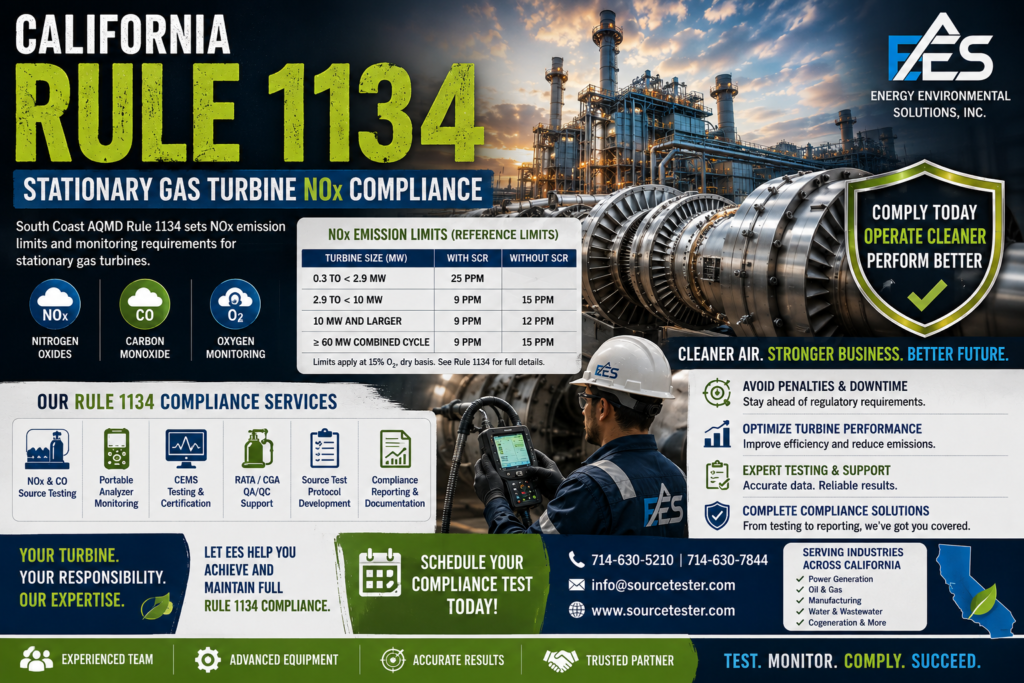
Rule 1134 NOx Emission Limits
Rule 1134 contains NOx limits based on turbine size and applicable technology.
The rule’s reference limits include categories such as:
| Stationary Gas Turbine | Reference NOx Limit |
|---|---|
| 0.3 to <2.9 MW | 25 ppm |
| 2.9 to <10 MW | 9 ppm |
| 2.9 to <10 MW, No SCR | 15 ppm |
| 10 MW and larger | 9 ppm |
| 10 MW and larger, No SCR | 12 ppm |
| ≥60 MW Combined Cycle, No SCR | 15 ppm |
| ≥60 MW Combined Cycle | 9 ppm |
There are additional provisions and special categories, including turbines using qualifying sewage-digester-gas fuel. The applicable compliance calculation can also involve the turbine’s demonstrated or manufacturer-rated efficiency.
Important:
Never determine your compliance obligation from a generic table alone.
The applicable limit can depend on the specific turbine, control technology, permit and rule provisions.
Why NOx Testing Is Important
A gas turbine can appear to operate normally while its NOx emissions change because of:
- Combustion conditions
- Fuel characteristics
- Turbine load
- Air/fuel ratio
- Burner condition
- SCR performance
- Catalyst condition
- Ammonia injection
- Control-system performance
- Maintenance condition
Therefore:
Normal operation does not automatically mean compliant emissions.
Professional emissions testing provides objective data.
Rule 1134 Source Testing
For applicable turbines that do not use a CEMS, Rule 1134 includes source-testing requirements.
The rule provides for measurement of parameters including:
- NOx concentration
- Carbon monoxide concentration
- Turbine efficiency, where applicable
NOx and CO concentrations are expressed in ppm by volume and corrected to 15% oxygen on a dry basis, according to the rule’s provisions.
This is where professional source testing becomes critical.
A compliant test requires more than simply taking an emissions reading.
It requires:
Correct sampling location
Correct test method
Proper calibration
Representative operating conditions
Quality assurance
Accurate calculations
Regulatory documentation
CEMS Requirements Under Rule 1134
Large turbines may have additional monitoring obligations.
Under Rule 1134, certain gas turbines 2.9 MW and larger at non-RECLAIM NOx facilities are subject to continuous monitoring provisions.
The rule requires applicable systems to monitor NOx and oxygen and also capture information such as:
- Flow rate
- Water/steam-to-fuel ratio where applicable
- Operating time
- Turbine output in MW
The CEMS requirements reference South Coast AQMD Rules 218, 218.1, 218.2 and 218.3.
That means Rule 1134 compliance can connect directly with:
CEMS Certification + QA/QC + RATA + CGA + Data Validation
CEMS vs. Source Testing
| CEMS | Source Testing |
|---|---|
| Continuous monitoring | Periodic testing |
| Provides ongoing emissions data | Provides test-period emissions data |
| Used for applicable large turbines | Used where source testing is required |
| Requires QA/QC | Requires approved test procedures |
| May require certification | Requires proper field testing |
| Can identify changes over time | Provides a compliance snapshot |
Depending on the turbine and regulatory requirements, a facility may need one or both approaches.
What Happens During a Gas Turbine Emissions Test?
A professional test program may include:
Step 1 — Pre-Test Review
Review:
- Air permit
- Turbine specifications
- Fuel
- Control equipment
- Previous test results
- Applicable Rule 1134 requirements
Step 2 — Test Planning
Determine:
- Pollutants
- Test methods
- Operating conditions
- Sampling location
- Required test runs
- Equipment
- QA/QC
Step 3 — Equipment Preparation
Verify:
- Calibration
- Sampling equipment
- Analyzers
- Data systems
- Gas standards
- Flow measurement
Step 4 — Field Testing
Collect representative emissions data under applicable operating conditions.
Step 5 — Data Validation
Review:
- Calibration data
- Run data
- QA/QC
- Operating parameters
- Calculations
Step 6 — Compliance Evaluation
Compare the results with applicable requirements.
Step 7 — Reporting
Prepare the technical source-test report and required documentation.
Common Rule 1134 Compliance Problems
1. High NOx
Potential causes include:
- Combustion problems
- Poor tuning
- Control-system malfunction
- Fuel changes
- Catalyst problems
2. SCR Performance Problems
Catalyst degradation or improper ammonia control can affect emissions performance.
3. CEMS Problems
Analyzer drift, calibration issues or sampling-system problems can affect data validity.
4. Incorrect Operating Conditions
Testing at an inappropriate load may produce results that do not represent required compliance conditions.
5. Poor Documentation
Missing calibration, maintenance or testing records can create unnecessary compliance difficulties.
Rule 1134 Compliance Pros
✅ 1. Better NOx Control
Testing and monitoring help identify excessive NOx emissions.
✅ 2. Early Problem Detection
Emission testing can reveal problems before they become larger operational issues.
✅ 3. Improved Combustion Performance
Testing can help facilities understand turbine performance.
✅ 4. Better Compliance Documentation
Professional test reports create useful regulatory records.
✅ 5. Supports Environmental Goals
NOx reductions contribute to improved regional air quality.
✅ 6. Better Maintenance Decisions
Emission trends can provide an additional indicator of equipment condition.
Rule 1134 Compliance Cons / Challenges
❌ Testing Costs
Source testing requires specialized personnel, instruments and laboratory resources.
❌ Operational Coordination
The turbine may need to operate under specified conditions during testing.
❌ CEMS Investment
Large applicable turbines may require continuous monitoring systems.
❌ Maintenance Requirements
Emission-control equipment needs regular attention.
❌ Failed Testing
A failed test can require troubleshooting and additional testing.
❌ Regulatory Complexity
The applicable requirements can depend on equipment characteristics and permit conditions.
Why Proactive Testing Is Better Than Reactive Testing
Imagine discovering excessive NOx emissions one day before your compliance deadline.
You may have:
- No time for troubleshooting
- No time for repairs
- No time for retesting
- Production constraints
- Additional regulatory pressure
Instead:
Plan Early
↓
Test Early
↓
Identify Problems
↓
Correct Equipment
↓
Retest
↓
Submit Documentation
This approach gives facility operators much more control over the compliance process.
Industries That May Need Rule 1134 Services
Potentially affected sectors include:
⚡ Power Generation
Gas turbines used for electricity generation.
🏭 Manufacturing
Industrial facilities using gas turbines for process or power applications.
🔥 Cogeneration
Combined heat and power systems.
💧 Wastewater Treatment
Facilities using digester gas or other fuels in turbine systems.
🛢️ Oil & Gas
Facilities using turbines for compression or power generation.
🏢 Large Commercial/Institutional Facilities
Facilities using large stationary turbines for power or energy applications.
🔌 Distributed Generation
Large gas-turbine-based generation systems.
Applicability must always be confirmed against the facility’s specific permit and Rule 1134 provisions.
How EES Helps With Rule 1134 Compliance
Energy Environmental Solutions, Inc. (EES) can help facilities manage the technical side of stationary gas-turbine emissions compliance.
1. Rule Applicability Review
EES can review:
Turbine Size + Fuel + Operating Conditions + Control Technology + Permit
to help determine the applicable testing and monitoring requirements.
2. NOx Emissions Testing
EES can support applicable source testing for stationary gas turbines, including measurement of regulated combustion pollutants.
3. Source-Test Protocol Development
EES can help develop testing plans covering:
- Applicable regulations
- Test methods
- Sampling procedures
- Operating conditions
- QA/QC
- Required calculations
- Reporting requirements
4. CEMS Support
For applicable turbines, EES can assist with:
- CEMS Certification
- CEMS QA/QC
- RATA
- CGA
- Performance evaluation
- Data validation
5. Compliance Troubleshooting
If emissions results are higher than expected, EES can help identify potential technical causes and recommend appropriate next steps.
6. Technical Reporting
EES can prepare professional testing documentation that helps facilities maintain their compliance records.
EES Rule 1134 Compliance Process
REVIEW
Permit + Turbine + Rule Applicability
↓
PLAN
Test Requirements + Methods + Operating Conditions
↓
PREPARE
Equipment + Calibration + QA/QC
↓
TEST
NOx / CO / Applicable Parameters
↓
ANALYZE
Validate Data + Calculate Results
↓
REPORT
Prepare Technical Documentation
↓
FOLLOW UP
Corrective Action / Retesting When Necessary
Rule 1134 2026 Compliance Checklist
Before your next turbine test, ask:
- Is my turbine subject to Rule 1134?
- What is its rated MW capacity?
- What fuel does it use?
- Is the facility RECLAIM or non-RECLAIM?
- What NOx limit applies?
- Does the turbine use SCR?
- Is CEMS required?
- Is the CEMS certification current?
- Is RATA/QA testing due?
- Is source testing required?
- Are previous test results available?
- Are calibration records current?
- Are maintenance records complete?
- Is the permit current?
- Have recent Rule 1134 developments been reviewed?
Don’t Wait for a Failed NOx Test
Your gas turbine may be operating 24/7.
Your compliance program should be working just as continuously.
EES can help you plan, test, evaluate and document your Rule 1134 compliance requirements.
Our Support Can Include:
✔ Rule 1134 Applicability Review
✔ Stationary Gas Turbine NOx Testing
✔ Source-Test Protocol Development
✔ CEMS Certification
✔ RATA & CGA Support
✔ QA/QC Evaluation
✔ Compliance Documentation
✔ Troubleshooting & Retesting
🚨 Is Your Gas Turbine Ready for Its Next Compliance Test?
Don’t wait until the deadline.
Send EES your:
📍 Facility Location
⚙️ Turbine Manufacturer & Model
⚡ MW Rating
🔥 Fuel Type
🛠️ Control Technology / SCR Information
📄 Current Permit
📊 Previous Test Report
Request a Rule 1134 Compliance Review Today
Test Your Emissions. Verify Your Compliance. Protect Your Operation.
Energy Environmental Solutions, Inc. (EES)
Phone: 714-630-5210 | 714-630-7844
Email: info@sourcetester.com
Website: sourcetester.org