Rule 1146.2 in California 2026: Latest Updates, Pros, Cons & How EES Helps Industries
Rule 1146.2 is one of the most significant South Coast AQMD regulations affecting large water heaters, small boilers, process heaters, pool heaters, and certain high-temperature heaters. The rule is designed to reduce nitrogen oxide (NOx) emissions and, following its June 7, 2024 amendment, progressively moves covered equipment toward zero-NOx emissions.
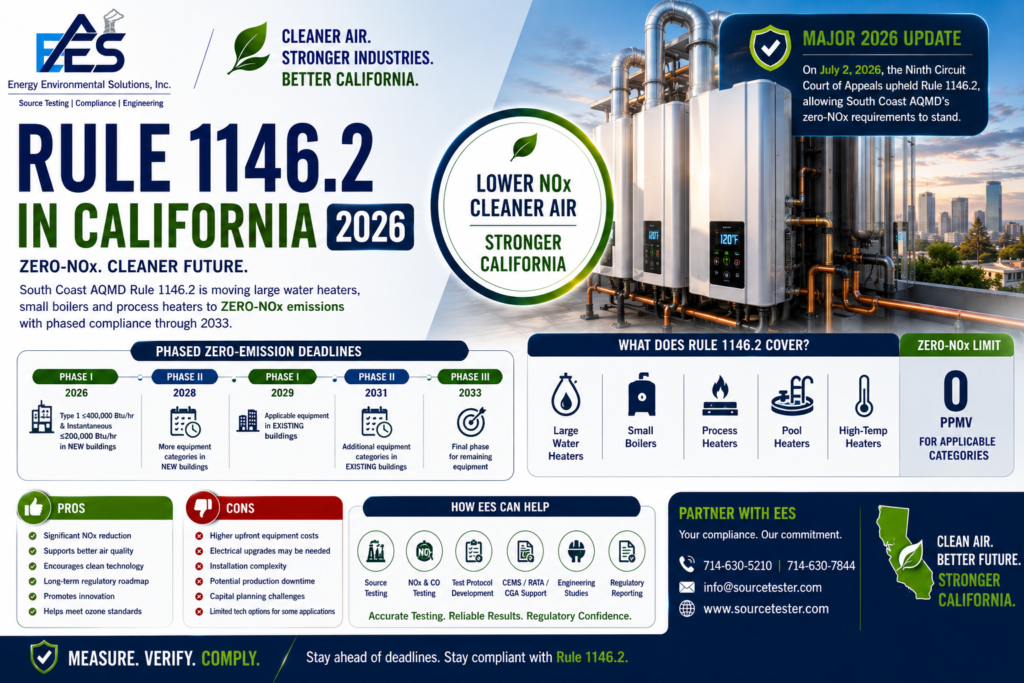
The biggest Rule 1146.2 development in 2026 is no longer just the January 1 compliance deadline. On July 2, 2026, the Ninth Circuit Court of Appeals upheld South Coast AQMD’s amended Rule 1146.2, rejecting an industry challenge arguing that the regulation was preempted by federal energy-efficiency law. This is a major development because it strengthens the legal position of the District’s zero-NOx transition.
At the same time, the first major compliance milestone has already arrived: beginning January 1, 2026, certain Type 1 units ≤400,000 Btu/hr and instantaneous water heaters ≤200,000 Btu/hr installed in new buildings must meet zero-emission limits.
Important: Rule 1146.2 is not a statewide California regulation. It is a South Coast AQMD rule, applying within the District’s jurisdiction and subject to the rule’s applicability provisions and exemptions.
What Is Rule 1146.2?
South Coast AQMD’s Rule 1146.2 is titled:
“Emissions of Oxides of Nitrogen from Large Water Heaters and Small Boilers and Process Heaters.”
The rule was originally adopted in 1998 and subsequently amended several times. The current version was amended on June 7, 2024.
The 2024 amendment significantly changed the regulatory direction by establishing zero-NOx emission limits and a phased implementation schedule for covered equipment.
The regulation covers equipment categories that can include:
- Large water heaters
- Small boilers
- Process heaters
- Pool heaters
- High-temperature heaters
- Instantaneous water heaters
- Other equipment meeting the rule’s definitions and applicability criteria
The exact applicability depends on equipment type, rated heat-input capacity, installation/building status, age, fuel and other conditions.
Why Is Rule 1146.2 Important in 2026?
There are three major reasons.
1. The first zero-emission deadline took effect
South Coast AQMD’s official 2026 compliance-deadline notice states that beginning January 1, 2026, certain Phase I equipment installed in new buildings must comply with zero-emission limits. Specifically, this includes Type 1 units with rated heat input capacity ≤400,000 Btu/hr and instantaneous water heaters ≤200,000 Btu/hr.
2. The Ninth Circuit upheld the rule
On July 2, 2026, the Ninth Circuit affirmed the lower court’s judgment in favor of South Coast AQMD in Rinnai America Corp. v. South Coast Air Quality Management District.
The court held that the Energy Policy and Conservation Act (EPCA) does not preempt Rule 1146.2, allowing the District’s zero-NOx emissions requirements to remain in place.
3. More deadlines are coming
The rule does not stop with 2026.
The current schedule establishes additional zero-emission deadlines in:
- 2028
- 2029
- 2031
- 2033
depending on equipment category and whether the unit is installed in a new or existing building.
That means businesses installing or replacing combustion equipment today should consider future compliance requirements, not only today’s requirements.
Latest 2026 News: Ninth Circuit Upholds Rule 1146.2
This is arguably the most important Rule 1146.2 development of 2026.
A coalition including appliance manufacturers and industry organizations challenged the rule, arguing that federal law preempted South Coast AQMD’s zero-NOx requirements.
On July 2, 2026, the Ninth Circuit rejected that argument and affirmed the lower court’s judgment for South Coast AQMD.
The court explained that the District adopted Rule 1146.2 as part of its effort to meet federal Clean Air Act ozone requirements.
The court’s opinion notes that the South Coast Air Basin faces severe ozone problems and that the District’s 2022 Air Quality Management Plan determined that widespread adoption of zero-emission technologies across stationary sources was necessary to achieve the required reductions.
What does this mean for industry?
It means companies should not assume that the zero-NOx provisions will disappear simply because they were challenged in court.
The Ninth Circuit decision substantially reinforces the legal status of the rule.
What Does Rule 1146.2 Require?
The 2024 amendment establishes zero-NOx limits for covered equipment according to phased implementation schedules.
The rule’s Table 2 establishes zero-emission limits for several categories, including:
| Equipment Category | NOx Limit |
|---|---|
| Type 1 Unit | 0 ppmv |
| Instantaneous Water Heater ≤200,000 Btu/hr | 0 ppmv |
| Instantaneous Water Heater >200,000 Btu/hr | 0 ppmv |
| Type 1 Pool Heater | 0 ppmv |
| Type 2 Unit | 0 ppmv |
| Type 1 High-Temperature Unit | 0 ppmv |
| Type 2 High-Temperature Unit | 0 ppmv |
The applicable compliance date varies by category.
This is a fundamental shift from conventional low-NOx combustion requirements.
The direction is clear:
Low NOx → Ultra-Low NOx → Zero NOx
2026 Compliance Deadline
The first major phase began on:
January 1, 2026
For new buildings, Phase I applies to specified equipment, including:
- Type 1 units ≤400,000 Btu/hr
- Instantaneous water heaters ≤200,000 Btu/hr
These units must comply with the applicable zero-emission limits.
This is why 2026 is an important year for:
Building owners + contractors + developers + equipment manufacturers + facility managers + environmental compliance teams.
What About Existing Buildings?
Existing buildings are subject to later deadlines depending on equipment category.
The current Rule 1146.2 schedule identifies:
| Phase | New Buildings | Existing Buildings |
|---|---|---|
| Phase I | January 1, 2026 | January 1, 2029 |
| Phase II | January 1, 2028 | January 1, 2031 |
| Phase III | January 1, 2029 | January 1, 2033 |
These dates are tied to the specific equipment categories in the rule.
Therefore, an existing facility should not automatically assume that it has a 2026 deadline.
The facility needs to determine:
What equipment do we have?
When was it installed?
What is its rated heat input?
Which category applies?
Is it in a new or existing building?
Which phase applies?
Rule 1146.2 Is Not Just About New Equipment
A common misconception is that Rule 1146.2 only matters when buying new equipment.
That’s not necessarily true.
The rule includes provisions concerning existing units, unit age, burner modifications/replacements and demonstrations of compliance.
For example, the rule states that after applicable Table 3 compliance dates, an owner/operator may not operate a unit that exceeds the applicable Table 2 emission limits once the unit reaches the specified age. It also addresses modifications and burner replacements.
This means a facility planning a burner replacement should evaluate the regulatory consequences before purchasing or installing the replacement.
Why Zero-NOx Technology?
Traditional combustion equipment generates NOx during high-temperature combustion.
Zero-emission technologies can eliminate combustion-related NOx at the equipment itself.
The District’s rationale is connected to the South Coast Air Basin’s severe ozone challenge. The Ninth Circuit opinion states that the District determined widespread zero-emission technology adoption was necessary to achieve the NOx reductions required for compliance with federal ozone standards.
This makes Rule 1146.2 part of a much broader air-quality strategy.
Pros of Rule 1146.2
1. Significant NOx Reduction
The most obvious advantage is reducing NOx emissions from covered combustion equipment.
Zero-NOx equipment can substantially reduce combustion-related emissions compared with conventional natural-gas-fired equipment.
2. Supports Better Air Quality
NOx contributes to ozone formation and other air-quality problems.
Reducing stationary-source NOx supports South Coast AQMD’s broader clean-air objectives.
3. Encourages Technology Innovation
The rule creates market demand for:
- Electric water heating
- Electric boilers
- Heat-pump technology
- Other zero-emission technologies
- Advanced building systems
4. Provides a Long-Term Regulatory Roadmap
The phased schedule gives businesses several years to plan for future equipment transitions.
Instead of discovering a future requirement at the last minute, facility managers can incorporate it into capital planning.
5. Encourages Better Equipment Planning
Businesses replacing old equipment can evaluate whether the replacement will remain useful throughout its expected service life.
6. Supports Regional Ozone-Reduction Goals
The Ninth Circuit noted the District’s determination that significant additional NOx reductions were required to meet federal ozone standards.
Cons and Challenges of Rule 1146.2
1. Higher Initial Equipment Costs
Zero-emission equipment can cost more initially than conventional gas-fired equipment.
CARB’s current FAQ on zero-emission space and water heaters also notes that purchase and installation costs can be higher, particularly when electrical-panel, wiring, meter or utility upgrades are necessary.
2. Electrical Infrastructure
Switching from gas combustion to electric equipment may require:
- Larger electrical service
- New wiring
- Panel upgrades
- Utility coordination
- Additional installation work
3. Facility Downtime
Replacing boilers, water heaters or process heaters can interrupt operations.
Facilities need careful project scheduling.
4. Capital Planning Challenges
Businesses may need to replace functioning equipment earlier than originally expected because of future compliance requirements.
5. Technology Availability
Some industrial applications have more straightforward zero-emission alternatives than others.
High-temperature or specialized process applications may require more complex engineering.
6. Workforce and Engineering Requirements
Facility teams may need electrical, mechanical and environmental expertise simultaneously.
A Major 2026 Legal Development: What Industry Should Know
The Ninth Circuit’s July 2026 ruling is especially important for businesses because it rejected the argument that federal energy-efficiency law preempted Rule 1146.2.
The court also emphasized that the rule regulates emissions, not simply energy efficiency.
It further noted that Rule 1146.2 includes process heaters, which are not among the products covered by EPCA’s federal efficiency standards, making the plaintiffs’ facial challenge unsuccessful.
Practical takeaway:
Businesses should plan around the current Rule 1146.2 requirements rather than assuming that litigation will suspend the rule.
Does Rule 1146.2 Require Source Testing?
Source testing remains relevant to Rule 1146.2 compliance.
South Coast AQMD publishes a specific:
Rule 1121/1146.2 NOx Compliance Testing Protocol for Water Heaters & Small Boilers
The District’s Methods & Procedures page identifies this protocol as part of its official source-testing materials.
Rule 1146.2 also contains provisions allowing certain modified units to demonstrate compliance through source testing conducted according to South Coast AQMD Source Test Method 100.1 by an independent testing laboratory.
This is where professional testing becomes valuable.
Why Compliance Testing Still Matters in a Zero-NOx Transition
You might ask:
“If the new standard is zero emissions, why would testing still matter?”
Because the transition doesn’t happen overnight.
Facilities continue to operate existing equipment during the phase-in period, and some equipment may use compliance demonstrations, retrofit provisions, certification or other mechanisms specified by the rule.
Testing can help establish:
- Actual emissions
- Equipment performance
- Compliance status
- Baseline conditions
- Retrofit effectiveness
- Documentation for regulatory review
South Coast AQMD also operates a Laboratory Approval Program (LAP) under which independent source-testing firms are evaluated for specific methods and technical capabilities.
Certified Equipment Is Becoming More Important
South Coast AQMD maintains a certified equipment list for Rule 1146.2.
The District’s certified-equipment page currently identifies the Rule 1146.2 certified boilers list as last updated December 30, 2025.
The dedicated Rule 1146.2 support page also provides access to the certified equipment information.
For contractors, developers and facility owners, checking equipment certification before purchasing can help avoid expensive compliance surprises.
What Industries Should Pay Attention to Rule 1146.2?
Potentially affected operations include:
- Commercial buildings
- Hotels
- Hospitals
- Universities
- Apartment buildings
- Restaurants
- Food-processing facilities
- Manufacturing plants
- Industrial facilities
- Warehouses with process heating
- Swimming-pool facilities
- Commercial water-heating operations
- Industrial process-heating operations
The exact applicability depends on the equipment and the rule’s definitions and exemptions.
Rule 1146.2 Compliance Checklist for 2026
Facility owners and environmental managers should review:
Equipment
- Equipment type
- Manufacturer
- Model number
- Serial number
- Rated heat-input capacity
- Installation date
- Fuel type
- Building type
Regulatory Status
- Applicable Rule 1146.2 category
- Applicable compliance phase
- Current emission limit
- Unit age
- Permit conditions
- Certification status
Testing
- Last source test
- Next required test
- Applicable test method
- Test protocol
- Laboratory qualifications
- Calibration and QA/QC
- Test report
Future Planning
- 2028 deadlines
- 2029 deadlines
- 2031 deadlines
- 2033 deadlines
- Equipment replacement strategy
- Electrical infrastructure requirements
- Capital budget
How EES Helps Industries With Rule 1146.2
Energy Environmental Solutions, Inc. (EES) provides source-testing and environmental compliance services for industrial and commercial facilities.
Energy Environmental Solutions, Inc. / SourceTester.com
Rule 1146.2 Compliance Testing
EES can assist facilities in evaluating applicable emissions requirements and conducting required testing.
NOx Testing
Accurate NOx measurements can help establish whether equipment meets applicable requirements during the transition period.
CO Testing
Where applicable, EES can provide CO measurement alongside NOx testing.
Source-Test Protocol Development
EES can help prepare technical testing protocols covering:
Sampling locations → Test methods → Operating conditions → QA/QC → Calculations → Reporting
Retrofit Verification
Where a unit has been modified or retrofitted, testing can help demonstrate emissions performance when the applicable rule provision requires it.
CEMS / RATA / CGA Support
For facilities with applicable continuous monitoring systems or related requirements, EES can provide specialized emissions-monitoring support.
Engineering Studies
EES can help facilities understand their current emissions and evaluate potential compliance strategies.
Regulatory Documentation
Testing is only useful when the results are properly documented.
EES can support the technical reporting process associated with emissions testing.
Rule 1146.2 Compliance Strategy for 2026
A smart facility strategy can be divided into five steps:
1. Identify
Determine exactly which Rule 1146.2 provisions apply to each unit.
2. Measure
Establish actual emissions and operating performance where testing is required or useful.
3. Evaluate
Compare the equipment’s current status with the applicable limits and deadlines.
4. Plan
Determine whether the facility needs:
- Retrofit
- Replacement
- Electrification
- Process modification
- Electrical upgrades
- Additional testing
5. Act
Complete the required compliance work before the applicable deadline.
Rule 1146.2: Pros vs. Cons
| Pros | Cons |
|---|---|
| Major NOx reductions | Higher equipment costs |
| Supports cleaner air | Potential electrical upgrades |
| Encourages zero-emission technology | Installation complexity |
| Long-term regulatory roadmap | Possible equipment replacement |
| Promotes technology innovation | Production downtime |
| Reduces combustion-related emissions | Specialized engineering may be needed |
| Helps meet ozone-reduction goals | Capital-planning burden |
What Should Businesses Do Now?
The most important lesson from the 2026 developments is simple:
Don’t wait for your deadline to start planning.
If your facility operates a water heater, boiler or process heater affected by Rule 1146.2, determine its regulatory status now.
A useful first step is to create an equipment inventory containing:
Model → Size → Age → Fuel → Location → Certification → Current emissions → Applicable deadline
Then compare that information against the current Rule 1146.2 requirements.
This can reveal whether your facility needs testing, certification review, retrofit planning or equipment replacement.
Final Takeaway: Rule 1146.2 in 2026
Rule 1146.2 represents a major shift in Southern California’s approach to combustion equipment.
The rule is moving covered equipment toward zero-NOx emissions, with phased deadlines extending from 2026 through 2033.
The first Phase I deadline began on January 1, 2026, and the July 2, 2026 Ninth Circuit decision upheld the rule against an industry preemption challenge.
For industry, the message is clear:
Measure your emissions. Understand your deadline. Plan your equipment transition.
And don’t treat Rule 1146.2 as simply a future issue.
2026 is already the beginning of the compliance transition.
Need Rule 1146.2 Testing & Compliance Support?
EES helps industries with:
Rule 1146.2 Testing | NOx Testing | CO Testing | Water Heater Testing | Boiler Testing | Process Heater Testing | Source-Test Protocol Development | Retrofit Verification | CEMS | RATA | CGA | Engineering Studies | Emissions Monitoring | Regulatory Reporting
Measure Emissions. Verify Compliance. Prepare for Zero-NOx Requirements.
Energy Environmental Solutions, Inc. (EES)
Phone: 714-630-5210 | 714-630-7844
Email: info@sourcetester.com
Website: www.sourcetester.org