Rule 1146 in California 2026: Latest Updates, Pros, Cons & How EES Helps Industries
Rule 1146 — Emissions of Oxides of Nitrogen from Industrial, Institutional and Commercial Boilers, Steam Generators, and Process Heaters is one of the key South Coast AQMD regulations governing NOx emissions from larger combustion equipment.
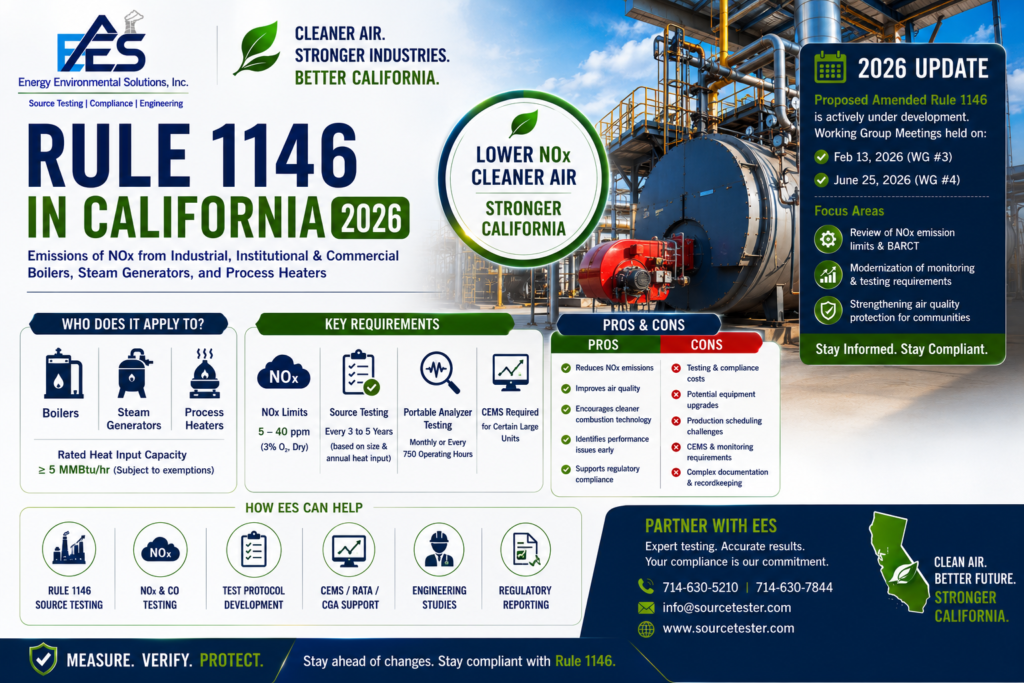
A major development for 2026 is that Rule 1146 is actively being reconsidered. The current adopted rule was amended on December 4, 2020, but South Coast AQMD is now conducting a new Proposed Amended Rule 1146 (PAR 1146) rulemaking. The District held Working Group Meeting #3 on February 13, 2026 and Working Group Meeting #4 on June 25, 2026, showing that the amendment process is actively progressing.
Important: Rule 1146 is not a statewide California rule. It is a South Coast AQMD rule, so its requirements apply to qualifying sources within the District’s jurisdiction. The current rule covers industrial, institutional and commercial boilers, steam generators and process heaters with rated heat-input capacity generally 5 MMBtu/hr or greater, subject to the rule’s applicability and exemptions.
For companies operating boilers and process heaters, 2026 is therefore a good time to review emissions performance, testing schedules and upcoming regulatory changes.
What Is California Rule 1146?
South Coast AQMD Rule 1146 controls NOx emissions from industrial, institutional and commercial boilers, steam generators and process heaters.
These combustion systems are commonly found in:
- Manufacturing facilities
- Food-processing plants
- Pharmaceutical facilities
- Hospitals and institutions
- Commercial facilities
- Chemical manufacturing
- Industrial heating operations
- Steam-generation systems
- Thermal-fluid heating applications
The current Regulation XI rulebook identifies Rule 1146 as “Emissions of Oxides of Nitrogen from Industrial, Institutional and Commercial Boilers, Steam Generators, and Process Heaters”, amended December 4, 2020.
The regulation is designed primarily around reducing NOx, a pollutant that contributes to ozone and particulate pollution.
Why Is Rule 1146 Important in 2026?
The biggest reason is simple:
Rule 1146 is currently under active amendment discussions.
South Coast AQMD’s official PAR 1146/1146.1 page lists:
- Working Group #1 — November 13, 2024
- Working Group #2 — April 24, 2025
- Working Group #3 — February 13, 2026
- Working Group #4 — June 25, 2026
The District also lists a March 27, 2026 stakeholder comment letter from the SoCal Clean Manufacturing Coalition.
This is significant for industry because the regulatory framework could evolve even though the currently adopted Rule 1146 has not yet been replaced by a new final rule.
In other words:
2026 is a monitoring-and-preparation year—not a reason to assume that proposed requirements are already mandatory.
Facilities should continue complying with the currently effective rule and permit conditions while following the proposed amendment process.
Latest 2026 Update: Proposed Amended Rule 1146
South Coast AQMD’s current rulemaking page confirms that the District is actively working on amendments to Rule 1146 and Rule 1146.1.
The proposed amendment is particularly important because the District is evaluating NOx requirements for combustion equipment against evolving Best Available Retrofit Control Technology (BARCT) and air-quality objectives.
The proposal process includes technical discussions with stakeholders, meaning facility owners, environmental managers, equipment manufacturers and testing professionals have an opportunity to understand where the regulation may be heading.
But there is an important compliance distinction:
A proposed amendment is not the same thing as an adopted regulation.
Companies should not replace their current compliance program based solely on a draft presentation or proposed rule language.
Instead, they should:
Monitor → Evaluate → Test → Plan → Prepare
What Equipment Does Rule 1146 Cover?
Rule 1146 generally applies to boilers, steam generators and process heaters with rated heat input of 5 MMBtu/hr or greater, subject to specific exclusions and provisions.
The rule has historically established different NOx requirements based on equipment characteristics, including size and fuel type.
Examples of potentially regulated equipment include:
Industrial Boilers
Used to generate steam for manufacturing, heating or processing.
Steam Generators
Used where steam is an essential part of production or facility operations.
Process Heaters
Used to provide direct or indirect heat for industrial processes.
Thermal Fluid Heaters
Certain thermal-fluid heating systems can also fall within Rule 1146 requirements.
What Are the Current NOx Limits?
One of the most important things to understand about Rule 1146 is that there is not one universal NOx limit.
The applicable limit depends on the equipment category, size, fuel and other rule provisions.
Current regulatory summaries identify limits including:
| Equipment Category | Current NOx Requirement* |
|---|---|
| Large units ≥75 MMBtu/hr | 5 ppm |
| Units ≥20 and <75 MMBtu/hr | 5–9 ppm, depending on applicable group/sub-tier |
| Units ≥5 and <20 MMBtu/hr | 7–9 ppm |
| Atmospheric units | 12 ppm |
| Digester-gas units | 15 ppm |
| Landfill-gas units | 25 ppm |
| Certain other gaseous-fuel units | 30 ppm |
| Non-gaseous-fuel units | 40 ppm |
*Limits and applicability depend on the specific rule provisions, equipment configuration, fuel and permit conditions. Current technical summaries report these values at 3% O₂, dry basis.
This is why simply saying “California Rule 1146 requires 5 ppm” is misleading.
The correct question is:
“Which Rule 1146 category applies to my equipment?”
Rule 1146 Source Testing Requirements
Source testing is an important part of demonstrating compliance.
Current compliance information indicates that source-testing frequency is related to equipment size and operating characteristics.
For example, current industry compliance guidance reports:
- Units ≥10 MMBtu/hr — generally tested every 3 years
- Units >2 and <10 MMBtu/hr under the related Rule 1146.1 framework — generally tested every 5 years
Rule 1146 and Rule 1146.1 also contain periodic portable-analyzer monitoring requirements.
The exact obligation should always be confirmed against the current rule and the facility’s permit.
Portable Analyzer Testing Is Also Important
Rule 1146 compliance isn’t limited to occasional stack testing.
Periodic NOx and CO checks using an approved portable analyzer are also part of the compliance framework.
Current guidance indicates that Rule 1146 units may require portable analyzer testing monthly or every 750 operating hours, with opportunities for an extended schedule under specified compliance conditions. If a unit fails a check, the testing frequency can revert to the more frequent schedule.
That means facility operators need to track:
Operating hours + testing dates + analyzer results + oxygen settings + maintenance + corrective actions
Missing a periodic monitoring event can become a compliance-management problem even when the equipment itself is functioning properly.
CEMS Requirements
Certain large Rule 1146 units may require Continuous Emissions Monitoring Systems (CEMS).
Current guidance identifies, for example, CEMS requirements associated with certain units having rated heat-input capacity of 40 MMBtu/hr or greater and specified annual heat input.
CEMS compliance can involve:
- NOx monitoring
- Oxygen monitoring
- Calibration
- Certification
- Quality assurance
- Data validation
- RATA
- CGA
- Recordkeeping
- Reporting
This creates an additional layer of technical responsibility for large industrial boilers.
Why NOx Testing Matters
NOx isn’t simply another number on a laboratory report.
During combustion, high-temperature processes can produce nitrogen oxides. In the atmosphere, NOx participates in reactions that contribute to ozone formation and particulate pollution.
Southern California has historically faced serious ozone and air-quality challenges.
That is why stationary combustion sources such as boilers and process heaters remain an important part of the South Coast AQMD regulatory strategy.
Rule 1146 is one component of the broader NOx-control framework.
2026 Regulatory Direction: Why Facilities Should Pay Attention
South Coast AQMD’s current 2026 activity shows that Rule 1146 is being actively evaluated.
The District’s proposed-rule page confirms the June 25, 2026 Working Group #4 meeting, while the February 2026 meeting was Working Group #3.
This suggests that facilities should expect continued technical discussion around the regulation.
Potential areas of concern for industry include:
- Future NOx limits
- BARCT assessments
- Compliance timelines
- Monitoring requirements
- Source testing
- CEMS
- Equipment upgrades
- Existing-unit provisions
- New-unit requirements
- Economic impacts
Again, these should be treated as rulemaking considerations until formally adopted.
Pros of Rule 1146
1. Lower NOx Emissions
The strongest benefit is reduced NOx emissions from industrial combustion equipment.
Lower NOx supports regional air-quality improvement.
2. Better Combustion Performance
Regular testing can identify combustion problems before they become major operational issues.
Testing can reveal problems involving:
- Burner performance
- Fuel-air ratio
- Excess oxygen
- Combustion controls
- Equipment deterioration
- Operating conditions
3. Encourages Cleaner Technology
Strict emission requirements can encourage industries to consider:
- Low-NOx burners
- Ultra-low-NOx burners
- Improved controls
- Combustion optimization
- Modern boiler technology
4. Creates Measurable Compliance
Instead of relying entirely on theoretical emission factors, facilities can demonstrate actual emissions through testing.
5. Supports Air-Quality Planning
NOx reductions from stationary combustion sources contribute to broader regional clean-air objectives.
6. Encourages Proactive Maintenance
Regular monitoring creates an incentive to identify and correct combustion problems early.
Cons and Challenges of Rule 1146
1. Compliance Costs
Source testing, analyzer monitoring, engineering reviews and CEMS can create ongoing expenses.
2. Equipment Upgrades
Older boilers may struggle to meet modern low-NOx requirements without burner replacement or combustion-control upgrades.
3. Production Disruption
Source testing must often be coordinated with production schedules.
4. Recordkeeping Burden
Operators need organized records for testing, maintenance, operating hours and corrective actions.
5. Proposed Changes Create Uncertainty
Because PAR 1146 is actively being developed in 2026, businesses may face uncertainty over future requirements until the final rule is adopted.
6. Small Errors Can Create Large Problems
A missed monitoring check, incorrect analyzer calibration or poorly documented maintenance event can complicate compliance.
What Does the 2026 Rulemaking Mean for Businesses?
The biggest takeaway is:
Don’t wait until a final amendment is adopted to understand your equipment’s emissions.
If your boiler currently operates close to its NOx limit, future tightening could potentially create an equipment-upgrade issue.
Testing today provides a baseline.
For example:
Current NOx = 7 ppm
That tells you something useful.
But if your boiler regularly produces:
Current NOx = 11 ppm
you already have a reason to investigate the combustion system.
The best compliance strategy is therefore:
Measure first. Diagnose second. Upgrade if necessary.
Rule 1146 Compliance Checklist for 2026
Facility managers should review:
- Current South Coast AQMD permit
- Equipment rated heat input
- Fuel type
- Applicable Rule 1146 category
- Current NOx limit
- CO requirements
- Last source-test date
- Next source-test deadline
- Portable analyzer schedule
- Operating hours
- Burner condition
- Oxygen set point
- CEMS applicability
- RATA/CGA requirements
- Maintenance records
- Source-test reports
- Potential impact of proposed PAR 1146
How EES Helps Industries With Rule 1146
Energy Environmental Solutions, Inc. (EES) can help industrial facilities manage the technical side of air-emissions compliance.
Rule 1146 Source Testing
EES can support source testing for applicable boilers, steam generators and process heaters.
NOx Testing
Accurate NOx measurements help facilities determine whether combustion equipment is meeting the applicable limit.
CO Testing
CO testing can be incorporated where required by the applicable rule or permit.
Portable Analyzer Monitoring
Facilities can benefit from a structured monitoring program that tracks required periodic emissions checks.
Compliance Test Protocol Development
EES can help develop testing protocols covering:
Sampling → Methods → Operating Conditions → QA/QC → Calculations → Reporting
CEMS Support
For applicable large combustion units, EES can assist with emissions-monitoring programs.
RATA & CGA
EES can support applicable Relative Accuracy Test Audits (RATA) and Cylinder Gas Audits (CGA).
Engineering Studies
When emissions are approaching regulatory limits, engineering analysis can help identify potential causes and improvement strategies.
Regulatory Reporting
EES can help organize technical documentation and compliance reporting following testing.
Industries That May Need Rule 1146 Support
Potentially affected industries include:
- Manufacturing
- Food processing
- Pharmaceutical manufacturing
- Chemical manufacturing
- Hospitals
- Universities
- Commercial facilities
- Industrial steam generation
- Metal processing
- Textile manufacturing
- Paper manufacturing
- Plastics manufacturing
- Industrial process heating
- Thermal-fluid heating operations
Applicability depends on the specific equipment, fuel, heat input, permit and regulatory status.
Rule 1146 vs. Rule 1146.1 vs. Rule 1146.2
These rules are frequently confused.
| Rule | General Equipment Size | Main Focus |
|---|---|---|
| Rule 1146 | ≥5 MMBtu/hr | Industrial, institutional & commercial boilers, steam generators & process heaters |
| Rule 1146.1 | >2 to <5 MMBtu/hr | Small boilers, steam generators & process heaters |
| Rule 1146.2 | ≤2 MMBtu/hr | Large water heaters and small boilers/process heaters |
South Coast AQMD’s regulatory materials distinguish these three rules according to equipment size and type.
This distinction matters because testing schedules and emission limits can differ.
2026 Pros vs. Cons at a Glance
| Pros | Cons |
|---|---|
| Reduces NOx | Testing costs |
| Improves air quality | Possible equipment upgrades |
| Encourages low-NOx technology | Production interruptions |
| Provides measurable emissions data | Monitoring workload |
| Supports proactive maintenance | CEMS costs for applicable units |
| Improves compliance documentation | Potential uncertainty from proposed amendments |
| Supports regional clean-air goals | Complex requirements for large facilities |
Why Businesses Should Prepare Now
The 2026 amendment process creates a useful opportunity for businesses to examine their current emissions before regulatory requirements potentially change.
South Coast AQMD has already held multiple stakeholder working-group meetings for PAR 1146/1146.1, including two meetings in 2026.
This doesn’t mean every facility needs to replace its boiler today.
It means facility owners should know their numbers.
Ask yourself:
When was my boiler last tested?
What is the current NOx level?
What is my applicable limit?
How often am I required to monitor?
Is my burner operating efficiently?
Could my equipment meet a more stringent future requirement?
If you don’t know the answers, now is the right time to investigate.
The Bottom Line for Rule 1146 in 2026
Rule 1146 remains an important South Coast AQMD NOx regulation for industrial, institutional and commercial boilers, steam generators and process heaters.
The current adopted rule was amended in December 2020, while Proposed Amended Rule 1146 is actively being developed in 2026, with Working Group #4 held on June 25, 2026.
The proposed amendment should not be described as a final 2026 regulation yet. Facilities should continue following the currently effective rule and permit requirements while monitoring the rulemaking process.
For industrial operators, the smartest strategy is straightforward:
Test before you guess.
Measure before you upgrade.
Prepare before the deadline.
Need Rule 1146 Compliance Testing?
Energy Environmental Solutions, Inc. (EES) helps industries with:
Rule 1146 Source Testing | Boiler Emissions Testing | NOx Testing | CO Testing | Portable Analyzer Testing | Compliance Test Protocol Development | CEMS | RATA | CGA | Engineering Studies | Stack Testing | Regulatory Reporting
Measure Emissions. Verify Compliance. Protect Your Operations.
Energy Environmental Solutions, Inc. (EES)
Phone: 714-630-5210 | 714-630-7844
Email: info@sourcetester.com
Website: sourcetester.org