Rule 1147.2 in California 2026: Latest Updates, Pros, Cons & How EES Helps Industries
Rule 1147.2 — NOx Reductions from Metal Melting and Heating Furnaces is a key South Coast AQMD regulation for facilities operating permitted metal melting, metal heat-treating, metal heating, and metal forging furnaces.
A critical clarification before discussing 2026: Rule 1147.2 is not a statewide California regulation. It is a South Coast AQMD rule applicable within the District’s jurisdiction when the equipment meets the rule’s applicability requirements. The current official rule is identified as Rule 1147.2, adopted April 1, 2022.
As of August 2026, the official South Coast AQMD material reviewed does not show a newly adopted 2026 amendment replacing Rule 1147.2. However, 2026 remains important because South Coast AQMD has an active rulemaking agenda with more than two dozen planned amendments/adoptions across its regulatory program, while the agency continues implementing measures aimed at reducing emissions and improving air quality.
For metal-processing facilities, the practical question is therefore not simply, “Was Rule 1147.2 changed in 2026?” It is:
“Is my furnace currently meeting the applicable Rule 1147.2 limits, testing schedule, permit conditions and monitoring requirements?”
That’s where professional source testing and compliance support become valuable.
Energy Environmental Solutions, Inc. (EES) can help industries with Rule 1147.2 source testing, NOx testing, CO testing, compliance test protocol development, CEMS, RATA, CGA, engineering studies, emissions monitoring and regulatory reporting.
What Is Rule 1147.2?
Rule 1147.2 was created specifically to reduce nitrogen oxide (NOx) and carbon monoxide (CO) emissions from four major categories of combustion equipment:
- Metal melting furnaces
- Metal heat-treating furnaces
- Metal heating furnaces
- Metal forging furnaces
The rule applies to an owner or operator of one of these furnaces when the equipment requires a South Coast AQMD permit.
The regulation was developed as part of South Coast AQMD’s broader transition away from the RECLAIM program toward more source-specific emissions controls. South Coast AQMD documents describe Rule 1147.2 as moving metal melting and heating furnace operations from Rule 1147 into a dedicated rule with NOx limits reflecting current BARCT — Best Available Retrofit Control Technology.
That makes Rule 1147.2 particularly relevant to businesses in the metal-processing sector.
Why Does Rule 1147.2 Matter in 2026?
NOx is a major precursor to ozone and particulate pollution. In Southern California, reducing stationary-source NOx remains an important component of regional air-quality planning.
South Coast AQMD’s 2026 outlook identifies extensive rulemaking activity intended to implement the 2016 and 2022 Air Quality Management Plans and the 2024 PM Plan, reduce health risks, and support attainment of state and federal air-quality standards.
That means industrial facilities shouldn’t treat Rule 1147.2 as an old compliance document sitting in a filing cabinet.
The rule continues to establish requirements for:
NOx limits → CO limits → implementation → source testing → monitoring → CEMS → reporting → recordkeeping
And 2026 is especially relevant for facilities managing multiple furnaces because some of the rule’s multi-unit implementation schedule reaches 100% compliance milestones in 2026 and beyond.
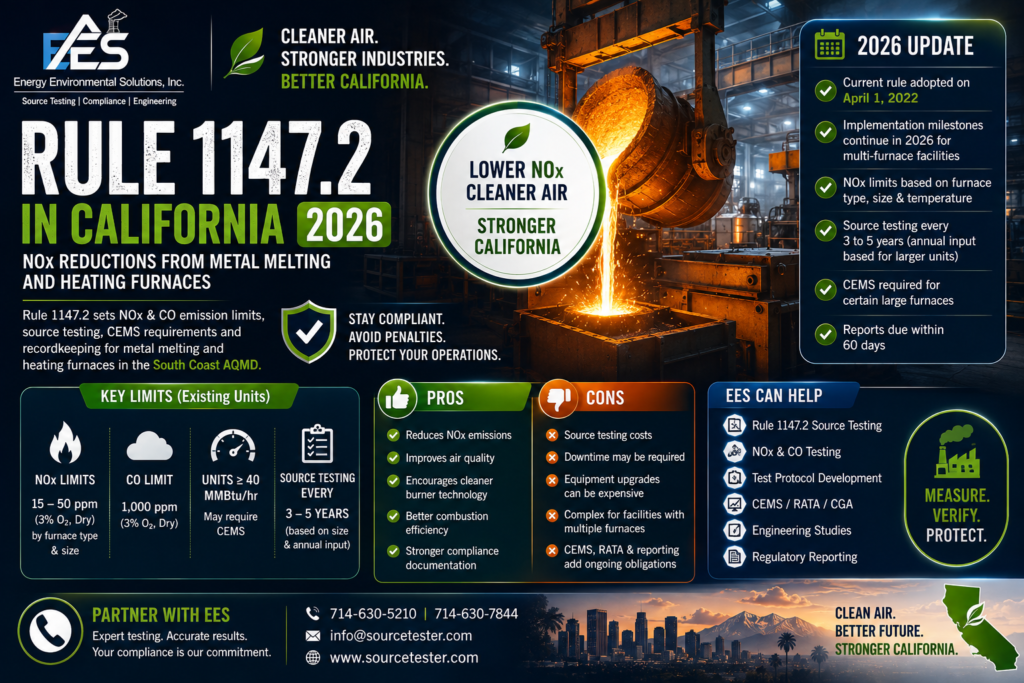
Latest Rule 1147.2 Updates for 2026
1. The Current Adopted Rule Is Still the April 1, 2022 Rule
The official South Coast AQMD rulebook identifies Rule 1147.2 as:
Rule 1147.2 — NOx Reductions from Metal Melting and Heating Furnaces
Adopted: April 1, 2022
The current official rule remains the primary document facilities should use when evaluating compliance in 2026.
There is an important distinction between current regulatory obligations and future rulemaking activity.
A facility shouldn’t assume that every item appearing on a proposed-rule page is already law.
2. 2026 Is an Important Milestone for Multiple-Furnace Facilities
One of the most relevant provisions for 2026 is the multiple-unit implementation schedule.
For facilities with two or more applicable units, Rule 1147.2 provides a phased approach based on the percentage of total rated heat-input capacity represented by units covered by the implementation schedule.
The rule specifies a January 1, 2026 milestone requiring:
- 100% of applicable rated heat-input capacity for facilities with 2–9 units
- 67% for facilities with 10–19 units
The schedule continues to January 1, 2028, when 100% applies to the 20-or-more-unit category under the specified schedule.
Why is this important?
A company operating one furnace may have a relatively straightforward compliance program.
A company operating 10, 15 or 20 furnaces has a much more complicated compliance calendar.
For those facilities, 2026 is not simply another year on the calendar—it can represent a significant implementation milestone.
3. Rule 1147.2 Has Different Limits for Different Furnaces
One of the biggest mistakes a facility can make is assuming there is one universal NOx limit for every furnace.
There isn’t.
For existing units below 40 MMBtu/hr, Table 1 establishes different NOx limits depending on furnace type and operating temperature.
| Existing Furnace | NOx Limit | CO Limit |
|---|---|---|
| Metal Melting | 40 ppm | 1,000 ppm |
| Metal Heat Treating / Heating / Forging ≤1,200°F | 40 ppm | — |
| Metal Heat Treating / Heating / Forging >1,200°F | 50 ppm | — |
| Radiant-Tube Burners | 50 ppm | — |
| Units ≥40 MMBtu/hr | 15 ppm | — |
The applicable ppm limits are corrected to 3% oxygen on a dry basis, with an 8-hour rolling average applying where specified for units equipped with certified NOx CEMS.
That means compliance testing has to be designed around the actual furnace configuration.
4. New Units Face Different Requirements
Rule 1147.2 also establishes a separate Table 3 for new units.
For example:
- Metal melting furnaces below 40 MMBtu/hr: 40 ppm NOx
- Metal heat treating/heating/forging ≤1,200°F: 30 ppm NOx
- Metal heat treating/heating/forging >1,200°F: 40 ppm NOx
- Radiant-tube burners: 40 ppm NOx
- Units ≥40 MMBtu/hr: 15 ppm NOx
The rule specifies the applicable oxygen correction and averaging provisions.
This is an important consideration when a facility is replacing an old furnace.
Replacing equipment does not necessarily mean you can simply carry the old compliance assumptions into the new installation.
5. Burner Age Can Affect Implementation
For certain units below 40 MMBtu/hr, Rule 1147.2 uses burner age as part of its implementation schedule.
For applicable existing units, facilities need to determine burner age using documentation such as:
- Burner manufacturer invoices
- Previous permit applications
- Manufacturer identification/rating plates
- Other substantiated written information approved by the Executive Officer
Where burner age cannot be determined through the specified methods, the rule provides a default treatment.
This makes equipment records extremely important.
Think of burner documentation as part of your compliance evidence.
If you don’t know when the burner was installed, you may have difficulty determining which implementation pathway applies.
6. Source Testing Is a Core Requirement
Rule 1147.2 contains specific source-testing requirements.
For units subject to the applicable concentration limits:
Units below 10 MMBtu/hr
A source test is required no later than 60 calendar months from the previous source test.
Units ≥10 MMBtu/hr
The testing interval depends on annual heat input:
- ≤23 billion Btu/year: up to 60 months
- >23 billion Btu/year: up to 36 months
These requirements are based on the rule’s specified testing provisions.
This means the test frequency isn’t necessarily determined by furnace size alone.
Annual heat input can matter.
7. New Furnaces Have an Initial Testing Requirement
For new units, Rule 1147.2 requires an initial source test no later than 18 months after the Permit to Construct is issued, unless the Executive Officer approves an extension in writing.
For existing units, the rule establishes its own initial testing provisions and allows certain previously conducted South Coast AQMD-approved source tests to be used when the specified conditions are satisfied.
This creates an important project-management requirement:
Environmental compliance should be included in the equipment installation schedule from the beginning.
Don’t wait until the furnace is commissioned and production is underway to start thinking about source testing.
8. A Test Protocol Must Be Submitted Before Testing
Rule 1147.2 requires the source-test protocol to be submitted to the Executive Officer for approval at least 90 days before the scheduled source test.
The rule also specifies when the actual test must occur relative to protocol approval.
This is one of the strongest reasons to work with an experienced source-testing company.
A compliance test is not simply:
“Bring the analyzer → measure emissions → issue a report.”
The process involves:
Rule review → permit review → protocol → approval → field testing → QA/QC → calculations → reporting
9. Approved Testing Methods Matter
Rule 1147.2 specifies approved source-testing procedures, including applicable South Coast AQMD methods and EPA Method 19, with alternative methods requiring the appropriate advance approvals.
The rule specifically references methods including:
- South Coast AQMD Method 100.1
- South Coast AQMD Method 7.1
- South Coast AQMD Method 10.1
- EPA Method 19
It also requires compliance source testing to use a South Coast AQMD-approved contractor under the Laboratory Approval Program for the applicable procedures.
That makes contractor selection a compliance issue—not merely a purchasing decision.
10. Source-Test Reports Have a 60-Day Deadline
After testing, Rule 1147.2 requires source-test reports to be submitted to the Executive Officer within 60 days of completion of the source test.
This creates three separate deadlines that facility managers should track:
Protocol submission → Test date → Report submission
A facility can conduct a technically successful test and still create a compliance problem if the required documentation isn’t handled correctly.
11. Large Furnaces May Require CEMS
For units with a rated heat-input capacity of 40 MMBtu/hr or greater, Rule 1147.2 includes CEMS requirements for measuring NOx and oxygen under specified facility circumstances.
The rule references applicable requirements under South Coast AQMD Rules 218.2 and 218.3, and Rule 2012 for certain RECLAIM facilities.
This means large-furnace compliance may involve much more than periodic stack testing.
Facilities may need to manage:
CEMS → Certification → QA/QC → RATA → Monitoring → Data validation
That is where specialized environmental testing expertise becomes especially valuable.
Pros of Rule 1147.2
1. Lower NOx Emissions
The primary benefit is reduced NOx emissions from metal-processing furnaces.
Lower NOx supports regional efforts to improve ozone and particulate pollution.
2. Better Combustion Performance
Testing can identify combustion problems involving:
- Burner settings
- Air/fuel ratio
- Excess oxygen
- Burner deterioration
- Furnace operation
- Control systems
3. More Transparent Compliance
Measured emissions data provide a stronger compliance record than relying solely on theoretical calculations.
4. Encourages Cleaner Technology
The regulation can encourage facilities to consider:
- Low-NOx burners
- Improved combustion controls
- Burner modernization
- Better monitoring
- Furnace upgrades
5. Supports Long-Term Planning
A structured testing program gives facility managers better information about equipment performance.
6. Helps Reduce Community Exposure
Metal-processing facilities can be located near industrial communities. Reducing combustion-related pollutants can support broader air-quality objectives.
Cons and Challenges of Rule 1147.2
1. Testing Costs
Professional source testing requires specialized personnel, equipment, calibration, field measurements, data analysis and reporting.
2. Production Disruption
Testing must be coordinated with furnace operations and production schedules.
3. Equipment Upgrades Can Be Expensive
Older burners may not easily achieve newer emission limits without modification or replacement.
4. Multiple Units Increase Compliance Complexity
Facilities with many furnaces may have different:
- Burner ages
- Heat-input ratings
- Operating temperatures
- Emission limits
- Test frequencies
- Permit conditions
5. CEMS Adds Another Layer
Large units may have continuing CEMS-related responsibilities involving certification, maintenance and performance testing.
6. Documentation Is Critical
Permit records, burner-age documentation, source-test reports and monitoring records need to remain organized.
What Industries Should Pay Attention to Rule 1147.2?
Potentially affected operations include facilities involved in:
Metal Casting
Foundries
Metal Forging
Heat Treating
Metal Heating
Aluminum Processing
Steel Processing
Iron Processing
Nonferrous Metal Manufacturing
Industrial Furnace Operations
Metal Fabrication
The exact applicability depends on the equipment and permit.
Rule 1147.2 Compliance: What Should a Facility Check?
A facility manager should review the following:
- Is the furnace subject to Rule 1147.2?
- What type of furnace is it?
- What is its rated heat-input capacity?
- What is the burner age?
- What is the applicable NOx limit?
- Does a CO limit apply?
- Is the unit a new or existing unit?
- Is the facility RECLAIM, former RECLAIM or non-RECLAIM?
- When was the last source test?
- When is the next test due?
- Is the source-test protocol approved?
- Is CEMS required?
- Are RATA/CGA requirements applicable?
- Are the required permits current?
- Are source-test reports submitted on time?
- Are records complete?
How EES Helps With Rule 1147.2 Compliance
Energy Environmental Solutions, Inc. (EES) provides environmental testing and engineering support to industrial facilities.
Rule 1147.2 Source Testing
EES can help facilities perform compliance source testing for applicable metal-processing furnaces.
NOx Testing
Accurate NOx measurement is fundamental to demonstrating compliance with Rule 1147.2.
CO Testing
Where applicable, EES can support CO emissions testing alongside NOx measurements.
Compliance Test Protocol Development
EES can help develop protocols addressing:
Sampling locations → Test methods → Operating conditions → QA/QC → Calculations → Reporting
CEMS Support
For large furnaces subject to CEMS requirements, EES can support emissions monitoring programs.
RATA & CGA
EES can assist facilities with applicable Relative Accuracy Test Audits (RATA) and Cylinder Gas Audits (CGA).
Engineering Studies
EES can evaluate combustion performance and help facilities understand potential compliance strategies.
Regulatory Reporting
After testing, EES can assist with technical documentation and reporting.
Rule 1147.2 Testing Process
A professional compliance project can be organized into the following stages:
1. Permit Review
Review the current South Coast AQMD permit and equipment information.
2. Applicability Review
Determine exactly how Rule 1147.2 applies to the furnace.
3. Limit Identification
Determine the applicable NOx and CO limits.
4. Testing Schedule
Calculate when the next source test is due.
5. Protocol Development
Develop and submit the source-test protocol.
6. Field Testing
Conduct the required emissions measurements under appropriate operating conditions.
7. QA/QC
Review calibration, sampling and analytical data.
8. Emissions Calculations
Calculate concentrations and applicable emission rates.
9. Reporting
Prepare and submit the source-test report.
10. Follow-Up
If results indicate noncompliance, evaluate appropriate corrective actions.
Why Proactive Rule 1147.2 Testing Is Important in 2026
South Coast AQMD’s 2026 regulatory agenda demonstrates that the District continues to actively develop and implement air-quality controls. The agency says its 2026 rule calendar contains more than two dozen planned rule amendments and adoptions aimed at implementing air-quality plans, reducing health risks and improving compliance clarity.
That doesn’t mean Rule 1147.2 itself was amended in 2026.
It means the regulatory environment surrounding industrial emissions continues to evolve.
A facility that waits until an inspection, permit renewal or failed test to examine its furnace emissions may have fewer options than a facility that monitors performance proactively.
Rule 1147.2: 2026 Pros vs. Cons
| Pros | Cons |
|---|---|
| Reduces NOx emissions | Source testing costs |
| Supports cleaner air | Production scheduling challenges |
| Encourages modern burners | Potential equipment upgrades |
| Provides measurable compliance data | Complex requirements for multiple furnaces |
| Helps identify combustion problems | CEMS obligations for certain large units |
| Improves regulatory readiness | Detailed documentation required |
| Supports long-term environmental planning | Testing must follow approved methods |
The 2026 Takeaway
Rule 1147.2 remains an important compliance requirement for applicable metal-processing furnaces in the South Coast AQMD jurisdiction.
The current adopted rule dates to April 1, 2022, and the official material reviewed does not show a replacement 2026 amendment. At the same time, 2026 includes important implementation and regulatory-planning milestones, particularly for facilities with multiple furnaces.
For facility managers, the smartest approach is not to wait for a regulatory surprise.
Know your furnace.
Know your burner age.
Know your NOx limit.
Know your testing frequency.
Know your permit.
Know your CEMS obligations.
And most importantly:
Know whether your emissions data can demonstrate compliance.
Need Rule 1147.2 Testing?
Energy Environmental Solutions, Inc. (EES) helps industrial facilities with:
Rule 1147.2 Source Testing | Metal Furnace Testing | NOx Testing | CO Testing | Compliance Test Protocol Development | CEMS | RATA | CGA | Stack Testing | Engineering Studies | Emissions Monitoring | QA/QC | Regulatory Reporting
Measure Emissions. Verify Compliance. Protect Your Operations.
Energy Environmental Solutions, Inc. (EES)
Phone: 714-630-5210 | 714-630-7844
Email: info@sourcetester.com
Website: sourcetester.org