California Rule 1153 Compliance: Commercial Bakery Oven VOC Testing & 2026 Regulatory Updates
Is Your Commercial Bakery Oven Ready for California Air Quality Compliance?
If you operate a commercial bakery, food manufacturing facility, bread production plant, or other operation using regulated bakery ovens in Southern California, South Coast AQMD Rule 1153 – Commercial Bakery Ovens may affect your facility.
Rule 1153 addresses Volatile Organic Compound (VOC) emissions from commercial bakery ovens. For facilities subject to the rule, demonstrating the required level of VOC emission reduction is an important part of maintaining environmental compliance.
And there is another reason bakery operators should be paying attention in 2026:
South Coast AQMD is continuing to move commercial food-oven regulations toward lower and zero-emission technologies under Rule 1153.1.
That means bakery and food-processing facilities should not wait until the next compliance deadline, equipment replacement or regulatory inspection to evaluate their emissions and testing requirements.
What Does Rule 1153 Cover?
South Coast AQMD Rule 1153 applies to commercial bakery ovens meeting specific heat-input and VOC-emission criteria.
The rule generally applies to bakery ovens with:
- Rated heat input capacity of 2 million BTU/hour or more
- Average daily VOC emissions of 50 pounds or more
- VOC emissions associated with fermentation and baking of yeast-leavened products
Facilities should evaluate their individual equipment, permits, operating conditions and emissions before determining applicability.
What Are the Rule 1153 VOC Requirements?
For applicable existing bakery ovens, Rule 1153 establishes VOC emission-reduction requirements based on the oven’s emissions.
Existing Bakery Ovens
Depending on the applicable emissions category:
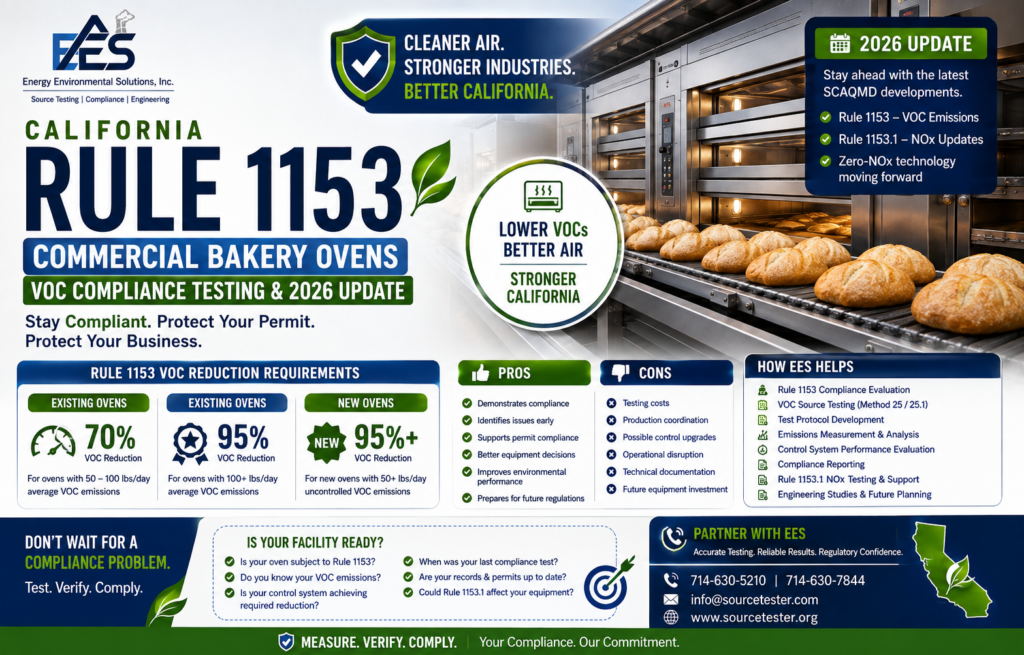
70% minimum VOC reduction
For an existing oven with base-year average daily VOC emissions of 50 pounds or more, but less than 100 pounds.
95% minimum VOC reduction
For an existing oven with base-year average daily VOC emissions of 100 pounds or more.
New Bakery Ovens
New bakery ovens subject to Rule 1153 generally require:
95% or greater VOC emission reduction when uncontrolled average daily VOC emissions are 50 pounds or more.
These requirements can make accurate emissions measurement and control-device performance evaluation extremely important.
Why Rule 1153 Compliance Testing Matters
A bakery may believe that its oven is operating normally, but normal production does not automatically mean regulatory compliance.
VOC emissions can be influenced by factors such as:
- Yeast percentage
- Fermentation time
- Product type
- Production rate
- Oven operating conditions
- Exhaust flow
- Control-device performance
- Changes in equipment configuration
- Changes in production processes
A properly planned emissions test can help establish whether the equipment is achieving the required emission-reduction performance.
For facilities subject to source-testing requirements, testing should be planned around the applicable permit conditions, regulatory requirements, approved test methods and operating conditions.
2026 Update: Why Bakery Operators Should Also Watch Rule 1153.1
While Rule 1153 focuses on VOC emissions, Rule 1153.1 addresses NOx emissions from commercial food ovens.
This distinction is extremely important.
In 2026, South Coast AQMD conducted a technology check-in concerning the future zero-NOx requirements under Rule 1153.1.
The agency’s 2026 assessment reported that zero-NOx technology is technically feasible and cost-effective for smaller oven categories. At the same time, the agency recognized that transitioning from natural gas to electricity can create significant fuel-switching and infrastructure costs, particularly for larger ovens.
The 2026 activity included:
- February 3, 2026 technology check-in
- March 20, 2026 Stationary Source Committee discussion
- April 3, 2026 Governing Board update
- Continued evaluation of zero-NOx technology and cost-effectiveness
- Continued preparation for future zero-emission requirements
Why Does This Matter to Bakery Facilities?
Because today’s VOC compliance project can become part of tomorrow’s broader emissions-management strategy.
Bakery operators should consider both:
VOC compliance under Rule 1153
and
NOx requirements under Rule 1153.1
when planning major oven modifications, burner replacements, electrification projects, new equipment purchases or facility expansions.
What Is Coming Under Rule 1153.1?
Rule 1153.1 establishes Phase I NOx requirements and future zero-emission requirements for certain commercial food ovens.
The zero-emission provisions include categories such as:
- Certain bakery ovens rated at or below 3 MMBtu/hr
- Certain cooking ovens rated at or below 3 MMBtu/hr
- Indirect-fired bakery ovens
- Smokehouses
The future compliance structure is based in part on equipment and burner age.
For affected facilities, the transition toward zero-NOx technology can involve:
- Equipment evaluation
- Electrical capacity assessment
- Utility coordination
- Permit planning
- Equipment replacement or modification
- Compliance testing
- Engineering analysis
- Documentation and reporting
The key message for facility owners: Don’t wait until an equipment deadline forces a rushed decision.
Pros of Rule 1153 Compliance & Emissions Testing
1. Helps Demonstrate Regulatory Compliance
Accurate testing provides documented emissions data that can support compliance demonstrations.
2. Identifies Emissions Problems Early
Testing can reveal problems with oven operation, exhaust systems or VOC control equipment before they become larger compliance concerns.
3. Supports Permit Compliance
Testing and reporting can help facilities maintain documentation associated with applicable permits and regulatory requirements.
4. Supports Better Equipment Decisions
Reliable emissions information can help facility managers determine whether to maintain, modify, upgrade or replace equipment.
5. Improves Environmental Performance
Effective VOC control can contribute to reduced ozone-forming emissions and improved regional air quality.
6. Helps Prepare for Future Regulations
With California continuing to move toward lower-emission and zero-emission technologies, early testing and engineering evaluation can help facilities prepare for future requirements.
Cons & Challenges of Rule 1153 Compliance
Compliance is important, but it can create practical challenges for bakery operators.
1. Testing Costs
Professional source testing requires specialized personnel, equipment, laboratory analysis and reporting.
2. Production Coordination
Testing often needs to occur under representative operating conditions, which requires coordination with production schedules.
3. Potential Control-System Upgrades
If testing identifies insufficient VOC reduction, the facility may need to evaluate control-device modifications or other corrective measures.
4. Operational Disruption
Poorly planned testing can interfere with production schedules.
5. Technical Documentation
Permit conditions, test protocols, operating parameters, calculations and final reports can be complicated.
6. Future Equipment Investment
The broader transition toward low-NOx and zero-NOx commercial food-oven technology may require significant capital planning, particularly where electrical upgrades or equipment replacement are necessary.
How EES Helps With Rule 1153 Compliance
Energy Environmental Solutions, Inc. – Your Compliance Testing Partner
At Energy Environmental Solutions, Inc. (EES), we help industrial and commercial facilities approach air-quality compliance through professional testing, engineering support and regulatory documentation.
For bakery and food-processing facilities, EES can help with a compliance strategy that may include:
Rule 1153 Compliance Evaluation
Review the facility’s applicable equipment, operating conditions and regulatory requirements to help determine the appropriate compliance pathway.
VOC Source Testing
Perform emissions testing using applicable regulatory and approved test methodologies.
Test Protocol Development
Develop a testing strategy and protocol based on applicable requirements, permit conditions and facility operating parameters.
Emissions Measurement & Data Analysis
Collect and evaluate emissions data to support an accurate compliance determination.
Control-System Performance Evaluation
Where applicable, evaluate the performance of VOC emission-control equipment.
Compliance Reporting
Prepare technically organized documentation and reports to support regulatory compliance and facility records.
Rule 1153.1 Support
For facilities affected by commercial food-oven NOx requirements, EES can also support:
- NOx testing
- CO testing
- Source-test planning
- Compliance documentation
- Equipment evaluation
- Engineering studies
- Regulatory support
- Future low-NOx and zero-NOx transition planning
Why Choose EES?
Environmental compliance is not simply about collecting numbers.
The quality of the testing plan, operating conditions, measurements, calculations and final documentation can all matter.
EES provides a coordinated approach:
PLAN → TEST → ANALYZE → REPORT → SUPPORT COMPLIANCE
Our goal is to help customers obtain accurate, defensible emissions data while minimizing unnecessary operational disruption.
Don’t Wait for a Compliance Problem
If your facility operates commercial bakery ovens in California, now is a good time to review your compliance position.
Ask yourself:
- Is my bakery oven subject to Rule 1153?
- Do I know my uncontrolled VOC emissions?
- Is my VOC control system achieving the required reduction?
- When was my last compliance test?
- Are my testing records complete?
- Does my current permit accurately reflect my equipment?
- Could upcoming Rule 1153.1 requirements affect my equipment?
- Will future electrification require electrical or utility upgrades?
- Should I plan equipment modifications or replacement before a regulatory deadline?
If you cannot confidently answer these questions, a professional compliance review may be worthwhile.
Partner With EES for California Air Quality Compliance
Accurate Testing. Reliable Results. Regulatory Confidence.
Energy Environmental Solutions, Inc. helps facilities navigate complex air-emissions testing and compliance requirements with technical, engineering and testing support.
Protect Your Permit. Protect Your Operations. Prepare for What’s Next.
Call EES today: 714-630-5210 | 714-630-7844
Email: info@sourcetester.com
Website: www.sourcetester.org
Energy Environmental Solutions, Inc.
Source Testing | Compliance | Engineering
Your Compliance. Our Commitment.