Rule 1420, 1420.1 & 1420.2 in California: Lead Emissions Testing, Source Testing & 2026 Compliance Guide
Is Your Facility Ready for California’s Lead Emission Compliance Requirements?
If your facility processes lead-containing materials, recycles lead-acid batteries, or operates metal-melting equipment, environmental compliance should be a top priority.
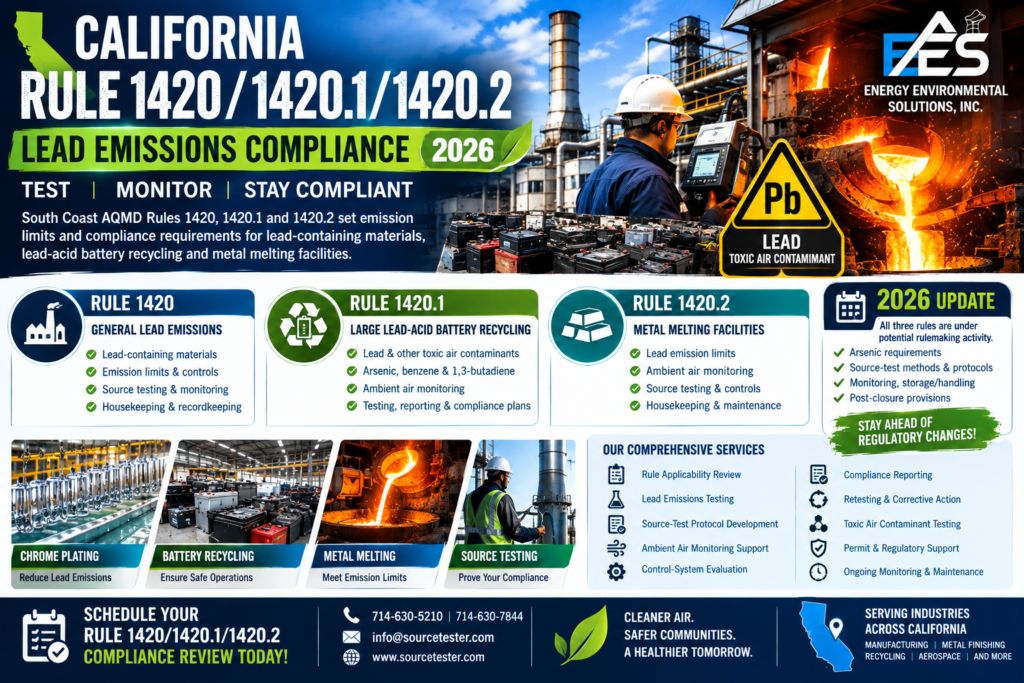
In the South Coast Air Quality Management District (South Coast AQMD), three important lead-emission rules address different categories of facilities:
- Rule 1420 – Emission Standard for Lead
- Rule 1420.1 – Emission Standards for Lead and Other Toxic Air Contaminants from Large Lead-Acid Battery Recycling Facilities
- Rule 1420.2 – Emission Standards for Lead from Metal Melting Facilities
These rules address lead emissions through combinations of emission limits, ambient air monitoring, source testing, control systems, housekeeping, recordkeeping, compliance plans and operational requirements.
And 2026 brings an important reason to review your compliance program.
South Coast AQMD’s 2026 rulemaking forecast identifies potential amendments to all three rules. The proposed work includes arsenic-related requirements, updated testing methods, source-test protocol clarifications, monitoring, storage/handling and post-closure provisions.
For affected facilities, this means that relying on an old compliance checklist may not be enough.
What Are Rules 1420, 1420.1 and 1420.2?
Although these rules are closely related, they do not regulate exactly the same facilities.
Understanding which rule applies to your operation is the first step toward an effective compliance program.
Rule 1420 – Emission Standard for Lead
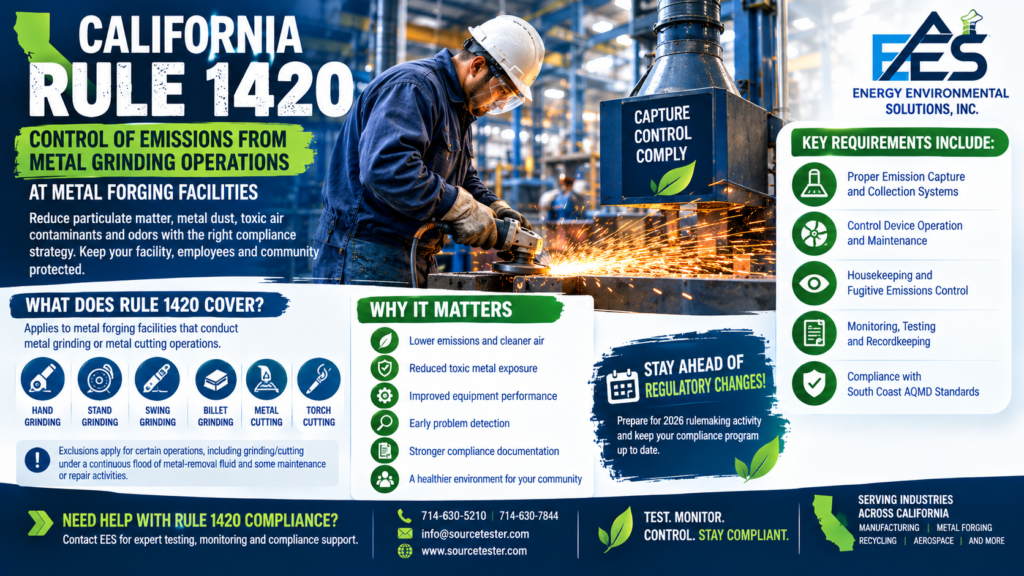
Rule 1420 is the broader lead-emission rule for facilities that use or process lead-containing materials and are not regulated under the more specific Rules 1420.1 or 1420.2.
The rule’s purpose is to reduce lead emissions and protect public health.
Potentially affected operations can include:
- Lead-processing facilities
- Lead-containing material processors
- Foundries
- Certain metal-processing operations
- Lead-acid battery-related operations not covered by Rule 1420.1
- Other facilities processing lead-containing materials
South Coast AQMD’s current rule structure identifies Rule 1420 separately from the specialized rules for large lead-acid battery recyclers and large metal-melting facilities.
Rule 1420.1 – Large Lead-Acid Battery Recycling Facilities
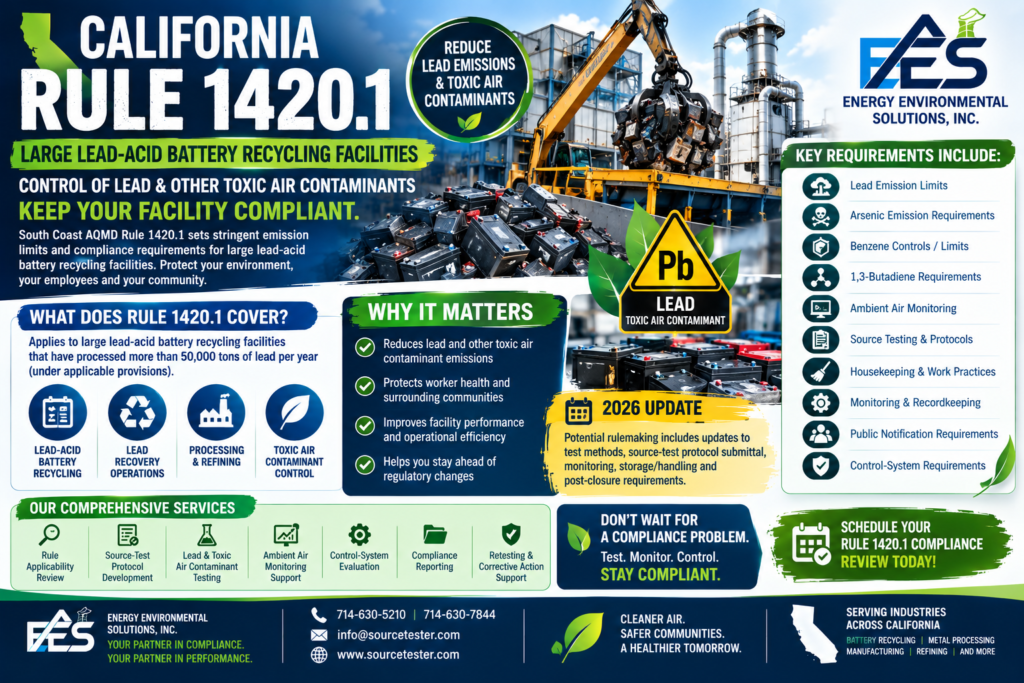
Rule 1420.1 specifically addresses large lead-acid battery recycling facilities.
South Coast AQMD states that the rule applies to large lead-acid battery recycling facilities that have processed more than 50,000 tons of lead per year under the applicable historical/current applicability provisions.
The rule addresses not only lead but also other toxic air contaminants associated with these operations.
Requirements can include:
- Lead emission limits
- Arsenic emission requirements
- Benzene controls/limits
- 1,3-butadiene requirements
- Ambient air monitoring
- Stack/source testing
- Housekeeping
- Work practices
- Monitoring and recordkeeping
- Public notification requirements
- Control-system requirements
South Coast AQMD describes Rule 1420.1 as having some of the most stringent requirements for lead-acid battery recycling facilities in the country.
Rule 1420.2 – Lead from Metal Melting Facilities
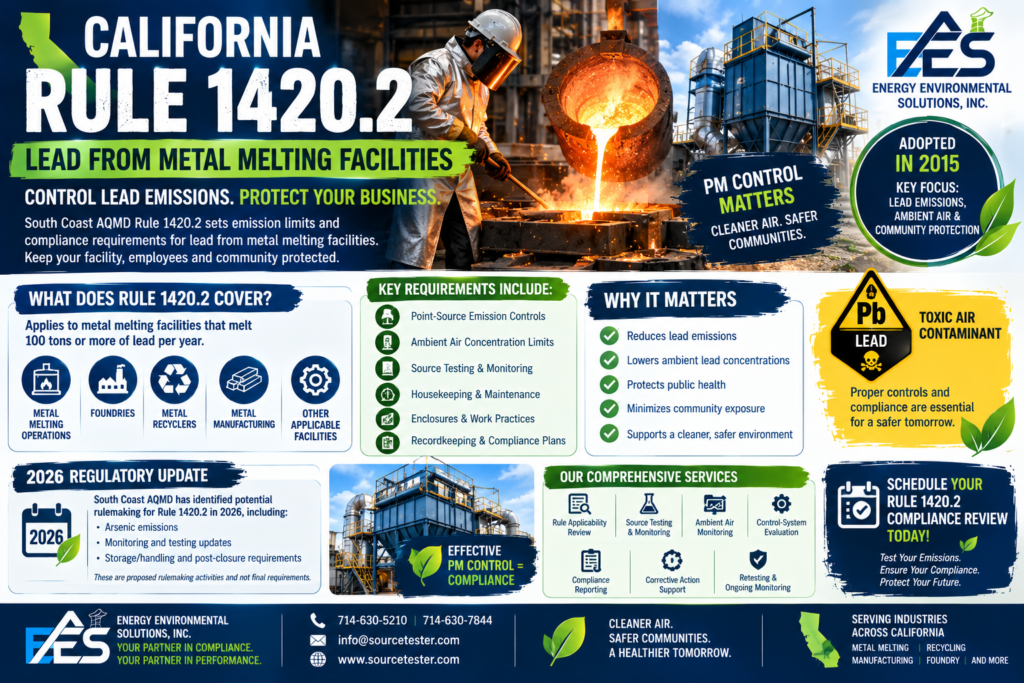
Rule 1420.2 focuses on metal melting facilities that melt 100 tons or more of lead per year.
The rule was adopted to reduce:
- Lead emissions
- Ambient lead concentrations
- Public exposure to lead
It includes requirements involving:
- Point-source emission controls
- Ambient air lead concentration limits
- Source testing
- Ambient air monitoring
- Housekeeping
- Maintenance
- Enclosures
- Recordkeeping
- Compliance plans when applicable
🚨 Major 2026 Update: All Three Rules Are Under Regulatory Review
This is one of the most important reasons affected businesses should review their compliance programs in 2026.
South Coast AQMD’s 2026 rulemaking forecast identifies:
Rule 1420
Potential amendments to address:
- Arsenic emissions
- Storage and handling requirements
- Closure requirements
The objective is to close a regulatory gap between Rule 1420 and Rule 1407, which regulates arsenic, cadmium and nickel from non-ferrous metal melting operations.
Rule 1420.1
Potential amendments are planned to:
- Update applicable test methods
- Clarify source-test protocol submittal
- Potentially address monitoring
- Potentially address post-closure requirements
Rule 1420.2
Potential amendments are planned to:
- Address arsenic emissions
- Close a regulatory gap between Rule 1420.2 and Rule 1407
- Potentially address monitoring
- Potentially address post-closure requirements
Important:
These items are rulemaking plans/proposed activities—not automatically final requirements. Facilities should verify the adopted rule language and permit conditions before making compliance decisions.
Why Lead Emission Testing Matters
Lead is a toxic air contaminant, and controlling emissions is an important component of protecting workers and surrounding communities.
For regulated facilities, emissions testing can provide evidence that:
Emission Sources → Control Equipment → Operating Conditions → Emission Results → Regulatory Compliance
are functioning as required.
Testing can also help identify problems before they become more expensive compliance issues.
What Does Lead Source Testing Involve?
Depending on the applicable rule, equipment and approved test method, testing may evaluate:
Lead Emissions
Measurement of lead concentrations or emission rates from applicable exhaust points.
Particulate Matter
Lead can be associated with particulate emissions, making particulate control important in many processes.
Control Device Performance
Testing may help determine whether equipment such as baghouses, scrubbers or other controls is operating effectively.
Capture Efficiency
For applicable sources, testing can evaluate whether emissions are adequately captured.
Operating Parameters
Testing should be performed under representative conditions required by the applicable rule/test protocol.
Ambient Air Monitoring
One of the major components of the lead rules is ambient air monitoring.
Instead of looking only at what leaves a stack, ambient monitoring can evaluate lead concentrations around the facility.
This provides a different compliance perspective:
Stack Testing
What is being emitted from the source?
Ambient Monitoring
What concentration is present in the surrounding air?
Both can be important for facilities subject to applicable requirements.
Rule 1420.2, for example, includes ambient air monitoring and concentration requirements as part of its compliance framework.
Point-Source Controls
Facilities subject to the lead rules may need appropriate controls on emission points.
Depending on the process, controls may include:
- Baghouse systems
- Fabric filters
- Scrubbers
- Enclosures
- Local exhaust ventilation
- Negative-pressure systems
- Other approved control technologies
Rule 1420.1, for example, requires large lead-acid battery recycling facilities to maintain building operations under constant negative pressure so emissions can be collected and routed to air-pollution-control equipment.
Baghouse Monitoring Is Critical
For facilities using baghouses or similar particulate-control equipment, monitoring performance is an important component of compliance.
South Coast AQMD’s Rule 1420 materials include requirements concerning:
- Pressure-drop monitoring
- Calibration
- Data acquisition
- Recordkeeping
- Bag-leak detection
- Maintenance
Why this matters:
A source can pass an emissions test but still experience control-system deterioration later.
Continuous or periodic monitoring can provide an early warning.
Rule 1420 Compliance Plans
For certain facilities, a Compliance Plan can be an important part of the regulatory process.
South Coast AQMD’s Rule 1420 framework includes compliance-plan provisions for qualifying lead-processing facilities, including facilities processing more than specified quantities of lead.
A compliance plan can involve information such as:
- Material processed
- Lead content
- Emission sources
- Emission estimates
- Monitoring
- Air-dispersion modeling
- Control measures
- Compliance strategies
The exact requirement depends on facility applicability and current rule language.
Air Dispersion Modeling
For certain Rule 1420 facilities, air-dispersion modeling can be part of the compliance process.
Modeling helps estimate how emissions from a facility may affect ambient concentrations.
A professional compliance program can therefore involve:
Emission Testing + Ambient Monitoring + Modeling + Control Evaluation
rather than relying on one test alone.
Housekeeping Is Not Optional
Lead dust can become a significant compliance concern.
Rules 1420, 1420.1 and 1420.2 contain requirements addressing housekeeping, maintenance and control of fugitive lead emissions.
Potential areas of concern include:
- Floors
- Work areas
- Material storage
- Process areas
- Equipment
- Conveyors
- Dust collection systems
- Maintenance activities
- Construction/repair work
Rule 1420.2 specifically addresses fugitive lead-dust potential from certain construction and maintenance activities.
The lesson:
Clean facility ≠ automatically compliant.
But poor housekeeping can create additional emissions and regulatory risk.
Rule 1420.1: More Than Lead
Large lead-acid battery recycling facilities should pay attention to more than lead.
Rule 1420.1 also addresses toxic air contaminants including:
- Arsenic
- Benzene
- 1,3-Butadiene
South Coast AQMD’s rule activity page identifies additional administrative, monitoring and source-testing requirements associated with these contaminants.
This makes Rule 1420.1 compliance significantly more complex than a simple lead stack test.
Rule 1420.2: Metal Melting Facilities
If your facility melts significant quantities of lead-containing material, Rule 1420.2 deserves special attention.
Potentially affected industries can include:
- Metal recyclers
- Foundries
- Metal manufacturers
- Aerospace-related manufacturing
- Steel/metal facilities
- Lead-acid battery manufacturing
- Other lead-melting operations
The original rulemaking documentation identified metal-melting facilities as significant stationary lead-emission sources and established requirements for ambient monitoring, source testing, point-source controls and housekeeping.
2026 Arsenic Regulatory Development
A particularly important development is the planned effort to address arsenic emissions under Rules 1420 and 1420.2.
South Coast AQMD’s 2026 forecast states that proposed amendments would help close a regulatory gap between these rules and Rule 1407 – Control of Emissions of Arsenic, Cadmium, and Nickel from Non-Ferrous Metal Melting Operations.
Why should businesses care?
A facility that has historically focused primarily on lead compliance may need to evaluate whether arsenic requirements could affect:
- Testing
- Monitoring
- Control equipment
- Recordkeeping
- Permit conditions
- Future facility modifications
2026 Source-Test Protocol Update for Rule 1420.1
For large lead-acid battery recyclers, South Coast AQMD specifically identifies potential updates to applicable test methods and clarification of source-test protocol submittal requirements in the 2026 rulemaking forecast.
This is a strong reason to review your testing program before scheduling the next source test.
Don’t simply reuse an old protocol.
Your compliance team should confirm:
- Current rule language
- Current test methods
- Current protocol requirements
- Current permit conditions
- Current monitoring requirements
- Current reporting requirements
Pros of Rule 1420/1420.1/1420.2 Compliance
✅ 1. Better Lead Emission Control
The rules are designed to reduce lead emissions and ambient exposure.
✅ 2. Improved Community Protection
Ambient monitoring and emission controls provide additional protection for surrounding communities.
✅ 3. Early Detection of Problems
Source testing and monitoring can identify deteriorating control-system performance.
✅ 4. Better Regulatory Documentation
Well-organized test reports and monitoring records provide evidence of compliance.
✅ 5. Improved Facility Management
Regular testing can help facilities understand how process changes affect emissions.
✅ 6. Proactive 2026 Planning
Reviewing the rules now gives facilities time to prepare for potential regulatory changes.
Cons & Challenges
❌ 1. Testing Costs
Lead and toxic-air-contaminant testing requires specialized equipment, laboratories and experienced professionals.
❌ 2. Production Coordination
Testing often needs to occur under specific operating conditions.
❌ 3. Control-System Maintenance
Facilities may need ongoing maintenance of baghouses, scrubbers, ventilation and other controls.
❌ 4. Ambient Monitoring Costs
Applicable facilities may need monitoring networks and ongoing data management.
❌ 5. Recordkeeping Burden
Monitoring, testing and maintenance records must be properly maintained.
❌ 6. Potential Capital Investment
Facilities may need control-system upgrades when existing equipment cannot meet applicable requirements.
❌ 7. Regulatory Changes
The 2026 rulemaking activity means businesses should monitor future amendments rather than relying on outdated compliance procedures.
Common Lead-Compliance Mistakes
❌ Mistake #1: Assuming Rule 1420 Applies to Everyone
Rules 1420.1 and 1420.2 address specific facility categories.
❌ Mistake #2: Treating the Three Rules as Identical
They have different applicability, requirements and compliance pathways.
❌ Mistake #3: Using an Old Source-Test Protocol
Rule 1420.1 is specifically identified for potential 2026 test-method and protocol-submittal updates.
❌ Mistake #4: Ignoring Ambient Monitoring
Stack emissions and ambient concentrations are different compliance questions.
❌ Mistake #5: Ignoring Arsenic
The 2026 rulemaking activity specifically highlights arsenic under Rules 1420 and 1420.2.
❌ Mistake #6: Poor Control-Device Records
A baghouse or scrubber needs documented monitoring and maintenance.
❌ Mistake #7: Waiting Until an Inspection
A proactive compliance review gives you more time to correct problems.
How EES Helps Industries With Rule 1420, 1420.1 & 1420.2
Energy Environmental Solutions, Inc. (EES) can help facilities develop a structured emissions-testing and compliance strategy.
1. Rule Applicability Review
EES can help determine whether your operation falls under:
Rule 1420
Rule 1420.1
Rule 1420.2
or another applicable South Coast AQMD requirement.
2. Lead Emissions Source Testing
EES can support applicable testing programs for:
- Lead
- Particulate-related emissions
- Applicable toxic air contaminants
- Control-device performance
3. Source-Test Protocol Development
EES can help prepare source-test protocols covering:
- Applicable rule
- Emission limits
- Test methods
- Sampling locations
- Operating conditions
- QA/QC
- Analytical requirements
- Calculations
- Reporting
4. Ambient Air Monitoring Support
For facilities subject to applicable ambient-monitoring requirements, EES can assist with monitoring program planning and compliance documentation.
5. Control-System Evaluation
EES can help evaluate emission-control systems such as:
- Baghouses
- Scrubbers
- Local exhaust systems
- Enclosures
- Negative-pressure systems
- Other pollution-control equipment
6. Compliance Documentation
EES can help organize:
- Source-test reports
- Monitoring records
- Maintenance records
- Compliance documentation
- Corrective-action records
7. 2026 Regulatory Readiness
With Rules 1420, 1420.1 and 1420.2 identified for potential 2026 amendments, EES can help facilities review their existing compliance program against developing requirements.
EES Lead-Generation Compliance Process
STEP 1 — IDENTIFY
Facility + Process + Materials + Permit
↓
STEP 2 — CLASSIFY
Rule 1420 / 1420.1 / 1420.2
↓
STEP 3 — REVIEW
Emission Limits + Monitoring + Testing
↓
STEP 4 — PLAN
Source-Test Protocol + Sampling Strategy
↓
STEP 5 — TEST
Lead / Applicable TACs / Control Performance
↓
STEP 6 — ANALYZE
Validate Results Against Applicable Requirements
↓
STEP 7 — REPORT
Technical Compliance Documentation
↓
STEP 8 — IMPROVE
Corrective Action + Retesting + Ongoing Monitoring
Who Should Contact EES?
Potential clients include:
🏭 Metal Melting Facilities
♻️ Lead Recycling Facilities
🔋 Lead-Acid Battery Recycling Facilities
⚙️ Foundries
🔩 Metal Manufacturers
✈️ Aerospace Manufacturers
🏗️ Industrial Metal Processors
🔧 Metal Recyclers
🏢 Facilities Processing Lead-Containing Materials
🧪 Facilities Requiring Toxic Air Contaminant Testing
Actual applicability should be confirmed against the current South Coast AQMD rules and facility-specific permit.
2026 Lead Compliance Checklist
Before your next regulatory review, ask:
- Which lead rule applies to my facility?
- Are we subject to Rule 1420?
- Are we a large lead-acid battery recycling facility?
- Do we fall under Rule 1420.1?
- Do we melt 100+ tons of lead annually?
- Does Rule 1420.2 apply?
- What are our current lead emission limits?
- Are ambient monitoring requirements applicable?
- When was our last source test?
- When is our next test due?
- Is our source-test protocol current?
- Are our control devices operating correctly?
- Are baghouse monitoring records complete?
- Are housekeeping records current?
- Are maintenance records complete?
- Are we prepared for potential arsenic requirements?
- Have we reviewed the 2026 rulemaking activity?
- Do our permits accurately reflect current operations?
Don’t Wait for a Compliance Problem
Lead-emission compliance can involve much more than one annual test.
A strong program combines:
Testing + Monitoring + Controls + Housekeeping + Documentation + Regulatory Planning
If your facility processes lead-containing materials or operates lead-melting/recycling equipment, reviewing your compliance program before your next test can help identify gaps while there is still time to address them.
🚨 Is Your Facility Ready for the 2026 Lead Compliance Requirements?
EES Can Help With:
✔ Rule 1420 Applicability Review
✔ Rule 1420.1 Compliance Support
✔ Rule 1420.2 Compliance Support
✔ Lead Emissions Testing
✔ Source-Test Protocol Development
✔ Ambient Air Monitoring Support
✔ Control-System Evaluation
✔ Toxic Air Contaminant Testing
✔ Compliance Reporting
✔ Retesting & Corrective-Action Support
Request a Lead Emissions Compliance Review
Know Your Emissions. Verify Your Controls. Prepare for Regulatory Changes.
If you operate a lead-processing, battery-recycling or metal-melting facility, contact EES for a professional compliance review.
Send EES:
📍 Facility Location
⚙️ Process Type
🧪 Materials Processed
🔥 Furnace/Process Information
💨 Control Equipment Details
📄 Current Air Permit
📊 Previous Source-Test Report
Energy Environmental Solutions, Inc. (EES)
Phone: 714-630-5210 | 714-630-7844
Email: info@sourcetester.com
Website: sourcetester.org