Thermal Oxidizer Testing in California (2026): Latest Updates, Pros, Cons & How EES Helps Industries Stay Compliant
California continues to maintain some of the nation’s most demanding requirements for controlling VOC and toxic air contaminant emissions from industrial operations. For facilities using thermal oxidizers, regenerative thermal oxidizers (RTOs), catalytic oxidizers, afterburners, or related combustion-control equipment, performance testing can be an important part of demonstrating that the control device is actually achieving the required emissions-control performance.
A key 2026 development is that South Coast AQMD is actively evaluating control technologies and emissions requirements across several industrial sectors. Its March 2026 staff report for aerospace coating operations, for example, discusses thermal oxidizers as VOC and toxic-air-contaminant controls and notes that they can achieve destruction efficiencies above 98% in appropriate applications. At the same time, the report highlights an important challenge: thermal oxidation of certain compounds can create secondary pollutants such as HCl and HF, potentially requiring additional control equipment.
For industrial facilities, this means thermal oxidizer testing should not be viewed simply as a one-time emissions test. Temperature, residence time, combustion conditions, VOC destruction efficiency, NOx, CO, and potentially other pollutants all need to be considered according to the applicable permit and Air District requirements.
Energy Environmental Solutions, Inc. (EES) helps California industries with Thermal Oxidizer Testing, VOC Testing, Source & Stack Testing, NOx and CO Testing, Compliance Test Protocol Development, CEMS/RATA/CGA, Engineering Studies, and Regulatory Reporting.
What Is Thermal Oxidizer Testing?
A thermal oxidizer destroys VOCs and other combustible pollutants by oxidizing them at elevated temperatures.
Testing can be used to determine whether the equipment is achieving the required destruction or removal efficiency (DRE) and whether emissions from the control device comply with applicable permit or regulatory limits.
Depending on the facility and permit, testing may evaluate:
- VOC destruction efficiency
- VOC concentration
- NOx emissions
- CO emissions
- CO₂
- O₂
- Flow rate
- Temperature
- Residence time
- Combustion conditions
- Particulate matter
- Toxic air contaminants, where applicable
The exact testing requirements are facility- and permit-specific. There is no single California-wide thermal-oxidizer test that automatically applies to every facility.
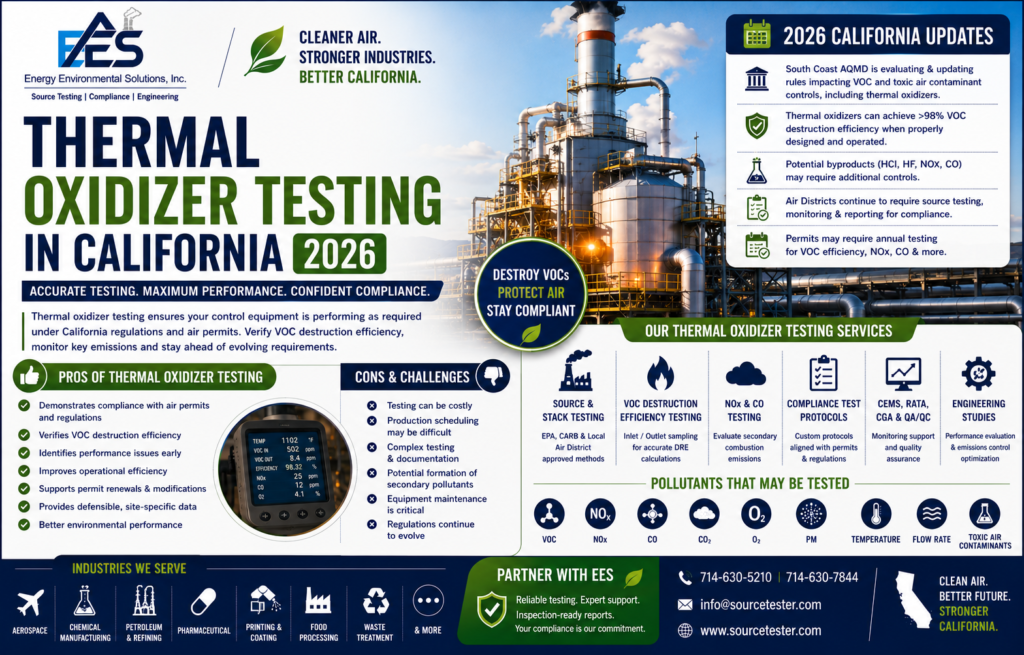
Latest California Thermal Oxidizer Updates for 2026
1. South Coast AQMD Is Actively Evaluating Thermal Oxidizers
One of the clearest 2026 regulatory developments comes from South Coast AQMD’s work on Proposed Amended Rule 1124, covering aerospace assembly and component manufacturing operations.
The March 2026 staff report evaluates thermal oxidizers as a potential control technology for VOC and toxic-air-contaminant emissions. South Coast AQMD states that thermal oxidizers can achieve destruction efficiencies exceeding 98% under suitable operating conditions.
However, the agency also identifies limitations for some compounds. For example, thermal oxidation of chlorinated and fluorinated compounds can generate acidic byproducts such as hydrochloric acid and hydrofluoric acid, potentially requiring scrubbers and additional controls.
What this means for industry: choosing a thermal oxidizer is not simply about achieving a high VOC destruction percentage. Facilities must also evaluate the pollutants created by the combustion process.
2. 2026 Rulemaking Continues Across California’s Industrial Air Sector
South Coast AQMD’s 2026 regulatory agenda includes numerous proposed amendments and new rules addressing particulate matter, toxic air contaminants, monitoring, New Source Review, and other air-quality requirements.
This broader regulatory activity matters to facilities operating thermal oxidizers because a control device may address one pollutant while creating or affecting another.
For example, South Coast AQMD’s emissions-reporting guidance for thermal oxidation notes that when VOC vapors are destroyed through thermal oxidation, NOx, SOx, CO, PM, and toxic air contaminants may also be generated. The agency encourages operators to use site-specific test results where available for emissions calculations.
That makes comprehensive testing increasingly valuable.
3. Source Testing Can Be a Permit Requirement
Thermal oxidizer testing requirements are often written directly into individual facility permits.
For example, a Bay Area Air Quality Management District permit requires a thermal oxidizer to be source tested annually for VOC control efficiency as well as NOx and CO emissions, with results reported to the District. The permit also specifies continuous temperature monitoring and recordkeeping requirements.
This demonstrates an important point:
Thermal oxidizer testing frequency and pollutants are determined by the applicable permit and regulatory requirements.
Some facilities may require annual testing; others may have different schedules or testing triggers.
4. California Facilities Continue Using Performance Testing to Demonstrate Control Efficiency
South Coast AQMD Hearing Board documents also show real-world applications of thermal oxidizers.
In a 2025 case involving a petroleum facility, a portable thermal oxidizer was allowed temporarily to replace an afterburner, subject to conditions including a minimum overall VOC control efficiency of 99% and a performance test shortly after startup to demonstrate compliance.
Although that order was issued in 2025, it remains a useful example of how regulators can use performance testing to verify control-device performance during temporary or modified operating conditions.
Why Is Thermal Oxidizer Testing Important?
A thermal oxidizer may look like a simple solution:
VOC-containing gas → high-temperature combustion → cleaner exhaust
But real-world performance depends on several variables.
If the temperature is too low, residence time is inadequate, mixing is poor, or the system is overloaded, destruction efficiency can decline.
Testing helps answer the critical question:
Is the thermal oxidizer actually performing as required under real operating conditions?
Key Parameters That Can Affect Performance
Temperature
Thermal oxidation requires sufficient temperature to initiate and maintain the oxidation reaction.
Temperature requirements vary depending on the equipment, pollutants, permit, and process.
Residence Time
The contaminated gas needs enough time inside the combustion chamber for the oxidation reaction to occur effectively.
Turbulence & Mixing
Good mixing of combustion air and contaminated gas is essential for consistent oxidation.
South Coast AQMD specifically identifies temperature, residence time, and turbulence/mixing as important design factors for thermal oxidizers.
VOC Loading
An oxidizer operating with a highly variable VOC concentration may behave differently from one receiving a stable waste stream.
Testing under representative operating conditions is therefore critical.
Pros of Thermal Oxidizer Testing
1. Demonstrates Compliance
Testing can provide documented evidence that the control device is meeting applicable permit requirements.
2. Verifies VOC Destruction Efficiency
Testing can determine whether the thermal oxidizer is achieving its required VOC control efficiency.
3. Identifies Performance Problems
Testing can reveal declining control efficiency, combustion problems, unusual emissions, or operational conditions requiring investigation.
4. Supports Permit Compliance
Reliable source-test results can support permit renewals, modifications, inspections, and regulatory reporting.
5. Improves Environmental Performance
Properly operated thermal oxidizers can substantially reduce VOC emissions and associated air-quality impacts.
6. Provides Better Emissions Data
Site-specific testing can provide more defensible information than relying exclusively on generic emission factors.
Cons & Challenges of Thermal Oxidizer Testing
Thermal oxidizer testing also comes with challenges.
Testing Costs
Professional source testing requires specialized equipment, trained personnel, laboratory analysis where applicable, and technical reporting.
Production Scheduling
Testing may need to be performed during specific operating conditions, making coordination with production important.
Complex Testing Requirements
VOC destruction efficiency testing can require simultaneous inlet and outlet measurements, operating-condition documentation, and carefully designed sampling procedures.
Secondary Pollutants
Thermal oxidation can produce NOx, CO, SOx, PM, and potentially toxic or acidic combustion byproducts, depending on the waste stream. South Coast AQMD specifically highlights these considerations in its emissions-reporting guidance.
Equipment Maintenance
Burners, combustion chambers, temperature sensors, controls, fans, dampers, and related equipment need appropriate maintenance to maintain performance.
Regulatory Changes
California’s air-quality regulations continue evolving, making it important for facilities to verify current requirements rather than relying on an old test protocol.
Thermal Oxidizer Testing: What May Be Tested?
A facility’s testing program may include:
| Parameter | Why It May Be Tested |
|---|---|
| VOC | Determine emissions and/or destruction efficiency |
| NOx | Evaluate combustion-related emissions |
| CO | Identify incomplete combustion |
| CO₂ | Support combustion and emissions calculations |
| O₂ | Support emissions calculations and combustion evaluation |
| Flow Rate | Determine mass emissions |
| Temperature | Verify operating conditions |
| PM | Evaluate particulate emissions where applicable |
| Toxic Air Contaminants | Evaluate pollutants specific to the process |
| Inlet/Outlet VOC | Calculate control efficiency |
The exact parameters should always be determined from the facility permit, applicable Air District rules, approved test protocol, and regulatory requirements.
How Energy Environmental Solutions, Inc. Helps Industries
Energy Environmental Solutions, Inc. (EES) provides comprehensive testing and engineering support for facilities using thermal oxidizers and other air pollution control devices.
Thermal Oxidizer Performance Testing
EES can help facilities evaluate thermal oxidizer performance through appropriate source-testing programs.
VOC Destruction Efficiency Testing
We can support testing programs designed to determine VOC inlet and outlet concentrations and control efficiency, where required.
NOx & CO Testing
Because combustion can create secondary pollutants, EES can support testing for NOx and CO where required by permits or regulations.
Source & Stack Testing
Our team provides source and stack testing using applicable EPA, CARB, and local Air District methods.
Compliance Test Protocol Development
Before testing begins, a well-developed protocol can define:
- Sampling locations
- Test methods
- Operating conditions
- Number of runs
- QA/QC requirements
- Analytical procedures
- Calculations
- Reporting requirements
CEMS, RATA & CGA
EES also supports:
- CEMS Certification
- RATA
- CGA
- QA/QC programs
- Monitoring support
Engineering Studies
Engineering evaluations can help facilities understand equipment performance and identify potential emissions-control improvements.
Regulatory Reporting
After testing, EES can provide technical reports containing emissions calculations, field information, QA/QC documentation, and test results suitable for regulatory review.
Industries That May Use Thermal Oxidizers
Thermal oxidizers are used across many industrial applications, including:
- Chemical Manufacturing
- Aerospace Manufacturing
- Petroleum & Refining
- Pharmaceutical Manufacturing
- Printing Operations
- Coating Operations
- Food Processing
- Industrial Manufacturing
- Waste Treatment
- Landfill Gas Control
- Solvent-Using Operations
- Fuel Processing
- Composite Manufacturing
The applicable testing requirements vary significantly by industry and facility.
Why Choose EES for Thermal Oxidizer Testing?
When a thermal oxidizer is part of your compliance strategy, the question isn’t simply “Can it burn VOCs?”
The real questions are:
Is it achieving the required control efficiency?
Are operating conditions documented?
Are secondary emissions being evaluated?
Is the testing performed according to the applicable protocol?
Is the final report defensible during an inspection?
EES helps facilities address these questions through:
- ✔ Experienced environmental professionals
- ✔ California regulatory expertise
- ✔ Source & stack testing
- ✔ VOC testing
- ✔ Thermal oxidizer performance testing
- ✔ NOx & CO testing
- ✔ Compliance test protocols
- ✔ CEMS/RATA/CGA support
- ✔ Engineering studies
- ✔ QA/QC documentation
- ✔ Inspection-ready reporting
- ✔ Responsive technical support
Don’t Wait Until Your Thermal Oxidizer Fails a Test
A thermal oxidizer is a control device, not a guarantee of compliance.
Its performance depends on equipment condition, operating parameters, waste-stream characteristics, combustion conditions, monitoring, and maintenance.
With California continuing to develop and amend air-quality requirements in 2026, proactive testing and compliance planning can help industrial facilities identify potential issues before they become larger regulatory problems. South Coast AQMD’s current rulemaking activity and facility-specific permit requirements demonstrate why companies should review their testing obligations regularly.
Need Thermal Oxidizer Testing in California?
Energy Environmental Solutions, Inc. can help with:
Thermal Oxidizer Testing | VOC Testing | Source Testing | Stack Testing | NOx Testing | CO Testing | CEMS | RATA | CGA | Compliance Test Protocols | Engineering Studies | Regulatory Reporting
Your Compliance. Our Commitment.
Contact EES
Phone: 714-630-5210 | 714-630-7844
Email: info@sourcetester.com
Website: www.sourcetester.com