Air Toxics Testing California 2026 | Multimetals, Hex Chrome & Dioxin/Furans
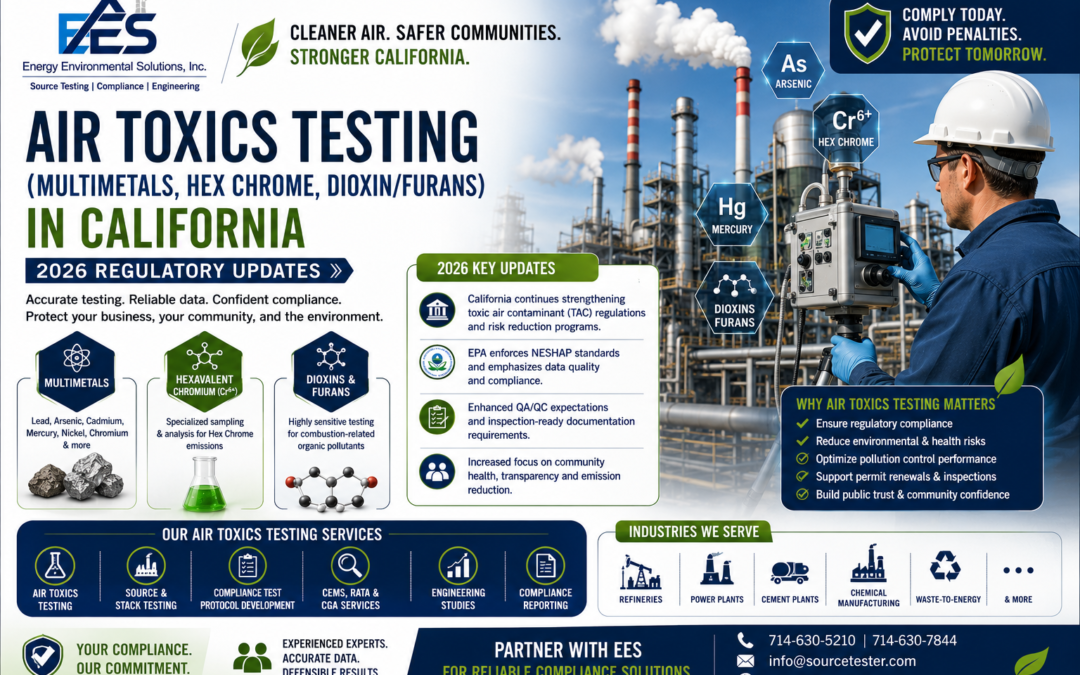
Air Toxics Testing in California: Multimetals, Hexavalent Chromium & Dioxin/Furans — 2026 Compliance Guide
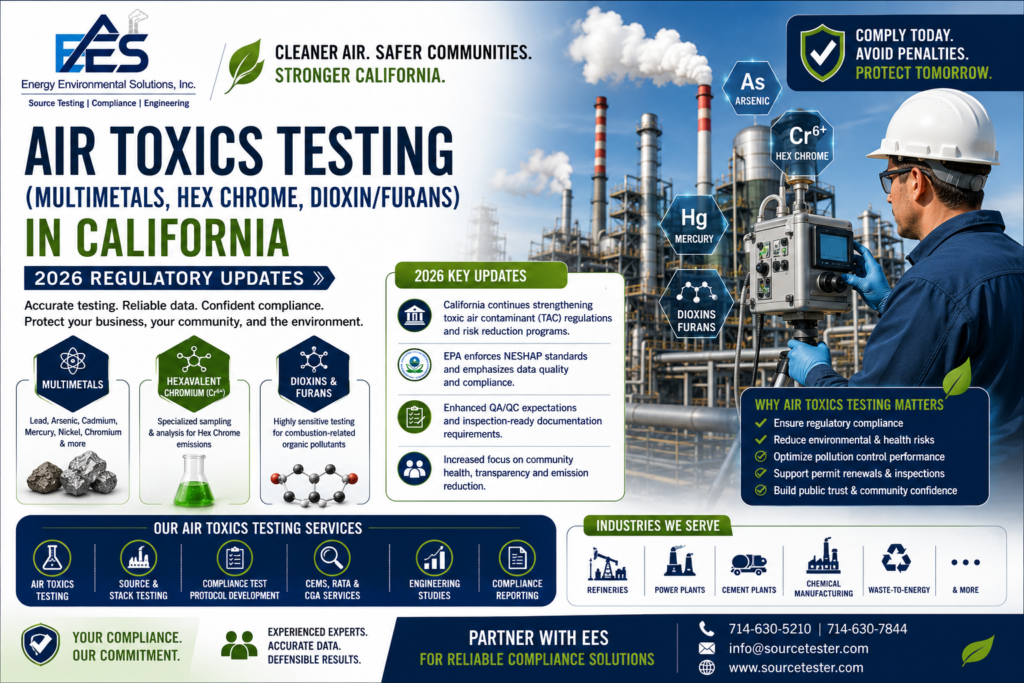
California continues to maintain one of the most comprehensive air-toxics regulatory frameworks in the United States. For facilities that emit or may emit toxic air contaminants (TACs), accurate emissions measurement is increasingly important for permitting, compliance demonstrations, health-risk assessments and regulatory reporting.
For industrial facilities, Air Toxics Testing can involve specialized testing for multimetals, hexavalent chromium (Hex Chrome), dioxins/furans and other toxic pollutants. The exact testing obligation depends on the facility’s permit, applicable air-district rules, source type, pollutant and regulatory program. CARB specifically notes that California compliance-testing requirements vary by local agency and may use CARB, U.S. EPA or other published test methods.
With regulatory activity continuing through 2026, now is an important time for facilities to review their air-toxics testing programs.
Why Is Air Toxics Testing Important in California?
Toxic air contaminants are different from ordinary criteria pollutants because the regulatory focus is strongly connected to potential human-health impacts.
California’s AB 1807 program established a framework for identifying and controlling toxic air contaminants. CARB describes the program as a two-step process involving risk identification and risk management.
California’s identified toxic-air-contaminant list includes substances such as:
- Hexavalent chromium
- Arsenic compounds
- Cadmium compounds
- Lead compounds
- Nickel compounds
- Mercury compounds
- Manganese compounds
- Dioxins and furans
- Benzene
- Formaldehyde
- Other toxic compounds
CARB’s current TAC information identifies hexavalent chromium and chlorinated dioxins/furans among substances for which no threshold level has been identified in its listing.
That is why reliable emissions data matters.
You cannot effectively manage what you have not accurately measured.
What Is Air Toxics Testing?
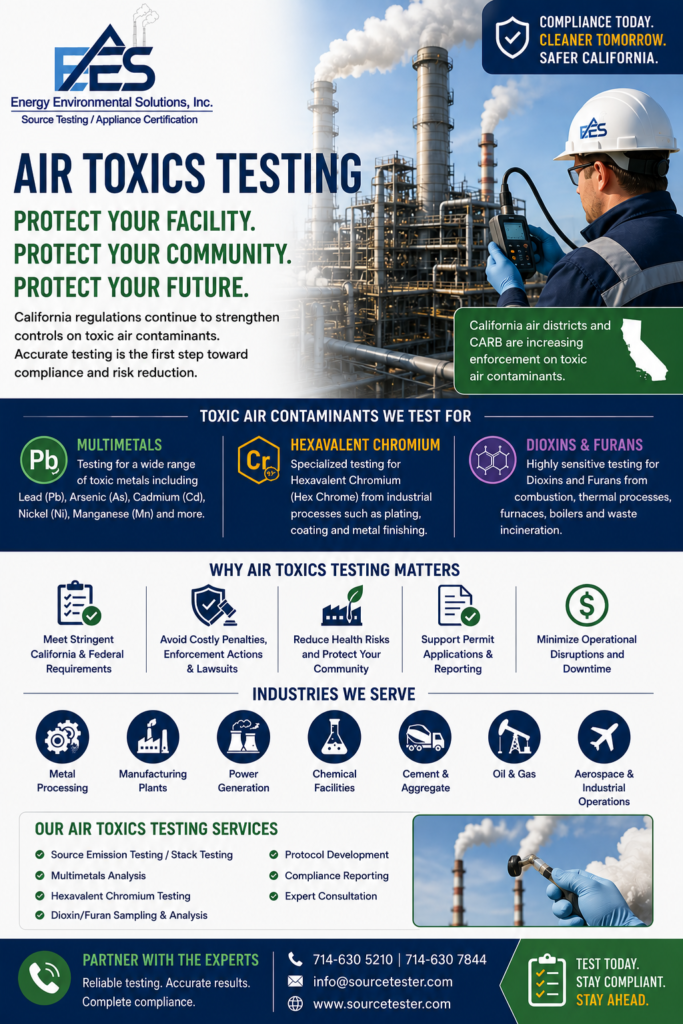
Air Toxics Testing is the measurement and laboratory analysis of hazardous or toxic pollutants emitted from an industrial process, combustion source, control device or other emission point.
Depending on the facility, testing can include:
Multimetals Testing
Measurement of multiple metals potentially present in industrial emissions, such as:
- Arsenic
- Cadmium
- Chromium
- Lead
- Nickel
- Manganese
- Mercury
- Antimony
- Beryllium
- Cobalt
- Selenium
- Other regulated metals
Hexavalent Chromium Testing
Specialized measurement of Cr(VI) emissions from applicable chromium-related processes.
Dioxin/Furan Testing
Measurement of chlorinated dioxins and furans, which can be associated with certain combustion and industrial processes.
CARB identifies dioxins as toxic air contaminants and notes that they can originate from waste incineration, some chemical manufacturing and other industrial sources that burn fuel.
2026 California Air Toxics Regulatory Updates
1. South Coast AQMD Is Updating Toxic-Air-Contaminant Requirements
One of the most important 2026 developments is continued work on Proposed Amended Rule 1401 — New Source Review of Toxic Air Contaminants.
South Coast AQMD’s 2026 rulemaking materials show workshops and draft rule language during 2026, with proposed changes addressing new toxic air contaminants identified by California’s Office of Environmental Health Hazard Assessment and revisions to health values for existing compounds.
What does this mean for facilities?
A pollutant that previously received little attention could become more important when:
Toxicity information changes → health values change → risk calculations change → permitting/testing requirements may change.
Facilities should therefore avoid assuming that an old emissions profile automatically represents today’s regulatory requirements.
2. Rule 1469 and Hexavalent Chromium Requirements Have Become More Stringent
Hexavalent chromium remains one of California’s most closely scrutinized toxic air contaminants.
South Coast AQMD amended Rule 1469 — Hexavalent Chromium Emissions from Chromium Electroplating and Chromic Acid Anodizing Operations on December 5, 2025. The rule incorporates more stringent requirements associated with CARB’s Chromium ATCM, including lower emission limits and increased source-testing requirements for applicable operations.
South Coast AQMD’s regulatory advisory states that beginning January 1, 2026, functional chrome-plating facilities face more stringent requirements, including lower limits for applicable Tier III tanks and source testing every two years for Tier III tanks.
This makes Hex Chrome source testing particularly important for applicable chrome-plating and chromic-acid-anodizing facilities.
3. Source-Test Protocols Are Becoming More Important
For applicable Rule 1469 facilities, the source-testing process isn’t simply a matter of showing up with sampling equipment.
South Coast AQMD’s Rule 1469 materials specify situations where a source-test protocol must be submitted in advance. For certain Tier III tanks beginning January 1, 2026, the protocol must be submitted at least 60 days before the first applicable source test for approval.
That means facilities need to think about:
Rule review → protocol development → agency submission → approval → testing → laboratory analysis → report
Waiting until the last minute can create avoidable scheduling and compliance problems.
4. Air Toxics “Hot Spots” Activity Continues in 2026
California’s AB 2588 Air Toxics “Hot Spots” Program remains an important part of the regulatory landscape.
South Coast AQMD’s current 2026 AB 2588 activity includes approved health-risk assessments, facility public-notification activity and updated guidance documents. The District lists, for example, a January 2026 update to its emission-factor reference-source template and 2026 health-risk-assessment activity.
For facilities subject to AB 2588 requirements, emissions information can ultimately feed into health-risk assessments and risk-management decisions.
This is another reason why reliable source-test data is valuable.
Multimetals Testing: Why It Matters
Industrial processes can release several metals simultaneously.
A facility might not have a compliance concern involving only one metal. Depending on the source and applicable requirements, the emissions profile could contain multiple regulated metals.
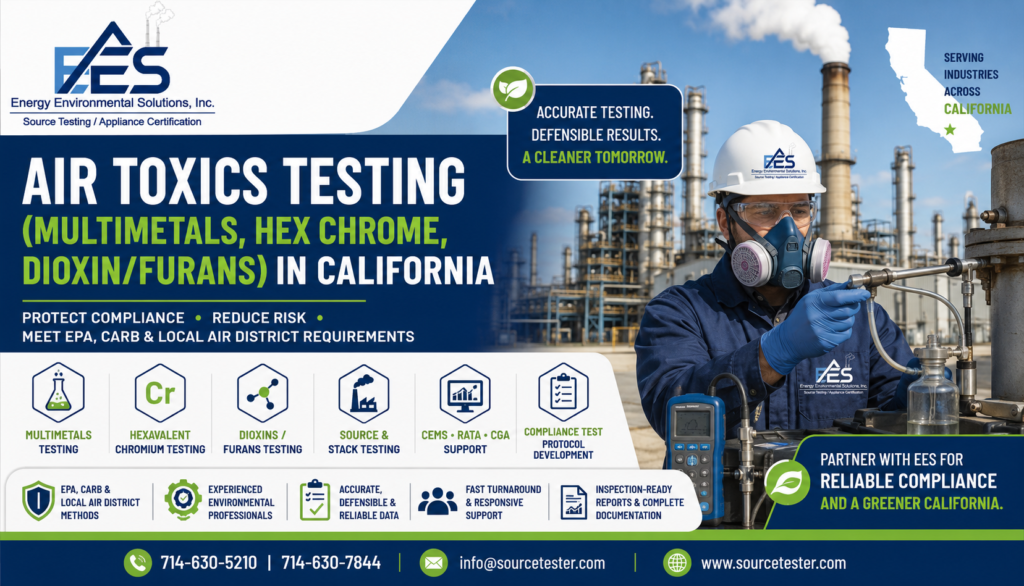
Multimetals testing can therefore provide a more comprehensive picture of emissions.
Potential applications include:
- Metal processing
- Metal melting
- Foundries
- Plating
- Aerospace manufacturing
- Welding-related operations
- Chemical manufacturing
- Waste processing
- Combustion processes
- Manufacturing operations
- Industrial furnaces
South Coast AQMD’s Regulation XIV contains multiple rules addressing toxic and non-criteria pollutants, including metal-related rules and Rule 1469 for hexavalent chromium.
Hexavalent Chromium Testing
Hexavalent chromium, commonly written as Cr(VI) or Hex Chrome, deserves special attention.
It can be associated with processes including:
- Hard chrome plating
- Decorative chrome plating
- Chromic acid anodizing
- Certain chromium-containing coating operations
- Other applicable industrial processes
The regulatory environment around chrome operations has tightened.
South Coast AQMD’s 2025 Rule 1469 amendment incorporated the state’s more stringent chromium requirements, including phase-out provisions, lower emission limits and more frequent source testing for applicable operations.
If your facility handles chromium, don’t rely on an old testing schedule without checking the current rule.
Dioxin & Furan Testing
Dioxins and furans are another category where specialized testing is essential.
CARB explains that dioxins can be produced through certain combustion activities and chemical manufacturing processes and identifies dioxins as toxic air contaminants.
Potentially relevant sources can include:
- Waste combustion
- Incineration
- Certain thermal processes
- Chemical manufacturing
- Industrial combustion
- Certain metal-processing activities
- Other processes identified by the applicable regulatory program
Dioxin/furan testing generally requires highly specialized sampling and laboratory analysis.
This is not a routine emissions test.
The sampling, sample handling, analytical procedures and quality-control requirements must be carefully planned.
What Can a Professional Air Toxics Test Evaluate?
Depending on the applicable regulation and test method, a testing program may evaluate:
| Testing Category | Examples |
|---|---|
| Multimetals | Arsenic, lead, cadmium, chromium, nickel, manganese |
| Hex Chrome | Cr(VI) emissions |
| Dioxins/Furans | Chlorinated dioxin and furan compounds |
| Particulate-Associated Metals | Metals captured on particulate sampling media |
| Combustion Toxics | Pollutants associated with combustion sources |
| Other TACs | Facility-specific toxic air contaminants |
The actual pollutant list should be determined from the applicable permit, rule and testing requirement.
Pros of Air Toxics Testing
1. Stronger Compliance Documentation
Testing produces measured emissions data that can support compliance demonstrations and regulatory reporting.
2. Better Risk Assessment
Accurate emissions data can be important when evaluating potential health risks.
3. Early Problem Identification
Testing can reveal unexpected emissions before they develop into a larger compliance issue.
4. Better Pollution-Control Performance Evaluation
Testing can help determine whether an air-pollution-control device is achieving its intended performance.
5. Improved Regulatory Preparedness
Facilities that maintain current emissions information are better positioned to respond to permit modifications and regulatory changes.
6. Greater Confidence for Management
Facility managers can make decisions using measured data instead of assumptions or outdated emission factors.
Challenges and Cons of Air Toxics Testing
| Challenge | What It Can Mean for Facilities |
|---|---|
| Cost | Specialized testing and laboratory analysis can be expensive |
| Complexity | Toxic-air-contaminant methods can be technically demanding |
| Scheduling | Testing may need coordination with production |
| Downtime | Some tests require specific operating conditions |
| Protocol Requirements | Certain programs require advance protocol preparation/submission |
| Laboratory Requirements | Applicable rules may require qualified or approved laboratories |
| Corrective Action | Elevated results may require investigation or additional testing |
South Coast AQMD operates a Laboratory Approval Program under which independent laboratories/source-testing firms are evaluated method-by-method for personnel, equipment, documentation, QA and related criteria.
Why Choosing the Right Testing Company Matters
Air toxics testing is not simply about collecting a sample.
The complete process can involve:
Regulatory Review
↓
Test Protocol Development
↓
Sampling Plan
↓
Field Testing
↓
Sample Handling
↓
Laboratory Analysis
↓
QA/QC Review
↓
Engineering Calculations
↓
Compliance Report
A mistake at any stage can affect the usefulness of the final results.
That’s why industrial facilities should work with an experienced environmental testing provider familiar with California air-district requirements and source-testing procedures.
How EES Helps Industries With Air Toxics Testing
Energy Environmental Solutions, Inc. (EES) can help industrial facilities manage specialized air-toxics testing programs.
1. Multimetals Testing
EES can support testing programs for applicable metal emissions, including multi-metal analysis.
2. Hex Chrome Testing
For applicable chromium-related operations, EES can support hexavalent chromium emissions testing and associated compliance programs.
3. Dioxin/Furan Testing
EES can support specialized testing programs involving dioxins and furans for applicable industrial sources.
4. Test Protocol Development
Before testing begins, EES can help develop a protocol addressing:
- Applicable regulations
- Sampling methods
- Sampling locations
- Operating conditions
- Analytical methods
- QA/QC
- Reporting requirements
5. Source Testing
EES can coordinate and perform applicable source-testing services based on the requirements of the relevant air district and permit.
6. Laboratory Coordination
Specialized air-toxics testing requires appropriate analytical capabilities. EES can coordinate applicable laboratory analysis and documentation.
7. Compliance Reporting
The final objective isn’t just a laboratory result.
It is a defensible compliance record.
8. Regulatory Support
EES can help facilities understand how their testing program fits within applicable California air-quality requirements.
Industries That May Need Air Toxics Testing
Potential clients include:
- Metal Plating Facilities
- Chrome Plating Facilities
- Aerospace Manufacturers
- Metal Fabrication Facilities
- Foundries
- Chemical Manufacturers
- Waste Processing Facilities
- Industrial Combustion Facilities
- Manufacturing Plants
- Coating Operations
- Refineries
- Power Generation Facilities
- Thermal Processing Facilities
- Incineration Operations
- Other Facilities Subject to TAC Requirements
CARB’s Air Toxics Tool notes that different industries can be associated with different toxic pollutants and that the listed substances are not necessarily a complete list for every industry.
2026 Air Toxics Compliance Checklist
Before your next test, ask:
☑ What toxic pollutants could my source emit?
☑ What does my current permit require?
☑ Does my air district require source testing?
☑ Is multimetals testing required?
☑ Is Hex Chrome testing applicable?
☑ Are dioxin/furan emissions relevant to my process?
☑ Is a source-test protocol required?
☑ Does the protocol require advance agency approval?
☑ Is a qualified/approved laboratory required?
☑ Is my previous test still representative?
☑ Has the equipment or production process changed?
☑ Have applicable rules changed for 2026?
Why You Should Not Wait Until the Testing Deadline
Imagine discovering two weeks before your regulatory deadline that:
- Your sampling ports need modification.
- Your old protocol is no longer appropriate.
- The applicable test method has changed.
- Your laboratory needs advance scheduling.
- Your facility cannot achieve the required operating condition.
- The air district requires advance protocol submission.
Now your testing deadline becomes a business problem.
Early planning turns regulatory pressure into a manageable project.
For specialized testing such as Hex Chrome or Dioxin/Furan, advance coordination is especially important.
Why 2026 Is the Right Time to Review Your Air Toxics Program
California’s toxic-air-contaminant regulatory environment continues to evolve.
South Coast AQMD’s 2026 rulemaking schedule includes activity surrounding Rule 1401, toxic-air-contaminant health values and additional toxic-emission controls.
At the same time, Rule 1469 requirements for applicable chromium operations have become more stringent, with increased attention to source testing.
The practical takeaway for facility owners and EHS managers is simple:
Don’t manage today’s emissions with yesterday’s compliance assumptions.
Review your:
Permit + Rules + Equipment + Testing Schedule + Test Methods + Emissions Data
Turn Air Toxics Compliance Into a Competitive Advantage
Compliance is often treated as a cost.
But smart companies can look at it differently.
Reliable emissions testing can help you:
Identify problems early → improve process control → reduce compliance uncertainty → maintain better records → respond faster to regulatory changes
That’s a much stronger position than waiting for an inspection or regulatory deadline.
Need Air Toxics Testing in California?
EES Can Help
Energy Environmental Solutions, Inc. (EES) provides specialized environmental testing and compliance support for industrial facilities.
Services include:
Multimetals Testing
Hexavalent Chromium Testing
Dioxin/Furan Testing
Air Toxics Testing
Source Testing
Stack Testing
Test Protocol Development
NOx Testing
VOC Testing
PM10 / PM2.5 Testing
Total Particulate Matter Testing
Boiler Testing
Thermal Oxidizer Testing
RTO Testing
Destruction Efficiency Testing
CEMS / RATA / CGA
Compliance Reporting
Measure Toxic Emissions. Verify Compliance. Protect Your Facility.
Energy Environmental Solutions, Inc. (EES)
Phone: 714-630-5210 | 714-630-7844
Email: info@sourcetester.com
Website:sourcetester.org