Rule 1147 Compliance in California: NOx Testing, CO Testing & Source Testing Requirements
Is your combustion equipment ready for South Coast AQMD Rule 1147 compliance?
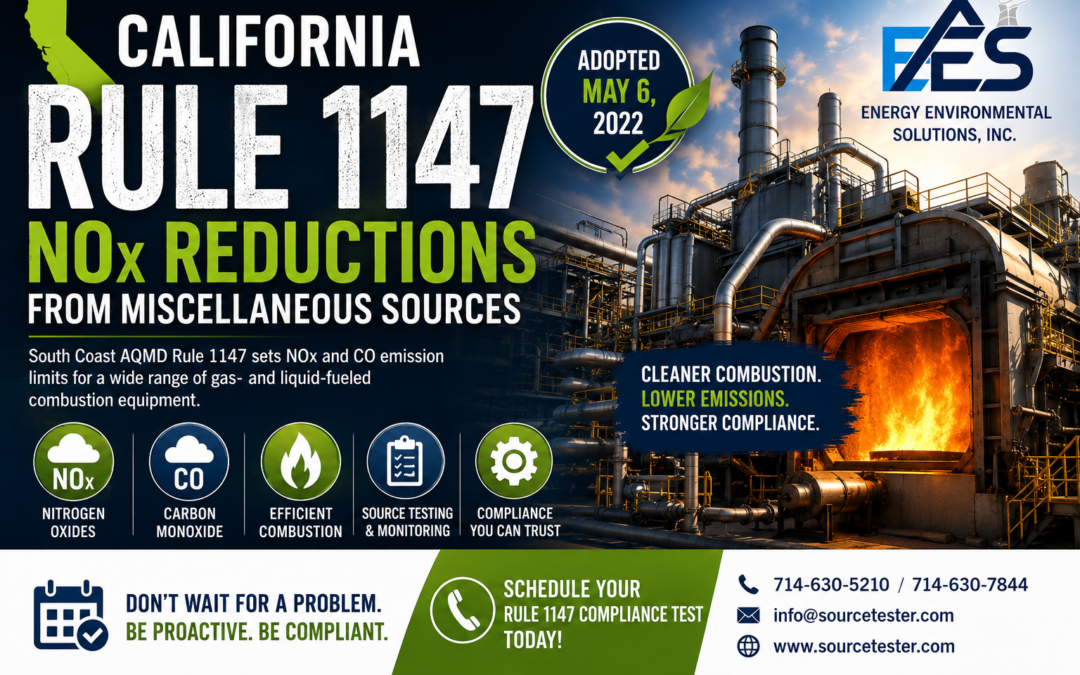
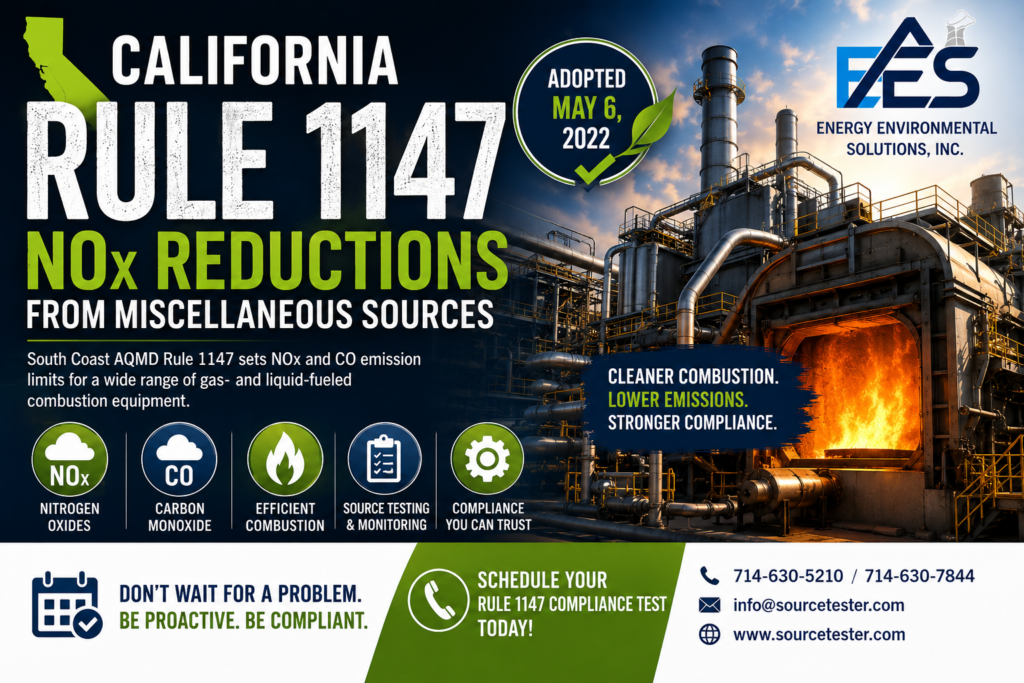
If your facility operates permitted gas- or liquid-fueled combustion equipment that is not covered by another Regulation XI rule, South Coast AQMD Rule 1147 – NOx Reductions from Miscellaneous Sources may apply to your equipment. The rule is designed to reduce NOx emissions while limiting CO emissions.
For manufacturers, industrial facilities, commercial operations, environmental managers and plant owners, understanding Rule 1147 is important because compliance can involve emission limits, source testing, monitoring, combustion-system maintenance, recordkeeping and permit requirements.
Important: Rule 1147 is a South Coast AQMD rule, not a uniform statewide California requirement.
What Is Rule 1147?
Rule 1147 – NOx Reductions from Miscellaneous Sources applies to manufacturers, distributors, retailers, installers, owners and operators of gaseous- and/or liquid-fueled combustion equipment that requires a South Coast AQMD permit when another Regulation XI rule does not apply.
The current adopted rule was amended May 6, 2022.
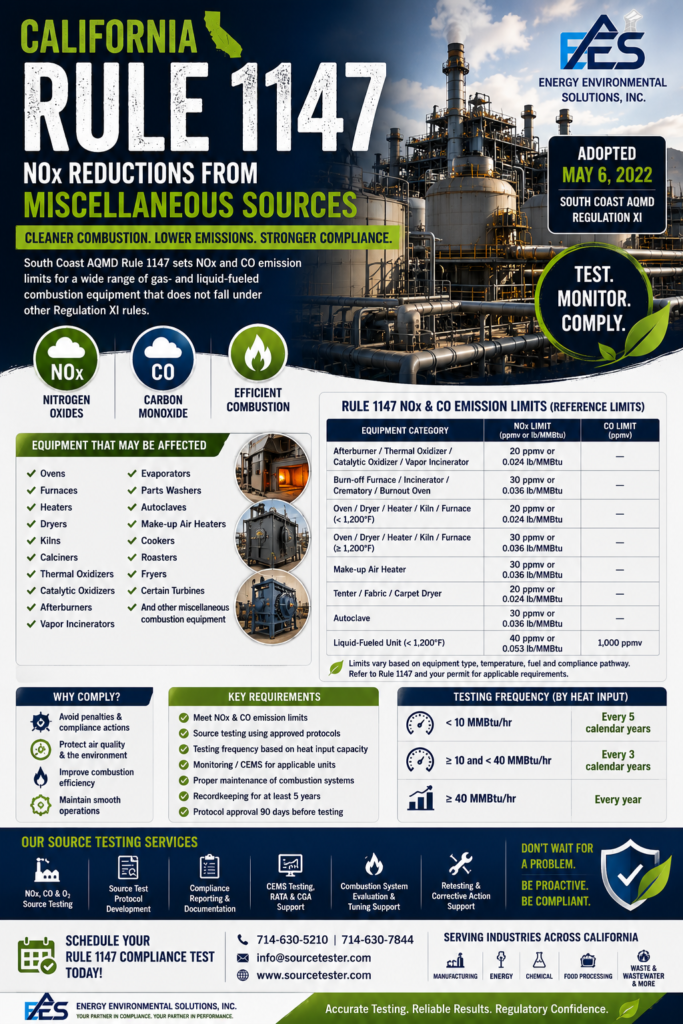
Rule 1147 can cover a wide range of equipment, including:
Ovens
Dryers
Heaters
Furnaces
Kilns
Calciners
Cookers
Roasters
Heated tanks
Thermal oxidizers
Catalytic oxidizers
Afterburners
Vapor incinerators
Evaporators
Fryers
Parts washers
Autoclaves
Make-up air heaters
Certain turbines
Other miscellaneous combustion equipment
The exact applicability depends on the equipment, permit status, fuel, heat-input rating and whether another South Coast AQMD rule applies.
Why Rule 1147 Matters to California Industries
NOx emissions contribute to ozone and other air-quality problems. Rule 1147 establishes emission requirements intended to reduce NOx from combustion sources while also establishing CO limits for applicable equipment.
For businesses, compliance is not simply about having a permitted burner.
You need to demonstrate that applicable equipment continues to meet the required emission limits under the applicable compliance pathway.
2026 Rule 1147 Update: What Businesses Need to Know
The major regulatory change remains the May 6, 2022 amendment, which introduced updated NOx and CO limits, implementation schedules, monitoring/source-testing requirements, revised exemptions and provisions affecting both RECLAIM and non-RECLAIM facilities.
South Coast AQMD’s current official rule book lists Rule 1147 as amended May 6, 2022.
South Coast AQMD also provides a Rule 1147 Guidance Document dated March 7, 2025, which explains applicability, implementation schedules and source-testing requirements.
What does this mean in 2026?
Facilities should not rely on an old compliance checklist.
Your team should verify:
Current Rule + Current Permit + Equipment Age + Rated Heat Input + Previous Test Date + Applicable Compliance Schedule
Which Equipment Can Be Affected?
Rule 1147 has a broad equipment scope.
Examples include:
🔥 Industrial Heating Equipment
Furnaces
Heaters
Ovens
Dryers
Kilns
Calciners
Roasters
🏭 Process Equipment
Heated process tanks
Evaporators
Parts washers
Autoclaves
Cookers
🌡️ Air & Pollution-Control Equipment
Make-up air heaters
Thermal oxidizers
Catalytic oxidizers
Afterburners
Vapor incinerators
⚡ Other Combustion Equipment
Certain turbines and miscellaneous gas- or liquid-fired units may also fall within the rule.
Equipment Below 325,000 BTU/hr
One important exemption is that Rule 1147 does not apply to units with a heat-input rating below 325,000 Btu/hr, subject to the rule’s other provisions. Charbroilers and food ovens are also specifically excluded.
This is one reason a facility should perform an equipment-by-equipment applicability review rather than assuming every combustion device is regulated identically.
Rule 1147 NOx & CO Limits
The rule uses different emission limits depending on:
Equipment category
Fuel type
Process temperature
Equipment age/status
Applicable compliance schedule
For example, Table 2 includes requirements such as:
These are reference examples from Table 2, not a substitute for determining the limit applicable to a particular unit.
The “Less Than 1 Pound of NOx Per Day” Option
One of the important Rule 1147 compliance pathways allows an owner/operator to elect to demonstrate that NOx emissions are less than one pound per day averaged over a calendar month, subject to the rule’s requirements.
This can involve a non-resettable totalizing time meter or fuel meter and prescribed operating/fuel-use limits.
For example, the rule provides monthly operating-hour limits based on rated heat input for certain units:
Below 1 MMBtu/hr: 240 hours/month
1 to below 1.5 MMBtu/hr: 160 hours/month
1.5 to 2 MMBtu/hr: 120 hours/month
The actual compliance pathway must be evaluated against the rule and facility conditions.
Rule 1147 Source Testing Requirements
This is where professional emissions testing becomes particularly important.
Rule 1147 requires applicable compliance determinations to use a South Coast AQMD-approved source-test protocol and test under specified operating conditions. Testing generally uses a period of at least 15 minutes and no more than 60 consecutive minutes, unless an alternative period is approved.
Testing must be performed after startup and at the unit’s normal firing rate.
For specified equipment categories, an additional compliance determination may be required at low heat input or during a specified period after startup.
Source-Test Protocol: A Critical Step
Don’t wait until the testing date to think about the protocol.
Rule 1147 requires the source-test protocol to be submitted to the Executive Officer for approval no later than 90 days before the scheduled source test.
Typical process:
Rule Review
↓
Equipment Review
↓
Test Protocol Development
↓
Protocol Submission
↓
Regulatory Approval
↓
Field Testing
↓
Data Analysis
↓
Compliance Report
This is one reason early scheduling is important.
Required Testing Frequency
For applicable units with NOx emissions ≥1 pound/day, Rule 1147 establishes source-testing frequencies based on rated heat input capacity:
Units <10 MMBtu/hr
Every 5 calendar years
Units ≥10 and <40 MMBtu/hr
Every 3 calendar years
Units ≥40 MMBtu/hr
Every calendar year
The rule also establishes minimum intervals between tests and special provisions for units that have been shut down for extended periods.
This makes one thing clear:
Knowing your last test date is not enough.
You need to know the rated heat input and applicable compliance category.
Who Can Conduct Rule 1147 Testing?
Rule 1147 requires applicable compliance determinations to be performed using an independent contractor approved by the Executive Officer under the Laboratory Approval Program for the applicable test methods.
This is an important consideration when selecting a testing company.
Before scheduling your test, verify:
Appropriate test-method approval
Qualified personnel
Proper instrumentation
Calibration procedures
QA/QC
South Coast AQMD experience
Reporting capability
What Is Tested?
Depending on the equipment and compliance pathway, testing can involve:
NOx
The primary pollutant targeted by Rule 1147.
CO
Rule 1147 also establishes CO requirements for applicable equipment.
Oxygen
O₂ measurements are used in applicable emission calculations and correction procedures.
Carbon Dioxide
CO₂ may also be measured as part of applicable source-test procedures.
South Coast AQMD Method 100.1 and Method 10.1 are among the methods identified in Rule 1147 for applicable compliance determinations.
Rule 1147 Maintenance Requirements
Testing alone is not enough.
Rule 1147 requires owners/operators to perform combustion-system maintenance according to the manufacturer’s schedule and specifications and maintain the relevant records.
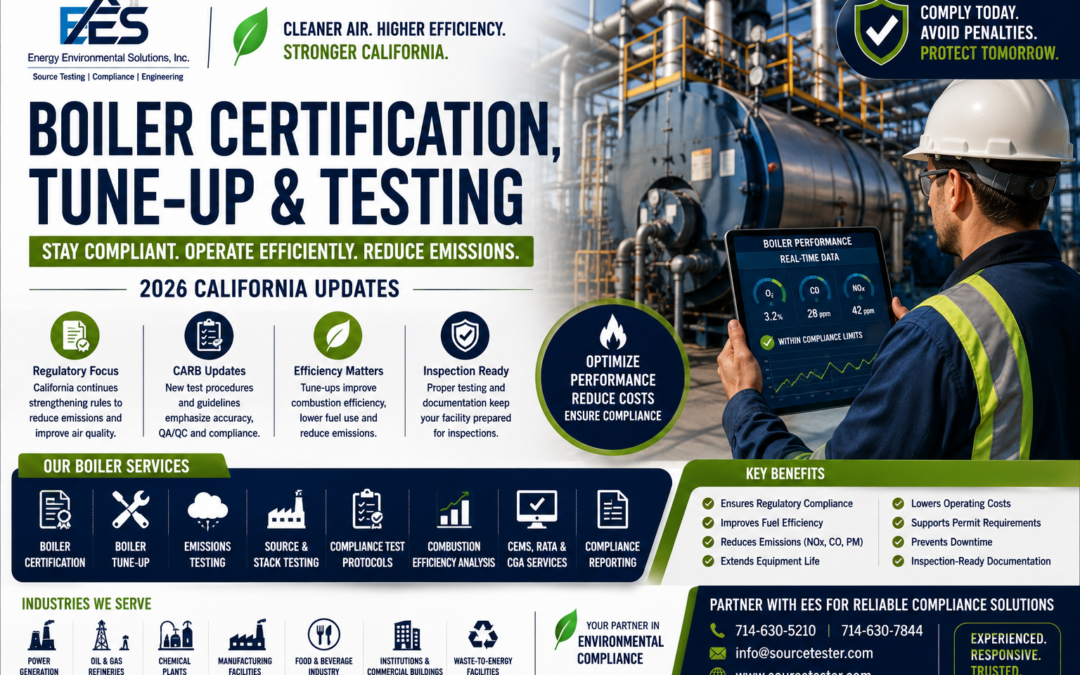
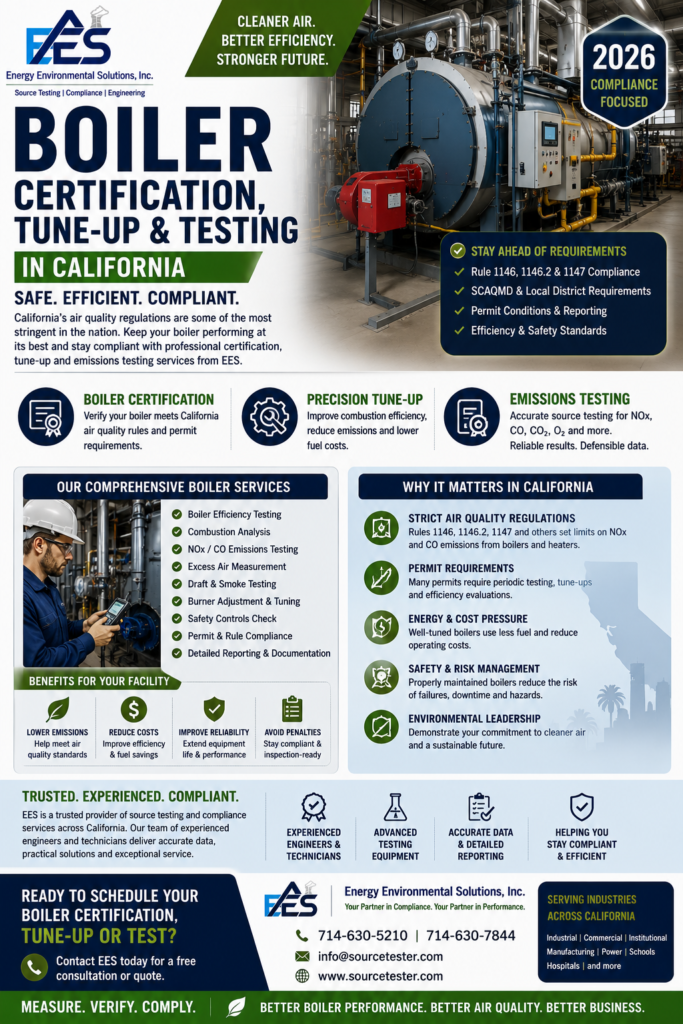
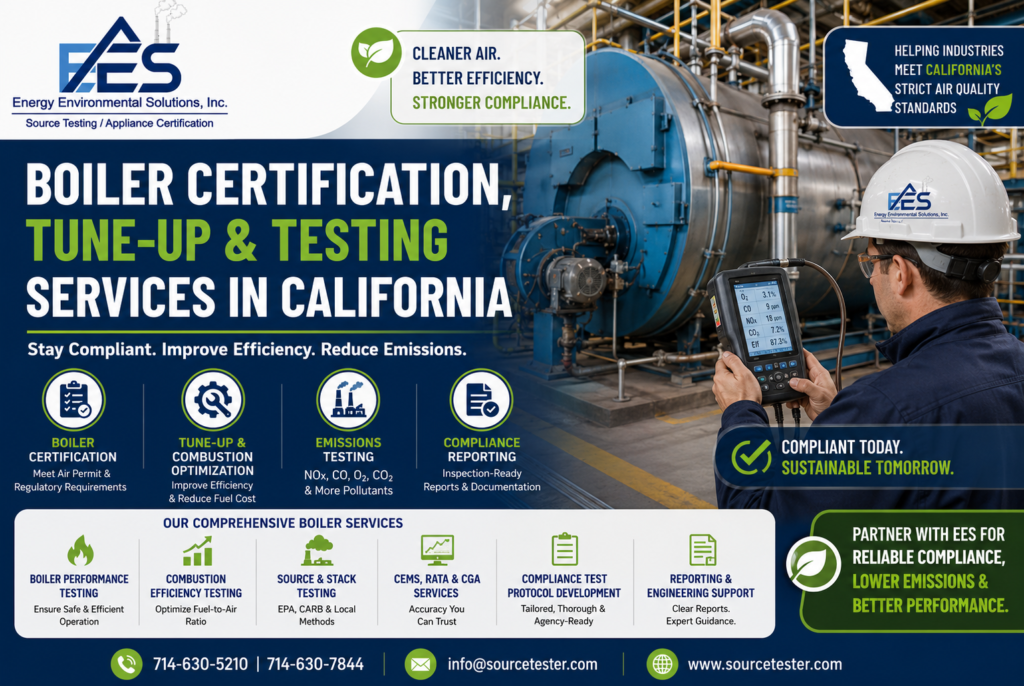
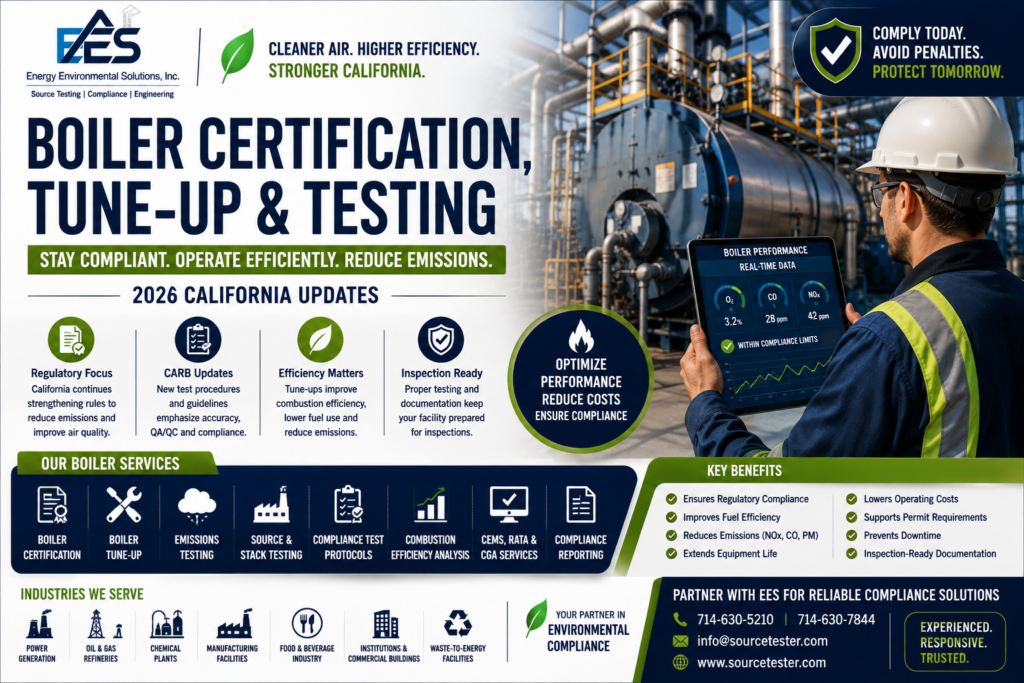
Boiler Certification, Tune-Up & Testing in California: 2026 Compliance Guide for Industrial & Commercial Facilities
Is your boiler operating efficiently—and is it meeting California air-quality requirements?
For industrial, institutional and commercial facilities, boiler compliance is more than keeping equipment running. Depending on the boiler size, fuel, location, permit and applicable air district rules, facilities may need certification, periodic tune-ups, emissions testing, recordkeeping and other compliance activities.
In Southern California, South Coast AQMD Rules 1146, 1146.1 and 1146.2 are particularly important for boilers, steam generators, process heaters and certain water heaters. South Coast AQMD’s current rule book lists Rule 1146 as amended in 2020, Rule 1146.1 as amended in 2018, and Rule 1146.2 as amended in 2024.
For facility owners and EHS managers, the key question is not simply:
“Does my boiler work?”
It is:
“Can my boiler demonstrate compliance with the applicable air-quality requirements?”
This is where professional Boiler Certification, Tune-Up and Testing services become valuable.
What Is Boiler Certification, Tune-Up & Testing?
These are related but different compliance activities.
Boiler Certification
Certification generally involves demonstrating that applicable equipment meets the requirements of the governing air-district rule or certification program.
For example, South Coast AQMD maintains a Certified Boilers List under Rule 1146.2, with the current equipment list updated December 30, 2025.
Boiler Tune-Up
A tune-up evaluates and adjusts combustion performance to help the boiler operate properly while controlling emissions.
Boiler Emissions Testing
Testing measures actual emissions—such as NOx, CO and oxygen—using the applicable regulatory test method.
NOx is particularly important because it contributes to ozone and smog formation.
South Coast AQMD states that combustion sources are among the sources of NOx emissions in the region, and its Rule 1146.2 amendments were designed to achieve significant NOx reductions.
For businesses, this means boiler operation can have both:
Facilities operating older boilers should therefore monitor rule developments rather than assuming today’s requirements will remain unchanged.
Boiler Testing Company
2026 Update: Rule 1146.2 Has Important Zero-Emission Requirements
South Coast AQMD amended Rule 1146.2 on June 7, 2024, establishing a transition toward zero-emission equipment for certain water heaters, boilers and process heaters.
A major 2026 milestone is:
January 1, 2026
South Coast AQMD’s 2026 compliance-deadline guidance states that certain Type 1 units ≤400,000 Btu/hr and qualifying instantaneous water heaters ≤200,000 Btu/hr installed in new buildings must comply with zero-emission limits.
The practical implication is significant:
Boiler and water-heating equipment planning is changing.
Facilities installing or replacing equipment should evaluate applicable requirements before purchasing equipment, rather than discovering a compliance issue after installation.
What Does a Boiler Tune-Up Actually Do?
A professional tune-up focuses on combustion performance.
Depending on the equipment and applicable rule, the process can include checking:
Fuel-to-air ratio
Oxygen concentration
Carbon monoxide
Stack temperature
Flame condition
Burner operation
Draft
Combustion-air supply
Fuel pressure
Operating load
Control settings
South Coast AQMD’s Rule 1146 tuning procedures specifically address operating the equipment at a representative firing rate and recording combustion parameters such as stack temperature, oxygen and CO.
For example, poor combustion can contribute to elevated CO or inefficient operation.
Too much excess air can also reduce combustion efficiency.
Too little combustion air can create incomplete combustion and elevated CO.
A properly performed tune-up seeks an appropriate combustion balance while maintaining safe operation.
South Coast AQMD’s tuning procedures explicitly state that tuning must not create unsafe conditions or violate applicable safety requirements, manufacturer specifications or other relevant regulations.
When Is Boiler Tune-Up Required?
This depends on the applicable rule and the specific unit.
For example, Rule 1146.1 contains a tune-up option for certain qualifying units with annual heat input of 18,000 therms or less. Units using this option must be tuned at least twice per year, at intervals of four to eight months, according to the prescribed or manufacturer’s procedure, with records maintained for a rolling 24-month period.
That does not mean every California boiler requires two tune-ups every year.
This distinction is important.
The applicable:
Rule + Unit Size + Fuel + Operating History + Permit
determine what is required.
Boiler Emissions Testing: What Is Measured?
Depending on the applicable regulatory requirement, testing may include:
NOx
Nitrogen oxides are a major regulatory focus for combustion equipment.
CO
Carbon monoxide helps evaluate combustion performance and may be subject to emission limits.
Oxygen
O₂ measurements can be used for combustion analysis and, depending on the rule, emissions corrections.
Other Parameters
Depending on the source, testing may also evaluate:
Stack temperature
Exhaust flow
Fuel consumption
Heat input
Operating load
Control-device parameters
Boiler Tune-Up Services
How Often Does a Boiler Need Emissions Testing?
There is no single California-wide testing interval.
The frequency depends on the applicable rule and equipment.
For example, South Coast AQMD Rule 1146 provides specific compliance-testing provisions. Under one provision, certain units at or above 10 MMBtu/hr have a three-year compliance determination interval, while certain units from 5 to below 10 MMBtu/hr have a five-year interval.
Other requirements may apply depending on the boiler category, compliance option and regulatory program.
Don’t assume your neighbor’s testing schedule applies to your boiler.
Boiler Certification vs. Boiler Testing
These terms are often confused.
Certification
Testing
Demonstrates equipment meets a certification requirement
Measures actual emissions
Often associated with specific equipment categories
Usually associated with operating equipment
Can apply to equipment models/configurations
Measures field performance
May be required before installation/operation
May be periodic
Documentation-based
Data/measurement-based
South Coast AQMD maintains certified equipment lists to help businesses identify equipment that meets applicable requirements. The current Rule 1146.2 certified-boiler list was updated December 30, 2025.
Why Boiler Testing Can Fail
A boiler doesn’t necessarily fail because it is mechanically broken.
Compliance problems can come from:
1. Incorrect Burner Settings
Improper combustion settings can increase emissions.
2. Excessive CO
Incomplete combustion can produce elevated CO.
3. Excess NOx
Combustion conditions may result in NOx above an applicable limit.
4. Poor Maintenance
Dirty burners, fouled surfaces or degraded components can affect combustion.
5. Incorrect Operating Conditions
A test performed under the wrong load or process conditions may not demonstrate compliance.
6. Aging Equipment
Older boilers may have difficulty meeting newer emissions requirements.
7. Inadequate Documentation
Even when equipment performs properly, missing records can create compliance complications.
The Cost of Ignoring Boiler Compliance
For a facility manager, a boiler compliance problem can quickly become an operational problem.
Potential consequences may include:
Failed emissions test
↓
Investigation
↓
Corrective maintenance
↓
Retesting
↓
Production disruption
↓
Additional engineering expense
↓
Possible regulatory enforcement
The exact consequences depend on the applicable air district, rule, permit and circumstances.
The smarter approach is preventive compliance.
Pros of Professional Boiler Certification, Tune-Up & Testing
✅ 1. Helps Demonstrate Regulatory Compliance
Measured data and proper documentation provide evidence of compliance with applicable requirements.
✅ 2. Improves Combustion Performance
A properly tuned boiler can operate more effectively.
✅ 3. Helps Identify Problems Early
Testing can reveal elevated emissions before they become a larger compliance issue.
✅ 4. Supports Better Maintenance Decisions
Testing data can help identify when burners, controls or other components need attention.
✅ 5. Reduces Compliance Surprises
A planned testing program is safer than waiting for a regulatory deadline.
✅ 6. Supports Equipment Planning
Testing can help determine whether an older boiler can continue operating within applicable limits.
Challenges / Cons
Professional testing also involves costs and planning.
Challenge
Potential Impact
Testing cost
Budget required
Tune-up cost
Technician/engineering expense
Production coordination
Boiler access may require scheduling
Retesting
Additional cost if results are unsatisfactory
Documentation
Requires organized recordkeeping
Regulatory changes
Existing equipment may face future requirements
Equipment upgrades
Older boilers may require modernization
But there is a difference between a compliance cost and an unexpected compliance crisis.
Planning usually gives a facility more options.
Which Industries Need Boiler Compliance Services?
Potential clients include:
Manufacturing
Food processing
Pharmaceutical manufacturing
Chemical manufacturing
Automotive
Aerospace
Textile
Paper
Plastics
Institutional
Hospitals
Universities
Schools
Government facilities
Commercial
Hotels
Large commercial buildings
Laundry facilities
Food-service operations
Industrial
Refineries
Industrial processing plants
Warehouses with process heating
Energy facilities
The exact requirements depend on the equipment and jurisdiction.
Boiler Tune-Up Services
Why Hospitals and Large Facilities Should Pay Special Attention
Hospitals, universities and large commercial buildings often rely heavily on boilers for:
Steam
Hot water
Heating
Sterilization
Laundry
Process applications
A boiler compliance issue can therefore affect more than emissions.
It can affect:
Operations + Energy Use + Maintenance + Compliance
This makes proactive testing particularly valuable.
How EES Helps With Boiler Certification, Tune-Up & Testing
A boiler test should not be treated as an isolated laboratory exercise.
Your testing company should understand:
The boiler → the combustion process → the air district → the rule → the test method → the compliance limit
That’s the difference between simply collecting emissions data and building a useful compliance program.
2026 Boiler Compliance Checklist
Before your next boiler test or tune-up, ask:
Is the boiler properly permitted/registered?
What is the rated heat-input capacity?
What fuel does it use?
Which California air district regulates the facility?
Which boiler rule applies?
Is certification required?
Is a tune-up required?
When was the last tune-up?
When was the last emissions test?
What are the applicable NOx limits?
What are the applicable CO requirements?
Is a source-test protocol required?
Is agency notification/approval required?
Are operating conditions specified?
Are records current?
Has the boiler or burner been modified?
Has the applicable rule changed?
2026: Why Facilities Should Review Their Boiler Compliance Program Now
The regulatory environment is moving toward lower-emission and zero-emission technologies.
South Coast AQMD’s 2026 rule-development work includes proposed amendments to Rules 1146 and 1146.1.
At the same time, Rule 1146.2 has already introduced significant zero-emission requirements for certain equipment categories, including requirements taking effect January 1, 2026.
This creates a strategic question for facility owners:
Should you continue maintaining the existing boiler, upgrade it, replace the burner, or transition to another technology?
Current emissions-testing data can help answer that question.
Don’t Wait for a Failed Boiler Test
A failed compliance test is often the worst time to start investigating your boiler.
Instead:
Test → Analyze → Tune → Verify → Document
This approach gives facility managers a better opportunity to identify problems before they become emergencies.
Need Boiler Certification, Tune-Up & Testing in California?
EES Can Help Your Facility Stay Ahead of Compliance Requirements
Rule 1147.1 in California 2026: Latest Updates, Pros, Cons & How EES Helps Aggregate-Drying Facilities
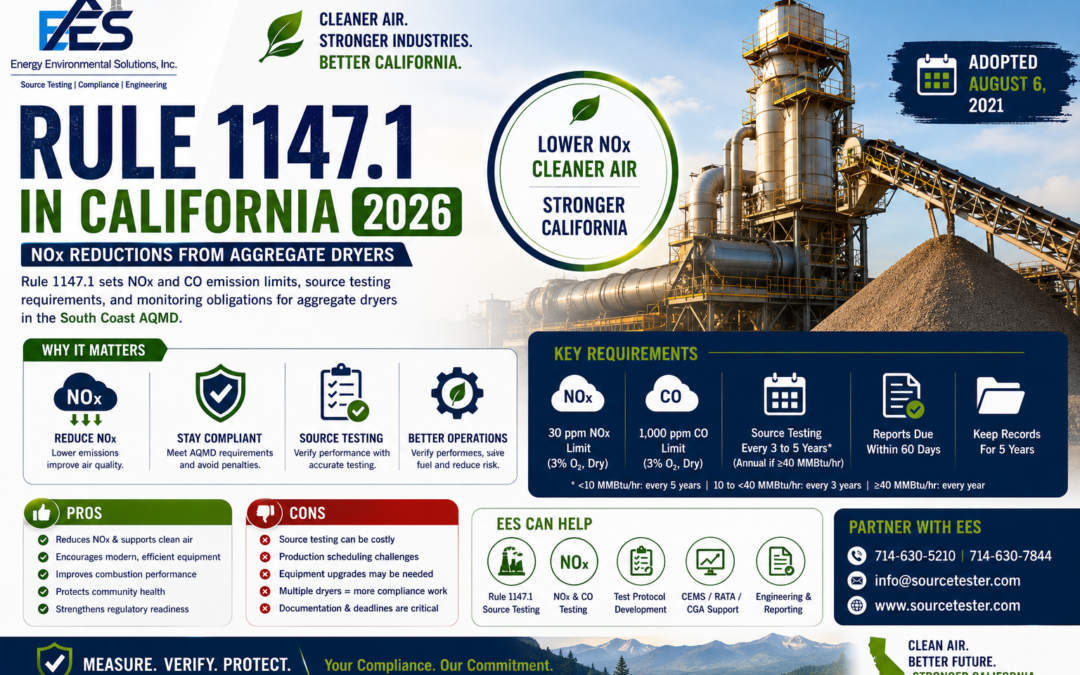
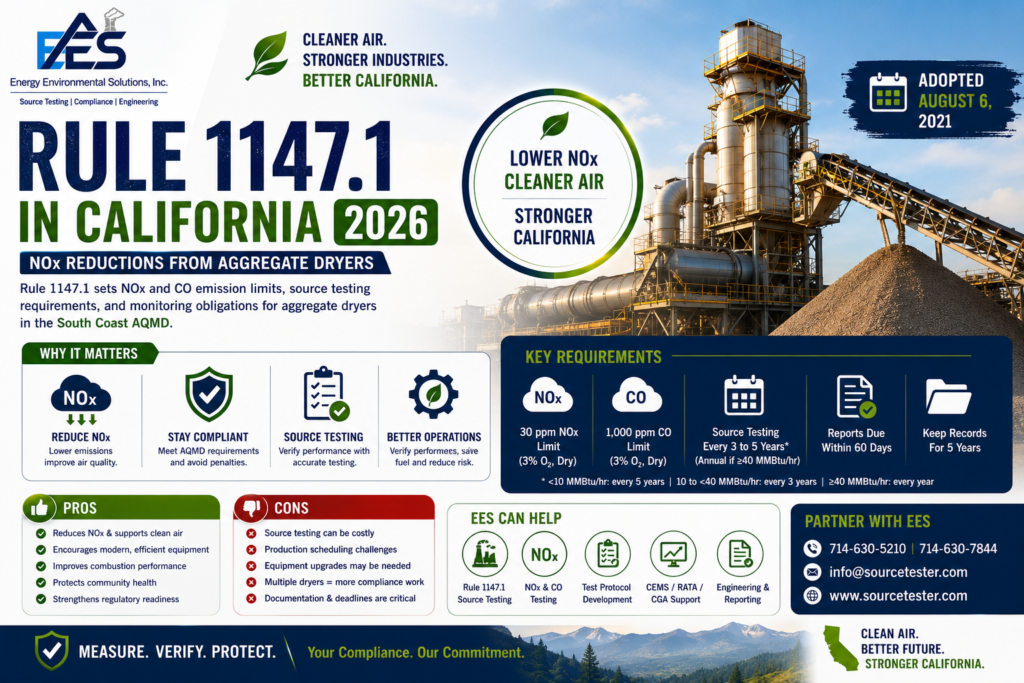
Rule 1147.1 — NOx Reductions from Aggregate Dryers is an important South Coast AQMD regulation affecting certain aggregate-drying operations in Southern California. The rule establishes NOx and CO emission limits, source-testing requirements, monitoring provisions, recordkeeping, and compliance obligations for applicable aggregate dryers.
For 2026, there is an important distinction to make: Rule 1147.1 is not a statewide California regulation. It is a South Coast AQMD rule that applies within the District’s jurisdiction when the equipment meets the rule’s applicability requirements. South Coast AQMD’s current Regulation XI rulebook identifies Rule 1147.1 as “NOx Reductions from Aggregate Dryers,” adopted August 6, 2021.
At the same time, South Coast AQMD’s current proposed-rules pages continue to list Proposed Rule 1147.1 among rules in the proposal process. The dedicated proposal page, however, contains rulemaking documents dating primarily from 2020–2021. Therefore, businesses should not interpret that listing alone as evidence that a new Rule 1147.1 amendment was adopted in 2026.
For aggregate producers, asphalt and construction-material facilities, and other operations using regulated dryers, the practical message is simple:
Know your applicable NOx limit, know your testing deadline, and verify that your aggregate dryer can demonstrate compliance.
Energy Environmental Solutions, Inc. (EES) can help facilities with Rule 1147.1 source testing, NOx testing, CO testing, compliance test protocol development, emissions measurements, CEMS/RATA support, engineering studies, QA/QC and regulatory reporting.
What Is Rule 1147.1?
Rule 1147.1 was adopted by the South Coast AQMD Governing Board on August 6, 2021. It specifically addresses NOx reductions from aggregate dryers and was created as part of South Coast AQMD’s broader strategy to transition NOx sources away from the RECLAIM trading program toward more direct, source-specific controls.
The rule applies to qualifying gaseous-fuel-fired aggregate dryers with more than 1 pound per day of NOx emissions and a rated heat-input capacity greater than 2 million Btu/hour, subject to the rule’s detailed applicability provisions and exemptions.
Aggregate dryers are used to remove moisture from materials such as sand, gravel, crushed stone and other aggregate products. Because the drying process commonly involves high-temperature combustion, the burners can generate NOx.
And here’s the important part:
The larger the combustion system and the higher its emissions, the more important compliance testing becomes.
Why Does Rule 1147.1 Matter in 2026?
NOx is a major air pollutant involved in the formation of ground-level ozone and particulate matter. Southern California has historically faced significant challenges meeting federal and state air-quality standards, so stationary combustion sources remain an important part of regional emission-reduction strategies.
South Coast AQMD specifically developed Rule 1147.1 to establish NOx and CO requirements for aggregate dryers at non-RECLAIM, RECLAIM and former-RECLAIM facilities, together with monitoring, reporting and recordkeeping provisions.
The District’s planning documents estimate that Rule 1147.1 contributes additional NOx reductions as part of the transition from RECLAIM to command-and-control requirements. One South Coast AQMD emissions-inventory document identifies an estimated 0.01 tons/day of NOx reduction by 2030 attributable to Rule 1147.1, with implementation beginning in 2025 and reductions continuing toward 2057.
So while Rule 1147.1 is not a brand-new 2026 regulation, its compliance requirements remain relevant.
Latest 2026 Rule 1147.1 Update: What Facilities Should Know
1. The Current Adopted Rule Is Still Dated August 6, 2021
South Coast AQMD’s current official Regulation XI listing identifies:
Rule 1147.1 — NOx Reductions from Aggregate Dryers Adopted: August 6, 2021
Unlike several other South Coast AQMD rules that received amendments in 2025 or 2026, the current rulebook does not identify a 2026 amendment to Rule 1147.1.
That is an important SEO and compliance point because online articles sometimes describe old proposed-rule documents as if they were new 2026 regulations.
For 2026, facilities should work from:
The currently adopted Rule 1147.1 + their current South Coast AQMD permit + any applicable compliance conditions.
2. Proposed Rule 1147.1 Still Appears on South Coast AQMD’s Proposal Page
There is an unusual point worth highlighting.
South Coast AQMD’s current Active Proposed Rules page lists Proposed Rule 1147.1.
However, the dedicated Rule 1147.1 proposal page presents the original rulemaking materials, including the August 6, 2021 Notice of Public Hearing, July 2021 draft language and 2021 staff documents.
Therefore, companies should be careful when reading search results about “new Rule 1147.1 updates.”
The safest interpretation in 2026 is:
Rule 1147.1 remains an adopted South Coast AQMD rule, while the District’s website also retains/list its proposed-rule project materials. There is no verified evidence in the current official rulebook that a new 2026 amendment has replaced the adopted August 2021 rule.
This distinction is particularly important when preparing a compliance test.
3. NOx and CO Limits Remain Central
Rule 1147.1 establishes a 30 ppm NOx limit and 1,000 ppm CO limit, corrected to 3% oxygen on a dry basis, for the applicable gaseous-fuel-fired aggregate dryers under the rule’s relevant provisions.
The rule also established interim requirements for certain facilities during implementation.
The 2021 adoption materials identify:
Requirement
Rule 1147.1 Provision
Primary NOx limit
30 ppm
CO limit
1,000 ppm
Oxygen correction
3% O₂, dry
Applicability threshold
>1 lb/day NOx
Rated heat-input threshold
>2 MMBtu/hr
Source testing
Required for applicable units
Large dryers ≥40 MMBtu/hr
Annual testing
The precise applicability and compliance pathway should always be confirmed against the current rule and permit.
4. Source Testing Frequency Depends on Dryer Size
One of the most important Rule 1147.1 requirements for facility managers is the periodic source-testing schedule.
The current rule provides different testing frequencies based on the aggregate dryer’s rated heat-input capacity.
Aggregate dryer below 10 MMBtu/hr
Source testing is required every 5 calendar years, with the rule restricting how early the subsequent test can occur.
Aggregate dryer ≥10 and <40 MMBtu/hr
Source testing is required every 3 calendar years, again subject to the minimum interval specified by the rule.
Aggregate dryer ≥40 MMBtu/hr
Source testing is required every calendar year.
For a large dryer that has not operated for at least six consecutive months, the rule also provides a provision allowing the source test to occur within 90 days after operations resume, subject to the rule’s conditions and fuel-use documentation.
Why This Matters for 2026
Imagine an aggregate dryer operating at 45 MMBtu/hr.
Its operator cannot treat compliance testing as something to think about every three or five years.
The applicable rule calls for annual source testing.
Now consider a facility operating several dryers of different sizes. The testing calendar can become complicated very quickly.
That is why environmental managers should maintain a centralized compliance schedule containing:
Equipment identification
Burner age
Rated heat input
Applicable NOx limit
Applicable CO limit
Last source-test date
Next source-test deadline
Permit conditions
Protocol approval
Test report submission date
Maintenance records
Missing a testing deadline can turn a technical compliance requirement into an operational problem.
5. Source-Test Reports Must Be Submitted
Rule 1147.1 requires source-test reports to be submitted to the Executive Officer within 60 days of completion of the test.
That means the project does not end when the field testing is complete.
The complete compliance cycle is:
Plan → Protocol → Test → QA/QC → Calculations → Report → Submission → Recordkeeping
A technically excellent field test can still create headaches if the final report is incomplete, inaccurate or submitted late.
6. Five-Year Recordkeeping Requirement
Rule 1147.1 requires source-test records to be maintained for five years and made available to South Coast AQMD personnel upon request.
This is especially important for companies with multiple facilities or multiple aggregate dryers.
Environmental records should not be scattered across emails, maintenance folders and individual computers.
A better approach is to maintain a centralized compliance file for every regulated unit.
7. Existing CEMS and Monitoring Systems Matter
Rule 1147.1 does not simply require every aggregate dryer to install a brand-new CEMS.
However, qualifying facilities with existing continuous in-stack emissions monitoring systems or equivalent verification systems must retain and operate them according to the applicable requirements.
The rule also allows certain other required testing or monitoring activities to satisfy a source-test requirement under specified conditions.
For example, qualifying:
Title V periodic monitoring/testing, or
RATA associated with CEMS
may be used to satisfy one instance of periodic source testing when the requirements of the rule are met.
This can potentially reduce duplicate testing—but only when the regulatory conditions are satisfied.
Rule 1147.1 Compliance: Pros
1. Reduces NOx Emissions
The biggest environmental advantage is straightforward: lower NOx emissions from aggregate-drying operations.
NOx reductions support South Coast AQMD’s broader efforts to improve regional air quality.
2. Encourages Modern Combustion Technology
Older burners can have substantially different emissions performance from newer low-NOx systems.
Rule 1147.1 creates an incentive for facilities to evaluate burner technology and combustion performance.
3. Provides Measurable Compliance
Instead of relying entirely on equipment specifications, source testing gives the facility actual emissions data.
4. Identifies Equipment Problems
Testing can uncover issues involving:
Burner performance
Combustion-air ratios
Fuel/air control
Temperature
Draft
Excess oxygen
Maintenance
Instrumentation
5. Improves Regulatory Documentation
A well-prepared test report provides evidence that the facility is monitoring its environmental performance.
6. Supports Long-Term Air-Quality Planning
South Coast AQMD’s Rule 1147.1 strategy is part of the District’s broader transition from RECLAIM to direct emissions limits.
Rule 1147.1 Compliance: Cons & Challenges
1. Source Testing Costs Money
Qualified source testing requires trained personnel, specialized instruments, calibration, field work, calculations and reporting.
2. Production Scheduling Can Be Difficult
Aggregate facilities cannot always stop or modify production simply to accommodate a test.
Testing must often occur under representative operating conditions.
3. Burner Replacement Can Be Expensive
Facilities with older burners may need to evaluate replacement or upgrades to maintain compliance.
4. Multiple Dryers Increase Complexity
A facility operating several aggregate dryers may have different:
Heat-input ratings
Burner ages
Permit conditions
Testing frequencies
Compliance deadlines
5. Compliance Data Must Be Defensible
Incorrect oxygen correction, sampling problems, calibration issues or unsuitable operating conditions can compromise a test.
6. Regulatory Interpretation Can Be Complex
Rule 1147.1 interacts with permits, monitoring requirements and the broader South Coast AQMD regulatory structure.
That is why facilities should not rely solely on a generic internet summary.
What Does an Aggregate Dryer Test Measure?
A Rule 1147.1 compliance test can involve measurement of NOx and CO, along with supporting measurements necessary to establish compliance under the applicable test method and permit.
Depending on the test protocol, testing may involve:
NOx concentration
CO concentration
Oxygen
Carbon dioxide
Stack gas conditions
Gas flow
Moisture
Fuel usage
Production rate
Dryer operating temperature
Burner operating conditions
The data are then evaluated against the applicable regulatory limit.
The goal is not simply to produce numbers.
The goal is to produce defensible compliance evidence.
Why Compliance Test Protocol Development Matters
Before testing begins, facilities should determine exactly how the test will be performed.
A compliance test protocol can identify:
Applicable regulations
Permit conditions
Emission limits
Sampling locations
Test methods
Number of test runs
Operating conditions
QA/QC requirements
Calculations
Reporting requirements
Rule 1147.1 requires applicable source testing and approved testing procedures under its compliance provisions.
A poorly planned test can create unnecessary risk.
Protocol first. Testing second.
How EES Helps Industries With Rule 1147.1
Energy Environmental Solutions, Inc. (EES) provides environmental testing and compliance support for industrial facilities.
Rule 1147.1 Source Testing
EES can support compliance testing for applicable aggregate dryers, including NOx and CO measurements.
NOx Testing
Accurate NOx measurement is at the center of Rule 1147.1 compliance.
CO Testing
The rule also establishes CO requirements, making reliable CO measurement important.
Where applicable, EES can support continuous emissions monitoring and associated performance testing.
Engineering Studies
EES can help facilities evaluate combustion equipment, emissions trends and potential control strategies.
Regulatory Reporting
EES can assist with technical documentation and reporting following source testing.
Industries That May Need Rule 1147.1 Support
Potentially affected operations can include facilities involved in:
Aggregate production
Sand and gravel processing
Crushed stone production
Construction materials
Asphalt-related material production
Mineral processing
Aggregate drying
Other operations using qualifying aggregate dryers
Applicability must be confirmed against the actual equipment and permit.
Rule 1147.1 vs. Rule 1147
These rules are easy to confuse.
Rule
Primary Focus
Rule 1147
NOx reductions from miscellaneous combustion sources
Rule 1147.1
NOx reductions from aggregate dryers
Rule 1147.2
NOx reductions from metal melting and heating furnaces
South Coast AQMD adopted Rule 1147.1 specifically to separate aggregate dryers from the broader miscellaneous-source framework.
This distinction matters when determining the applicable emission limits and testing requirements.
2026 Rule 1147.1 Compliance Checklist
If your facility operates an aggregate dryer in the South Coast AQMD jurisdiction, review:
Is the dryer subject to Rule 1147.1?
What is its rated heat-input capacity?
Is its NOx emission level above the applicability threshold?
What NOx limit applies?
What CO limit applies?
When was the burner installed?
When was the last source test?
When is the next test due?
Is the testing contractor appropriately qualified/approved?
Is the test protocol ready?
Are operating conditions representative?
Are calibration records current?
Are CEMS/RATA requirements applicable?
Are source-test reports submitted within the required timeframe?
Are five years of records available?
The 2026 Takeaway for Aggregate Facilities
The biggest misunderstanding about Rule 1147.1 is thinking:
“It is a 2021 rule, so it isn’t a 2026 issue.”
That’s not how environmental compliance works.
A rule can remain unchanged while its testing deadlines, permit conditions and operational obligations continue year after year.
For applicable aggregate dryers, Rule 1147.1 establishes a structured framework around NOx and CO emissions, periodic source testing, monitoring, reporting and recordkeeping. South Coast AQMD’s current rulebook continues to identify the adopted rule, while the District’s current proposal pages still reference Proposed Rule 1147.1 materials.
Don’t wait for the next compliance deadline.
If your aggregate dryer is approaching its source-test date, now is the time to verify:
Your permit. Your emission limits. Your testing frequency. Your protocol. Your equipment condition. Your records.
Need Rule 1147.1 Testing in California?
Energy Environmental Solutions, Inc. (EES) helps industrial facilities with:
Rule 1147.1 Source Testing | Aggregate Dryer Testing | NOx Testing | CO Testing | Compliance Test Protocol Development | Source Testing | Stack Testing | CEMS | RATA | CGA | Engineering Studies | QA/QC | Regulatory Reporting
Measure Emissions. Verify Compliance. Protect Your Operations.