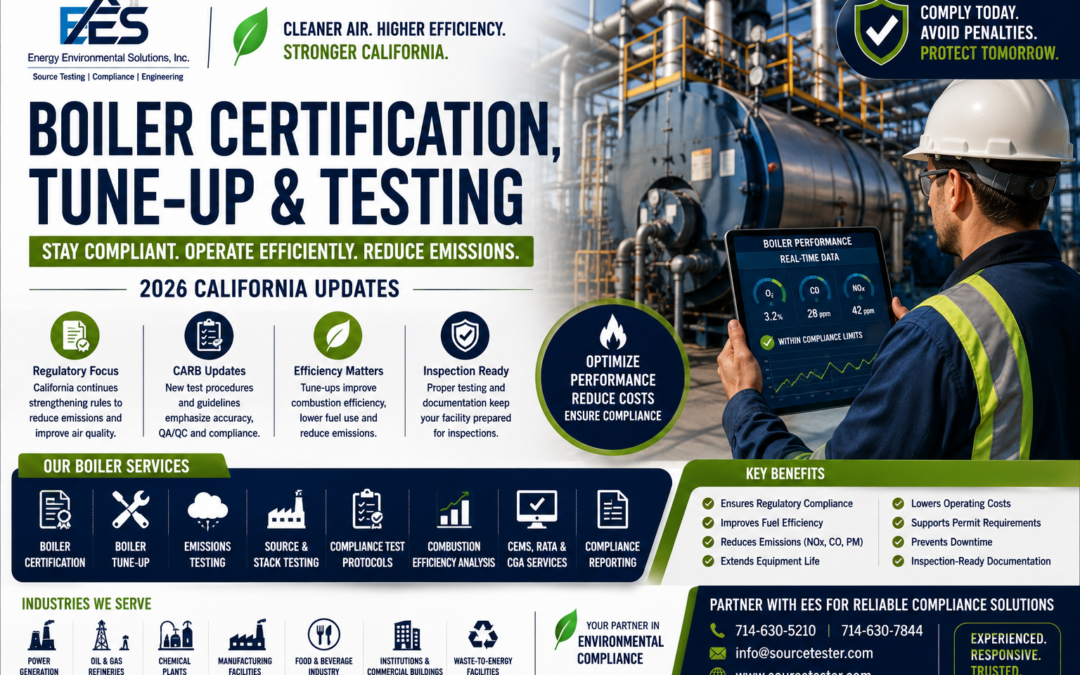
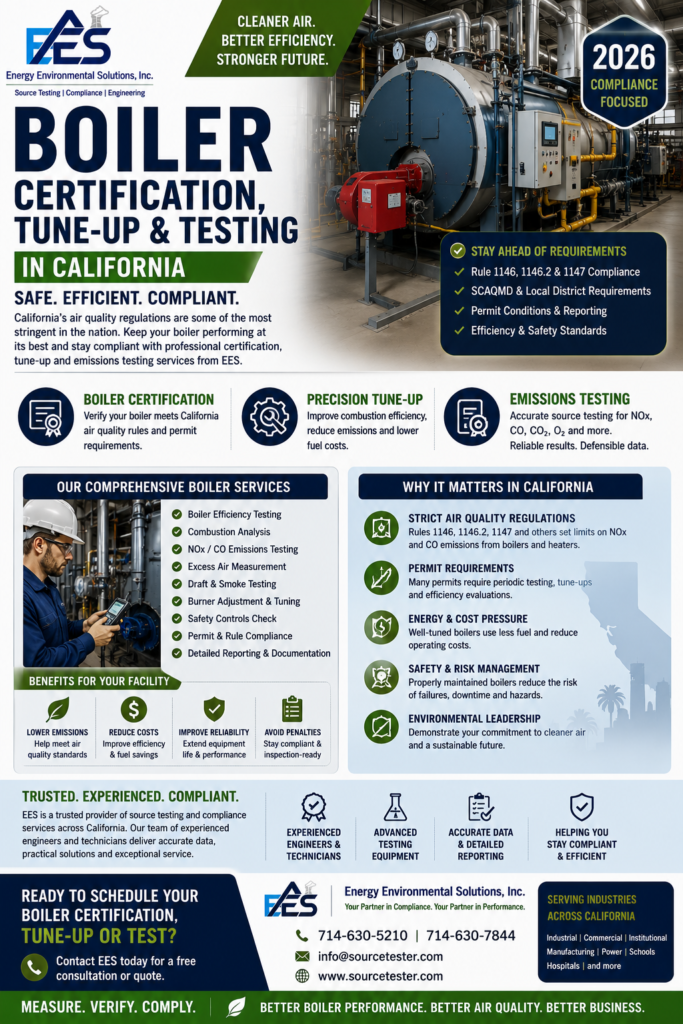
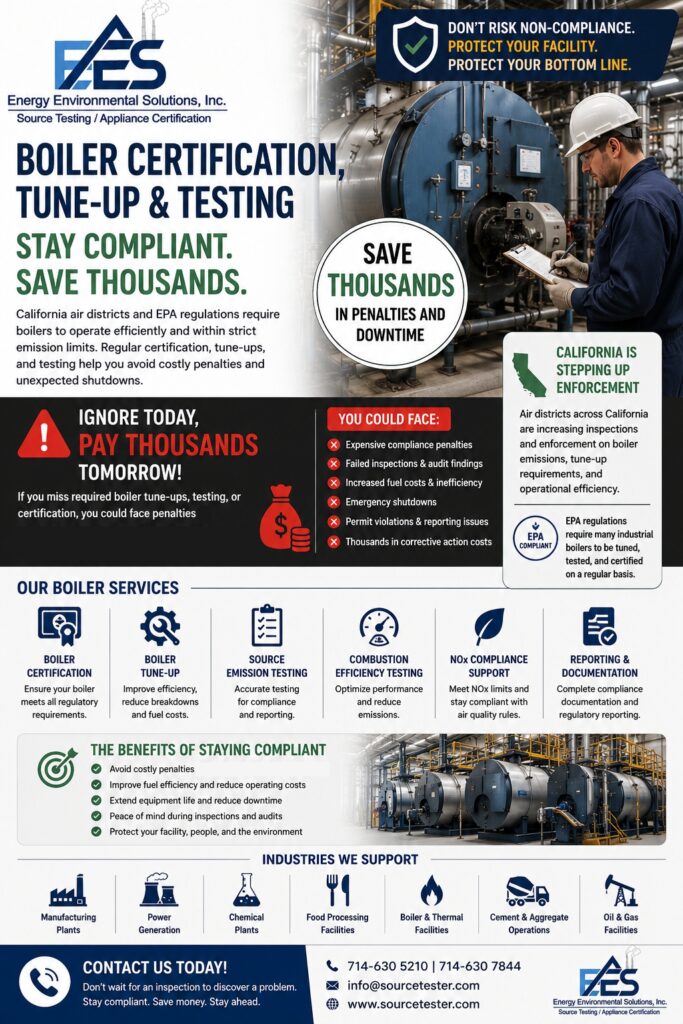
Boiler Certification, Tune-Up & Testing in California: 2026 Compliance Guide for Industrial & Commercial Facilities
Is your boiler operating efficiently—and is it meeting California air-quality requirements?
For industrial, institutional and commercial facilities, boiler compliance is more than keeping equipment running. Depending on the boiler size, fuel, location, permit and applicable air district rules, facilities may need certification, periodic tune-ups, emissions testing, recordkeeping and other compliance activities.
In Southern California, South Coast AQMD Rules 1146, 1146.1 and 1146.2 are particularly important for boilers, steam generators, process heaters and certain water heaters. South Coast AQMD’s current rule book lists Rule 1146 as amended in 2020, Rule 1146.1 as amended in 2018, and Rule 1146.2 as amended in 2024.
For facility owners and EHS managers, the key question is not simply:
“Does my boiler work?”
It is:
“Can my boiler demonstrate compliance with the applicable air-quality requirements?”
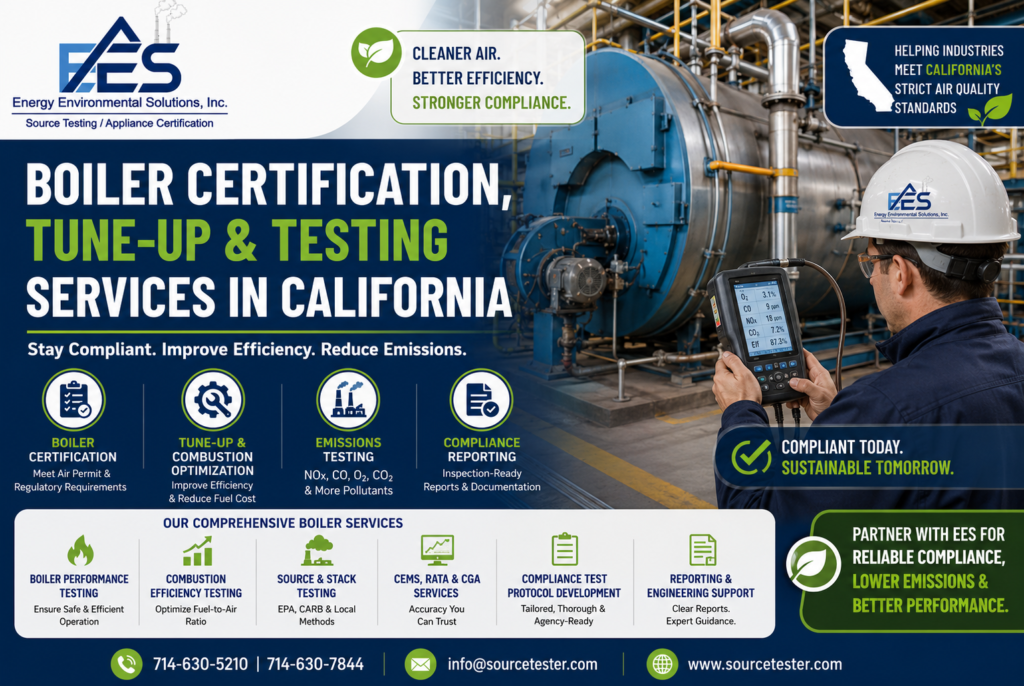
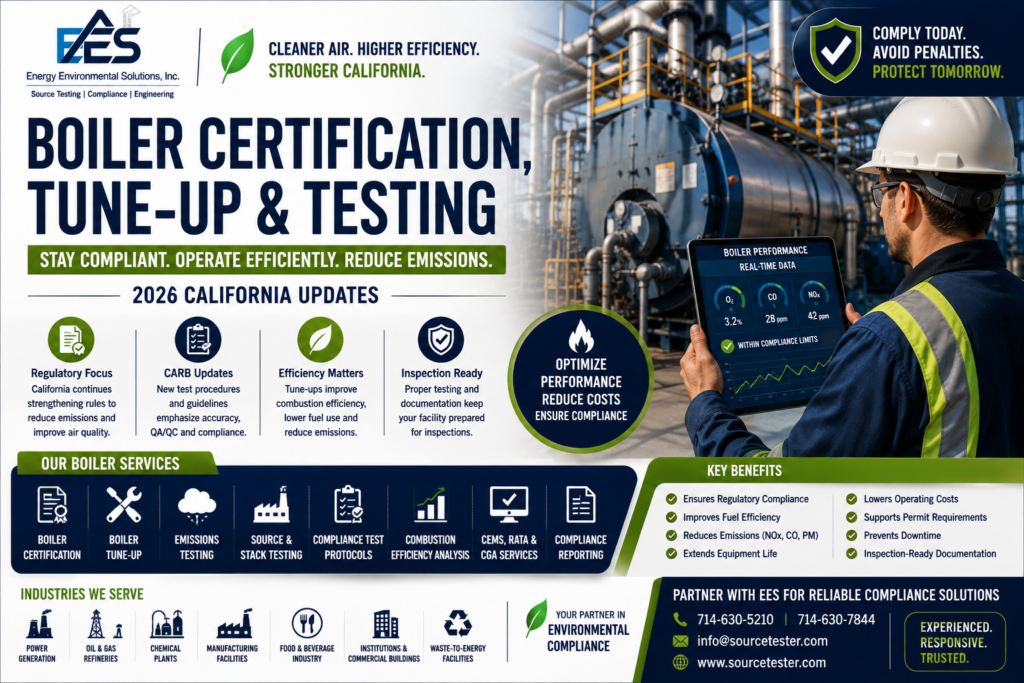
This is where professional Boiler Certification, Tune-Up and Testing services become valuable.
What Is Boiler Certification, Tune-Up & Testing?
These are related but different compliance activities.
Boiler Certification
Certification generally involves demonstrating that applicable equipment meets the requirements of the governing air-district rule or certification program.
For example, South Coast AQMD maintains a Certified Boilers List under Rule 1146.2, with the current equipment list updated December 30, 2025.
Boiler Tune-Up
A tune-up evaluates and adjusts combustion performance to help the boiler operate properly while controlling emissions.
Boiler Emissions Testing
Testing measures actual emissions—such as NOx, CO and oxygen—using the applicable regulatory test method.
NOx is particularly important because it contributes to ozone and smog formation.
South Coast AQMD states that combustion sources are among the sources of NOx emissions in the region, and its Rule 1146.2 amendments were designed to achieve significant NOx reductions.
For businesses, this means boiler operation can have both:
Facilities operating older boilers should therefore monitor rule developments rather than assuming today’s requirements will remain unchanged.
Boiler Testing Company
2026 Update: Rule 1146.2 Has Important Zero-Emission Requirements
South Coast AQMD amended Rule 1146.2 on June 7, 2024, establishing a transition toward zero-emission equipment for certain water heaters, boilers and process heaters.
A major 2026 milestone is:
January 1, 2026
South Coast AQMD’s 2026 compliance-deadline guidance states that certain Type 1 units ≤400,000 Btu/hr and qualifying instantaneous water heaters ≤200,000 Btu/hr installed in new buildings must comply with zero-emission limits.
The practical implication is significant:
Boiler and water-heating equipment planning is changing.
Facilities installing or replacing equipment should evaluate applicable requirements before purchasing equipment, rather than discovering a compliance issue after installation.
What Does a Boiler Tune-Up Actually Do?
A professional tune-up focuses on combustion performance.
Depending on the equipment and applicable rule, the process can include checking:
Fuel-to-air ratio
Oxygen concentration
Carbon monoxide
Stack temperature
Flame condition
Burner operation
Draft
Combustion-air supply
Fuel pressure
Operating load
Control settings
South Coast AQMD’s Rule 1146 tuning procedures specifically address operating the equipment at a representative firing rate and recording combustion parameters such as stack temperature, oxygen and CO.
For example, poor combustion can contribute to elevated CO or inefficient operation.
Too much excess air can also reduce combustion efficiency.
Too little combustion air can create incomplete combustion and elevated CO.
A properly performed tune-up seeks an appropriate combustion balance while maintaining safe operation.
South Coast AQMD’s tuning procedures explicitly state that tuning must not create unsafe conditions or violate applicable safety requirements, manufacturer specifications or other relevant regulations.
When Is Boiler Tune-Up Required?
This depends on the applicable rule and the specific unit.
For example, Rule 1146.1 contains a tune-up option for certain qualifying units with annual heat input of 18,000 therms or less. Units using this option must be tuned at least twice per year, at intervals of four to eight months, according to the prescribed or manufacturer’s procedure, with records maintained for a rolling 24-month period.
That does not mean every California boiler requires two tune-ups every year.
This distinction is important.
The applicable:
Rule + Unit Size + Fuel + Operating History + Permit
determine what is required.
Boiler Emissions Testing: What Is Measured?
Depending on the applicable regulatory requirement, testing may include:
NOx
Nitrogen oxides are a major regulatory focus for combustion equipment.
CO
Carbon monoxide helps evaluate combustion performance and may be subject to emission limits.
Oxygen
O₂ measurements can be used for combustion analysis and, depending on the rule, emissions corrections.
Other Parameters
Depending on the source, testing may also evaluate:
Stack temperature
Exhaust flow
Fuel consumption
Heat input
Operating load
Control-device parameters
Boiler Tune-Up Services
How Often Does a Boiler Need Emissions Testing?
There is no single California-wide testing interval.
The frequency depends on the applicable rule and equipment.
For example, South Coast AQMD Rule 1146 provides specific compliance-testing provisions. Under one provision, certain units at or above 10 MMBtu/hr have a three-year compliance determination interval, while certain units from 5 to below 10 MMBtu/hr have a five-year interval.
Other requirements may apply depending on the boiler category, compliance option and regulatory program.
Don’t assume your neighbor’s testing schedule applies to your boiler.
Boiler Certification vs. Boiler Testing
These terms are often confused.
Certification
Testing
Demonstrates equipment meets a certification requirement
Measures actual emissions
Often associated with specific equipment categories
Usually associated with operating equipment
Can apply to equipment models/configurations
Measures field performance
May be required before installation/operation
May be periodic
Documentation-based
Data/measurement-based
South Coast AQMD maintains certified equipment lists to help businesses identify equipment that meets applicable requirements. The current Rule 1146.2 certified-boiler list was updated December 30, 2025.
Why Boiler Testing Can Fail
A boiler doesn’t necessarily fail because it is mechanically broken.
Compliance problems can come from:
1. Incorrect Burner Settings
Improper combustion settings can increase emissions.
2. Excessive CO
Incomplete combustion can produce elevated CO.
3. Excess NOx
Combustion conditions may result in NOx above an applicable limit.
4. Poor Maintenance
Dirty burners, fouled surfaces or degraded components can affect combustion.
5. Incorrect Operating Conditions
A test performed under the wrong load or process conditions may not demonstrate compliance.
6. Aging Equipment
Older boilers may have difficulty meeting newer emissions requirements.
7. Inadequate Documentation
Even when equipment performs properly, missing records can create compliance complications.
The Cost of Ignoring Boiler Compliance
For a facility manager, a boiler compliance problem can quickly become an operational problem.
Potential consequences may include:
Failed emissions test
↓
Investigation
↓
Corrective maintenance
↓
Retesting
↓
Production disruption
↓
Additional engineering expense
↓
Possible regulatory enforcement
The exact consequences depend on the applicable air district, rule, permit and circumstances.
The smarter approach is preventive compliance.
Pros of Professional Boiler Certification, Tune-Up & Testing
✅ 1. Helps Demonstrate Regulatory Compliance
Measured data and proper documentation provide evidence of compliance with applicable requirements.
✅ 2. Improves Combustion Performance
A properly tuned boiler can operate more effectively.
✅ 3. Helps Identify Problems Early
Testing can reveal elevated emissions before they become a larger compliance issue.
✅ 4. Supports Better Maintenance Decisions
Testing data can help identify when burners, controls or other components need attention.
✅ 5. Reduces Compliance Surprises
A planned testing program is safer than waiting for a regulatory deadline.
✅ 6. Supports Equipment Planning
Testing can help determine whether an older boiler can continue operating within applicable limits.
Challenges / Cons
Professional testing also involves costs and planning.
Challenge
Potential Impact
Testing cost
Budget required
Tune-up cost
Technician/engineering expense
Production coordination
Boiler access may require scheduling
Retesting
Additional cost if results are unsatisfactory
Documentation
Requires organized recordkeeping
Regulatory changes
Existing equipment may face future requirements
Equipment upgrades
Older boilers may require modernization
But there is a difference between a compliance cost and an unexpected compliance crisis.
Planning usually gives a facility more options.
Which Industries Need Boiler Compliance Services?
Potential clients include:
Manufacturing
Food processing
Pharmaceutical manufacturing
Chemical manufacturing
Automotive
Aerospace
Textile
Paper
Plastics
Institutional
Hospitals
Universities
Schools
Government facilities
Commercial
Hotels
Large commercial buildings
Laundry facilities
Food-service operations
Industrial
Refineries
Industrial processing plants
Warehouses with process heating
Energy facilities
The exact requirements depend on the equipment and jurisdiction.
Boiler Tune-Up Services
Why Hospitals and Large Facilities Should Pay Special Attention
Hospitals, universities and large commercial buildings often rely heavily on boilers for:
Steam
Hot water
Heating
Sterilization
Laundry
Process applications
A boiler compliance issue can therefore affect more than emissions.
It can affect:
Operations + Energy Use + Maintenance + Compliance
This makes proactive testing particularly valuable.
How EES Helps With Boiler Certification, Tune-Up & Testing
A boiler test should not be treated as an isolated laboratory exercise.
Your testing company should understand:
The boiler → the combustion process → the air district → the rule → the test method → the compliance limit
That’s the difference between simply collecting emissions data and building a useful compliance program.
2026 Boiler Compliance Checklist
Before your next boiler test or tune-up, ask:
Is the boiler properly permitted/registered?
What is the rated heat-input capacity?
What fuel does it use?
Which California air district regulates the facility?
Which boiler rule applies?
Is certification required?
Is a tune-up required?
When was the last tune-up?
When was the last emissions test?
What are the applicable NOx limits?
What are the applicable CO requirements?
Is a source-test protocol required?
Is agency notification/approval required?
Are operating conditions specified?
Are records current?
Has the boiler or burner been modified?
Has the applicable rule changed?
2026: Why Facilities Should Review Their Boiler Compliance Program Now
The regulatory environment is moving toward lower-emission and zero-emission technologies.
South Coast AQMD’s 2026 rule-development work includes proposed amendments to Rules 1146 and 1146.1.
At the same time, Rule 1146.2 has already introduced significant zero-emission requirements for certain equipment categories, including requirements taking effect January 1, 2026.
This creates a strategic question for facility owners:
Should you continue maintaining the existing boiler, upgrade it, replace the burner, or transition to another technology?
Current emissions-testing data can help answer that question.
Don’t Wait for a Failed Boiler Test
A failed compliance test is often the worst time to start investigating your boiler.
Instead:
Test → Analyze → Tune → Verify → Document
This approach gives facility managers a better opportunity to identify problems before they become emergencies.
Need Boiler Certification, Tune-Up & Testing in California?
EES Can Help Your Facility Stay Ahead of Compliance Requirements
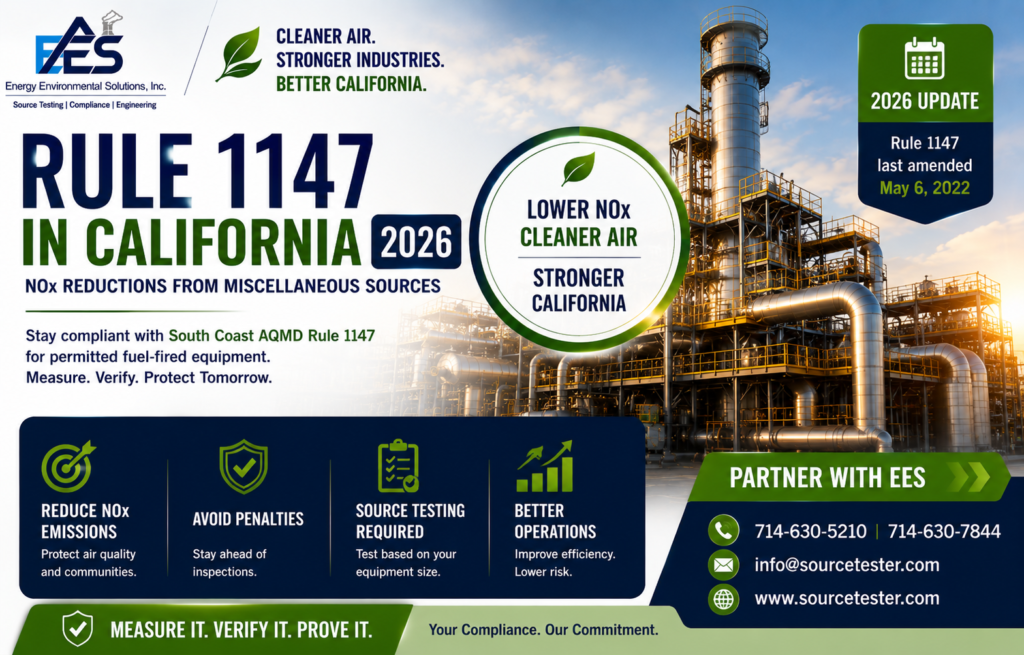
Rule 1147 in California 2026: Latest Updates, Pros, Cons & How EES Helps Industries
Rule 1147 — NOx Reductions from Miscellaneous Sources is an important South Coast AQMD regulation for certain fuel-fired combustion equipment in Southern California. It is designed to reduce nitrogen oxide (NOx) emissions while limiting carbon monoxide (CO) from permitted gaseous- and liquid-fuel-fired equipment that is not covered by another applicable Regulation XI rule.
Important: Rule 1147 is not a statewide California rule. It applies within the South Coast AQMD jurisdiction to equipment meeting the rule’s applicability requirements. Other California air districts have their own rules and permit requirements.
For industrial facilities operating spray-booth heaters, ovens, dryers, furnaces, thermal oxidizers, afterburners, vapor incinerators, tenter-frame dryers, process heaters and other miscellaneous combustion equipment, understanding the current Rule 1147 requirements can be critical to avoiding compliance problems.
Energy Environmental Solutions, Inc. (EES) helps facilities with Rule 1147 source testing, NOx testing, CO testing, compliance test protocol development, emissions testing, CEMS/RATA/CGA, engineering studies and regulatory reporting.
What Is South Coast AQMD Rule 1147?
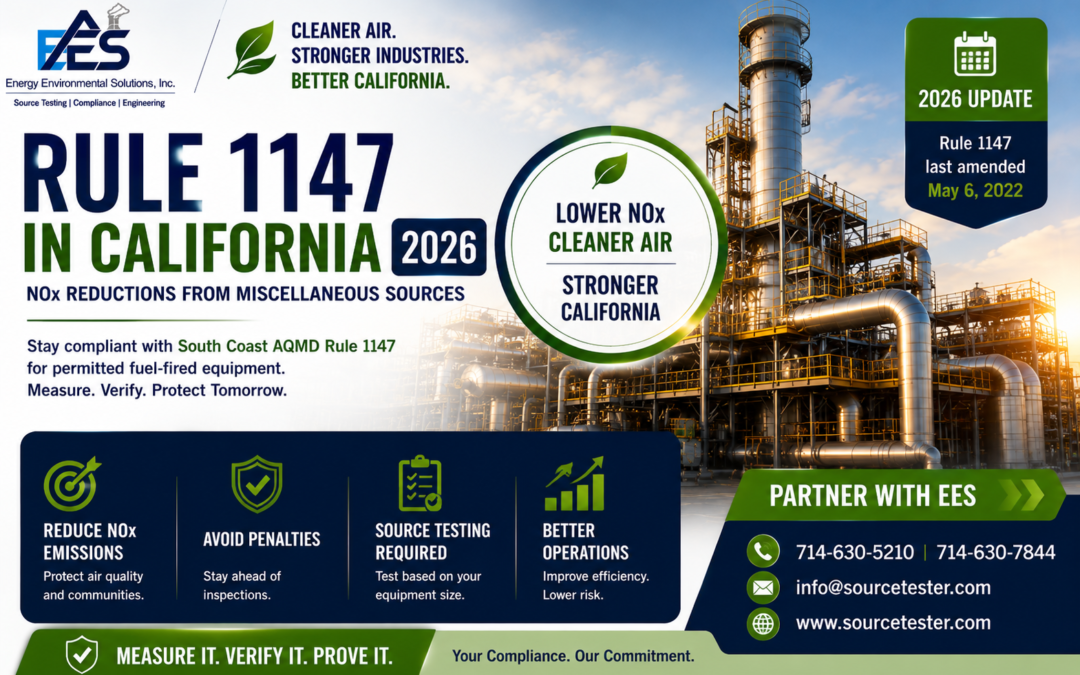
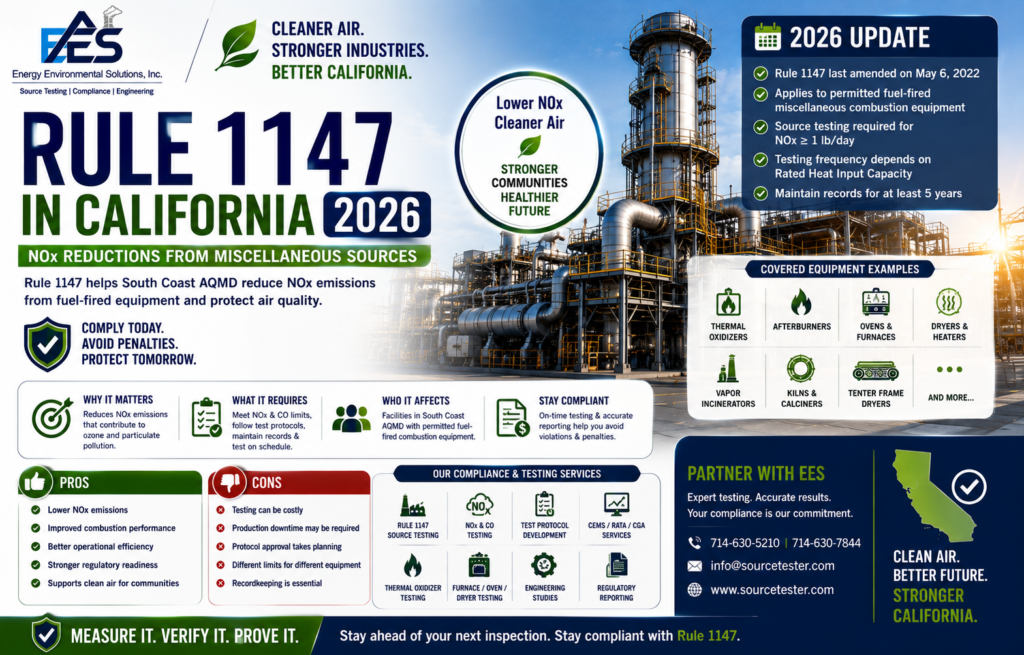
Rule 1147 was adopted in 2008 and most recently amended on May 6, 2022. The current South Coast AQMD rulebook identifies it as Rule 1147 — NOx Reductions from Miscellaneous Sources.
The rule applies to certain gaseous- and/or liquid-fuel-fired combustion equipment requiring a South Coast AQMD permit, when another Regulation XI rule does not already apply to the unit.
Covered equipment can include categories such as:
Thermal oxidizers
Catalytic oxidizers
Afterburners
Vapor incinerators
Ovens
Dryers
Dehydrators
Heaters
Furnaces
Kilns
Calciners
Cookers
Roasters
Tenter-frame dryers
Fabric and carpet dryers
Remediation units
Certain liquid-fuel-fired equipment
The exact applicability depends on the equipment, fuel, rated heat-input capacity, permit status and other provisions of the rule.
Why Does Rule 1147 Matter in 2026?
The environmental reason is straightforward: NOx contributes to ozone and particulate pollution, making NOx reductions an important component of regional air-quality planning.
South Coast AQMD’s Rule 1147 technology assessment explains that the rule’s NOx reductions are an important part of the region’s attainment strategy for federal and state ambient air-quality standards, including standards for ozone, PM2.5 and PM10.
And the need for effective air-quality controls remains highly relevant in 2026. South Coast AQMD’s current 2026 news and regulatory activity includes ozone advisories, particulate-related actions, toxic-air-contaminant rulemaking and additional emissions-control initiatives.
The compliance message for industry:
NOx compliance is not simply about installing a burner or combustion system. Facilities need to demonstrate that applicable equipment actually operates within its required emissions limits.
Latest Rule 1147 Updates for 2026
1. The Current Rule Remains the May 6, 2022 Version
As of August 2026, South Coast AQMD’s current Regulation XI listing identifies Rule 1147 as amended May 6, 2022. There is no indication on the current official rule listing of a newer 2026 amendment to Rule 1147 itself.
That distinction is important.
“Latest 2026 update” does not mean Rule 1147 itself was amended in 2026. Instead, facilities need to consider the current Rule 1147 requirements alongside their current permits and other 2026 regulatory developments.
2. Source Testing Remains a Major Compliance Requirement
For units subject to Rule 1147 with NOx emissions of at least 1 pound per day, the rule requires source testing to demonstrate compliance with applicable NOx and CO limits in the rule or permit.
The testing frequency depends on the equipment’s Rated Heat Input Capacity:
Rated Heat Input Capacity
Source-Test Frequency
< 10 MMBtu/hr
Every 5 calendar years
≥ 10 and < 40 MMBtu/hr
Every 3 calendar years
≥ 40 MMBtu/hr
Every calendar year
≥40 MMBtu/hr with ≥6 months shutdown
Test within 90 days after resumed operation, subject to the rule’s conditions
These intervals are specified in Rule 1147 paragraph (h)(12).
This is one of the most important points for facility managers:
Your source-test due date can depend directly on the equipment’s rated heat-input capacity and NOx emissions.
3. Rule 1147 Requires an Approved Test Protocol
Source testing isn’t simply a matter of sending a technician to the facility and taking measurements.
Rule 1147 requires the operator to submit a source-test protocol to the Executive Officer for approval no later than 90 days before the scheduled source test, subject to the rule’s timing provisions.
For subsequent compliance determinations, protocol resubmission may not be necessary when an approved protocol already exists, provided the unit has not been modified in a way requiring a permit modification and the applicable limits have not become more stringent.
Why does this matter?
Because an improperly planned test can create unnecessary delays, additional costs and potentially unusable compliance data.
Test planning should happen before the test day—not after.
4. Independent Testing Is Required
Rule 1147 requires compliance determinations to be conducted by an independent contractor approved by the Executive Officer under the Laboratory Approval Program for the applicable test methods.
That means facilities should verify that their selected testing company has the appropriate qualifications and approvals for the methods being used.
This is particularly important when a facility is approaching a regulatory deadline.
5. Recordkeeping Still Matters
Rule 1147 requires source-test reports and maintenance records to be maintained for at least five years and made available to South Coast AQMD personnel upon request.
This means compliance doesn’t end when the testing crew leaves the site.
Your facility should maintain:
Source-test reports
Maintenance records
Rated heat-input information
Fuel records where applicable
CEMS records where applicable
Compliance documentation
Approved testing protocols
Equipment modification records
Good documentation can be as important as good testing.
What Emission Limits Does Rule 1147 Establish?
Rule 1147 contains different NOx and CO limits depending on the equipment category, fuel type, process temperature and whether the unit is an in-use unit or subject to the newer Table 2 requirements.
For example, Table 1 includes different limits for equipment such as thermal oxidizers, ovens, heaters, dryers and other combustion equipment.
For certain gaseous-fuel-fired thermal oxidizers, catalytic oxidizers, afterburners and vapor incinerators, the Table 1 NOx limit is 60 ppmv or 0.073 lb/MMBtu, with a CO limit of 1,000 ppmv.
Table 2 establishes more stringent requirements for applicable equipment.
For example, gaseous-fuel-fired thermal oxidizers, catalytic oxidizers, afterburners and vapor incinerators are listed at 20 ppmv or 0.024 lb/MMBtu NOx under Table 2.
Do not assume these numbers automatically apply to your equipment. The applicable limit must be determined from the rule, equipment category, permit and compliance schedule.
A Key 2026 Compliance Option: Less Than 1 Pound of NOx Per Day
Rule 1147 provides an alternative pathway for certain units.
An owner or operator may elect to comply by demonstrating NOx emissions below 1 pound per day averaged over a calendar month, or by meeting an existing permit limit below 1 pound per day, whichever is applicable under the rule.
However, if the facility fails to demonstrate compliance with that option, additional permit and compliance requirements can be triggered.
This makes accurate emissions calculations and recordkeeping particularly important.
Pros of Rule 1147 Compliance
1. Lower NOx Emissions
The primary environmental benefit is reduced NOx emissions from miscellaneous combustion sources.
Lower NOx contributes to regional efforts to address ozone and particulate pollution. South Coast AQMD describes Rule 1147’s NOx reductions as an important component of its attainment strategy.
2. Better Combustion Performance
Testing can reveal problems involving burners, combustion-air systems, controls or operating conditions.
A failed or borderline test can therefore become an opportunity to identify equipment problems.
3. More Reliable Compliance Data
Professional source testing provides measured emissions data instead of relying exclusively on theoretical calculations or equipment specifications.
4. Better Maintenance Decisions
Testing results can help environmental and maintenance teams identify whether combustion equipment needs adjustment, repair or modernization.
5. Improved Regulatory Readiness
Maintaining current testing and maintenance records can make inspections and compliance reviews easier.
Cons and Challenges of Rule 1147
1. Testing Costs
Source testing requires specialized equipment, qualified personnel, laboratory or analytical resources and technical reporting.
2. Production Disruption
Testing may need to occur under specific operating conditions, which can require coordination with production schedules.
3. Protocol Approval Takes Planning
The requirement for an approved test protocol means facilities need to start preparing well before the actual test date.
4. Equipment Modifications Can Change Requirements
Changes to burners, combustion systems, fuel systems or operating conditions may affect the compliance pathway.
5. Multiple Equipment Categories
Rule 1147 covers a wide variety of equipment, so the correct testing approach is not identical for every unit.
6. Testing at the Wrong Operating Condition Can Create Problems
Rule 1147 specifies operating conditions for compliance determinations, including testing at the maximum heat-input range at which the unit normally operates and additional conditions for specified equipment categories.
What Equipment Should California Facilities Review?
If your facility is located in the South Coast AQMD jurisdiction, review Rule 1147 applicability if you operate permitted fuel-fired equipment such as:
The actual applicability must be confirmed against the current rule and permit.
How EES Helps With Rule 1147 Compliance
Energy Environmental Solutions, Inc. (EES) provides technical testing and environmental compliance support for industrial facilities.
Rule 1147 Source Testing
EES can assist with testing programs designed to demonstrate applicable NOx and CO emission compliance.
Compliance Test Protocol Development
EES helps develop testing protocols covering:
Sampling locations
Applicable test methods
Operating conditions
Test runs
QA/QC
Calculations
Reporting requirements
NOx Testing
Accurate NOx measurements are central to Rule 1147 compliance.
CO Testing
Rule 1147 also establishes CO requirements for applicable equipment, making CO testing an important part of many compliance demonstrations.
CEMS / RATA / CGA
For facilities using continuous emissions monitoring systems, EES can support applicable CEMS, RATA and CGA requirements.
Rule 1147 also provides circumstances in which qualifying periodic monitoring or CEMS relative-accuracy testing may be used as part of the source-testing compliance schedule.
Engineering Studies
EES can help facilities evaluate combustion-system performance, emissions trends and potential compliance strategies.
Regulatory Reporting
Testing isn’t complete until the data have been properly evaluated and documented.
EES can help prepare organized technical reports and supporting documentation.
Rule 1147 Compliance Testing Process
A professional compliance project generally follows this sequence:
1. Review the Permit Determine the applicable permit limits and conditions.
2. Confirm Rule Applicability Determine whether Rule 1147 applies to the unit.
3. Determine Testing Frequency Review NOx emissions and rated heat-input capacity.
4. Develop the Test Protocol Select appropriate methods and operating conditions.
5. Submit for Approval Follow South Coast AQMD protocol-approval requirements.
6. Conduct Field Testing Perform NOx, CO and supporting measurements.
7. QA/QC Review Review calibration, field data and calculations.
8. Calculate Emissions Determine compliance with the applicable limit.
9. Prepare the Report Document the test conditions, methods, results and conclusions.
10. Maintain Records Retain required documentation for the applicable period.
Why Proactive Rule 1147 Testing Makes Sense in 2026
South Coast AQMD states that its compliance staff conduct regular inspections to ensure equipment and processes are operating in compliance with applicable clean-air rules.
The agency also explains that failure to correct a Notice to Comply can lead to a Notice of Violation and penalties, while continuing violations can result in daily penalties.
That is why waiting until an inspector identifies a problem is a risky compliance strategy.
A better approach:
Know your limit. Know your test date. Know your operating conditions. Know your documentation.
Rule 1147 Compliance Checklist for 2026
Before your next test, review:
Is the unit subject to Rule 1147?
Is the current permit available?
What NOx limit applies?
What CO limit applies?
What is the unit’s rated heat-input capacity?
Is NOx ≥1 lb/day?
When was the last approved source test?
Is the next test due?
Has the test protocol been approved?
Has the equipment been modified?
Are operating conditions representative?
Are maintenance records current?
Are required fuel meters installed and maintained?
Are five years of required records available?
Is the testing contractor appropriately approved?
2026 Bottom Line
Rule 1147 remains an important South Coast AQMD NOx-compliance requirement in 2026. Although the rule itself was last amended on May 6, 2022, its current requirements continue to govern applicable miscellaneous combustion equipment, including specific source-testing frequencies, test protocols, NOx/CO limits and recordkeeping requirements.
For facilities with applicable equipment, the biggest mistake is assuming that “the equipment has always passed” means the next test can be treated casually.
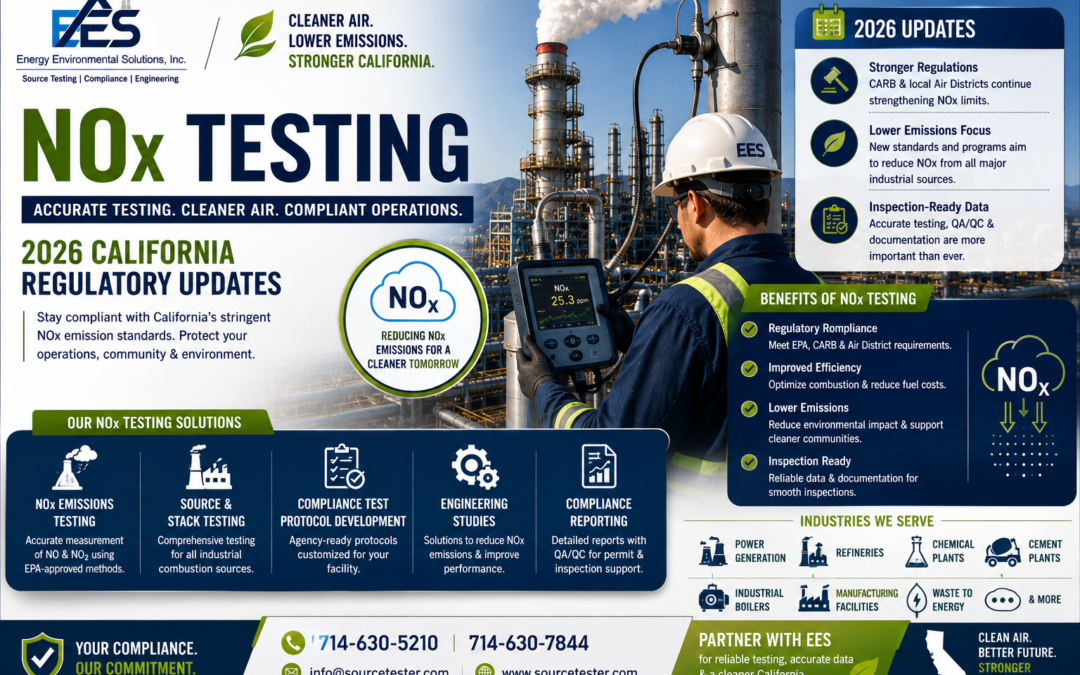
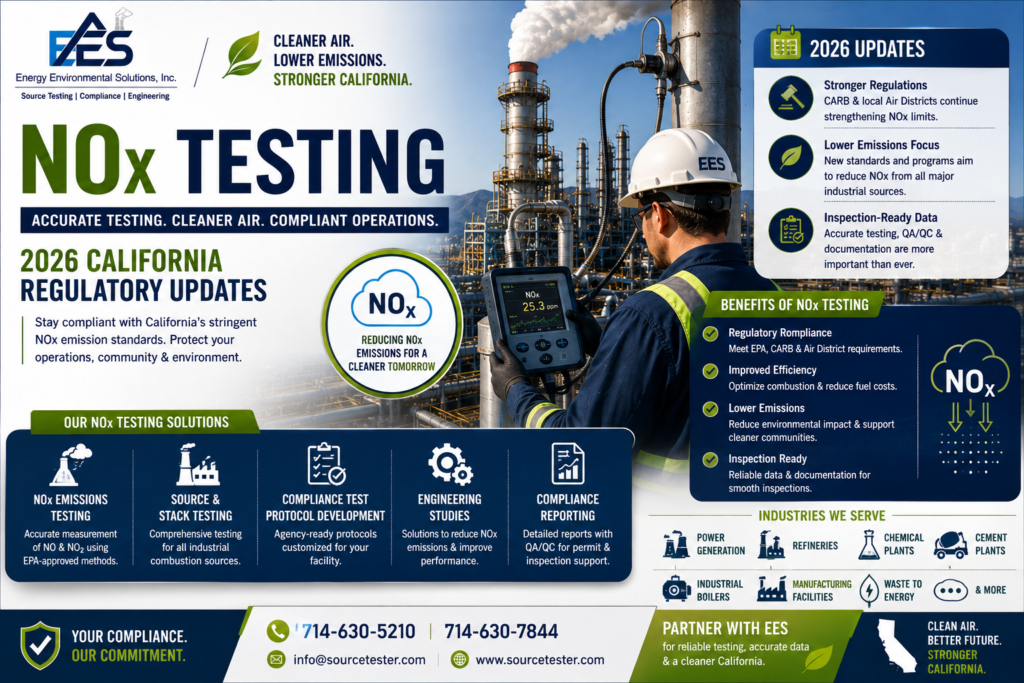
NOx Testing in California (2026): Latest Updates, Benefits, Challenges & How Energy Environmental Solutions, Inc. Helps Industries Stay Compliant
California remains at the forefront of air quality regulation, and Nitrogen Oxides (NOx) Testing continues to play a critical role in protecting public health and meeting stringent emissions standards. In 2026, the California Air Resources Board (CARB) and local Air Quality Management Districts continue to strengthen regulations aimed at reducing NOx emissions from industrial boilers, combustion equipment, turbines, engines, refineries, power plants, and manufacturing facilities. CARB has also updated its climate programs and continues developing new Tier 5 engine standards focused on further reducing NOx emissions from off-road equipment.
For facilities operating under air permits, accurate NOx emissions testing is essential for demonstrating compliance, optimizing combustion efficiency, and avoiding costly compliance issues.
At Energy Environmental Solutions, Inc. (EES), we provide comprehensive NOx Testing, Source Testing, Stack Testing, Compliance Test Protocol Development, Engineering Support, and Regulatory Reporting to help industries confidently meet EPA, CARB, and California Air District requirements.
What Is NOx Testing?
NOx (Nitrogen Oxides) Testing measures emissions of nitric oxide (NO) and nitrogen dioxide (NO₂) released during fuel combustion.
NOx testing is commonly required for:
Industrial Boilers
Process Heaters
Furnaces
Gas Turbines
Internal Combustion Engines
Refineries
Cement Plants
Chemical Manufacturing
Power Generation Facilities
Waste-to-Energy Plants
Testing is performed using EPA-approved reference methods and California Air District requirements to verify emissions remain within permitted limits.
Latest California News & Updates (2026)
1. CARB Continues Advancing Low-NOx Regulations
CARB is continuing development of Tier 5 off-road engine standards, including updated test procedures and compliance requirements designed to further reduce NOx and particulate matter emissions from new diesel engines.
2. South Coast AQMD 2026 Compliance Deadlines
South Coast AQMD has announced several 2026 compliance deadlines, including lower NOx standards and new source-testing requirements for certain oil and gas production equipment, as well as compliance requirements for nitric acid tanks under Rule 1159.1.
3. Stronger Focus on Accurate Emissions Data
Regulators continue emphasizing:
Accurate NOx measurements
QA/QC documentation
Calibration records
Inspection-ready reports
Defensible emissions data
Complete compliance documentation
Facilities with well-planned emissions testing programs are generally better positioned for efficient regulatory reviews.
4. Climate Programs Continue Expanding
CARB adopted updates to California’s Cap-and-Invest Program in 2026 to support long-term emissions reductions while maintaining regulatory certainty for industry, reinforcing the importance of reliable emissions monitoring and compliance planning.
Why NOx Testing Is Important
Professional NOx testing helps facilities:
Demonstrate permit compliance.
Verify combustion performance.
Reduce NOx emissions.
Improve fuel efficiency.
Support EPA, CARB, and Air District inspections.
Maintain inspection-ready documentation.
Support permit renewals.
Reduce environmental impact.
Benefits of Professional NOx Testing
Regulatory Compliance
Testing confirms compliance with EPA, CARB, and local Air District emission limits.
Improved Combustion Efficiency
Testing helps optimize burner performance and reduce fuel consumption.
Lower Operating Costs
Efficient combustion often results in lower fuel use and improved equipment performance.
Reduced Environmental Impact
Lower NOx emissions contribute to improved air quality and reduced smog formation.
Better Inspection Readiness
Complete documentation simplifies agency inspections and regulatory reporting.
Challenges Facilities May Face
Facilities conducting NOx testing may encounter:
Frequently changing regulations.
Complex testing methodologies.
Combustion optimization challenges.
Detailed QA/QC documentation requirements.
Production scheduling around testing activities.
Working with experienced environmental professionals helps reduce these challenges and improve project efficiency.
How Energy Environmental Solutions, Inc. Helps Industries
Energy Environmental Solutions, Inc. (EES) provides complete NOx compliance support throughout California.
Our Services Include
NOx Emissions Testing
Accurate measurement of NO and NO₂ emissions using EPA-approved methodologies.
Source & Stack Testing
Professional emissions testing supporting permit demonstrations and compliance reporting.
Air Quality Compliance Testing
Reliable emissions testing tailored to facility-specific permit requirements.
Boiler Certification & Combustion Testing
Performance evaluations to improve efficiency while reducing emissions.
Compliance Test Protocol Development
Preparation of agency-ready testing protocols customized for your facility.
CEMS Services
CEMS Certification
Relative Accuracy Test Audits (RATA)
Cylinder Gas Audits (CGA)
QA/QC Programs
Engineering Studies
Technical evaluations supporting emissions reduction and process optimization.
Compliance Reporting
Inspection-ready reports with complete QA/QC documentation and technical summaries.
Why Industries Choose EES
Energy Environmental Solutions, Inc. is trusted across California because we provide:
✔ Experienced Environmental Engineers
✔ EPA & California Regulatory Expertise
✔ Accurate & Defensible Emissions Data
✔ Advanced Testing Equipment
✔ Comprehensive QA/QC Procedures
✔ Fast Scheduling & Responsive Technical Support
✔ Inspection-Ready Documentation
✔ Reliable Compliance Reporting
✔ Engineering & Regulatory Support
✔ End-to-End Environmental Compliance Solutions
Industries We Serve
EES supports:
Petroleum Refineries
Power Generation Facilities
Chemical Manufacturers
Cement Plants
Food Processing Facilities
Pharmaceutical Manufacturers
Aerospace & Metal Processing
Waste-to-Energy Facilities
Industrial Boilers
Manufacturing Plants
Municipal Utilities
Glass Manufacturing
Partner with EES for Reliable NOx Testing
As California continues strengthening air quality regulations, NOx Testing has become more important than ever for facilities operating combustion equipment.
Whether your facility requires NOx Testing, Source Testing, Stack Testing, Boiler Testing, CEMS Certification, RATA, CGA, Compliance Test Protocol Development, Engineering Studies, or Regulatory Reporting, Energy Environmental Solutions, Inc. has the expertise to help.
Our experienced team delivers technically sound testing, reliable emissions data, and inspection-ready reporting that help facilities reduce compliance risk, improve operational efficiency, and confidently meet EPA, CARB, and California Air District requirements.
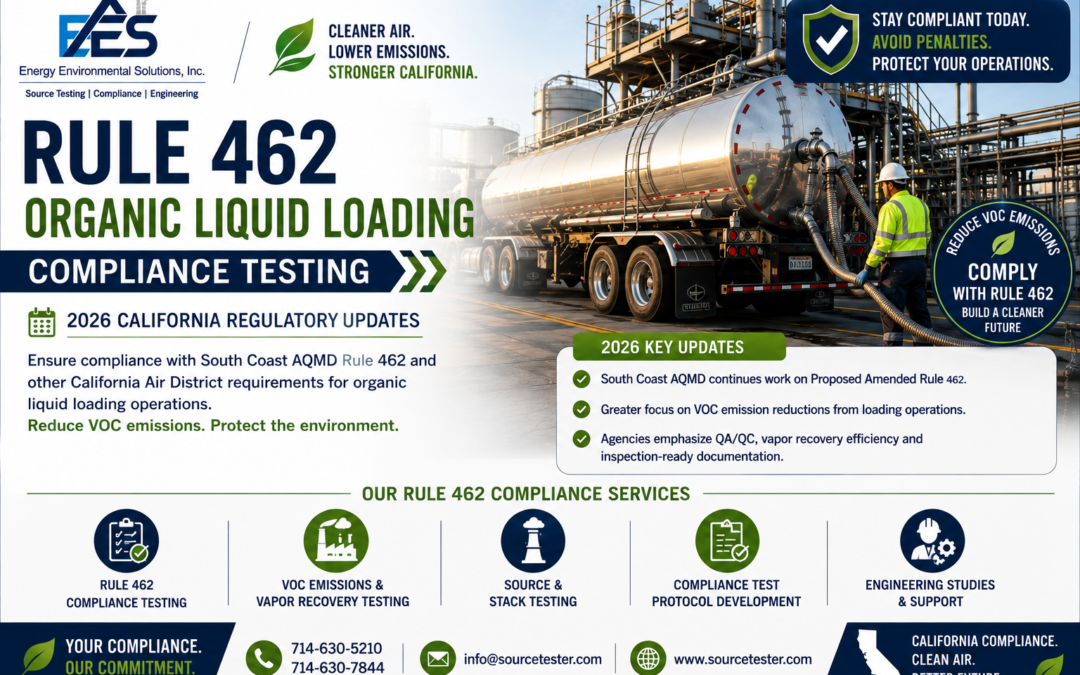
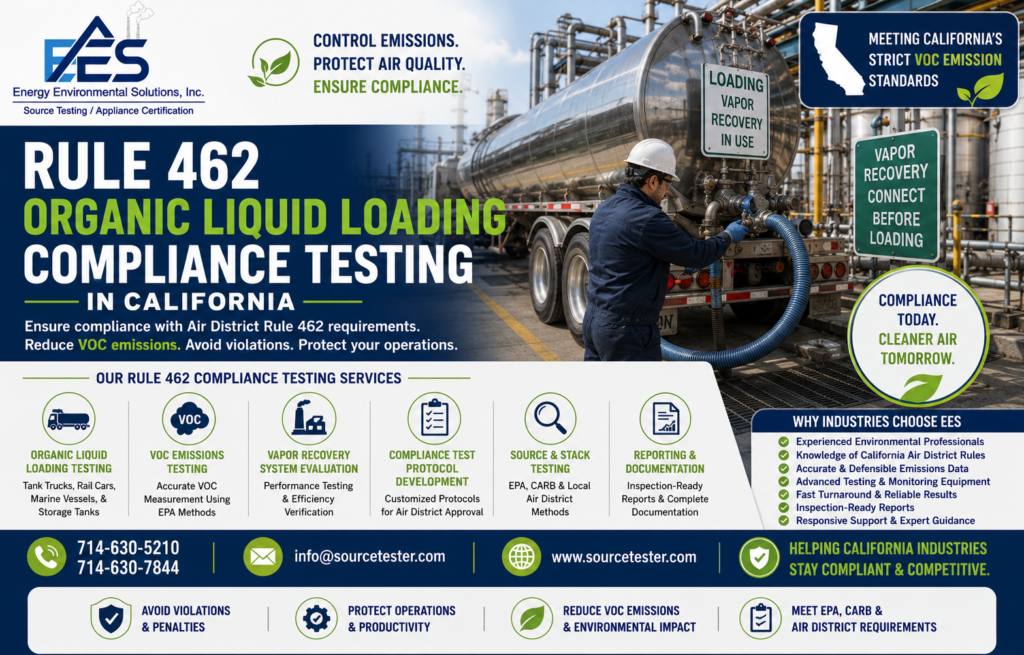
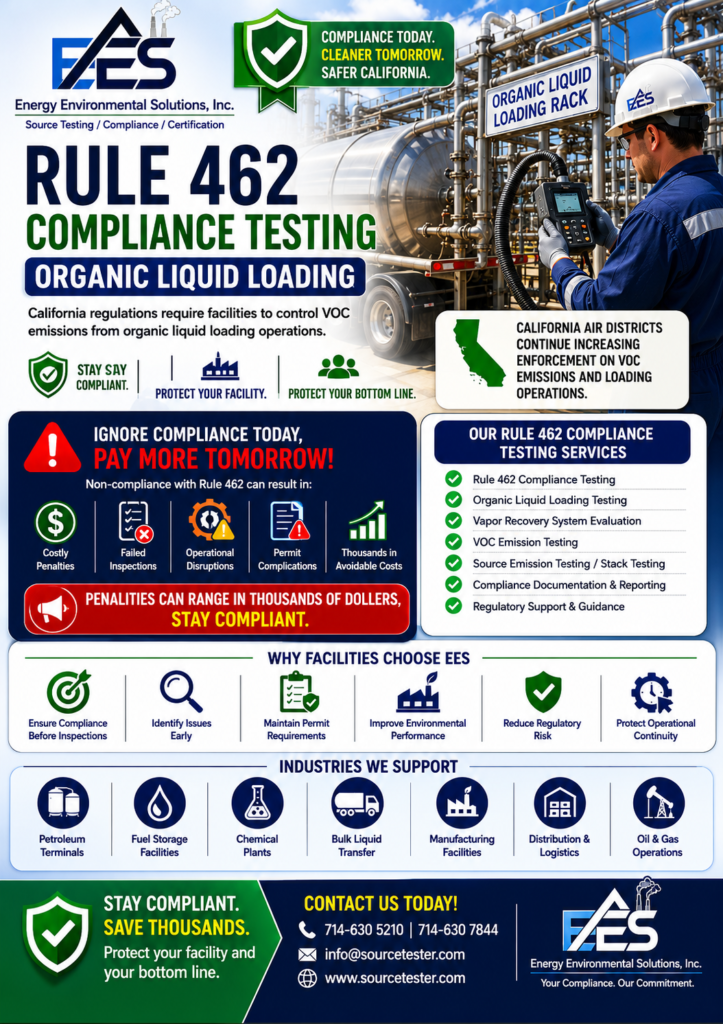
Compliance Testing for Rule 462 Organic Liquid Loading in California (2026): Latest Updates, Benefits, Challenges & How Energy Environmental Solutions, Inc. Helps Industries Stay Compliant
California continues to strengthen its air quality regulations to reduce Volatile Organic Compound (VOC) emissions from fuel terminals, bulk plants, chemical facilities, refineries, and other operations that load organic liquids into tank trucks, railcars, and trailers. In 2026, facilities subject to Rule 462 – Organic Liquid Loading remain under increased regulatory scrutiny, with agencies emphasizing vapor recovery efficiency, emissions monitoring, accurate source testing, and complete compliance documentation.
For facilities that transfer gasoline, solvents, crude oil, petroleum products, ethanol blends, or other volatile organic liquids, demonstrating compliance through Rule 462 Compliance Testing is essential to maintaining operating permits and minimizing environmental risks.
At Energy Environmental Solutions, Inc. (EES), we provide comprehensive Rule 462 Compliance Testing, Source Testing, Engineering Support, and Regulatory Reporting to help industries meet EPA, CARB, and California Air District requirements.
Rule 462 is designed to reduce VOC emissions generated during the loading of organic liquids into tank trucks, trailers, and railroad tank cars. It applies to many loading facilities based on throughput and operating conditions, requiring vapor recovery systems, leak prevention, and compliance demonstrations.
Typical compliance services include:
Rule 462 Compliance Testing
Vapor Recovery Efficiency Testing
Source & Stack Testing
VOC Emissions Testing
Compliance Test Protocol Development
EPA Method 21 Leak Detection
Engineering Studies
QA/QC Documentation
Regulatory Reporting
Air Permit Compliance Support
Latest California News & Updates (2026)
1. South Coast AQMD Continues Rule 462 Modernization
The South Coast Air Quality Management District continues work on Proposed Amended Rule 462, focusing on updated requirements for organic liquid loading operations, VOC emission controls, and compliance procedures. Facilities should monitor rulemaking developments and evaluate potential impacts on testing and permitting.
2. VOC Emissions Remain a Regulatory Priority
California Air Districts continue emphasizing VOC emission reductions because these emissions contribute to ground-level ozone and smog. Facilities handling volatile organic liquids are expected to maintain efficient vapor recovery systems and demonstrate ongoing compliance through testing and documentation.
3. Increased Focus on Inspection-Ready Documentation
Regulators continue placing greater emphasis on:
Accurate compliance testing
Complete QA/QC records
Vapor recovery verification
Equipment calibration
Inspection-ready reports
Defensible emissions data
Well-documented testing programs generally support smoother inspections and permit reviews.
Why Rule 462 Compliance Testing Is Important
Professional compliance testing helps facilities:
Demonstrate compliance with Air District permits.
Verify vapor recovery performance.
Reduce VOC emissions.
Improve environmental performance.
Support EPA and Air District inspections.
Reduce the likelihood of operational disruptions.
Maintain inspection-ready records.
Support permit renewals.
Benefits of Professional Rule 462 Compliance Testing
Regulatory Compliance
Testing demonstrates compliance with applicable Air District rules and permit conditions.
Reduced VOC Emissions
Proper testing helps verify vapor recovery systems are functioning effectively.
Improved Operational Efficiency
Identifying equipment issues early can reduce product losses and improve loading operations.
Lower Compliance Risk
Routine testing helps identify deficiencies before they become larger compliance concerns.
Better Environmental Stewardship
Reducing VOC emissions supports cleaner air and community health.
Challenges Facilities May Face
Facilities operating organic liquid loading systems often encounter:
Changing regulatory requirements.
Complex testing procedures.
Vapor recovery system maintenance.
Detailed reporting and QA/QC requirements.
Scheduling testing without disrupting operations.
Partnering with experienced environmental professionals helps facilities manage these challenges more efficiently.
Rule 462 Organic Liquid Loading Testing California
How Energy Environmental Solutions, Inc. Helps Industries
Energy Environmental Solutions, Inc. provides complete Rule 462 compliance support throughout California.
Our Services Include
Rule 462 Compliance Testing
Professional testing to verify compliance with organic liquid loading requirements.
VOC Emissions Testing
Accurate measurement of volatile organic compound emissions using approved EPA methodologies.
Vapor Recovery System Evaluation
Performance verification of vapor recovery equipment during loading operations.
Source & Stack Testing
Comprehensive emissions testing using EPA, CARB, and Local Air District-approved methods.
Air Quality Compliance Testing
Professional testing supporting permit demonstrations and regulatory reporting.
Compliance Test Protocol Development
Preparation of agency-ready protocols tailored to facility operations.
Engineering Studies
Technical evaluations supporting emissions reduction and system optimization.
CEMS Support
CEMS Certification
Relative Accuracy Test Audits (RATA)
Cylinder Gas Audits (CGA)
QA/QC Programs
Compliance Reporting
Inspection-ready reports with complete QA/QC documentation and technical summaries.
Why Industries Choose EES
Energy Environmental Solutions, Inc. is trusted across California because we provide:
✔ Experienced Environmental Engineers
✔ EPA & California Regulatory Expertise
✔ VOC Emissions Testing Specialists
✔ Accurate & Defensible Emissions Data
✔ Comprehensive QA/QC Programs
✔ Advanced Testing Equipment
✔ Fast Scheduling & Responsive Technical Support
✔ Inspection-Ready Documentation
✔ Reliable Compliance Reporting
✔ End-to-End Environmental Compliance Solutions
Industries We Serve
EES supports:
Petroleum Refineries
Bulk Fuel Terminals
Chemical Manufacturers
Fuel Distribution Facilities
Tank Farms
Marine Loading Facilities
Rail Loading Operations
Industrial Manufacturing Plants
Waste-to-Energy Facilities
Municipal Utilities
Pharmaceutical Manufacturers
Food Processing Facilities
Partner with EES for Reliable Rule 462 Compliance
California continues strengthening VOC emission control programs, making Rule 462 Organic Liquid Loading Compliance Testing essential for facilities handling volatile organic liquids.
Whether your facility requires Rule 462 Compliance Testing, VOC Emissions Testing, Vapor Recovery System Testing, Source Testing, Stack Testing, Compliance Test Protocol Development, Engineering Studies, CEMS Services, or Regulatory Reporting, Energy Environmental Solutions, Inc. has the expertise to help.
Our experienced team delivers technically sound testing, reliable reporting, and responsive support that helps facilities reduce VOC emissions, improve operational efficiency, and confidently meet EPA, CARB, and California Air District requirements.
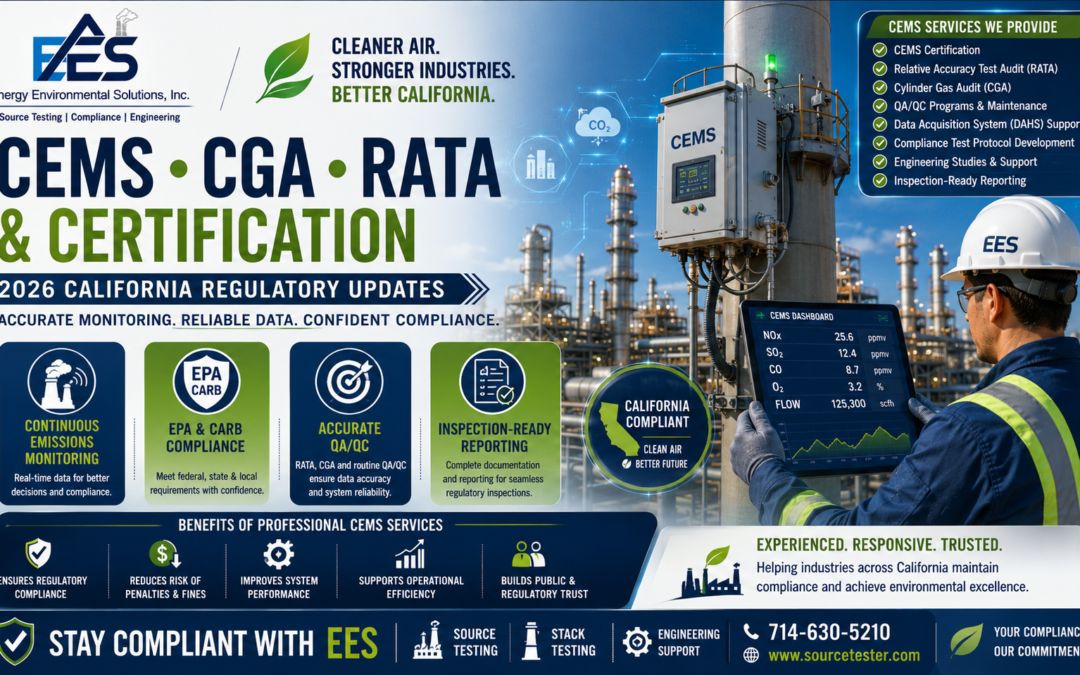
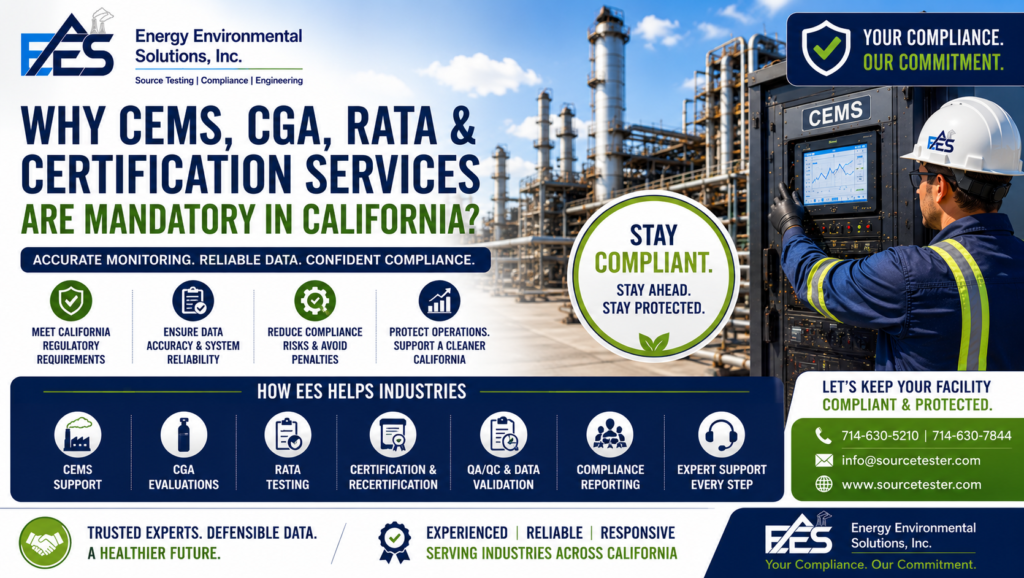
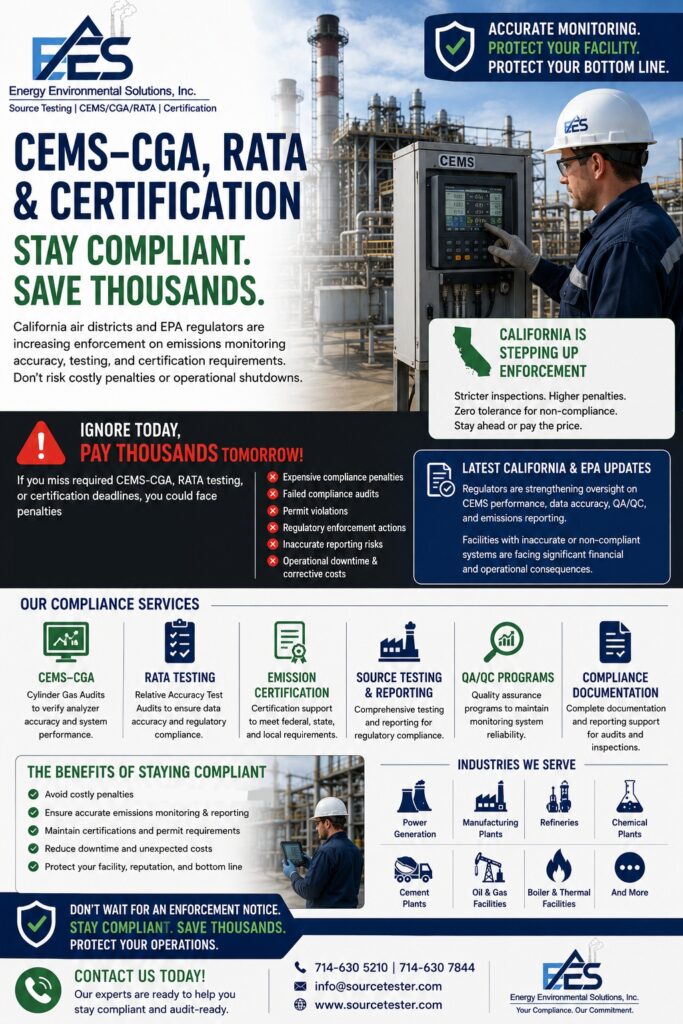
CEMS-CGA, RATA & Certification Services in California (2026): Latest Updates, Benefits, Challenges & How Energy Environmental Solutions, Inc. Helps Industries Stay Compliant
California continues to enforce some of the nation’s most rigorous air quality regulations, making Continuous Emissions Monitoring Systems (CEMS) a critical compliance tool for many industrial facilities. In 2026, regulatory agencies are placing even greater emphasis on Continuous Emissions Monitoring System Certification, Relative Accuracy Test Audits (RATA), Cylinder Gas Audits (CGA), Quality Assurance (QA/QC), and defensible emissions data.
Facilities operating under EPA, CARB, and local Air District permits must ensure their CEMS remain properly certified, calibrated, and maintained to produce reliable emissions data. Failure to perform required audits or certification can result in invalid monitoring data, additional regulatory scrutiny, or permit compliance issues. Recent South Coast AQMD guidance also reinforces documentation, Quality Assurance Plans (QAPs), and certification procedures for new, modified, and recertified CEMS.
At Energy Environmental Solutions, Inc. (EES), we provide complete CEMS Certification, CGA, RATA, QA/QC, and Engineering Support Services to help industries achieve accurate emissions monitoring and regulatory compliance.
RATA Testing Company
What Are CEMS, CGA, RATA & Certification?
A Continuous Emissions Monitoring System (CEMS) continuously measures pollutant concentrations from industrial stacks and process equipment.
To maintain compliance, CEMS typically require:
Initial CEMS Certification
CEMS Recertification
Relative Accuracy Test Audit (RATA)
Cylinder Gas Audit (CGA)
Daily Calibration Drift Checks
Quarterly QA/QC Audits
Preventive Maintenance
Quality Assurance Plan (QAP)
Data Acquisition System (DAHS) Verification
Regulatory Reporting
These activities help ensure emissions data remains accurate, traceable, and acceptable to regulatory agencies.
Latest California News & Updates (2026)
1. South Coast AQMD Updated CEMS Certification Guidance
South Coast AQMD updated its CEMS Application and Certification documentation in 2026, reinforcing requirements for Quality Assurance Plans (QAPs), certification testing, documentation, and recertification procedures for both RECLAIM and non-RECLAIM facilities.
2. Greater Focus on QA/QC Programs
EPA continues to require robust QA/QC programs under 40 CFR Part 60, Appendix F, Procedure 1, including routine calibration drift checks, quarterly audits, and periodic RATA to maintain valid emissions data.
3. Increased Attention to Monitoring Plans
Recent industry guidance highlights the importance of updating monitoring plans and QA/QC documentation whenever CEMS are certified or modified. Clear agency communication and complete documentation help reduce compliance risk and monitoring downtime.
4. California Continues Strengthening Environmental Reporting
California continues expanding emissions reporting and climate compliance programs, increasing the importance of accurate CEMS data for regulatory reporting and long-term environmental planning.
CEMS Certification California
Why CEMS Certification, CGA & RATA Are Important
Routine certification and audits help facilities:
Demonstrate permit compliance.
Maintain valid emissions monitoring data.
Verify analyzer accuracy.
Improve data quality.
Support EPA, CARB, and Air District inspections.
Reduce the risk of invalid emissions records.
Maintain confidence in environmental reporting.
Support operational efficiency.
Benefits of Professional CEMS Services
Accurate Regulatory Compliance
Proper certification helps ensure monitoring systems meet EPA, CARB, and local Air District performance requirements.
Reliable Emissions Data
Routine CGA and RATA verify analyzer performance and improve confidence in reported emissions.
Reduced Compliance Risk
Scheduled audits help identify calibration or performance issues before they affect compliance.
Better Equipment Reliability
Preventive maintenance and QA/QC reduce unexpected downtime and improve system availability.
Inspection Readiness
Well-maintained monitoring systems and complete documentation simplify regulatory inspections.
Challenges Facilities May Face
Facilities operating CEMS commonly encounter:
Complex certification requirements.
Evolving regulatory expectations.
Specialized QA/QC procedures.
Detailed documentation and reporting.
Equipment maintenance and calibration demands.
Production scheduling around certification testing.
Partnering with experienced environmental specialists helps reduce these challenges and keeps projects on schedule.
How Energy Environmental Solutions, Inc. Helps Industries
Energy Environmental Solutions, Inc. provides complete CEMS compliance support throughout California.
Our Services Include
CEMS Certification
Professional certification services supporting EPA, CARB, and Air District compliance.
Relative Accuracy Test Audits (RATA)
Independent performance evaluations comparing CEMS data with EPA reference methods.
Cylinder Gas Audits (CGA)
Routine analyzer accuracy verification using certified calibration gases.
Accurate emissions testing using EPA-approved methodologies.
Air Quality Compliance Testing
Professional testing supporting permit demonstrations and regulatory reporting.
Compliance Test Protocol Development
Preparation of agency-ready testing protocols tailored to facility operations.
Engineering Studies
Technical evaluations supporting emissions reduction, system optimization, and permitting.
Compliance Reporting
Inspection-ready reports with complete QA/QC documentation, calibration records, and technical summaries.
RATA Certification Services
Why Industries Choose EES
Facilities throughout California trust Energy Environmental Solutions, Inc. because we provide:
✔ Experienced Environmental Engineers
✔ EPA & California Regulatory Expertise
✔ Certified CEMS Specialists
✔ Accurate & Defensible Monitoring Data
✔ Comprehensive QA/QC Programs
✔ Advanced Testing Equipment
✔ Fast Scheduling & Responsive Technical Support
✔ Inspection-Ready Documentation
✔ Reliable Compliance Reporting
✔ End-to-End Environmental Compliance Solutions
Industries We Serve
EES supports:
Petroleum Refineries
Power Generation Facilities
Cement Plants
Chemical Manufacturers
Waste-to-Energy Facilities
Food Processing Facilities
Pharmaceutical Manufacturers
Aerospace & Metal Processing
Manufacturing Plants
Industrial Boilers
Glass Manufacturing
Municipal Utilities
Partner with EES for Reliable CEMS Compliance
As California continues strengthening emissions monitoring and reporting requirements, professionally managed CEMS Certification, RATA, CGA, and QA/QC Services are essential for maintaining compliance.
Whether your facility requires CEMS Certification, Relative Accuracy Test Audits (RATA), Cylinder Gas Audits (CGA), Source Testing, Stack Testing, Air Quality Compliance Testing, Compliance Test Protocol Development, Engineering Studies, or Regulatory Reporting, Energy Environmental Solutions, Inc. has the expertise to help.
Our experienced team delivers technically sound certification services, accurate emissions data, and inspection-ready documentation that help facilities reduce compliance risk, improve monitoring reliability, and confidently meet EPA, CARB, and California Air District requirements.