CEMS-CGA, RATA & Certification California | CEMS Testing Services
CEMS-CGA, RATA & Certification in California: 2026 Compliance Guide for Industrial Facilities
Is your Continuous Emissions Monitoring System actually producing data that regulators can rely on?
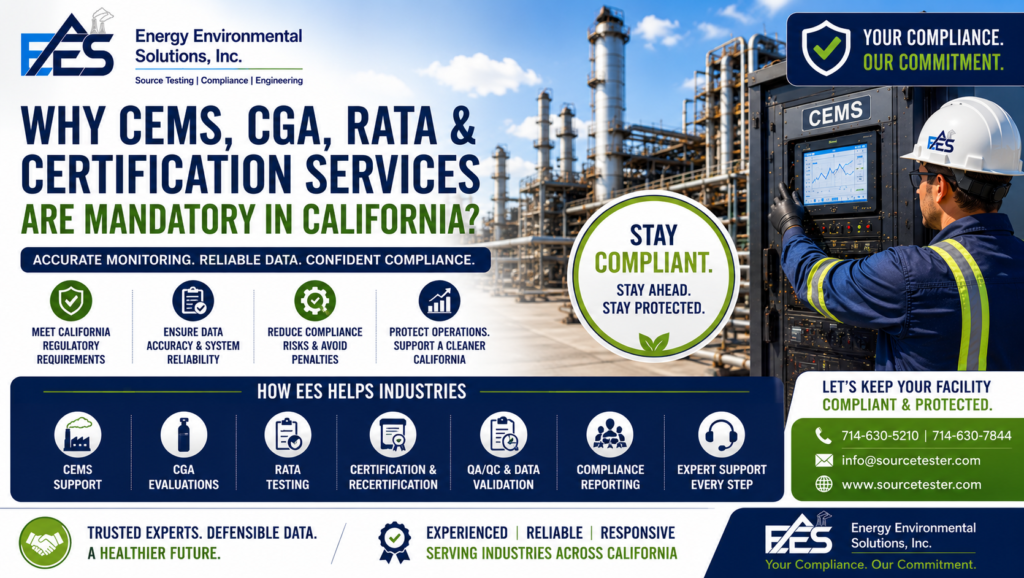
For many industrial facilities in California, having a CEMS (Continuous Emissions Monitoring System) installed is only the beginning. Depending on the applicable permit, air-district rules, and federal requirements, the system may need initial certification, quality assurance testing, Cylinder Gas Audits (CGA), Relative Accuracy Test Audits (RATA), ongoing QA/QC and periodic reporting.
For facilities regulated by the South Coast Air Quality Management District (South Coast AQMD), Rules 218, 218.2 and 218.3 establish important requirements for CEMS administration, certification, performance specifications and QA/QC. South Coast AQMD’s current rule book lists Rule 218 as amended March 5, 2021, and Rules 218.2 and 218.3 as amended September 2, 2022.
This makes professional CEMS Certification, CGA and RATA testing an important part of an industrial facility’s compliance strategy.
What Is CEMS?
CEMS stands for Continuous Emission Monitoring System.
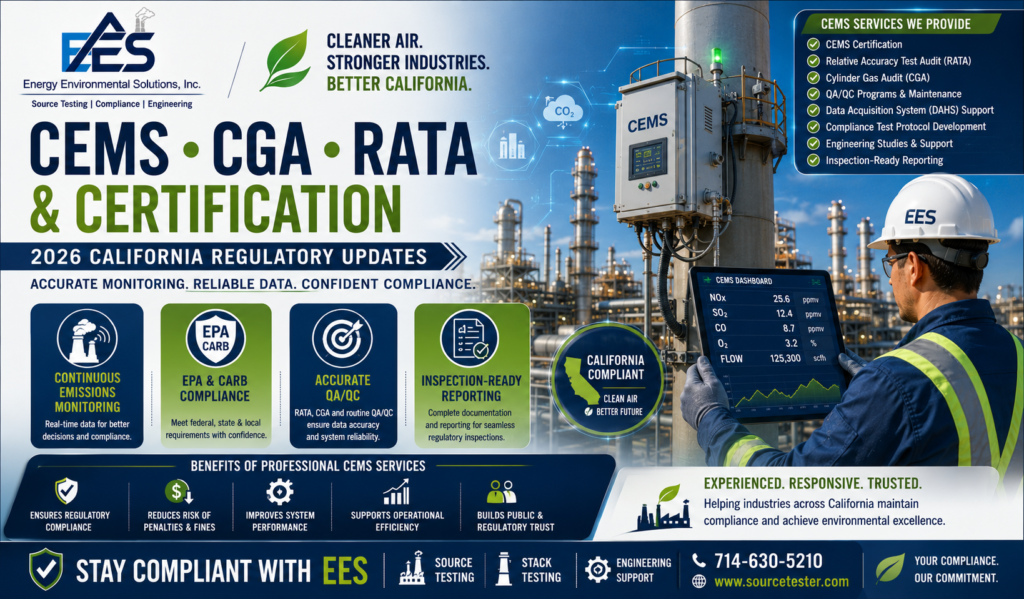
A CEMS continuously measures one or more emission parameters from an industrial source.
Depending on the application, it can monitor:
- NOx
- SO₂
- CO
- CO₂
- Oxygen (O₂)
- Flow rate
- Moisture
- Other regulated pollutants
A CEMS can continuously generate emissions data that may be used for compliance demonstrations, reporting and regulatory decision-making.
South Coast AQMD explains that CEMS can be required to continuously demonstrate compliance with permitted concentration limits and, for applicable RECLAIM systems, automatically report mass emissions.
The key point:
A CEMS is not automatically a compliance instrument simply because it is installed.
It must meet the applicable certification and performance requirements.
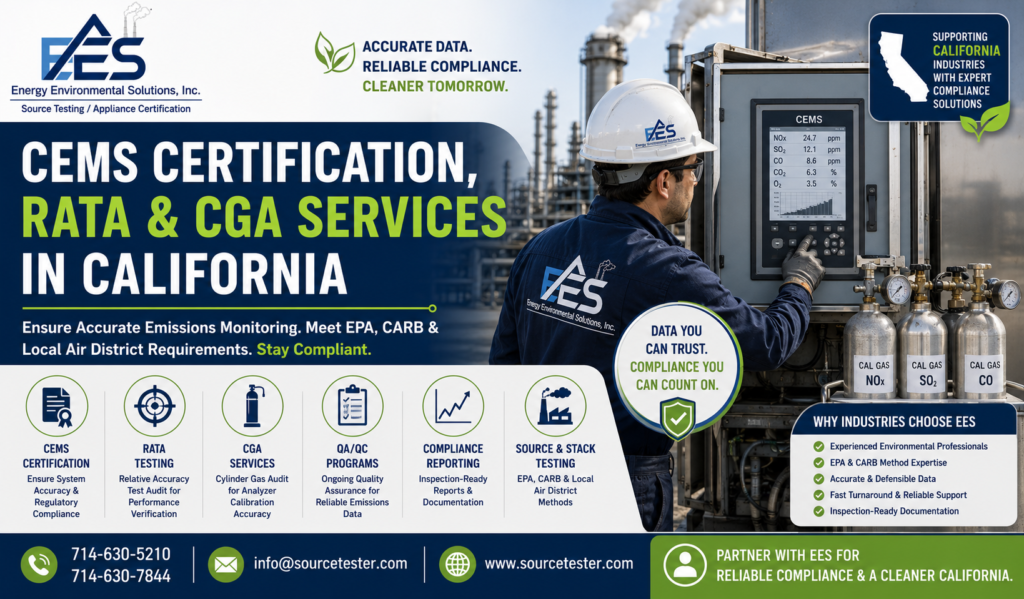
What Are CEMS Certification, RATA and CGA?
These three terms are closely connected but have different purposes.
CEMS Certification
Demonstrates that the monitoring system meets applicable regulatory performance and quality requirements and can function as an official data-reporting instrument.
RATA — Relative Accuracy Test Audit
Compares CEMS measurements against an applicable reference method to determine whether the CEMS is sufficiently accurate.
CGA — Cylinder Gas Audit
Challenges the CEMS with certified calibration/audit gases to verify analyzer response and measurement performance.
Together, they help answer:
Can regulators trust the emissions data being produced by the CEMS?
Why Is CEMS Compliance Important in California?
Industrial facilities may have strict emission limits for pollutants such as NOx, SO₂ and other contaminants.
When CEMS data are used to demonstrate compliance, inaccurate monitoring can create a serious problem.
A facility may believe it is compliant while the monitoring system is:
- Drifting
- Out of calibration
- Producing invalid data
- Experiencing excessive downtime
- Outside required performance specifications
- Operating outside its approved span range
- Missing required QA/QC tests
South Coast AQMD Rule 218.3 provides requirements addressing CEMS performance, QA/QC, out-of-control periods and alternative data acquisition.
2026 California CEMS Regulatory Landscape
California’s CEMS requirements continue to evolve through local air-district rules, federal requirements and pollutant-specific monitoring programs.
For South Coast AQMD-regulated facilities, Rules 218, 218.2 and 218.3 remain central to CEMS requirements.
South Coast AQMD’s FY 2026–27 budget and objectives also continue to identify CEMS Certification as a compliance activity, demonstrating that CEMS review and certification remain an active regulatory function.
2026 takeaway:
CEMS should be treated as an ongoing compliance program—not a one-time installation project.
CEMS Certification: What Does the Process Involve?
For a new or modified CEMS, certification can involve multiple stages.
South Coast AQMD’s current CEMS application package describes a certification pathway that includes:
- CEMS plan, where applicable
- CEMS application
- Quality Assurance Plan (QAP)
- Initial District approval
- Certification source-test protocol
- District review/approval of the protocol
- Certification source testing
- Certification source-test report
- District approval/final certification
- Continuing QA/QC and periodic testing
Once certified, the CEMS remains subject to requirements involving maintenance, modifications, outages, records and periodic QA/QC testing such as RATAs.
This is why certification should be planned early.
A facility should not wait until the CEMS installation is complete before considering the certification process.
What Is a RATA?
RATA = Relative Accuracy Test Audit.
A RATA evaluates how closely the CEMS measurement agrees with an applicable reference method.
In simple terms:
CEMS Result vs. Reference Method Result
The closer they agree, the more confidence regulators can have in the CEMS data.
South Coast AQMD defines relative accuracy in terms of the difference between CEMS-generated data and reference-method results, including the confidence coefficient.
A typical RATA may involve:
CEMS operating
↓
Reference-method sampling
↓
Simultaneous measurements
↓
Multiple test runs
↓
Statistical evaluation
↓
Relative accuracy calculation
↓
Pass / Fail determination
Why Is RATA Testing So Important?
Imagine your CEMS reports:
NOx = 45 ppm
But an approved reference method produces significantly different results.
Which number should regulators trust?
That’s exactly why RATA exists.
A successful RATA provides evidence that the CEMS is accurately measuring the emissions parameter within the applicable performance specification.
South Coast AQMD provides dedicated technical guidance for RATA-related issues, including RATA outliers and mass-emissions RATA for non-concurrent concentration and flow measurements.
What Is a CGA?
CGA = Cylinder Gas Audit.
During a CGA, the CEMS is challenged using gases with known certified concentrations.
Under federal EPA QA procedures, applicable CGA testing uses a zero-level gas and two upscale audit levels within specified ranges, with repeated injections designed to challenge the measurement system.
The basic concept is:
Known Gas → CEMS → Measured Value → Compare
If the CEMS response is outside the applicable tolerance, corrective action may be required.
RATA vs. CGA
| Feature | RATA | CGA |
|---|---|---|
| Full Name | Relative Accuracy Test Audit | Cylinder Gas Audit |
| Main Purpose | Compare CEMS against reference method | Check analyzer response using known gases |
| Reference Method | Yes | No, uses certified gases |
| Field Sampling | Usually required | Gas challenge |
| Statistical Evaluation | Yes | Yes, according to applicable procedure |
| Frequency | Depends on applicable rule/program | Depends on applicable rule/program |
| Certification Role | Important | Important QA/QC component |
| Failure Response | Investigation/correction/retest as required | Calibration/correction/retest as required |
Important:
Don’t assume that a CGA replaces a RATA in every regulatory program.
The applicable rule, permit and federal/state monitoring requirements determine what is required.
How Often Is RATA Required?
There is no single testing frequency for every California CEMS.
The interval depends on the applicable program.
For example, EPA’s Procedure 1 for applicable gas CEMS requires a RATA at least once every four calendar quarters, subject to the applicable provisions. It also provides for CGA-based quarterly QA in certain circumstances.
Other programs can have different requirements.
Your facility’s permit and applicable regulation control.
This is especially important for facilities operating under:
- Title V
- South Coast AQMD rules
- RECLAIM-related requirements
- Federal NSPS requirements
- Federal NESHAP/MACT requirements
- 40 CFR Part 60
- 40 CFR Part 75
- Pollutant-specific monitoring programs
What Happens When a CEMS Fails QA/QC?
This is where CEMS compliance becomes particularly important.
A failed QA/QC test can result in an out-of-control period under applicable requirements.
South Coast AQMD Rule 218.3 provides that CEMS data generated during an applicable out-of-control period can be considered invalid for emission quantification in a compliance demonstration.
The facility may then need to:
- Identify the problem
- Correct the CEMS
- Perform the required QA/QC test
- Establish when valid data resumes
- Evaluate affected data
- Use an approved alternative data-acquisition method where applicable
- Complete required reporting
This can become expensive if the issue is discovered too late.
Common Reasons CEMS Fail RATA or QA/QC
1. Analyzer Calibration Problems
Incorrect calibration can create measurement bias.
2. Sampling-System Problems
Leaks, condensation, contamination or sample-line problems can affect readings.
3. Span Range Problems
The selected span must be appropriate for the applicable requirements.
4. Moisture Interference
Moisture can affect certain monitoring systems if not properly accounted for.
5. Stratification
Non-uniform pollutant concentrations across the stack can affect comparison between the CEMS and reference method.
6. Flow Issues
Poor flow measurement can affect mass-emission calculations.
7. Aging Components
Sensors, analyzers, pumps and other components can degrade over time.
8. Poor Maintenance
A CEMS requires continuous attention.
CEMS Certification Is Not “Set It and Forget It”
A common mistake is:
Install CEMS → Get certified → Forget about it.
That’s not how an effective compliance program works.
After certification, facilities must continue managing:
Calibration + QA/QC + RATA + CGA + Maintenance + Data Availability + Records + Reporting
South Coast AQMD’s certification materials specifically state that certified CEMS remain subject to scheduled and unscheduled maintenance, outages, modifications, records/reporting and ongoing QA/QC.
2026 Update: CEMS Technology Is Expanding
CEMS requirements are also evolving for specialized pollutants.
A notable example is ethylene oxide (EtO).
South Coast AQMD entered into a July 2025 Memorandum of Understanding with Parter to help develop performance specifications, verification test protocols and implementation guidance for an EtO CEMS certification program. The MOU runs through December 31, 2026 unless extended.
This demonstrates an important industry trend:
Continuous monitoring is expanding beyond traditional NOx/SO₂ applications.
Facilities with specialized toxic-air-contaminant requirements should monitor regulatory developments closely.
CEMS and Environmental Compliance Are Becoming More Data-Driven
Modern air-quality compliance increasingly depends on continuous data.
Instead of relying only on periodic stack tests, regulators can use monitoring systems to evaluate:
- Hourly emissions
- Daily emissions
- Operating conditions
- Exceedances
- Data availability
- Control-device performance
- Long-term trends
South Coast AQMD’s CEMS application materials state that applicable CEMS can continuously monitor compliance and automatically signal exceedances, breakdowns and out-of-control periods.
Accurate data is therefore a compliance asset.
Pros of CEMS, RATA, CGA & Certification
✅ 1. Continuous Compliance Visibility
CEMS provides ongoing emissions information rather than occasional snapshots.
✅ 2. Early Problem Detection
Abnormal emissions can potentially be identified faster.
✅ 3. Stronger Compliance Documentation
Certified monitoring data can support regulatory reporting where applicable.
✅ 4. Better Process Control
Operators can use emissions information to improve process operation.
✅ 5. Reduced Compliance Uncertainty
Routine QA/QC helps identify monitoring problems before they become major issues.
✅ 6. Better Long-Term Data
Historical CEMS information can help identify trends.
Challenges / Cons
❌ Higher Initial Cost
Installing a compliant CEMS can require significant capital investment.
❌ Ongoing Maintenance
Analyzers, sampling systems and data-acquisition equipment require regular attention.
❌ QA/QC Requirements
RATA, CGA and other tests require planning and qualified personnel.
❌ Data Availability Issues
CEMS downtime can create compliance complications.
❌ Technical Complexity
CEMS involve instrumentation, electronics, sampling systems, software and regulatory requirements.
❌ Regulatory Changes
Changes to rules or permits can require modifications to the monitoring program.
But the cost of maintaining a reliable CEMS is usually easier to manage than discovering a monitoring failure during a compliance deadline.
Which Industries May Need CEMS Services?
Potential applications include:
Power & Energy
- Power plants
- Cogeneration facilities
- Distributed generation
Manufacturing
- Chemical plants
- Metal processing
- Cement
- Glass
- Manufacturing facilities
Petroleum & Chemical
- Refineries
- Petrochemical plants
- Process facilities
Waste & Combustion
- Waste-to-energy
- Incineration
- Thermal processing
Industrial Boilers
- Large boilers
- Steam generators
- Process heaters
Other Regulated Sources
Facilities with permit or regulatory requirements for continuous monitoring.
How EES Helps With CEMS-CGA, RATA & Certification
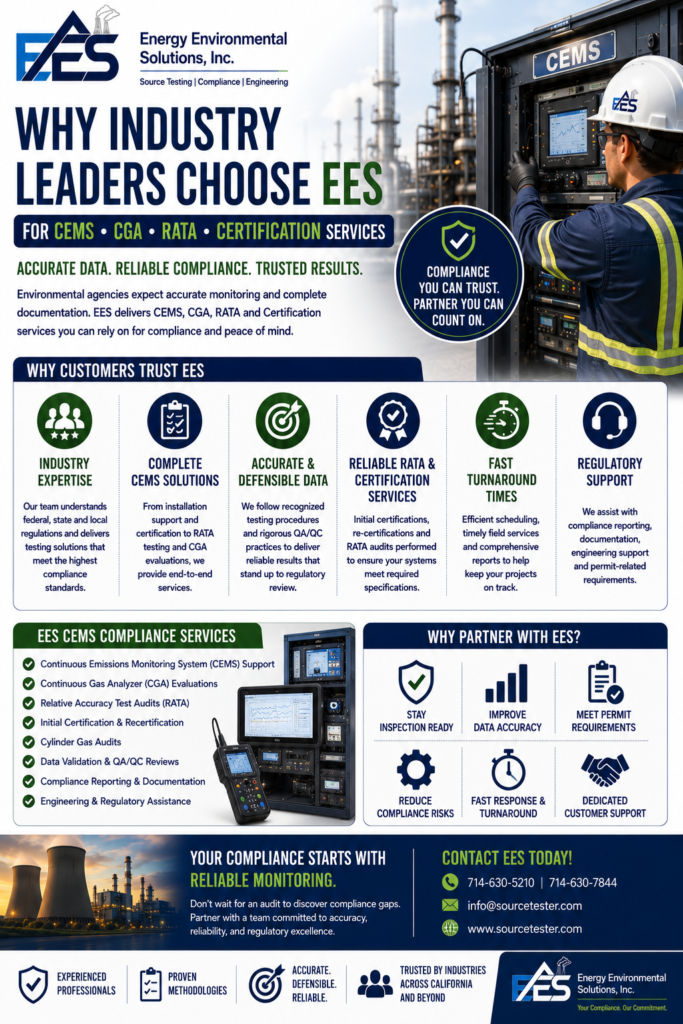
Energy Environmental Solutions, Inc. (EES) can help facilities manage the technical and regulatory aspects of their CEMS programs.
1. CEMS Certification Support
EES can support facilities through the certification process, including planning, protocol development, testing and reporting.
2. RATA Testing
EES can coordinate and perform applicable Relative Accuracy Test Audits using the appropriate reference methods and procedures.
3. CGA Testing
EES can perform applicable Cylinder Gas Audits using properly certified audit gases and the applicable QA/QC procedure.
4. CEMS QA/QC
EES can help facilities maintain an ongoing CEMS QA/QC program.
5. Test Protocol Development
Before testing, EES can prepare a protocol addressing:
- Applicable regulations
- CEMS configuration
- Reference methods
- Test conditions
- Sampling procedures
- Audit gases
- QA/QC
- Calculations
- Reporting
6. CEMS Performance Evaluation
EES can help evaluate:
- Analyzer performance
- Calibration
- Response
- Drift
- Sampling system
- Data acquisition
- Data availability
- QA/QC records
7. Troubleshooting Support
If a RATA or CGA fails, EES can help identify potential causes and coordinate corrective action and retesting.
8. Compliance Reporting
EES can assist with preparing the technical documentation required by the applicable regulatory program.
EES CEMS Compliance Process
STEP 1 — REVIEW
Permit + Applicable Rules + CEMS Configuration
↓
STEP 2 — PLAN
QA Plan + Test Protocol + Scheduling
↓
STEP 3 — PREPARE
Analyzer + Sampling System + Calibration + Audit Gases
↓
STEP 4 — TEST
RATA / CGA / Certification Testing
↓
STEP 5 — ANALYZE
Data Validation + Calculations + QA/QC
↓
STEP 6 — REPORT
Technical Report + Regulatory Documentation
↓
STEP 7 — MAINTAIN
Ongoing QA/QC + RATA + CGA + Monitoring
Why Choose EES?
CEMS compliance requires more than an instrument technician.
It requires an understanding of:
Instrumentation + Source Testing + Reference Methods + QA/QC + Air-District Requirements
EES can help bring these pieces together into one coordinated compliance program.
South Coast AQMD maintains a Laboratory Approval Program (LAP) under which laboratories and source-testing firms are evaluated method-by-method for personnel, equipment, documentation, QA and other criteria. Facilities should verify that the testing provider and applicable methods meet the requirements of their specific program.
2026 CEMS Compliance Checklist
Before your next CEMS audit, ask:
- Is my CEMS currently certified?
- Is the certification still valid?
- Is my QAP current?
- Is the RATA due?
- Is the CGA due?
- Are calibration gases properly certified?
- Is the analyzer within calibration?
- Are sampling lines leak-free?
- Is moisture correction working properly?
- Is the data acquisition system functioning?
- Are data-availability requirements being met?
- Have any CEMS modifications occurred?
- Does a modification require District approval?
- Are previous QA/QC records complete?
- Are there unresolved out-of-control periods?
- Is the applicable permit current?
- Have regulatory requirements changed?
Don’t Wait Until Your RATA Is Due
One of the most expensive mistakes is scheduling a RATA only days before the regulatory deadline.
A better strategy is:
Review → Prepare → Test → Correct → Retest → Report
This provides time to address unexpected problems.
If your CEMS fails on the first attempt and your deadline is tomorrow, your options become extremely limited.
Is Your CEMS Ready for Its Next Audit?
EES Can Help You Find Out.
If your facility has a CEMS and you need:
CEMS Certification
RATA Testing
CGA Testing
CEMS QA/QC
CEMS Performance Evaluation
CEMS Troubleshooting
CEMS Test Protocol Development
CEMS Compliance Reporting
EES can help you develop a testing and compliance strategy based on your applicable permit and regulatory requirements.
🚨 Don’t Let Invalid CEMS Data Become a Compliance Problem
Your CEMS is generating regulatory data every day.
Can you trust the numbers?
Let EES help you verify it.
Energy Environmental Solutions, Inc. (EES)
Phone: 714-630-5210 | 714-630-7844
Email: info@sourcetester.com
Website: sourcetester.org
CEMS Testing. RATA. CGA. Certification. Compliance.
One experienced team for your emissions-monitoring needs.