Air Quality Compliance Test Protocol Development California | EES
Air Quality Compliance Test Protocol Development in California: 2026 Guide, Latest Updates & How EES Helps Industries
California’s air-quality compliance environment is becoming increasingly technical. For facilities subject to source testing, developing the correct Air Quality Compliance Test Protocol before testing can be just as important as performing the test itself.
A source test is not simply “collect a sample and issue a report.” The protocol establishes what will be tested, how it will be tested, where samples will be collected, what operating conditions must be maintained, which test methods will be used, what quality-control procedures apply, and how compliance will be demonstrated.
California Air Resources Board (CARB) confirms that compliance-testing requirements vary by local agency and may use CARB, U.S. EPA or other published test methods. South Coast AQMD likewise maintains a dedicated collection of source-test methods and protocols for regulated facilities.
For industrial facilities planning a source test in 2026, the message is straightforward:
A poorly prepared protocol can create a poorly defensible compliance test.
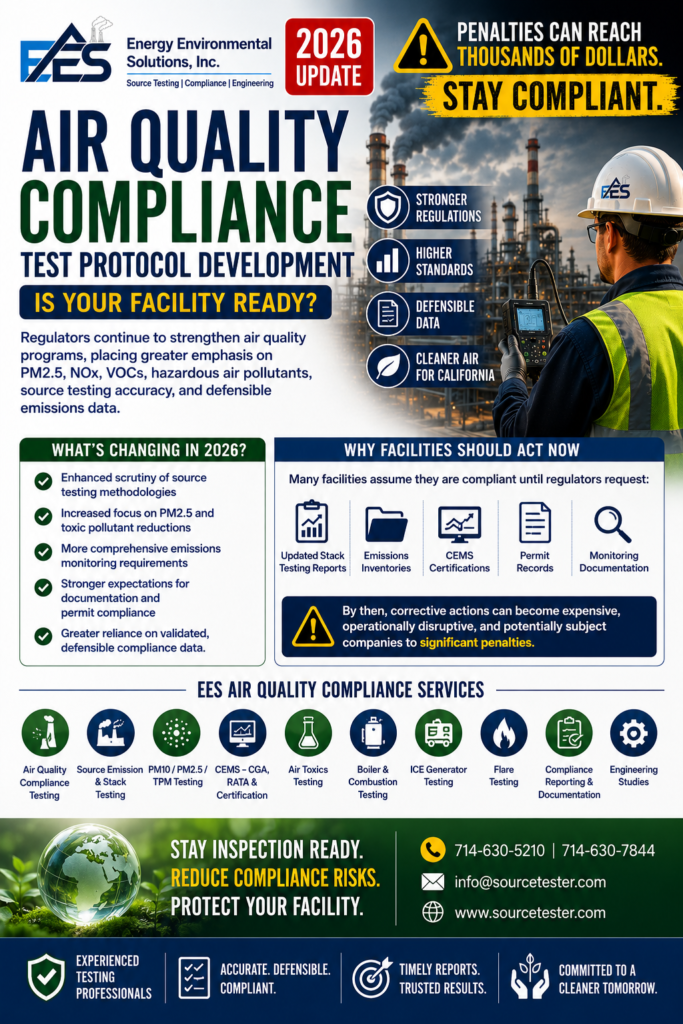
What Is an Air Quality Compliance Test Protocol?
An Air Quality Compliance Test Protocol is a technical testing plan prepared before a regulatory source test.
It translates the applicable rule and permit requirements into a practical testing program.
Depending on the source, a protocol may define:
- Source and emission point identification
- Equipment and process description
- Applicable regulatory requirements
- Pollutants to be measured
- Test methods
- Sampling locations
- Sampling ports
- Traverse points
- Sampling duration
- Number of test runs
- Operating conditions
- Fuel or material usage
- Production rate
- Control-device operating parameters
- Calibration requirements
- QA/QC procedures
- Laboratory analysis
- Calculations
- Data reporting
- Compliance determination
South Coast AQMD explains that source testing measures actual emissions that may be used to determine compliance with emission limits or, for toxic emissions, to support health-risk assessments. The District also notes that third-party contractors prepare source-test protocols detailing the testing program.
Why Is Test Protocol Development Important in California?
Imagine spending thousands of dollars preparing for a source test, coordinating production, arranging access to the stack, shutting down equipment, collecting samples and waiting for laboratory results—only to discover that the testing conditions did not adequately demonstrate compliance.
That is exactly why protocol development matters.
The protocol acts as the blueprint for the test.
It connects three things:
Regulation → Testing Procedure → Compliance Evidence
If any of these three pieces is disconnected, the final result can become difficult to defend.
California’s regulatory framework recognizes the importance of approved testing procedures. CARB states that local compliance-testing requirements can involve published CARB methods, U.S. EPA methods or other published methods.
2026 California Regulatory Update: Source Testing Remains a Major Compliance Activity
Current 2026 South Coast AQMD materials show that source testing remains an active part of the District’s regulatory program.
The District’s Stationary Source Committee materials describe source testing as a measurement of actual emissions used for compliance determinations and health-risk assessments, with third-party contractors preparing source-test protocols.
South Coast AQMD also maintains an extensive Methods & Procedures program containing source-test methods and protocols, including protocols for combustion sources, VOC capture efficiency and RECLAIM-related boiler testing.
This matters because protocol development is not a generic paperwork exercise. The protocol needs to match the applicable regulatory method and the physical characteristics of the source.
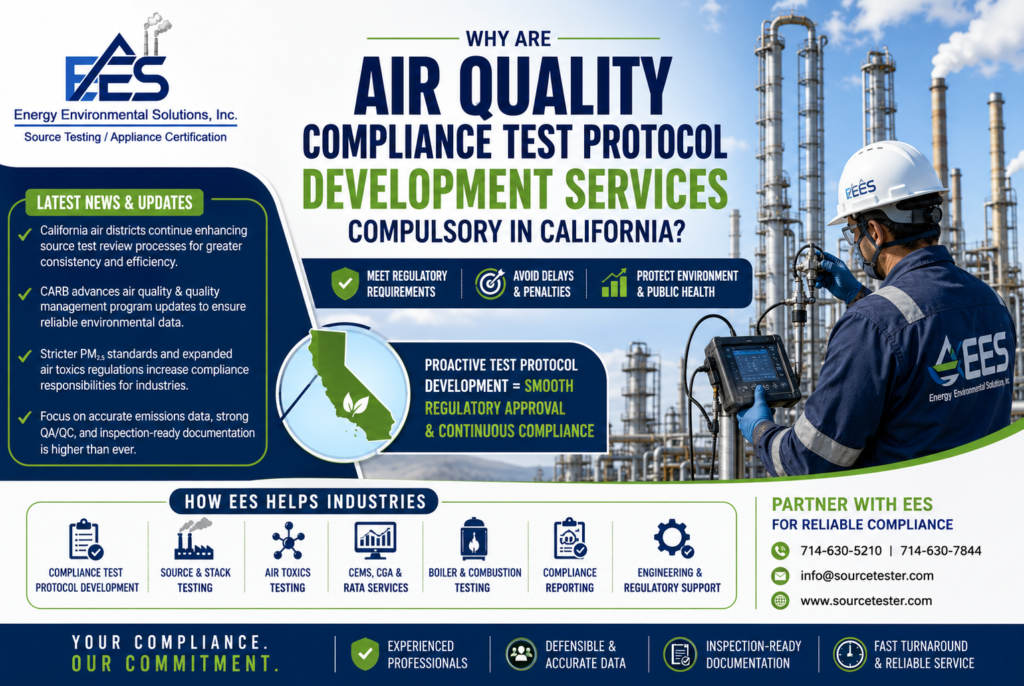
2026 Update: Toxic-Air-Contaminant Testing Is Increasingly Important
California’s air-quality programs continue to place significant attention on toxic air contaminants.
CARB’s current research priorities include identifying emerging air toxics of concern and developing monitoring protocols for pollutants that may become priorities for future air-toxics monitoring.
At the local level, South Coast AQMD’s ongoing rule-development and enforcement activities also demonstrate the importance of toxic-emission measurements.
For example, South Coast AQMD’s 2026 materials concerning chromium-related sources include source-testing requirements and tighter emission demonstrations for applicable operations.
For facilities handling metals, chromium compounds or other toxic substances, protocol development therefore needs to consider not only what pollutant is being measured, but also the analytical sensitivity, sampling approach and regulatory reporting requirements.
2026 Update: Rule 1469 Shows Why Protocols Matter
One of the clearest examples is South Coast AQMD Rule 1469, addressing hexavalent chromium emissions from chromium electroplating and chromic-acid anodizing operations.
Proposed amendments have included more stringent requirements and increased source-testing frequency for certain operations.
The proposed Rule 1469 language also specifies detailed information that may need to be included in a source-test protocol, including:
- Source-test criteria
- Assumptions
- Required data
- Target concentrations
- Preliminary analytical information
- Sampling parameters
This is a useful example for every facility:
The protocol can be a technical compliance document—not merely a scheduling form.
What Should an Air Quality Test Protocol Include?
The exact contents depend on the rule and source, but a professional protocol commonly addresses the following.
1. Facility and Source Identification
The protocol should clearly identify:
- Facility name
- Facility location
- Permit number
- Equipment ID
- Emission point
- Process
- Control device
- Test date
This prevents confusion when a facility has multiple similar emission points.
2. Description of the Process
The testing agency needs to understand what is actually happening during the test.
For example, a protocol for a thermal oxidizer might describe:
Production process → VOC-containing exhaust → capture system → oxidizer → stack
For a boiler, the protocol might identify:
Fuel → burner → combustion chamber → heat recovery → exhaust stack
Without understanding the process, it becomes harder to establish appropriate operating conditions.
3. Applicable Regulations
A strong protocol identifies the regulatory basis for the test.
Depending on the facility, this could include:
- South Coast AQMD rules
- Bay Area AQMD requirements
- San Joaquin Valley APCD rules
- San Diego APCD requirements
- CARB requirements
- U.S. EPA regulations
- Facility permit conditions
- Federal NESHAP requirements
- NSPS requirements
- ATCM requirements
The regulatory section should clearly explain why the test is being conducted and what compliance requirement the results will address.
4. Pollutants to Be Tested
The protocol should identify the pollutants being measured.
Examples include:
Combustion Sources
- NOx
- CO
- CO₂
- Oxygen
- SO₂
Particulate Sources
- Total PM
- PM10
- PM2.5
- Filterable PM
- Condensable PM
Organic Sources
- VOC
- THC
- Methane
- Non-methane hydrocarbons
Toxic Sources
- Metals
- Hexavalent chromium
- Dioxins/furans
- Acid gases
- Specific toxic compounds
The pollutant list must come from the applicable regulatory requirement—not from a generic checklist.
5. Test Methods
This is one of the most critical sections.
The protocol should identify the appropriate method for each pollutant.
Depending on the requirement, methods may come from:
- CARB
- U.S. EPA
- South Coast AQMD
- Other approved regulatory methods
CARB specifically states that compliance testing requirements can vary by local agency and may use CARB, EPA or other published test methods.
6. Sampling Location
The protocol should establish where the samples will be collected.
This can involve:
- Stack location
- Duct location
- Sampling ports
- Traverse points
- Port dimensions
- Stack diameter
- Flow direction
- Gas temperature
- Sampling accessibility
An incorrect or unsuitable sampling location can compromise the test even when the analytical laboratory performs perfectly.
7. Operating Conditions
This is another area where source tests frequently become complicated.
A compliance test may need to be performed while the facility operates at a specified:
- Production rate
- Fuel consumption
- Load
- Process throughput
- Control-device temperature
- Material feed rate
- Burner firing rate
The protocol should define how the required operating condition will be achieved and documented.
8. Control Equipment Parameters
If the source uses pollution-control equipment, the protocol should identify relevant operating parameters.
Examples include:
Thermal Oxidizer
- Combustion temperature
- Residence time
- Flow
- Pressure
- Fuel rate
Baghouse
- Pressure drop
- Fan operation
- Airflow
- Filter condition
Scrubber
- Liquid flow
- Pressure drop
- pH
- Scrubbing-liquid characteristics
CEMS
- Calibration
- Analyzer status
- Data availability
- QA/QC parameters
9. QA/QC Requirements
Quality assurance and quality control are essential because regulators need confidence that the data is representative.
Depending on the method, QA/QC may involve:
- Calibration checks
- Blanks
- Spikes
- Recovery checks
- Leak checks
- Sampling train checks
- Instrument verification
- Calibration gases
- Laboratory QA/QC
A good protocol identifies these requirements before testing begins.
10. Calculations and Compliance Determination
The protocol should explain how raw measurements become reported emissions.
Depending on the rule, calculations may involve:
Concentration → Dry/Wet Correction → Oxygen Correction → Flow Rate → Mass Emissions → Emission Factor → Compliance Limit
The final calculation should correspond to the applicable regulatory standard.
Why Protocol Approval Can Matter
Some California regulations require the source-test protocol to be submitted to the applicable air district before testing.
For example, CARB’s regulatory materials include requirements under certain programs for submitting a pre-test protocol to the air district before conducting a source test.
South Coast AQMD’s regulatory materials likewise contain rules requiring source-test protocols and, in some circumstances, approval before the test is performed.
Therefore:
Never assume that the testing contractor can simply arrive and begin sampling.
The applicable rule and permit should be reviewed first.
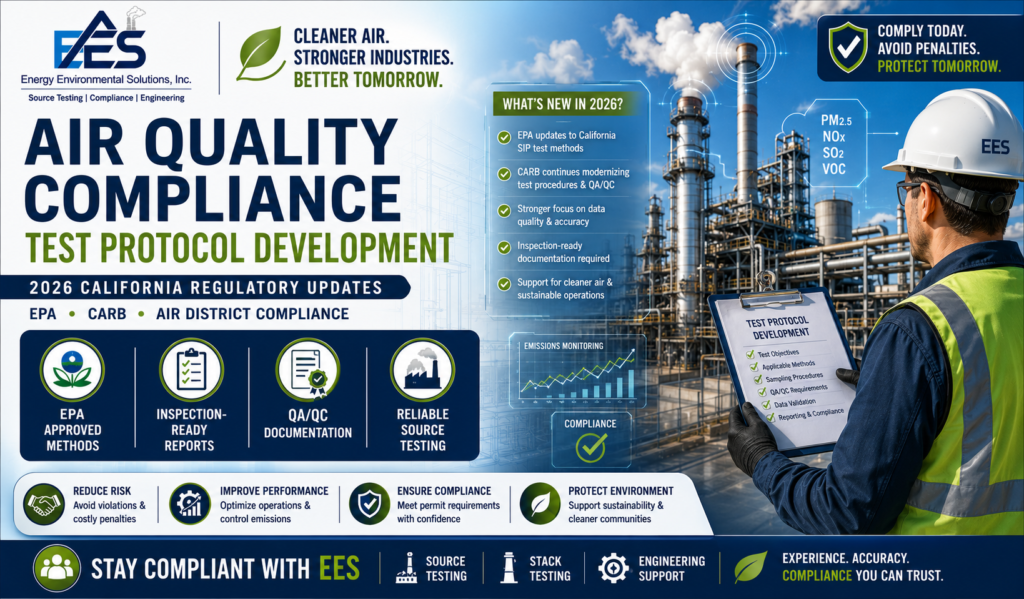
Common Problems With Poor Test Protocols
Problem 1: Wrong Test Method
A facility may identify the pollutant correctly but select an inappropriate or outdated method.
Result:
The test may not provide the intended compliance demonstration.
Problem 2: Incorrect Operating Condition
A test performed at the wrong production rate may fail to demonstrate compliance under the required conditions.
Problem 3: Missing Sampling Information
If stack dimensions, port configuration or traverse information are incomplete, the testing team may face problems on test day.
Problem 4: Permit and Rule Do Not Match
Sometimes facility personnel rely on an old permit or historical test report without checking current requirements.
Problem 5: Equipment Has Changed
A burner replacement, process modification, pollution-control upgrade or production change can make an older protocol unsuitable.
Problem 6: Insufficient QA/QC Documentation
Even good measurements can become difficult to defend if required QA/QC information is missing.
Air Quality Compliance Test Protocol Development: Pros & Cons
| Pros | Cons / Challenges |
|---|---|
| Creates a clear testing roadmap | Requires engineering expertise |
| Reduces testing-day surprises | Requires advance planning |
| Connects testing to permit requirements | Rule requirements can be complex |
| Helps select appropriate methods | Some protocols need agency approval |
| Improves data defensibility | Additional preparation cost |
| Identifies operating conditions in advance | Facility operations may need coordination |
| Supports accurate compliance reporting | Changes may require protocol revision |
| Helps prevent invalid testing | Testing deadlines can be tight |
When Should a Facility Develop a Test Protocol?
Don’t wait until the day before the test.
A facility should consider starting protocol development when:
- A source-test deadline is approaching
- A new permit is issued
- A permit is modified
- Equipment is installed
- A burner is replaced
- A control device is modified
- Production changes
- Fuel changes
- A new pollutant becomes regulated
- A regulatory amendment changes testing requirements
- A previous source test failed
- An agency requests additional testing
- A health-risk assessment requires updated emissions information
Which California Industries Need Test Protocol Development?
Potentially affected facilities include:
- Manufacturing plants
- Chemical facilities
- Petroleum facilities
- Refineries
- Metal-processing plants
- Aerospace facilities
- Automotive facilities
- Food-processing plants
- Pharmaceutical manufacturing
- Power-generation facilities
- Waste-management facilities
- Landfills
- Coating operations
- Printing facilities
- Boiler operations
- Industrial furnaces
- Thermal oxidizer operations
- RTO facilities
- Chrome-plating facilities
The actual testing requirement depends on the applicable air district, permit and source.
How EES Helps With Air Quality Compliance Test Protocol Development
Energy Environmental Solutions, Inc. (EES) can help facilities turn complicated regulatory requirements into a structured testing plan.
1. Regulatory Review
EES can review applicable rules and permit conditions to identify the testing requirements.
2. Test Protocol Development
EES can prepare technical protocols covering:
Source → Pollutant → Method → Sampling → Operating Conditions → QA/QC → Calculations → Reporting
3. Source-Test Coordination
EES can coordinate testing requirements with facility personnel to minimize operational disruption.
4. Sampling Location Evaluation
The team can review stack and duct configurations to identify appropriate sampling locations.
5. Operating-Condition Planning
EES can help establish the production/load/fuel conditions required during the test.
6. Method Selection
The testing program can be designed around the applicable CARB, EPA, South Coast AQMD or other approved method.
7. Compliance Testing
After protocol development, EES can support the actual source-testing program.
8. Engineering Calculations
Raw analytical data can be converted into the appropriate emissions units and compliance metrics.
9. Test Report Preparation
EES can prepare technical documentation describing the testing methodology, results, calculations and compliance determination.
10. Corrective-Action Support
If results indicate an emissions problem, EES can help identify potential technical causes and evaluate the need for additional testing or engineering work.
Why Choose a Professional Test Protocol Developer?
The cheapest protocol is not necessarily the least expensive option.
Suppose a facility spends $5,000–$20,000 or more coordinating a complex source test, but the protocol fails to address an important regulatory requirement.
The company may then face:
Retesting + additional laboratory costs + production disruption + engineering time + regulatory delays
A properly developed protocol can reduce that risk by identifying potential problems before the sampling team arrives.
Think of it like an aircraft flight plan.
The test itself is the flight.
The protocol is the flight plan.
You don’t want to discover the route, fuel requirements and destination after takeoff.
EES Air Quality Compliance Test Protocol Process
STEP 1 — REVIEW
Review the facility permit, rule and equipment.
↓
STEP 2 — IDENTIFY
Identify pollutants, emission points and applicable methods.
↓
STEP 3 — DEVELOP
Prepare the detailed source-test protocol.
↓
STEP 4 — COORDINATE
Coordinate facility operations, access, production and agency requirements.
↓
STEP 5 — TEST
Conduct the source test according to the approved requirements.
↓
STEP 6 — ANALYZE
Perform laboratory analysis and QA/QC evaluation.
↓
STEP 7 — CALCULATE
Convert measurements into the required emissions units.
↓
STEP 8 — REPORT
Prepare and submit the source-test report as required.
2026 Compliance Strategy: Test Smarter, Not Just Faster
The regulatory environment is becoming more sophisticated.
South Coast AQMD’s current Methods & Procedures resources include dedicated protocols for different applications, while CARB continues to maintain approved compliance-testing methods and contractor requirements.
At the same time, active regulatory changes—including toxic-air-contaminant programs and source-specific requirements—can affect testing obligations. South Coast AQMD’s 2026 materials show continuing activity around source testing, toxic emissions and compliance evaluation.
For facility managers, this means one thing:
Your old source-test protocol should not automatically be reused for the next test.
Before every significant test, ask:
Has the rule changed?
Has the permit changed?
Has the equipment changed?
Has the process changed?
Has the test method changed?
Has the required operating condition changed?
If the answer to any of these is yes, the protocol should be reviewed.
Air Quality Compliance Test Protocol Checklist
Before submitting or conducting your next source test, verify:
- Current facility permit reviewed
- Current applicable rule reviewed
- Emission points identified
- Pollutants identified
- Correct test methods selected
- Sampling locations confirmed
- Stack/duct dimensions verified
- Operating conditions established
- Production rate documented
- Control-device parameters identified
- QA/QC requirements established
- Laboratory requirements confirmed
- Agency notification requirements checked
- Protocol approval requirements checked
- Test schedule coordinated
- Reporting requirements confirmed
The Bottom Line
Air Quality Compliance Test Protocol Development is the foundation of a defensible source-testing program.
California’s regulatory framework gives air districts significant responsibility for implementing and enforcing air-quality requirements, while CARB confirms that compliance-testing requirements vary by local agency and may rely on CARB, EPA or other approved methods.
In 2026, with continuing rule development, source-testing activity and increasing attention to toxic and criteria pollutants, facilities should treat protocol development as a technical compliance function—not administrative paperwork.
The goal isn’t simply to complete a test.
The goal is to produce reliable data that can demonstrate compliance.
Need Air Quality Compliance Test Protocol Development in California?
Energy Environmental Solutions, Inc. (EES) provides professional support for:
Air Quality Compliance Test Protocol Development | Source Testing | Stack Testing | NOx Testing | VOC Testing | PM10 | PM2.5 | Total PM | Air Toxics | Hexavalent Chromium | Dioxin/Furans | Boiler Testing | Rule 1146 | Rule 1146.2 | Rule 1147 | Thermal Oxidizer Testing | RTO Testing | Destruction Efficiency | CEMS | RATA | CGA | Engineering Studies | Compliance Reporting
Plan the Test. Measure the Emissions. Prove Compliance.
Energy Environmental Solutions, Inc. (EES)
Phone: 714-630-5210 | 714-630-7844
Email: info@sourcetester.com
Website: sourcetester.org