Rule 1469 California | Hexavalent Chromium Testing & Compliance
Rule 1469 in California: Hexavalent Chromium Testing, Source Testing & Compliance Requirements
Is Your Chromium Plating or Chromic Acid Anodizing Facility Ready for Rule 1469 Compliance in 2026?
If your facility performs chromium electroplating or chromic acid anodizing in the South Coast Air Quality Management District (South Coast AQMD), Rule 1469 should be a critical part of your environmental compliance program.
South Coast AQMD Rule 1469 – Hexavalent Chromium Emissions from Chromium Electroplating and Chromic Acid Anodizing Operations is designed to reduce emissions of hexavalent chromium from affected facilities. The rule applies to facilities performing chromium electroplating or chromic acid anodizing and establishes requirements for emission controls, building enclosures, source testing, monitoring, housekeeping, recordkeeping and reporting.
And there is an important 2026 development:
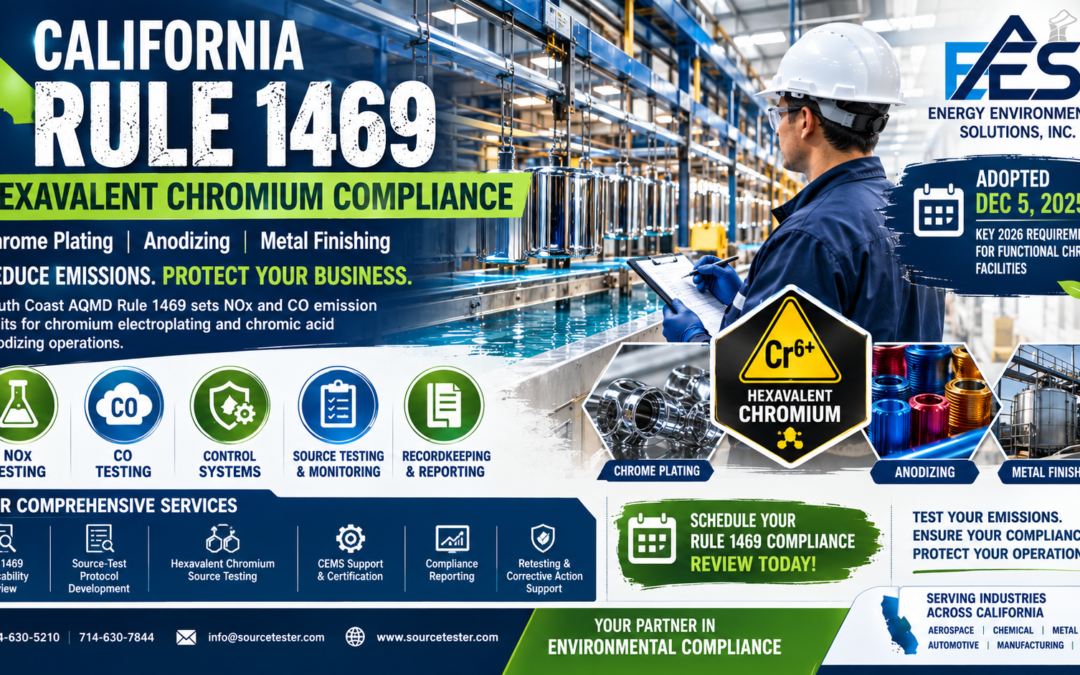
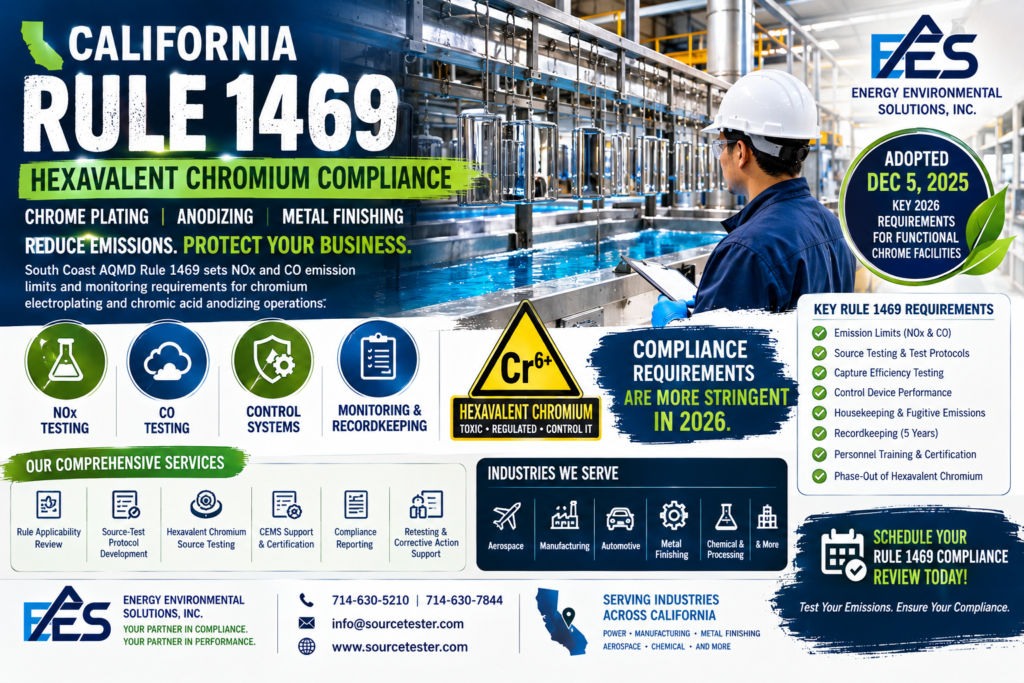
Rule 1469 was amended on December 5, 2025, and new requirements for functional chrome-plating facilities became effective beginning January 1, 2026.
For facilities that have not reviewed their Rule 1469 compliance strategy recently, now is the time to check your tanks, controls, permits, source-test schedule and monitoring records.
What Is Rule 1469?
Rule 1469 regulates hexavalent chromium emissions from:
- Chromium electroplating
- Hard chromium electroplating
- Decorative chromium electroplating
- Chromic acid anodizing
- Functional chrome-plating operations
- Certain associated process tanks and control equipment
The current rule defines Functional Chrome Plating as including hard chromium electroplating, chromic acid anodizing and continuous passivation.
Rule 1469 is a South Coast AQMD rule, so it should not be presented as a universal statewide California requirement. Facilities outside South Coast AQMD may have different requirements from their local air district and applicable California regulations.
Why Is Hexavalent Chromium Compliance Important?
Hexavalent chromium, commonly written as Cr(VI) or Cr+6, can be generated as a mist or emission during certain chromium plating and anodizing operations.
Rule 1469 therefore focuses on controlling emissions at the source.
The compliance strategy can involve:
Tank Controls
→ Emission Capture
→ Air Pollution Control
→ Source Testing
→ Parameter Monitoring
→ Maintenance
→ Recordkeeping
→ Annual Compliance Reporting
This makes Rule 1469 considerably more than a one-time emissions test.
🚨 Major 2026 Rule 1469 Update
One of the most important developments for 2026 is the implementation of stricter requirements for functional chrome-plating facilities.
South Coast AQMD’s 2025 regulatory advisory stated that, beginning January 1, 2026, functional plating facilities would face:
- Lower emission limits for applicable Tier III tanks
- More frequent source testing
- Additional requirements for pollution-control systems
The advisory identified a 0.00075 mg/amp-hr emission limit for functional chrome-plating tanks measured downstream of the add-on air-pollution-control device.
The amended Rule 1469 now incorporates these requirements for functional chrome facilities.
Why this matters
A facility that passed an older source test may not automatically be ready for the newer 2026 requirements.
Your previous test report, control device, permit conditions and testing frequency should be reviewed against the current requirements.
Rule 1469 Was Amended December 5, 2025
South Coast AQMD’s official rule book currently identifies Rule 1469 as amended:
- October 9, 1998
- May 2, 2003
- December 5, 2008
- November 2, 2018
- April 2, 2021
- December 5, 2025
The December 5, 2025 amendment is particularly important because it incorporates more stringent requirements associated with California’s Chrome Airborne Toxic Control Measure and establishes additional provisions for functional chrome operations and phase-out of hexavalent chromium use.
What Changed for Functional Chrome Facilities?
Beginning January 1, 2026, applicable functional chrome-plating facilities must meet the requirements in the amended rule.
For affected Tier III tanks, the rule establishes different emission limits depending on the tank and control-device configuration.
Examples include:
0.00075 mg/amp-hr
For a Tier III tank connected to an add-on air-pollution-control device that also controls a functional chrome-plating tank.
0.20 mg/hr
For certain Tier III tanks connected to an applicable add-on control device with a maximum exhaust rate of 5,000 cfm or less, or certain non-ventilated control configurations.
0.004 mg/hr-ft²
For certain Tier II/Tier III tanks connected to an add-on air-pollution-control device with an exhaust rate greater than 5,000 cfm and not connected to a functional chrome-plating tank.
The applicable limit must be determined from the facility’s exact configuration and current rule/permit conditions.
New Source-Testing Expectations
Source testing is one of the most important components of Rule 1469 compliance.
The amended rule requires applicable facilities to conduct source testing according to the specified schedule and approved source-test procedures.
For functional chrome facilities, the requirements are more frequent than the older general schedule.
South Coast AQMD’s 2025 regulatory advisory stated that source tests were required in 2024 or 2025 to demonstrate compliance with the January 1, 2026 requirements, followed by source testing every two calendar years.
In practical terms:
2026 compliance is not simply “we tested last year.”
You need to determine:
What tank?
What tier?
What process?
What control device?
What emission limit?
When was the last passing test?
When is the next test due?
Rule 1469 Source-Test Protocol
Source testing should be planned well before the actual field test.
The rule requires applicable source tests to be conducted according to an approved source-test protocol.
The protocol addresses items such as:
- Test criteria
- Target chromium concentration
- Analytical information
- Sampling parameters
- Operating conditions
- Test methods
- Applicable emission limits
- Required calculations
South Coast AQMD also requires advance notification of scheduled source testing. Under the current rule, the owner/operator must notify the Executive Officer at least 60 calendar days before the scheduled source test.
Don’t make this mistake:
Scheduling the test first and worrying about the protocol afterward.
A professional compliance program should start with the regulatory review and test protocol.
What Is Measured During Rule 1469 Testing?
Depending on the applicable source and testing requirement, Rule 1469 testing can involve measurement and evaluation of:
Hexavalent Chromium
The primary toxic pollutant addressed by the rule.
Total Chromium
Certain approved methods can report chromium emissions as total chromium where permitted by the applicable requirements.
Capture Efficiency
Testing may be necessary to demonstrate that chromium emissions are properly captured by the air-pollution-control system.
Control-Device Performance
Pressure, airflow and other operating parameters can be important to demonstrating proper control-device operation.
South Coast AQMD identifies CARB Method 425, U.S. EPA Method 306 and South Coast AQMD Method 205.1 among approved testing approaches in the rule, depending on the applicable requirement.
Tier I, Tier II and Tier III Tanks
Rule 1469 categorizes certain hexavalent-chromium tanks into Tier I, Tier II and Tier III classifications.
For example, the current rule defines a Tier I tank based in part on operation with a hexavalent chromium concentration of 1,000 ppm or greater.
Tier II and Tier III classifications are determined using specified temperature/concentration ranges and other equipment/process characteristics.
Why classification matters
Your tank classification can affect:
- Emission controls
- Testing
- Monitoring
- Operating requirements
- Source-test frequency
- Compliance limits
- Phase-out requirements
A tank-by-tank applicability review is therefore essential.
Air Pollution Control Systems
Rule 1469 can require affected facilities to control chromium emissions using appropriate pollution-control techniques.
Examples include:
- Add-on air pollution control devices
- Add-on non-ventilated control devices
- Composite mesh-pad systems
- Packed-bed scrubbers
- Fiber-bed mist eliminators
- HEPA filtration
- Tank covers
- Mechanical fume suppressants
- Approved chemical fume suppressants
The rule also establishes operating-parameter monitoring requirements for applicable control systems.
Control-Device Monitoring Matters
Passing a source test does not mean the facility can stop monitoring.
Rule 1469 establishes monitoring requirements for parameters such as:
- Static pressure
- Differential pressure
- Airflow
- Collection-slot velocity
- Push-air manifold pressure
For certain control systems, measurements are required at specified intervals and must remain within applicable ranges.
The rule also includes specific corrective-action requirements when measurements fall into repairable or failing ranges.
Example: Collection-Slot Monitoring
For certain add-on control systems, Rule 1469 establishes categories such as:
Acceptable
Measurements above specified thresholds based on the most recent passing source test or screening.
Repairable
Measurements falling into specified intermediate ranges may require repair or replacement and re-measurement.
Failing
Measurements below specified thresholds can require immediate action, including shutdown of tanks controlled by the affected system.
Why this matters for your business
Your environmental compliance team needs to know what happens when a monitoring value moves outside the acceptable range.
Waiting until an annual test can be too late.
Housekeeping & Fugitive-Emission Controls
Rule 1469 is not only about stack emissions.
The rule also addresses potential fugitive chromium emissions through requirements involving:
- Building enclosures
- Tank process areas
- Cleaning
- Dragout control
- Containment
- Storage
- Tank labeling
- Handling of contaminated materials
- Prevention of visible residue accumulation
For example, the current rule requires certain containment devices used to control dragout to be cleaned weekly so that visible residue, dust or potentially contaminated liquid does not accumulate.
Building Enclosure Requirements
Applicable Tier II and Tier III tanks must operate within required building-enclosure configurations.
Rule 1469 also contains specific provisions concerning enclosure openings and sensitive receptors.
For certain openings facing a sensitive receptor or school within 1,000 feet, additional closure requirements apply.
This makes facility layout and ventilation design an important part of compliance.
Chemical Fume Suppressants
Facilities using wetting-agent chemical fume suppressants must use products certified by South Coast AQMD under the applicable program.
South Coast AQMD states that certified chemical fume suppressants must achieve the applicable emission-performance criterion, and PFOS-containing suppressants are prohibited from being added to anodizing/chrome-plating tanks under the applicable requirements.
Facility operators should verify:
- Suppressant certification
- Surface tension
- Bath chemistry
- Monitoring records
- Required testing
- Applicable restrictions
Training & Certification
Rule 1469 includes training and certification provisions for personnel responsible for specified environmental compliance activities.
The current rule states that designated personnel involved in areas such as environmental compliance recordkeeping, electroplating bath chemistry and surface-tension testing must complete an approved training program and receive the required certification, with certification occurring on a two-year cycle.
This means your compliance program should include people, procedures and equipment—not just emissions testing.
Phase-Out of Hexavalent Chromium
One of the biggest long-term developments is the phase-out framework.
The amended Rule 1469 prohibits construction or operation of new tanks using hexavalent chromium for decorative plating, hard chromium plating or chromic acid anodizing unless the facility already had qualifying hexavalent-chromium equipment permitted on or before January 1, 2024.
Decorative Chrome
The default phase-out date is:
January 2, 2030
subject to the alternative phase-out provisions in the rule.
Functional Chrome
The rule establishes a phase-out date beginning:
January 2, 2039
or the date specified in the applicable California Air Toxics Control Measure, whichever is later, subject to the rule’s provisions.
What does this mean for manufacturers?
Businesses using hexavalent chromium should begin evaluating:
Alternative chemistry + replacement equipment + permits + capital planning + testing + production impacts
rather than waiting until a phase-out deadline approaches.
Rule 1469 Requirements for Modified Facilities
Facilities undergoing modifications face additional requirements.
Under the current rule, facilities modifying applicable equipment after January 1, 2024 must meet specified requirements, including maintaining permitted annual ampere-hour limitations and controlling affected tanks using appropriate add-on or non-ventilated control systems.
For applicable modified tanks, the rule establishes a 0.00075 mg/amp-hr or lower emission limitation demonstrated through source testing.
Planning a facility modification?
Review Rule 1469 before purchasing or installing the equipment.
Environmental compliance should be part of the engineering design—not an afterthought.
Rule 1469 Compliance Pros
✅ 1. Better Control of Hexavalent Chromium
Emission controls and testing help reduce chromium emissions from affected operations.
✅ 2. Improved Process Control
Monitoring airflow, pressure, surface tension and other parameters can identify problems early.
✅ 3. Better Environmental Documentation
Professional source-test reports and monitoring records provide valuable compliance documentation.
✅ 4. Early Detection of Control-System Problems
Testing and monitoring can reveal issues with scrubbers, mist eliminators, ventilation systems and other controls.
✅ 5. Supports Long-Term Transition Planning
The phase-out framework gives businesses an opportunity to evaluate alternative technologies and processes.
Rule 1469 Compliance Cons & Challenges
❌ 1. Higher Testing Costs
Specialized chromium emissions testing requires qualified personnel, analytical capabilities and appropriate equipment.
❌ 2. More Frequent Testing
Functional chrome facilities face increased source-testing requirements under the newer framework.
❌ 3. Equipment Upgrades
Some facilities may need upgrades to air-pollution-control systems to meet applicable limits.
❌ 4. Operational Disruption
Testing, maintenance and equipment modifications must be coordinated with production.
❌ 5. Detailed Recordkeeping
Compliance involves maintaining testing, monitoring, maintenance and reporting records.
❌ 6. Future Transition Costs
Facilities relying on hexavalent chromium should evaluate future process and equipment replacement costs well ahead of phase-out dates.
Common Rule 1469 Compliance Mistakes
❌ Using an outdated source-test schedule
The 2026 requirements can be more stringent for functional chrome operations.
❌ Testing without reviewing the current rule
A previous successful test does not automatically establish current compliance.
❌ Ignoring the control device
A good emissions result depends on properly functioning capture and control equipment.
❌ Poor monitoring records
Missing pressure, airflow or surface-tension records can weaken your compliance documentation.
❌ Delaying protocol preparation
Applicable source-test protocols need regulatory approval before the field test.
❌ Ignoring facility modifications
A modification can trigger additional requirements.
❌ Waiting for an inspection
A proactive compliance review is generally much easier to manage than an emergency response.
How EES Helps With Rule 1469 Compliance
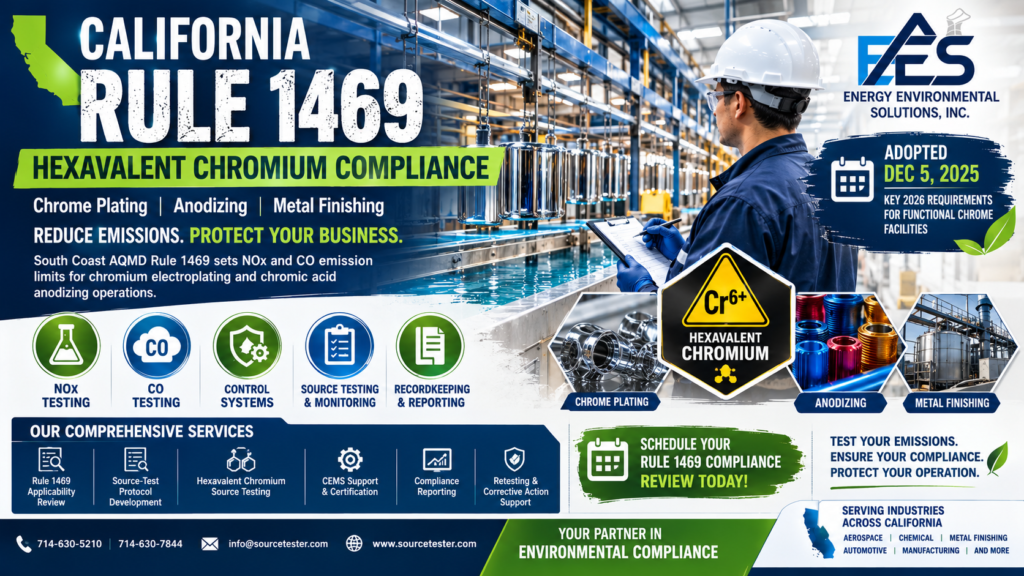
Energy Environmental Solutions, Inc. (EES) can help chromium-plating, anodizing and metal-finishing facilities with the technical testing and compliance documentation associated with Rule 1469.
1. Rule 1469 Applicability Review
EES can review:
Facility + Tanks + Process + Chromium Type + Tank Tier + Control Device + Permit
to identify applicable testing and monitoring requirements.
2. Hexavalent Chromium Source Testing
EES can provide/support applicable hexavalent chromium emissions testing and source-test programs.
This can include evaluation of:
- Chromium emissions
- Applicable emission limits
- Operating conditions
- Sampling parameters
- Control-device performance
3. Source-Test Protocol Development
EES can help prepare a detailed source-test protocol covering:
- Applicable regulations
- Test methods
- Sampling procedures
- Test conditions
- Analytical requirements
- QA/QC
- Calculations
- Reporting requirements
4. Capture Efficiency Testing
EES can support applicable testing to evaluate whether chromium emissions are being properly captured by the ventilation and control system.
5. Control-System Performance Evaluation
EES can help evaluate relevant operating parameters such as:
- Airflow
- Pressure
- Collection velocity
- Control-device performance
- Applicable monitoring parameters
6. Compliance Reporting
EES can help organize technical documentation and source-test reports for regulatory compliance records.
7. Retesting & Corrective-Action Support
If testing identifies an exceedance or control-system problem, EES can assist with planning follow-up testing and documenting corrective actions.
EES Rule 1469 Compliance Process
REVIEW
Facility + Permit + Tanks + Rule Applicability
↓
CLASSIFY
Tier I / Tier II / Tier III + Process Type
↓
PLAN
Applicable Limit + Test Method + Operating Conditions
↓
PROTOCOL
Prepare & Submit Source-Test Protocol
↓
TEST
Hexavalent Chromium / Chromium + Capture & Control Parameters
↓
ANALYZE
Validate Results Against Applicable Requirements
↓
REPORT
Prepare Technical Compliance Documentation
↓
FOLLOW UP
Corrective Action / Retesting / Ongoing Monitoring
Who May Need Rule 1469 Compliance Services?
Potential clients include:
✈️ Aerospace Manufacturers
Chromium plating and anodizing are commonly associated with aerospace manufacturing and component finishing.
⚙️ Metal-Finishing Companies
Facilities performing hard or decorative chrome plating.
🚗 Automotive & Transportation Manufacturing
Facilities using chromium finishing processes.
🏭 Industrial Manufacturers
Operations using chromium electroplating as part of production.
🔧 Machine & Tool Manufacturers
Facilities using hard chrome for wear resistance and surface performance.
🧪 Specialty Surface-Finishing Companies
Chromium-based plating and anodizing operations.
🛠️ Defense & Precision Manufacturing
Facilities where chromium finishing is used for performance and corrosion resistance.
Actual Rule 1469 applicability depends on the facility, process and applicable South Coast AQMD requirements.
2026 Rule 1469 Compliance Checklist
Before your next compliance review, ask:
- Is my facility subject to Rule 1469?
- Do we perform chromium electroplating?
- Do we perform chromic acid anodizing?
- Do we use hexavalent chromium?
- What tank tier applies?
- Are we a functional chrome facility?
- Is our current permit consistent with the equipment?
- What emission limit applies?
- Is our source-test protocol current?
- When was our last successful source test?
- When is our next source test due?
- Are our airflow and pressure measurements current?
- Are our control devices properly maintained?
- Are our housekeeping records complete?
- Are our personnel training/certifications current?
- Have we reviewed the 2026 requirements?
- Do we have a long-term plan for hexavalent chromium phase-out?
Don’t Wait for Your Next Compliance Deadline
For chromium-plating and anodizing facilities, Rule 1469 compliance is becoming increasingly technical.
The winning strategy is proactive:
Know Your Tank → Know Your Limit → Test Correctly → Monitor Continuously → Maintain Records → Plan Ahead
EES can help facilities move from reactive compliance to a structured testing and monitoring program.
🚨 Is Your Facility Ready for Rule 1469 in 2026?
If your facility performs:
✔ Hard Chrome Plating
✔ Decorative Chrome Plating
✔ Chromic Acid Anodizing
✔ Functional Chrome Operations
✔ Chromium-Based Metal Finishing
don’t wait until your next regulatory deadline to review your compliance status.
EES Can Help With:
✔ Rule 1469 Applicability Review
✔ Hexavalent Chromium Emissions Testing
✔ Source-Test Protocol Development
✔ Source Testing & Compliance Testing
✔ Capture Efficiency Testing
✔ Control-System Performance Evaluation
✔ Compliance Reporting
✔ Retesting Support
Get Your Rule 1469 Compliance Review
Is Your Chromium-Plating Operation Ready for the 2026 Requirements?
Send EES your:
📍 Facility Location
⚙️ Process Type
🧪 Chromium Chemistry
🛢️ Tank Information
💨 Air Pollution Control Device
📄 Current Permit
📊 Previous Source-Test Report
Request a Rule 1469 Compliance Assessment Today.
Test Your Emissions. Verify Your Controls. Strengthen Your Compliance Program.
Energy Environmental Solutions, Inc. (EES)
Phone: 714-630-5210 | 714-630-7844
Email: info@sourcetester.com
Website: sourcetester.org