Rule 1153.1 California 2026 | NOx Testing & Compliance for Commercial Food Ovens | Source Tester | EES
California Rule 1153.1 Compliance in 2026: Is Your Commercial Food Oven Ready for the Next NOx Requirement?
Commercial Food Oven Owners: The Zero-NOx Transition Is Getting Closer
If your facility operates commercial food ovens, bakery ovens, cooking ovens, tortilla ovens, smokehouses, roasters, dryers or other permitted commercial food-oven equipment in the South Coast AQMD jurisdiction, Rule 1153.1 – Emissions of Oxides of Nitrogen from Commercial Food Ovens deserves your attention.
South Coast AQMD adopted the current Rule 1153.1 amendment on August 4, 2023, and the rule establishes progressively tighter NOx requirements, including future zero-emission requirements for certain equipment categories.
And 2026 is an important year.
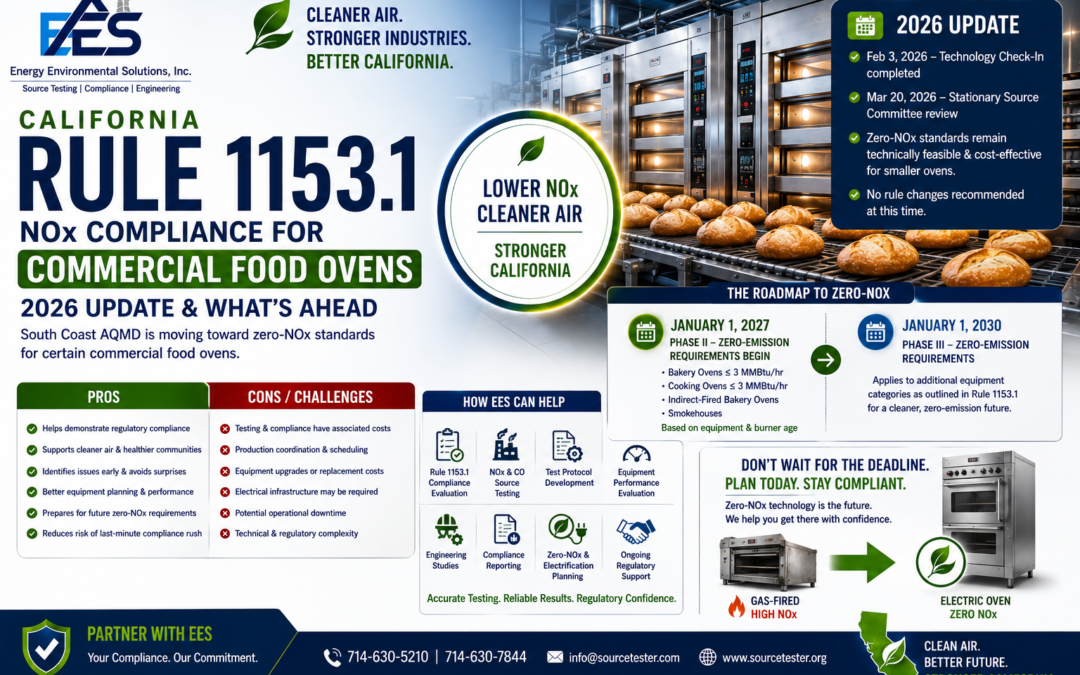
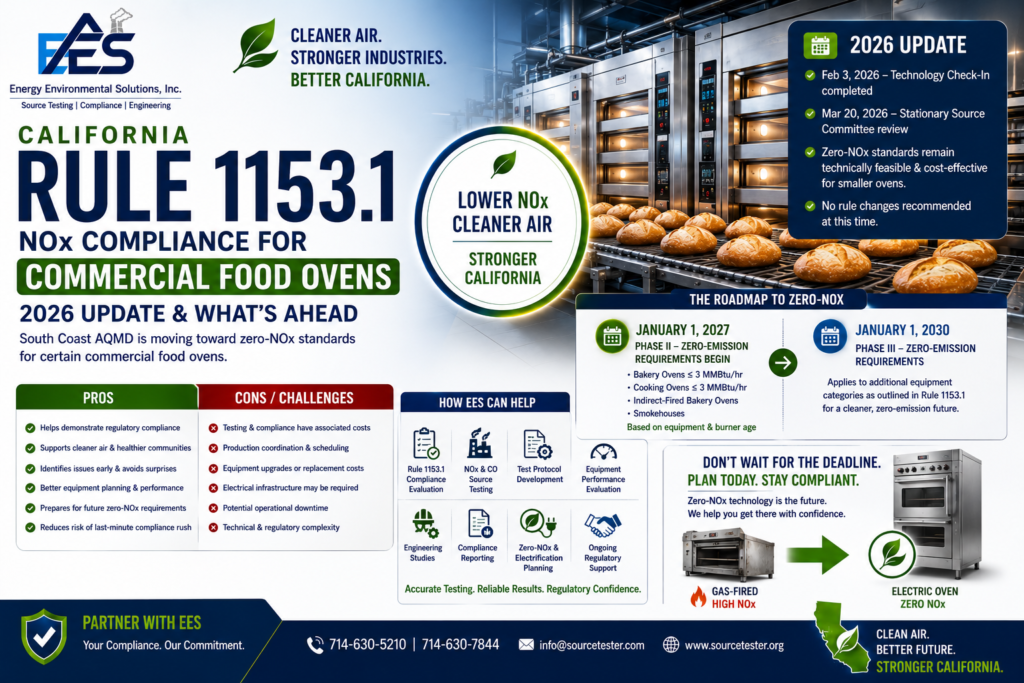
South Coast AQMD held a Rule 1153.1 Technology Check-In on February 3, 2026, followed by a Stationary Source Committee review on March 20, 2026. The District’s 2026 assessment found that zero-NOx standards remain technically feasible and cost-effective for certain smaller equipment categories, while larger units face greater cost and fuel-switching challenges.
The message for facility owners is simple:
Don’t wait until your oven is approaching a compliance trigger to start planning.
What Is California Rule 1153.1?
Rule 1153.1 controls NOx emissions from permitted commercial food ovens used to prepare food or products for making beverages for human consumption within the South Coast AQMD jurisdiction.
The regulated equipment can include:
- Bakery ovens
- Cooking ovens
- Tortilla ovens
- Drying ovens
- Smokehouses
- Roasters
- Dryers
- Other qualifying commercial food-oven equipment
The current rule establishes Phase I NOx limits, followed by future zero-emission requirements for specified categories.
What Are the Current NOx Requirements?
The 2023 amendment established Phase I limits of 30 ppm NOx for most commercial food-oven categories, while tortilla ovens heated solely by infrared burners have a 15 ppm NOx limit.
The rule then moves toward zero-emission requirements for specified equipment categories.
This is particularly important for equipment planning because a facility may need to consider:
NOx testing → equipment age → burner age → permit requirements → retrofit/replacement → electrification → future compliance
🚨 Major 2026 Rule 1153.1 Update
South Coast AQMD Completed a Technology Check-In
On February 3, 2026, South Coast AQMD held a public technology check-in for Rule 1153.1.
The purpose was to evaluate whether the technology and cost assumptions behind the future zero-NOx requirements remain appropriate.
The March 20, 2026 Stationary Source Committee materials reported an important conclusion:
Zero-NOx standards remain technically feasible and cost-effective for certain smaller units.
The District specifically reported zero-NOx standards as cost-effective for:
- Bakery ovens ≤3 MMBtu/hr
- Indirect-fired bakery ovens
- Cooking ovens ≤3 MMBtu/hr
- Smokehouses
For larger equipment, the District concluded that maintaining low-NOx requirements was appropriate because transitioning to zero emissions was not cost-effective at this time, with fuel-switching costs being a major factor.
Current status:
Staff did not recommend a rule change at the March 2026 technology check-in.
That makes the existing compliance roadmap especially important for businesses planning equipment upgrades or replacements.
What Is Coming Next?
The 2023 rule framework established future implementation dates for zero-emission requirements.
January 1, 2027
Phase II zero-emission requirements begin for applicable categories.
These include certain:
- Bakery ovens ≤3 MMBtu/hr
- Indirect-fired bakery ovens
- Cooking ovens
- Smokehouses
The specific compliance trigger for existing equipment can depend on the unit’s age and burner age, rather than simply the calendar date.
January 1, 2030
Phase III requirements apply to applicable categories under the rule framework.
The original rule development included additional time for larger equipment where zero-emission technology and electrification presented greater technical and economic challenges.
Important: Facility owners should evaluate the exact rule language, permit conditions, equipment age, burner age and applicable category before assuming a specific deadline applies to their equipment.
Why 2026 Is the Right Time to Start Planning
A major equipment transition cannot always happen overnight.
Zero-emission or electric commercial food ovens can require:
- New equipment
- Electrical infrastructure
- Utility coordination
- Facility modifications
- Engineering studies
- Permit review
- Production planning
- Installation time
- Startup and compliance evaluation
South Coast AQMD has recognized that fuel-switching costs can significantly affect cost-effectiveness, especially for larger equipment.
So waiting until the last moment could create unnecessary operational pressure.
Smart approach:
Evaluate → Test → Plan → Upgrade → Verify → Comply
Rule 1153.1 Compliance Testing: Why It Matters
NOx compliance is not simply about installing a new burner or purchasing an electric oven.
Facilities need reliable information about actual equipment performance.
Depending on the applicable requirements, a compliance program can involve:
- NOx emissions testing
- CO emissions testing
- Fuel-flow measurements
- Heat-input calculations
- Operating-condition verification
- Test protocol preparation
- Permit-condition review
- Source-test reporting
- Equipment certification or documentation
- Compliance recordkeeping
Accurate testing provides facility owners with defensible emissions data and helps identify potential problems before they become larger compliance issues.
Pros of Rule 1153.1 Compliance & NOx Testing
✅ 1. Helps Demonstrate Compliance
Professional emissions testing can provide documented data supporting applicable NOx and CO compliance requirements.
✅ 2. Supports Cleaner Operations
Lower NOx emissions contribute to South Coast California’s broader air-quality objectives.
✅ 3. Helps Identify Problems Early
Testing can identify combustion or operational issues before they become more expensive problems.
✅ 4. Supports Equipment Planning
Reliable emissions data can help facility managers decide whether equipment should be maintained, retrofitted or replaced.
✅ 5. Helps Prepare for Zero-NOx Requirements
Early assessment provides more time to evaluate electrification and zero-emission options.
✅ 6. Can Reduce Last-Minute Compliance Risk
Planning ahead can reduce the chance of rushing through testing, permitting or equipment changes near a regulatory trigger.
Cons & Challenges
Compliance also creates real operational challenges.
❌ Testing Costs
Professional source testing requires specialized equipment, personnel and technical reporting.
❌ Production Coordination
Testing may need to be conducted under representative operating conditions, requiring coordination with production.
❌ Equipment Modification Costs
Some facilities may need burner modifications, controls or equipment replacement.
❌ Electrification Costs
For applicable zero-NOx equipment, electrical upgrades and utility infrastructure can become significant expenses.
❌ Potential Production Disruption
Equipment replacement or modification may require planned downtime.
❌ Technical Complexity
Understanding NOx limits, equipment categories, burner age, unit age, permit requirements and compliance schedules can be complicated.
How EES Helps With Rule 1153.1
Energy Environmental Solutions, Inc. — Your Compliance Partner
Rule 1153.1 compliance requires more than simply taking an emissions reading.
EES can help facilities build a practical compliance strategy around testing, documentation and engineering support.
1. Rule 1153.1 Compliance Evaluation
EES can review applicable equipment and help identify the relevant regulatory and testing requirements.
2. NOx Source Testing
EES provides professional source-testing support to measure NOx emissions under applicable test conditions.
3. CO Testing
Where required, EES can support carbon monoxide emissions testing and compliance evaluation.
4. Test Protocol Development
EES can help develop test protocols based on applicable regulatory requirements, permit conditions and facility operations.
5. Equipment Performance Evaluation
Testing data can help determine whether equipment is performing within applicable emission requirements.
6. Regulatory Reporting
EES can support the preparation of technical emissions reports and compliance documentation.
7. Engineering Studies
For facilities evaluating equipment upgrades or future compliance strategies, engineering support can help assess available options.
8. Zero-NOx & Electrification Planning
As facilities move toward future zero-emission requirements, EES can help customers evaluate the emissions-testing and compliance side of equipment transition planning.
Rule 1153.1 + Rule 1153: Don’t Confuse the Two
This is important for commercial bakeries.
Rule 1153
VOC emissions
Commercial Bakery Ovens
Rule 1153.1
NOx emissions
Commercial Food Ovens
A bakery facility may need to consider both rules, depending on its equipment and operations.
EES can help facilities evaluate their applicable air-quality testing requirements rather than treating each requirement in isolation.
Is Your Commercial Food Oven Ready?
Ask your environmental/compliance team:
☑ Do we know which Rule 1153.1 category applies to our oven?
☑ Do we know our current NOx emissions?
☑ When was our last NOx compliance test?
☑ How old is our oven?
☑ How old is the burner?
☑ Are our permits and equipment records current?
☑ Will future zero-NOx requirements affect our equipment?
☑ Will electrical infrastructure be required?
☑ Have we started planning for potential equipment replacement?
☑ Do we have a testing and compliance strategy?
If several answers are “No” or “I’m not sure,” now is the time to investigate.
Don’t Wait for the Deadline
California’s commercial food-oven regulatory landscape is moving toward lower and, for certain equipment categories, zero-NOx emissions.
The 2026 technology check-in confirmed that zero-NOx requirements remain viable for certain smaller equipment categories, while larger equipment continues to face technical and economic challenges.
Your equipment may have years of useful life left—but your compliance planning should start now.
Partner With EES
Accurate Testing. Reliable Results. Regulatory Confidence.
Energy Environmental Solutions, Inc.
Source Testing | Compliance | Engineering
Need Rule 1153.1 NOx Testing or Compliance Support?
Contact EES
📞 714-630-5210 | 714-630-7844
MEASURE. VERIFY. COMPLY.
Your Compliance. Our Commitment.