Rule 1147 California | NOx & CO Source Testing & Compliance

Rule 1147 California | NOx & CO Source Testing & Compliance

Rule 1147 Compliance in California: NOx Testing, CO Testing & Source Testing Requirements

Is your combustion equipment ready for South Coast AQMD Rule 1147 compliance?

If your facility operates permitted gas- or liquid-fueled combustion equipment that is not covered by another Regulation XI rule, South Coast AQMD Rule 1147 – NOx Reductions from Miscellaneous Sources may apply to your equipment. The rule is designed to reduce NOx emissions while limiting CO emissions.

For manufacturers, industrial facilities, commercial operations, environmental managers and plant owners, understanding Rule 1147 is important because compliance can involve emission limits, source testing, monitoring, combustion-system maintenance, recordkeeping and permit requirements.

Important: Rule 1147 is a South Coast AQMD rule, not a uniform statewide California requirement.


What Is Rule 1147?

Rule 1147 – NOx Reductions from Miscellaneous Sources applies to manufacturers, distributors, retailers, installers, owners and operators of gaseous- and/or liquid-fueled combustion equipment that requires a South Coast AQMD permit when another Regulation XI rule does not apply.

The current adopted rule was amended May 6, 2022.

Rule 1147 can cover a wide range of equipment, including:

  • Ovens
  • Dryers
  • Heaters
  • Furnaces
  • Kilns
  • Calciners
  • Cookers
  • Roasters
  • Heated tanks
  • Thermal oxidizers
  • Catalytic oxidizers
  • Afterburners
  • Vapor incinerators
  • Evaporators
  • Fryers
  • Parts washers
  • Autoclaves
  • Make-up air heaters
  • Certain turbines
  • Other miscellaneous combustion equipment

The exact applicability depends on the equipment, permit status, fuel, heat-input rating and whether another South Coast AQMD rule applies.


Why Rule 1147 Matters to California Industries

NOx emissions contribute to ozone and other air-quality problems. Rule 1147 establishes emission requirements intended to reduce NOx from combustion sources while also establishing CO limits for applicable equipment.

For businesses, compliance is not simply about having a permitted burner.

You need to demonstrate that applicable equipment continues to meet the required emission limits under the applicable compliance pathway.

In simple terms:

Combustion Equipment → Emissions → Testing/Monitoring → Documentation → Compliance


2026 Rule 1147 Update: What Businesses Need to Know

The major regulatory change remains the May 6, 2022 amendment, which introduced updated NOx and CO limits, implementation schedules, monitoring/source-testing requirements, revised exemptions and provisions affecting both RECLAIM and non-RECLAIM facilities.

South Coast AQMD’s current official rule book lists Rule 1147 as amended May 6, 2022.

South Coast AQMD also provides a Rule 1147 Guidance Document dated March 7, 2025, which explains applicability, implementation schedules and source-testing requirements.

What does this mean in 2026?

Facilities should not rely on an old compliance checklist.

Your team should verify:

Current Rule + Current Permit + Equipment Age + Rated Heat Input + Previous Test Date + Applicable Compliance Schedule


Which Equipment Can Be Affected?

Rule 1147 has a broad equipment scope.

Examples include:

🔥 Industrial Heating Equipment

  • Furnaces
  • Heaters
  • Ovens
  • Dryers
  • Kilns
  • Calciners
  • Roasters

🏭 Process Equipment

  • Heated process tanks
  • Evaporators
  • Parts washers
  • Autoclaves
  • Cookers

🌡️ Air & Pollution-Control Equipment

  • Make-up air heaters
  • Thermal oxidizers
  • Catalytic oxidizers
  • Afterburners
  • Vapor incinerators

⚡ Other Combustion Equipment

Certain turbines and miscellaneous gas- or liquid-fired units may also fall within the rule.


Equipment Below 325,000 BTU/hr

One important exemption is that Rule 1147 does not apply to units with a heat-input rating below 325,000 Btu/hr, subject to the rule’s other provisions. Charbroilers and food ovens are also specifically excluded.

This is one reason a facility should perform an equipment-by-equipment applicability review rather than assuming every combustion device is regulated identically.


Rule 1147 NOx & CO Limits

The rule uses different emission limits depending on:

  • Equipment category
  • Fuel type
  • Process temperature
  • Equipment age/status
  • Applicable compliance schedule

For example, Table 2 includes requirements such as:

Equipment CategoryNOx LimitCO Limit
Afterburner / Thermal Oxidizer / Catalytic Oxidizer / Vapor Incinerator20 ppmv or 0.024 lb/MMBtu
Burn-off Furnace / Burnout Oven / Incinerator / Crematory30 ppmv or 0.036 lb/MMBtu
Oven / Dryer / Heater / Kiln / Furnace <1,200°F20 ppmv or 0.024 lb/MMBtu
Oven / Dryer / Heater / Kiln / Furnace ≥1,200°F30 ppmv or 0.036 lb/MMBtu
Make-up Air Heater30 ppmv or 0.036 lb/MMBtu
Tenter/Fabric/Carpet Dryer20 ppmv or 0.024 lb/MMBtu
Autoclave30 ppmv or 0.036 lb/MMBtu
Liquid-Fueled Unit <1,200°F40 ppmv or 0.053 lb/MMBtu1,000 ppmv

These are reference examples from Table 2, not a substitute for determining the limit applicable to a particular unit.


The “Less Than 1 Pound of NOx Per Day” Option

One of the important Rule 1147 compliance pathways allows an owner/operator to elect to demonstrate that NOx emissions are less than one pound per day averaged over a calendar month, subject to the rule’s requirements.

This can involve a non-resettable totalizing time meter or fuel meter and prescribed operating/fuel-use limits.

For example, the rule provides monthly operating-hour limits based on rated heat input for certain units:

  • Below 1 MMBtu/hr: 240 hours/month
  • 1 to below 1.5 MMBtu/hr: 160 hours/month
  • 1.5 to 2 MMBtu/hr: 120 hours/month

The actual compliance pathway must be evaluated against the rule and facility conditions.


Rule 1147 Source Testing Requirements

This is where professional emissions testing becomes particularly important.

Rule 1147 requires applicable compliance determinations to use a South Coast AQMD-approved source-test protocol and test under specified operating conditions. Testing generally uses a period of at least 15 minutes and no more than 60 consecutive minutes, unless an alternative period is approved.

Testing must be performed after startup and at the unit’s normal firing rate.

For specified equipment categories, an additional compliance determination may be required at low heat input or during a specified period after startup.


Source-Test Protocol: A Critical Step

Don’t wait until the testing date to think about the protocol.

Rule 1147 requires the source-test protocol to be submitted to the Executive Officer for approval no later than 90 days before the scheduled source test.

Typical process:

Rule Review

Equipment Review

Test Protocol Development

Protocol Submission

Regulatory Approval

Field Testing

Data Analysis

Compliance Report

This is one reason early scheduling is important.


Required Testing Frequency

For applicable units with NOx emissions ≥1 pound/day, Rule 1147 establishes source-testing frequencies based on rated heat input capacity:

Units <10 MMBtu/hr

Every 5 calendar years

Units ≥10 and <40 MMBtu/hr

Every 3 calendar years

Units ≥40 MMBtu/hr

Every calendar year

The rule also establishes minimum intervals between tests and special provisions for units that have been shut down for extended periods.

This makes one thing clear:

Knowing your last test date is not enough.

You need to know the rated heat input and applicable compliance category.


Who Can Conduct Rule 1147 Testing?

Rule 1147 requires applicable compliance determinations to be performed using an independent contractor approved by the Executive Officer under the Laboratory Approval Program for the applicable test methods.

This is an important consideration when selecting a testing company.

Before scheduling your test, verify:

  • Appropriate test-method approval
  • Qualified personnel
  • Proper instrumentation
  • Calibration procedures
  • QA/QC
  • South Coast AQMD experience
  • Reporting capability

What Is Tested?

Depending on the equipment and compliance pathway, testing can involve:

NOx

The primary pollutant targeted by Rule 1147.

CO

Rule 1147 also establishes CO requirements for applicable equipment.

Oxygen

O₂ measurements are used in applicable emission calculations and correction procedures.

Carbon Dioxide

CO₂ may also be measured as part of applicable source-test procedures.

South Coast AQMD Method 100.1 and Method 10.1 are among the methods identified in Rule 1147 for applicable compliance determinations.


Rule 1147 Maintenance Requirements

Testing alone is not enough.

Rule 1147 requires owners/operators to perform combustion-system maintenance according to the manufacturer’s schedule and specifications and maintain the relevant records.

A strong compliance program therefore combines:

Testing + Tuning + Maintenance + Monitoring + Documentation


Recordkeeping Requirements

Rule 1147 requires certain records to be maintained for at least five years, including:

  • Source-test reports
  • Maintenance records
  • Records supporting the less-than-one-pound-per-day pathway, when applicable
  • Rated heat-input information
  • Modification records
  • Applicable CEMS records
  • Manufacturer/distributor/maintenance-company schedules and instructions

Why does this matter?

Because compliance isn’t only about passing today’s test.

You may need to demonstrate your historical compliance during an inspection or regulatory review.


Rule 1147 Compliance: Pros

✅ Reduced NOx Emissions

The rule helps reduce NOx from miscellaneous combustion sources.

✅ Better Combustion Performance

Testing can identify inefficient combustion.

✅ Early Problem Detection

Emission testing can identify issues before they become major compliance problems.

✅ Better Documentation

Professional testing provides defensible technical records.

✅ Predictable Maintenance

Emission trends can help facilities plan maintenance.

✅ Environmental Benefits

Lower NOx emissions support regional air-quality objectives.


Rule 1147 Compliance: Challenges

❌ Testing Costs

Professional source testing requires specialized equipment and qualified personnel.

❌ Protocol Lead Time

Applicable protocols need to be planned and submitted well before testing.

❌ Equipment Downtime / Coordination

Testing must be coordinated with facility operations.

❌ Aging Burners

Older combustion systems may have difficulty meeting more stringent requirements.

❌ Retesting

If equipment fails, corrective action and additional testing may be necessary.

❌ Recordkeeping

Facilities must maintain compliance records for multiple years.


What Happens If Your Unit Fails?

A failed test doesn’t mean you should panic—but it does require prompt action.

Step 1 — Identify the Cause

Potential issues can include:

  • Burner condition
  • Fuel/air ratio
  • Combustion controls
  • Excess air
  • Burner wear
  • Maintenance problems
  • Operating temperature
  • Control-system performance

Step 2 — Correct the Problem

Tune, repair or modify the combustion system as appropriate.

Step 3 — Verify

Perform appropriate follow-up testing.

Step 4 — Document

Maintain:

  • Test results
  • Maintenance records
  • Corrective actions
  • Retest results

Step 5 — Maintain Compliance

Establish a monitoring and maintenance schedule to prevent repeat problems.


Rule 1147 compliance testing in California? Learn about NOx, CO, source testing, monitoring, maintenance and South Coast AQMD Rule 1147 requirements.

How EES Helps With Rule 1147 Compliance

Energy Environmental Solutions, Inc. (EES) can help industrial and commercial facilities manage the technical requirements associated with Rule 1147.

1. Rule Applicability Review

EES can review:

Equipment + Fuel + Rated Heat Input + Permit + Process Temperature + Applicable Regulation

to help identify the relevant compliance requirements.


2. NOx & CO Source Testing

EES can support applicable NOx and CO emissions testing using the appropriate approved procedures.


3. Source-Test Protocol Development

EES can help prepare protocols covering:

  • Equipment information
  • Applicable limits
  • Test methods
  • Operating conditions
  • Sampling procedures
  • QA/QC
  • Calculations
  • Reporting requirements

4. Compliance Testing

EES can coordinate field testing for applicable equipment and evaluate the resulting emissions data.


5. Combustion-System Compliance Support

Testing results can help identify whether burner tuning, maintenance or corrective action should be investigated.


6. Compliance Documentation

EES can assist with technical reports and organized documentation for your environmental compliance records.


7. Retesting & Corrective-Action Support

If results indicate an exceedance, EES can help facilities plan appropriate corrective testing.


EES Rule 1147 Compliance Process

1. REVIEW

Equipment + Permit + Rule Applicability

2. PLAN

Testing Requirements + Applicable Limits

3. PROTOCOL

Prepare & Submit Test Protocol

4. TEST

NOx + CO + O₂ + Applicable Parameters

5. ANALYZE

Validate Data & Calculate Results

6. REPORT

Prepare Compliance Documentation

7. FOLLOW UP

Corrective Action / Retesting if Required


Who Should Consider a Rule 1147 Compliance Review?

Potential clients include:

🏭 Manufacturing Facilities

🔥 Industrial Heating Operations

🧪 Chemical & Processing Facilities

🎨 Paint & Coating Operations

🚗 Automotive/Parts Manufacturing

🏺 Ceramic & Kiln Operations

♻️ Waste & Remediation Operations

🏢 Commercial Facilities

💧 Water/Wastewater Operations

⚙️ Facilities Using Thermal Oxidizers or Other Combustion Equipment

Applicability should always be confirmed based on the specific equipment and South Coast AQMD permit.


Rule 1147 Compliance Checklist for 2026

Before your next test, ask:

  • Is my equipment subject to Rule 1147?
  • Is the unit above 325,000 Btu/hr?
  • What is its rated heat input?
  • What fuel does it use?
  • What is the process temperature?
  • Is another Regulation XI rule applicable?
  • What NOx limit applies?
  • What CO limit applies?
  • Does my unit emit ≥1 lb NOx/day?
  • When was the last source test?
  • When is the next test due?
  • Is a source-test protocol required?
  • Has the protocol been submitted on time?
  • Is the testing contractor appropriately approved?
  • Are combustion-maintenance records current?
  • Are five years of compliance records available?
  • Has the equipment been modified?
  • Does the permit reflect the current equipment?

🚨 Don’t Wait Until Your Next Inspection

A compliance problem discovered at the last minute can create:

Testing delays + Maintenance Costs + Retesting + Production Disruption + Regulatory Risk

A proactive program gives you time to identify and correct problems.

EES Can Help You:

✔ Rule 1147 Applicability Review
✔ NOx Source Testing
✔ CO Testing
✔ Source-Test Protocol Development
✔ Combustion Compliance Testing
✔ Compliance Documentation
✔ Retesting Support
✔ Environmental Compliance Consulting


Ready for Rule 1147 Testing?

Is Your Combustion Equipment Ready for Its Next Compliance Test?

Don’t wait until your deadline is approaching.

Send EES:

📍 Facility Location
⚙️ Equipment Type
🔥 Fuel Type
📏 Rated Heat Input
🌡️ Operating Temperature
📄 Current Permit
📊 Last Source-Test Report

Request a Rule 1147 Compliance Review Today.

Test Your Emissions. Verify Your Compliance. Protect Your Operation.

Energy Environmental Solutions, Inc. (EES)
Phone: 714-630-5210 | 714-630-7844
Email: info@sourcetester.com
Website: sourcetester.org

Rule 1147 California 2026 | NOx Testing & Compliance Services | Source Tester | EES

Rule 1147 California 2026 | NOx Testing & Compliance Services | Source Tester | EES

Rule 1147 in California 2026: Latest Updates, Pros, Cons & How EES Helps Industries

Rule 1147 — NOx Reductions from Miscellaneous Sources is an important South Coast AQMD regulation for certain fuel-fired combustion equipment in Southern California. It is designed to reduce nitrogen oxide (NOx) emissions while limiting carbon monoxide (CO) from permitted gaseous- and liquid-fuel-fired equipment that is not covered by another applicable Regulation XI rule.

Important: Rule 1147 is not a statewide California rule. It applies within the South Coast AQMD jurisdiction to equipment meeting the rule’s applicability requirements. Other California air districts have their own rules and permit requirements.

For industrial facilities operating spray-booth heaters, ovens, dryers, furnaces, thermal oxidizers, afterburners, vapor incinerators, tenter-frame dryers, process heaters and other miscellaneous combustion equipment, understanding the current Rule 1147 requirements can be critical to avoiding compliance problems.

Energy Environmental Solutions, Inc. (EES) helps facilities with Rule 1147 source testing, NOx testing, CO testing, compliance test protocol development, emissions testing, CEMS/RATA/CGA, engineering studies and regulatory reporting.


What Is South Coast AQMD Rule 1147?

Rule 1147 was adopted in 2008 and most recently amended on May 6, 2022. The current South Coast AQMD rulebook identifies it as Rule 1147 — NOx Reductions from Miscellaneous Sources.

The rule applies to certain gaseous- and/or liquid-fuel-fired combustion equipment requiring a South Coast AQMD permit, when another Regulation XI rule does not already apply to the unit.

Covered equipment can include categories such as:

  • Thermal oxidizers
  • Catalytic oxidizers
  • Afterburners
  • Vapor incinerators
  • Ovens
  • Dryers
  • Dehydrators
  • Heaters
  • Furnaces
  • Kilns
  • Calciners
  • Cookers
  • Roasters
  • Tenter-frame dryers
  • Fabric and carpet dryers
  • Remediation units
  • Certain liquid-fuel-fired equipment

The exact applicability depends on the equipment, fuel, rated heat-input capacity, permit status and other provisions of the rule.
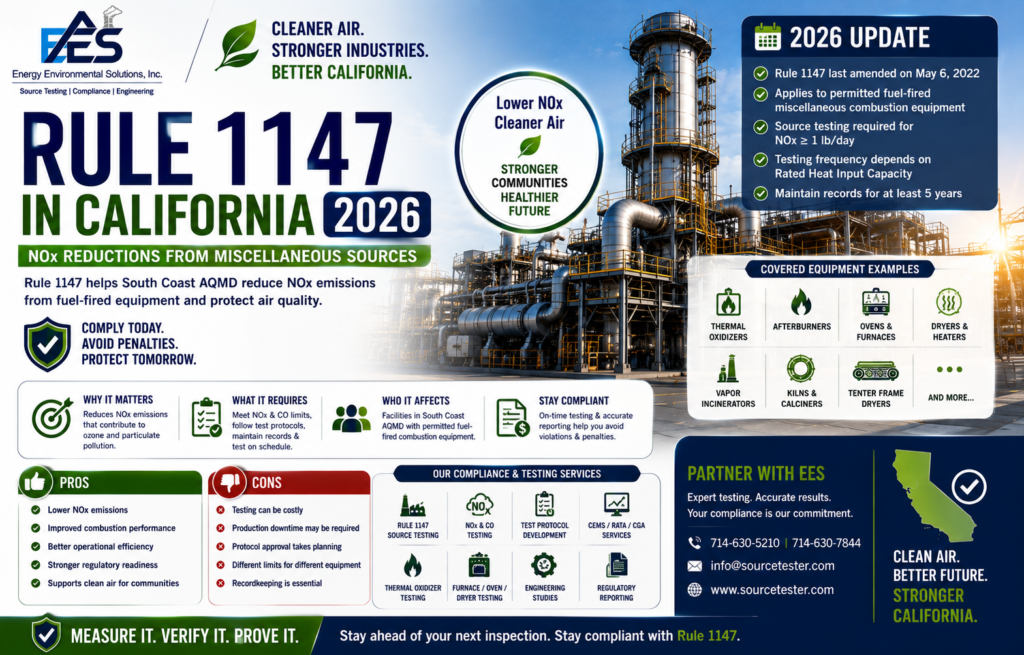

Latest 2026 Rule 1147 updates, NOx and CO testing requirements, pros and cons, source-test frequencies and how EES helps South Coast AQMD facilities stay compliant.

Why Does Rule 1147 Matter in 2026?

The environmental reason is straightforward: NOx contributes to ozone and particulate pollution, making NOx reductions an important component of regional air-quality planning.

South Coast AQMD’s Rule 1147 technology assessment explains that the rule’s NOx reductions are an important part of the region’s attainment strategy for federal and state ambient air-quality standards, including standards for ozone, PM2.5 and PM10.

And the need for effective air-quality controls remains highly relevant in 2026. South Coast AQMD’s current 2026 news and regulatory activity includes ozone advisories, particulate-related actions, toxic-air-contaminant rulemaking and additional emissions-control initiatives.

The compliance message for industry:

NOx compliance is not simply about installing a burner or combustion system. Facilities need to demonstrate that applicable equipment actually operates within its required emissions limits.


Latest Rule 1147 Updates for 2026

1. The Current Rule Remains the May 6, 2022 Version

As of August 2026, South Coast AQMD’s current Regulation XI listing identifies Rule 1147 as amended May 6, 2022. There is no indication on the current official rule listing of a newer 2026 amendment to Rule 1147 itself.

That distinction is important.

“Latest 2026 update” does not mean Rule 1147 itself was amended in 2026. Instead, facilities need to consider the current Rule 1147 requirements alongside their current permits and other 2026 regulatory developments.


2. Source Testing Remains a Major Compliance Requirement

For units subject to Rule 1147 with NOx emissions of at least 1 pound per day, the rule requires source testing to demonstrate compliance with applicable NOx and CO limits in the rule or permit.

The testing frequency depends on the equipment’s Rated Heat Input Capacity:

Rated Heat Input CapacitySource-Test Frequency
< 10 MMBtu/hrEvery 5 calendar years
≥ 10 and < 40 MMBtu/hrEvery 3 calendar years
≥ 40 MMBtu/hrEvery calendar year
≥40 MMBtu/hr with ≥6 months shutdownTest within 90 days after resumed operation, subject to the rule’s conditions

These intervals are specified in Rule 1147 paragraph (h)(12).

This is one of the most important points for facility managers:

Your source-test due date can depend directly on the equipment’s rated heat-input capacity and NOx emissions.


3. Rule 1147 Requires an Approved Test Protocol

Source testing isn’t simply a matter of sending a technician to the facility and taking measurements.

Rule 1147 requires the operator to submit a source-test protocol to the Executive Officer for approval no later than 90 days before the scheduled source test, subject to the rule’s timing provisions.

For subsequent compliance determinations, protocol resubmission may not be necessary when an approved protocol already exists, provided the unit has not been modified in a way requiring a permit modification and the applicable limits have not become more stringent.

Why does this matter?

Because an improperly planned test can create unnecessary delays, additional costs and potentially unusable compliance data.

Test planning should happen before the test day—not after.


4. Independent Testing Is Required

Rule 1147 requires compliance determinations to be conducted by an independent contractor approved by the Executive Officer under the Laboratory Approval Program for the applicable test methods.

That means facilities should verify that their selected testing company has the appropriate qualifications and approvals for the methods being used.

This is particularly important when a facility is approaching a regulatory deadline.


5. Recordkeeping Still Matters

Rule 1147 requires source-test reports and maintenance records to be maintained for at least five years and made available to South Coast AQMD personnel upon request.

This means compliance doesn’t end when the testing crew leaves the site.

Your facility should maintain:

  • Source-test reports
  • Maintenance records
  • Rated heat-input information
  • Fuel records where applicable
  • CEMS records where applicable
  • Compliance documentation
  • Approved testing protocols
  • Equipment modification records

Good documentation can be as important as good testing.


What Emission Limits Does Rule 1147 Establish?

Rule 1147 contains different NOx and CO limits depending on the equipment category, fuel type, process temperature and whether the unit is an in-use unit or subject to the newer Table 2 requirements.

For example, Table 1 includes different limits for equipment such as thermal oxidizers, ovens, heaters, dryers and other combustion equipment.

For certain gaseous-fuel-fired thermal oxidizers, catalytic oxidizers, afterburners and vapor incinerators, the Table 1 NOx limit is 60 ppmv or 0.073 lb/MMBtu, with a CO limit of 1,000 ppmv.

Table 2 establishes more stringent requirements for applicable equipment.

For example, gaseous-fuel-fired thermal oxidizers, catalytic oxidizers, afterburners and vapor incinerators are listed at 20 ppmv or 0.024 lb/MMBtu NOx under Table 2.

Do not assume these numbers automatically apply to your equipment. The applicable limit must be determined from the rule, equipment category, permit and compliance schedule.


A Key 2026 Compliance Option: Less Than 1 Pound of NOx Per Day

Rule 1147 provides an alternative pathway for certain units.

An owner or operator may elect to comply by demonstrating NOx emissions below 1 pound per day averaged over a calendar month, or by meeting an existing permit limit below 1 pound per day, whichever is applicable under the rule.

However, if the facility fails to demonstrate compliance with that option, additional permit and compliance requirements can be triggered.

This makes accurate emissions calculations and recordkeeping particularly important.


Pros of Rule 1147 Compliance

1. Lower NOx Emissions

The primary environmental benefit is reduced NOx emissions from miscellaneous combustion sources.

Lower NOx contributes to regional efforts to address ozone and particulate pollution. South Coast AQMD describes Rule 1147’s NOx reductions as an important component of its attainment strategy.

2. Better Combustion Performance

Testing can reveal problems involving burners, combustion-air systems, controls or operating conditions.

A failed or borderline test can therefore become an opportunity to identify equipment problems.

3. More Reliable Compliance Data

Professional source testing provides measured emissions data instead of relying exclusively on theoretical calculations or equipment specifications.

4. Better Maintenance Decisions

Testing results can help environmental and maintenance teams identify whether combustion equipment needs adjustment, repair or modernization.

5. Improved Regulatory Readiness

Maintaining current testing and maintenance records can make inspections and compliance reviews easier.


Cons and Challenges of Rule 1147

1. Testing Costs

Source testing requires specialized equipment, qualified personnel, laboratory or analytical resources and technical reporting.

2. Production Disruption

Testing may need to occur under specific operating conditions, which can require coordination with production schedules.

3. Protocol Approval Takes Planning

The requirement for an approved test protocol means facilities need to start preparing well before the actual test date.

4. Equipment Modifications Can Change Requirements

Changes to burners, combustion systems, fuel systems or operating conditions may affect the compliance pathway.

5. Multiple Equipment Categories

Rule 1147 covers a wide variety of equipment, so the correct testing approach is not identical for every unit.

6. Testing at the Wrong Operating Condition Can Create Problems

Rule 1147 specifies operating conditions for compliance determinations, including testing at the maximum heat-input range at which the unit normally operates and additional conditions for specified equipment categories.


What Equipment Should California Facilities Review?

If your facility is located in the South Coast AQMD jurisdiction, review Rule 1147 applicability if you operate permitted fuel-fired equipment such as:

Thermal Oxidizers • Afterburners • Vapor Incinerators • Ovens • Dryers • Heaters • Furnaces • Kilns • Tenter-Frame Dryers • Fabric Dryers • Carpet Dryers • Cookers • Roasters • Dehydrators • Remediation Units

The actual applicability must be confirmed against the current rule and permit.
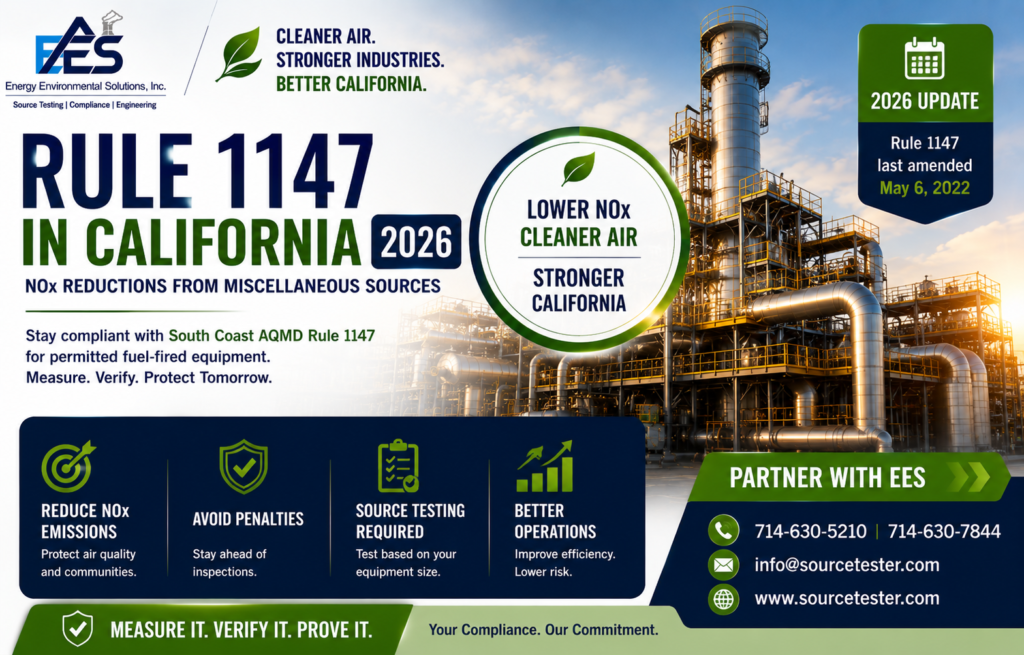

Latest 2026 Rule 1147 updates, NOx and CO testing requirements, pros and cons, source-test frequencies and how EES helps South Coast AQMD facilities stay compliant.

How EES Helps With Rule 1147 Compliance

Energy Environmental Solutions, Inc. (EES) provides technical testing and environmental compliance support for industrial facilities.

Rule 1147 Source Testing

EES can assist with testing programs designed to demonstrate applicable NOx and CO emission compliance.

Compliance Test Protocol Development

EES helps develop testing protocols covering:

  • Sampling locations
  • Applicable test methods
  • Operating conditions
  • Test runs
  • QA/QC
  • Calculations
  • Reporting requirements

NOx Testing

Accurate NOx measurements are central to Rule 1147 compliance.

CO Testing

Rule 1147 also establishes CO requirements for applicable equipment, making CO testing an important part of many compliance demonstrations.

CEMS / RATA / CGA

For facilities using continuous emissions monitoring systems, EES can support applicable CEMS, RATA and CGA requirements.

Rule 1147 also provides circumstances in which qualifying periodic monitoring or CEMS relative-accuracy testing may be used as part of the source-testing compliance schedule.

Engineering Studies

EES can help facilities evaluate combustion-system performance, emissions trends and potential compliance strategies.

Regulatory Reporting

Testing isn’t complete until the data have been properly evaluated and documented.

EES can help prepare organized technical reports and supporting documentation.


Rule 1147 Compliance Testing Process

A professional compliance project generally follows this sequence:

1. Review the Permit
Determine the applicable permit limits and conditions.

2. Confirm Rule Applicability
Determine whether Rule 1147 applies to the unit.

3. Determine Testing Frequency
Review NOx emissions and rated heat-input capacity.

4. Develop the Test Protocol
Select appropriate methods and operating conditions.

5. Submit for Approval
Follow South Coast AQMD protocol-approval requirements.

6. Conduct Field Testing
Perform NOx, CO and supporting measurements.

7. QA/QC Review
Review calibration, field data and calculations.

8. Calculate Emissions
Determine compliance with the applicable limit.

9. Prepare the Report
Document the test conditions, methods, results and conclusions.

10. Maintain Records
Retain required documentation for the applicable period.


Why Proactive Rule 1147 Testing Makes Sense in 2026

South Coast AQMD states that its compliance staff conduct regular inspections to ensure equipment and processes are operating in compliance with applicable clean-air rules.

The agency also explains that failure to correct a Notice to Comply can lead to a Notice of Violation and penalties, while continuing violations can result in daily penalties.

That is why waiting until an inspector identifies a problem is a risky compliance strategy.

A better approach:

Know your limit.
Know your test date.
Know your operating conditions.
Know your documentation.


Rule 1147 Compliance Checklist for 2026

Before your next test, review:

  • Is the unit subject to Rule 1147?
  • Is the current permit available?
  • What NOx limit applies?
  • What CO limit applies?
  • What is the unit’s rated heat-input capacity?
  • Is NOx ≥1 lb/day?
  • When was the last approved source test?
  • Is the next test due?
  • Has the test protocol been approved?
  • Has the equipment been modified?
  • Are operating conditions representative?
  • Are maintenance records current?
  • Are required fuel meters installed and maintained?
  • Are five years of required records available?
  • Is the testing contractor appropriately approved?

2026 Bottom Line

Rule 1147 remains an important South Coast AQMD NOx-compliance requirement in 2026. Although the rule itself was last amended on May 6, 2022, its current requirements continue to govern applicable miscellaneous combustion equipment, including specific source-testing frequencies, test protocols, NOx/CO limits and recordkeeping requirements.

For facilities with applicable equipment, the biggest mistake is assuming that “the equipment has always passed” means the next test can be treated casually.

Equipment ages. Burners are replaced. Processes change. Permits change. Operating conditions change.

And compliance requirements need to be checked against the current rule and permit.

Is your Rule 1147 source test due in 2026?

Are your NOx and CO emissions within the applicable limits?

Is your test protocol ready for South Coast AQMD approval?

Are your records inspection-ready?

If you’re uncertain, now is the right time to review your equipment and testing schedule.


Need Rule 1147 Testing in California?

Energy Environmental Solutions, Inc. (EES) helps industries with:

Rule 1147 Source Testing | NOx Testing | CO Testing | Compliance Test Protocol Development | Thermal Oxidizer Testing | Oven & Dryer Testing | Furnace Testing | Source & Stack Testing | CEMS | RATA | CGA | Engineering Studies | QA/QC | Regulatory Reporting

Measure Emissions. Verify Compliance. Protect Your Operations.

EES — Energy Environmental Solutions, Inc.

Phone: 714-630-5210 | 714-630-7844
Email: info@sourcetester.com
Website: sourcetester.org