Destruction Efficiency Testing California 2026 | VOC & RTO Compliance | Source Tester | EES
Destruction Efficiency in California 2026: Latest Updates, Pros, Cons & How EES Helps Industries Stay Compliant
Destruction efficiency is becoming an increasingly important performance metric for California facilities that use thermal oxidizers, regenerative thermal oxidizers (RTOs), flares, vapor-control systems, and other air-pollution control equipment to reduce VOC and other organic emissions.
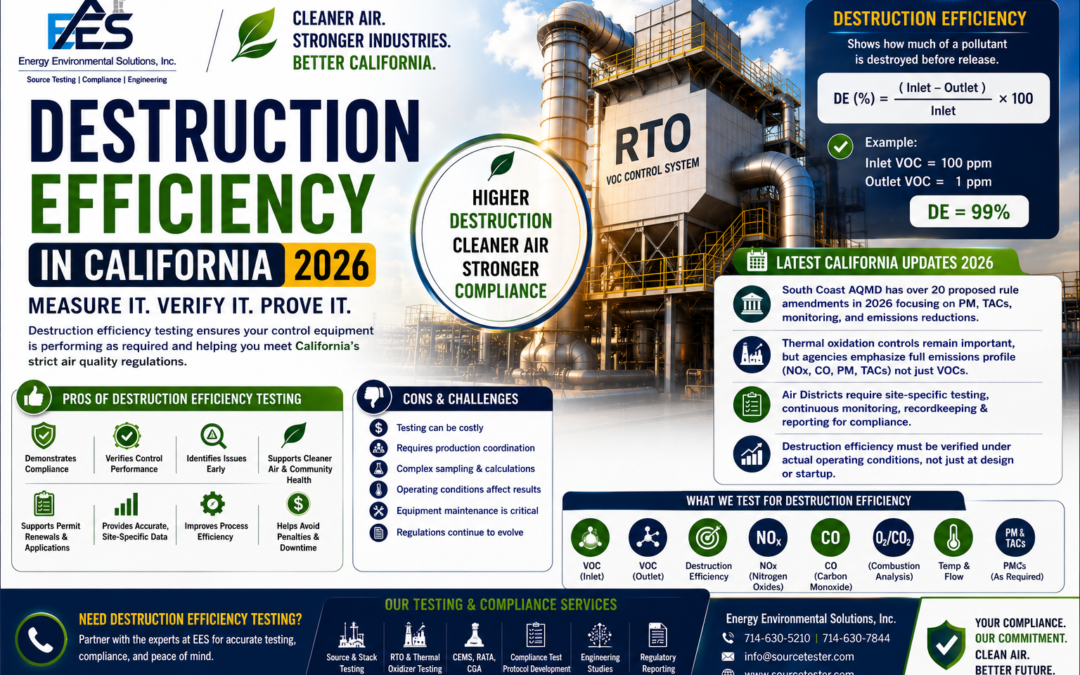
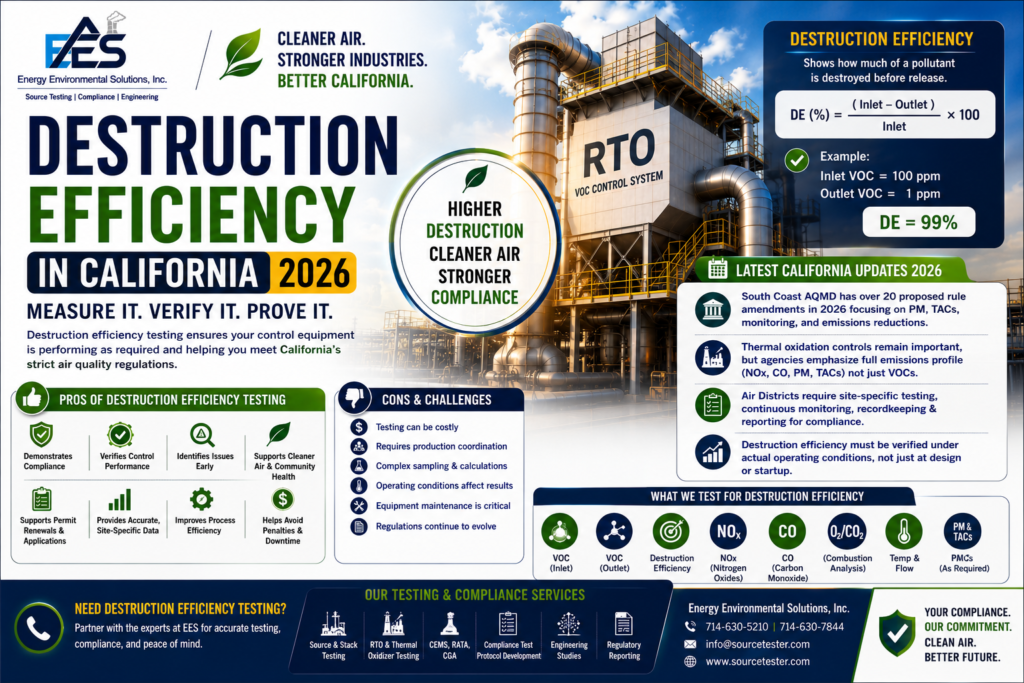
In simple terms, destruction efficiency measures how much of a pollutant entering a control device is actually destroyed before the treated gas is released. A commonly used calculation is:
Destruction Efficiency (%) = [(Inlet VOC − Outlet VOC) ÷ Inlet VOC] × 100
But achieving a high percentage during one test is not necessarily the same as maintaining compliant performance during everyday operation.
California’s 2026 regulatory environment continues to emphasize emission reductions, monitoring, source testing, toxic-air-contaminant controls, and reliable emissions data. South Coast AQMD’s 2026 rule calendar contains more than two dozen planned rule amendments and adoptions addressing particulate matter, toxic air contaminants, monitoring, New Source Review, and other air-quality objectives.
For facilities using thermal oxidation or other control technologies, that creates a growing need for accurate destruction-efficiency testing and defensible compliance documentation.
Energy Environmental Solutions, Inc. (EES) helps industries with Destruction Efficiency Testing, VOC Testing, RTO Testing, Thermal Oxidizer Testing, Source & Stack Testing, CEMS, RATA, CGA, Compliance Test Protocol Development, Engineering Studies, QA/QC, and Regulatory Reporting.
What Is Destruction Efficiency?
Destruction efficiency, often called Destruction Removal Efficiency (DRE), describes the percentage of a pollutant that a control device removes through destruction.
For example, if a control device receives 100 pounds of VOCs and only 1 pound remains in the outlet gas, the calculated destruction efficiency would be approximately 99%.
This measurement is particularly important for equipment such as:
- Regenerative Thermal Oxidizers (RTOs)
- Thermal oxidizers
- Catalytic oxidizers
- Afterburners
- Flares
- VOC control systems
- Certain combustion-based control devices
However, destruction efficiency is not the same as capture efficiency.
A facility can have an excellent control device but still release pollutants if the process exhaust is not effectively captured and routed to the control equipment.
That is why compliance evaluations may need to consider capture efficiency + control/destruction efficiency + operating conditions + actual emissions.
Is Destruction Efficiency Testing Compulsory in California?
There is an important distinction.
California does not have one universal destruction-efficiency testing requirement that applies identically to every industrial facility.
Whether a facility must demonstrate destruction efficiency depends on factors including:
- Facility location
- Local Air District
- Air permit
- Applicable regulation
- Source category
- Pollutant
- Control technology
- Required control efficiency
- Federal requirements
- State requirements
- Permit-specific testing conditions
A current South Coast AQMD emissions-reporting guideline specifically instructs facilities using thermal oxidation to use site-specific destruction-efficiency test results, the applicable permit, or the applicable rule limit when determining vapor-destruction efficiency.
This is an important compliance message:
Don’t assume your facility’s required destruction efficiency—verify it from the applicable permit and regulation.
Latest California Updates in 2026
1. California Continues Strengthening Air-Quality Controls
South Coast AQMD’s 2026 rulemaking program includes more than two dozen planned rule amendments and adoptions.
The agency’s priorities include:
- PM reduction
- Toxic-air-contaminant controls
- Updated toxic-air-contaminant lists
- New Source Review
- Monitoring requirements
- Community emission-reduction objectives
The agency says these activities support the 2016 and 2022 Air Quality Management Plans, 2024 PM Plan, federal and state air-quality standards, and AB 617 Community Emission Reduction Plans.
For facilities using VOC destruction systems, this reinforces the importance of having reliable performance data.
2. Thermal Oxidation Remains an Important Control Technology
South Coast AQMD continues to evaluate thermal oxidation as an emissions-control option.
A March 2026 South Coast AQMD staff report evaluating aerospace coating controls recognized that thermal oxidizers can technically achieve high destruction efficiencies for certain VOC and toxic compounds. However, the agency also identified limitations for some chlorinated and fluorinated compounds because thermal oxidation can produce HCl and HF, requiring additional controls such as scrubbers.
The lesson for industry is important:
A high destruction-efficiency percentage does not automatically mean a control technology is appropriate for every pollutant.
The entire emissions profile must be evaluated.
3. Regulators Are Looking Beyond a Single Performance Number
South Coast AQMD’s 2026 activities demonstrate a broader focus on monitoring, toxic air contaminants, particulate matter, and emissions data rather than relying on a single compliance measurement.
A control device may destroy VOCs while simultaneously generating other combustion-related pollutants.
South Coast AQMD’s emissions-reporting guidance specifically states that thermal oxidation can generate NOx, SOx, CO, PM, and toxic air contaminants, and encourages operators to use site-specific test results for emissions calculations when available.
Therefore, a strong testing program should evaluate the complete picture.
4. Real-World 2026 Cases Show Why Performance Verification Matters
In June 2026, South Coast AQMD hearing-board documents involving Chiquita Canyon included conditions requiring equipment modifications designed to maintain sufficient flare operation and methane content for destruction efficiency consistent with regulatory requirements.
Earlier 2026 correspondence from South Coast AQMD also discussed the relationship between operating conditions, temperature, equipment design, source-test results, and destruction efficiency at the facility.
Although this example involves landfill-gas combustion rather than a conventional industrial RTO, it illustrates a broader principle:
Regulators can require evidence that operating conditions actually support the required destruction performance.
Why Is Destruction Efficiency Testing Important?
A control device manufacturer’s guarantee may say 98%, 99%, or higher.
But what happens after the equipment has been installed?
What happens when:
- VOC loading changes?
- Production increases?
- Temperature fluctuates?
- Ceramic media becomes fouled?
- Valves begin leaking?
- Airflow changes?
- Process chemistry changes?
- The burner operates differently?
- The capture system develops leaks?
That’s where compliance testing becomes valuable.
Testing converts assumptions into measurable evidence.
Key Factors Affecting Destruction Efficiency
Temperature
Thermal oxidation generally requires sufficient temperature for effective oxidation.
If the temperature falls outside the required operating range, destruction performance may decline.
Residence Time
The contaminated gas needs sufficient time in the appropriate combustion environment.
Insufficient residence time can reduce destruction performance.
Turbulence & Mixing
Effective mixing is essential to expose the pollutant-containing gas to the required oxidation conditions.
VOC Concentration
A control system can perform differently depending on the concentration and composition of the incoming VOC stream.
Equipment Condition
Valves, burners, seals, ceramic media, sensors, ductwork, fans, and controls can all affect system performance.
Capture Efficiency
Even a highly efficient RTO cannot destroy pollutants that never reach it.
This makes capture and destruction efficiency two different but interconnected compliance considerations.
Pros of Destruction Efficiency Testing
1. Demonstrates Control Performance
Testing provides measurable evidence of how effectively the control device is destroying pollutants.
2. Supports Regulatory Compliance
Where required by a permit or regulation, test results can support compliance demonstrations.
3. Identifies Problems Early
Testing may reveal declining control efficiency before the problem becomes a larger compliance issue.
4. Supports Permit Applications
Reliable test data can be useful for permit modifications, renewals, and engineering evaluations.
5. Provides Site-Specific Data
South Coast AQMD specifically encourages the use of site-specific destruction-efficiency test results where available for emissions calculations.
6. Improves Operational Understanding
Testing can help facility engineers understand how production conditions affect control-device performance.
Cons & Challenges of Destruction Efficiency Testing
Professional testing also has challenges.
Testing Costs
Specialized source-testing equipment, qualified personnel, laboratory analysis, and reporting can increase project costs.
Production Coordination
Testing may need to occur under representative operating conditions, requiring coordination with production.
Complex Sampling
Some control-efficiency tests require simultaneous measurements at the inlet and outlet.
Variable VOC Streams
Changing process chemistry can make it difficult to establish representative testing conditions.
Secondary Pollutants
Thermal oxidation can create additional pollutants such as NOx, CO, SOx, PM, and certain toxic or acidic compounds, depending on the material being treated.
Documentation Requirements
A technically correct test can still create compliance problems if the supporting protocol, calibration, operating-condition records, calculations, or report are incomplete.
Destruction Efficiency vs. Removal Efficiency vs. Capture Efficiency
These terms are often confused.
| Term | What It Measures |
|---|---|
| Destruction Efficiency | Percentage of pollutant destroyed by the control device |
| Removal Efficiency | Percentage of pollutant removed from the treated stream; the exact meaning depends on the control process |
| Capture Efficiency | Percentage of process emissions successfully captured and routed to the control device |
| Overall Control Efficiency | Combined effect of capture and control/destruction |
A facility should understand exactly which metric its permit or regulation requires.
How Destruction Efficiency Testing Is Typically Performed
A professional testing program can include:
1. Permit Review
Identify the required control efficiency, pollutants, test frequency, and applicable methods.
2. Test Protocol Development
Define sampling locations, methods, operating conditions, number of runs, QA/QC, and calculations.
3. Pre-Test Coordination
Coordinate production and control-device operation to establish representative conditions.
4. Equipment Calibration
Prepare and calibrate sampling and analytical equipment.
5. Inlet Testing
Measure the pollutant concentration entering the control device.
6. Outlet Testing
Measure the pollutant concentration leaving the control device.
7. Operating Data Collection
Document temperature, flow, fuel use, production rate, oxygen, pressure, and other applicable parameters.
8. Calculations
Calculate destruction/control efficiency and mass emissions using the applicable methodology.
9. QA/QC Review
Verify data quality, calibration information, field records, and laboratory results.
10. Final Reporting
Prepare a technically defensible report for the facility and regulatory agency when required.
How EES Helps Industries
Energy Environmental Solutions, Inc. (EES) provides comprehensive emissions-testing and environmental compliance services for California industries.
Destruction Efficiency Testing
EES helps facilities design and perform testing programs to determine whether applicable control devices are achieving required performance.
RTO Testing
For regenerative thermal oxidizers, EES can support:
- VOC inlet testing
- VOC outlet testing
- VOC destruction/control efficiency
- NOx testing
- CO testing
- Operating-condition verification
Thermal Oxidizer Testing
EES can evaluate thermal oxidizer performance according to applicable permit and regulatory requirements.
Source & Stack Testing
Professional source and stack testing using applicable EPA, CARB, and local Air District methods.
Compliance Test Protocol Development
EES develops protocols covering:
- Test methods
- Sampling locations
- Operating conditions
- Test runs
- QA/QC
- Calculations
- Reporting
CEMS, RATA & CGA
EES also supports:
CEMS Certification | RATA | CGA | QA/QC | Monitoring
Engineering Studies
Engineering evaluations can help facilities understand emissions-control performance and identify potential improvement opportunities.
Compliance Reporting
EES provides organized technical documentation including field data, calculations, QA/QC records, operating information, and final test results.
Industries That May Need Destruction-Efficiency Testing
Depending on their control technology and permit requirements, EES can support facilities in industries such as:
- Aerospace
- Chemical Manufacturing
- Petroleum & Refining
- Pharmaceutical Manufacturing
- Paint & Coating
- Metal Finishing
- Printing
- Food Processing
- Waste Treatment
- Recycling
- Composite Manufacturing
- Fuel Processing
- Solvent-Using Industries
- Industrial Manufacturing
Why Choose EES?
When a regulator asks:
“How do you know your control device is achieving the required efficiency?”
A manufacturer’s brochure isn’t always enough.
You need credible, documented, site-specific evidence when your permit or regulation requires it.
EES helps facilities with:
✔ Destruction Efficiency Testing
✔ RTO Testing
✔ Thermal Oxidizer Testing
✔ VOC Testing
✔ Source & Stack Testing
✔ NOx & CO Testing
✔ Compliance Test Protocol Development
✔ CEMS Certification
✔ RATA & CGA
✔ QA/QC
✔ Engineering Studies
✔ Emissions Calculations
✔ Regulatory Reporting
✔ Inspection-Ready Documentation
The 2026 Compliance Message for California Industry
California’s 2026 regulatory activity shows that air-quality management is continuing to focus on emission reductions, monitoring, toxic-air contaminants, particulate matter, and community exposure.
At the same time, regulators continue to use site-specific data and permit conditions to evaluate whether emission-control equipment is achieving required performance. South Coast AQMD’s current emissions guidance specifically points to site-specific destruction-efficiency testing, permit requirements, or applicable rule limits when determining destruction efficiency for certain thermal-oxidation applications.
That makes proactive testing a smart compliance strategy.
Don’t wait until an underperforming control device becomes a regulatory problem.
Ask:
Is your VOC control efficiency still meeting your permit requirement?
Are your inlet and outlet measurements defensible?
Are your operating conditions properly documented?
Has your control device been tested under representative conditions?
Is your current test protocol aligned with your permit?
If you don’t know the answer, it may be time for a compliance review.
Need Destruction Efficiency Testing in California?
Energy Environmental Solutions, Inc. (EES) helps industrial facilities evaluate, document, and improve emissions-control performance.
Our Services
Destruction Efficiency Testing | RTO Testing | Thermal Oxidizer Testing | VOC Testing | Source Testing | Stack Testing | NOx Testing | CEMS | RATA | CGA | Compliance Test Protocol Development | Engineering Studies | Regulatory Reporting
Your Compliance. Our Commitment.
Contact Source Tester | EES
Phone: 714-630-5210 | 714-630-7844
Email: info@sourcetester.com
Website: www.sourcetester.com