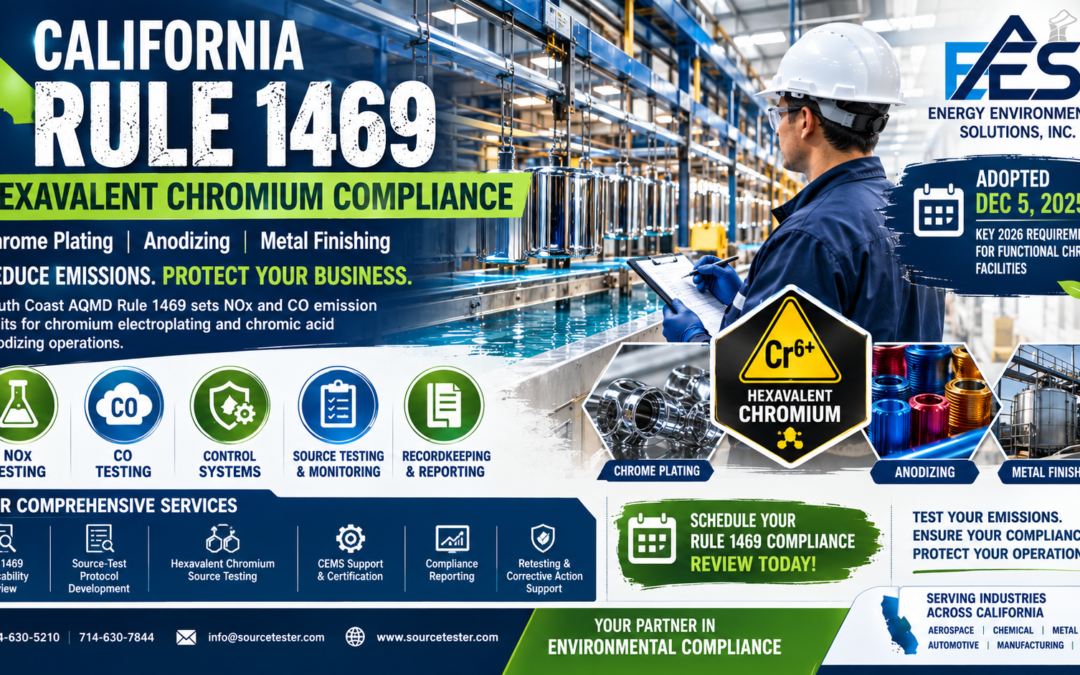
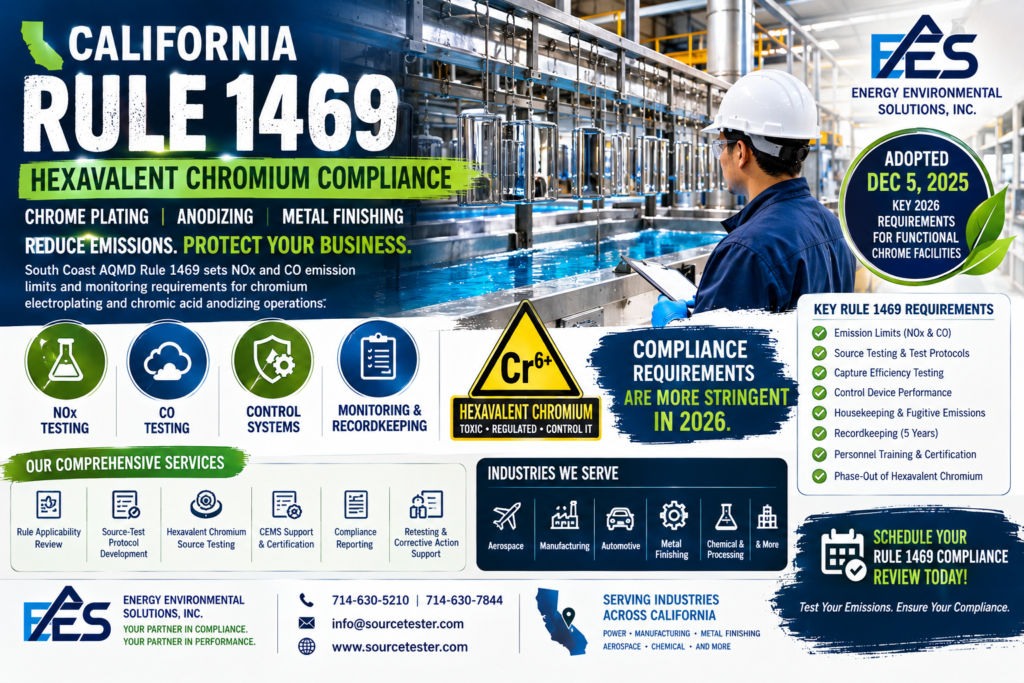
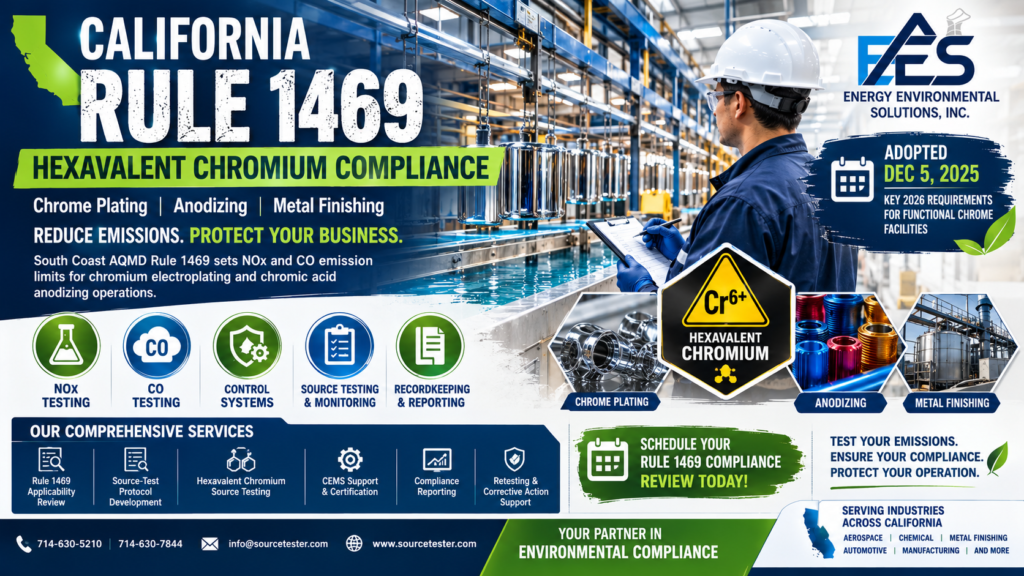
Is Your Chromium Plating or Chromic Acid Anodizing Facility Ready for Rule 1469 Compliance in 2026?
If your facility performs chromium electroplating or chromic acid anodizing in the South Coast Air Quality Management District (South Coast AQMD), Rule 1469 should be a critical part of your environmental compliance program.
South Coast AQMD Rule 1469 – Hexavalent Chromium Emissions from Chromium Electroplating and Chromic Acid Anodizing Operations is designed to reduce emissions of hexavalent chromium from affected facilities. The rule applies to facilities performing chromium electroplating or chromic acid anodizing and establishes requirements for emission controls, building enclosures, source testing, monitoring, housekeeping, recordkeeping and reporting.
And there is an important 2026 development:
Rule 1469 was amended on December 5, 2025, and new requirements for functional chrome-plating facilities became effective beginning January 1, 2026.
For facilities that have not reviewed their Rule 1469 compliance strategy recently, now is the time to check your tanks, controls, permits, source-test schedule and monitoring records.
Certain associated process tanks and control equipment
The current rule defines Functional Chrome Plating as including hard chromium electroplating, chromic acid anodizing and continuous passivation.
Rule 1469 is a South Coast AQMD rule, so it should not be presented as a universal statewide California requirement. Facilities outside South Coast AQMD may have different requirements from their local air district and applicable California regulations.
Why Is Hexavalent Chromium Compliance Important?
Hexavalent chromium, commonly written as Cr(VI) or Cr+6, can be generated as a mist or emission during certain chromium plating and anodizing operations.
Rule 1469 therefore focuses on controlling emissions at the source.
The compliance strategy can involve:
Tank Controls
→ Emission Capture
→ Air Pollution Control
→ Source Testing
→ Parameter Monitoring
→ Maintenance
→ Recordkeeping
→ Annual Compliance Reporting
This makes Rule 1469 considerably more than a one-time emissions test.
🚨 Major 2026 Rule 1469 Update
One of the most important developments for 2026 is the implementation of stricter requirements for functional chrome-plating facilities.
South Coast AQMD’s 2025 regulatory advisory stated that, beginning January 1, 2026, functional plating facilities would face:
Lower emission limits for applicable Tier III tanks
More frequent source testing
Additional requirements for pollution-control systems
The advisory identified a 0.00075 mg/amp-hr emission limit for functional chrome-plating tanks measured downstream of the add-on air-pollution-control device.
The amended Rule 1469 now incorporates these requirements for functional chrome facilities.
Why this matters
A facility that passed an older source test may not automatically be ready for the newer 2026 requirements.
Your previous test report, control device, permit conditions and testing frequency should be reviewed against the current requirements.
Rule 1469 Was Amended December 5, 2025
South Coast AQMD’s official rule book currently identifies Rule 1469 as amended:
October 9, 1998
May 2, 2003
December 5, 2008
November 2, 2018
April 2, 2021
December 5, 2025
The December 5, 2025 amendment is particularly important because it incorporates more stringent requirements associated with California’s Chrome Airborne Toxic Control Measure and establishes additional provisions for functional chrome operations and phase-out of hexavalent chromium use.
What Changed for Functional Chrome Facilities?
Beginning January 1, 2026, applicable functional chrome-plating facilities must meet the requirements in the amended rule.
For affected Tier III tanks, the rule establishes different emission limits depending on the tank and control-device configuration.
Examples include:
0.00075 mg/amp-hr
For a Tier III tank connected to an add-on air-pollution-control device that also controls a functional chrome-plating tank.
0.20 mg/hr
For certain Tier III tanks connected to an applicable add-on control device with a maximum exhaust rate of 5,000 cfm or less, or certain non-ventilated control configurations.
0.004 mg/hr-ft²
For certain Tier II/Tier III tanks connected to an add-on air-pollution-control device with an exhaust rate greater than 5,000 cfm and not connected to a functional chrome-plating tank.
The applicable limit must be determined from the facility’s exact configuration and current rule/permit conditions.
New Source-Testing Expectations
Source testing is one of the most important components of Rule 1469 compliance.
The amended rule requires applicable facilities to conduct source testing according to the specified schedule and approved source-test procedures.
For functional chrome facilities, the requirements are more frequent than the older general schedule.
South Coast AQMD’s 2025 regulatory advisory stated that source tests were required in 2024 or 2025 to demonstrate compliance with the January 1, 2026 requirements, followed by source testing every two calendar years.
In practical terms:
2026 compliance is not simply “we tested last year.”
You need to determine:
What tank?
What tier?
What process?
What control device?
What emission limit?
When was the last passing test?
When is the next test due?
Rule 1469 Source-Test Protocol
Source testing should be planned well before the actual field test.
The rule requires applicable source tests to be conducted according to an approved source-test protocol.
The protocol addresses items such as:
Test criteria
Target chromium concentration
Analytical information
Sampling parameters
Operating conditions
Test methods
Applicable emission limits
Required calculations
South Coast AQMD also requires advance notification of scheduled source testing. Under the current rule, the owner/operator must notify the Executive Officer at least 60 calendar days before the scheduled source test.
Don’t make this mistake:
Scheduling the test first and worrying about the protocol afterward.
A professional compliance program should start with the regulatory review and test protocol.
What Is Measured During Rule 1469 Testing?
Depending on the applicable source and testing requirement, Rule 1469 testing can involve measurement and evaluation of:
Hexavalent Chromium
The primary toxic pollutant addressed by the rule.
Total Chromium
Certain approved methods can report chromium emissions as total chromium where permitted by the applicable requirements.
Capture Efficiency
Testing may be necessary to demonstrate that chromium emissions are properly captured by the air-pollution-control system.
Control-Device Performance
Pressure, airflow and other operating parameters can be important to demonstrating proper control-device operation.
South Coast AQMD identifies CARB Method 425, U.S. EPA Method 306 and South Coast AQMD Method 205.1 among approved testing approaches in the rule, depending on the applicable requirement.
Tier I, Tier II and Tier III Tanks
Rule 1469 categorizes certain hexavalent-chromium tanks into Tier I, Tier II and Tier III classifications.
For example, the current rule defines a Tier I tank based in part on operation with a hexavalent chromium concentration of 1,000 ppm or greater.
Tier II and Tier III classifications are determined using specified temperature/concentration ranges and other equipment/process characteristics.
Why classification matters
Your tank classification can affect:
Emission controls
Testing
Monitoring
Operating requirements
Source-test frequency
Compliance limits
Phase-out requirements
A tank-by-tank applicability review is therefore essential.
Air Pollution Control Systems
Rule 1469 can require affected facilities to control chromium emissions using appropriate pollution-control techniques.
Examples include:
Add-on air pollution control devices
Add-on non-ventilated control devices
Composite mesh-pad systems
Packed-bed scrubbers
Fiber-bed mist eliminators
HEPA filtration
Tank covers
Mechanical fume suppressants
Approved chemical fume suppressants
The rule also establishes operating-parameter monitoring requirements for applicable control systems.
Control-Device Monitoring Matters
Passing a source test does not mean the facility can stop monitoring.
Rule 1469 establishes monitoring requirements for parameters such as:
Static pressure
Differential pressure
Airflow
Collection-slot velocity
Push-air manifold pressure
For certain control systems, measurements are required at specified intervals and must remain within applicable ranges.
The rule also includes specific corrective-action requirements when measurements fall into repairable or failing ranges.
Example: Collection-Slot Monitoring
For certain add-on control systems, Rule 1469 establishes categories such as:
Acceptable
Measurements above specified thresholds based on the most recent passing source test or screening.
Repairable
Measurements falling into specified intermediate ranges may require repair or replacement and re-measurement.
Failing
Measurements below specified thresholds can require immediate action, including shutdown of tanks controlled by the affected system.
Why this matters for your business
Your environmental compliance team needs to know what happens when a monitoring value moves outside the acceptable range.
Waiting until an annual test can be too late.
Housekeeping & Fugitive-Emission Controls
Rule 1469 is not only about stack emissions.
The rule also addresses potential fugitive chromium emissions through requirements involving:
Building enclosures
Tank process areas
Cleaning
Dragout control
Containment
Storage
Tank labeling
Handling of contaminated materials
Prevention of visible residue accumulation
For example, the current rule requires certain containment devices used to control dragout to be cleaned weekly so that visible residue, dust or potentially contaminated liquid does not accumulate.
Building Enclosure Requirements
Applicable Tier II and Tier III tanks must operate within required building-enclosure configurations.
Rule 1469 also contains specific provisions concerning enclosure openings and sensitive receptors.
For certain openings facing a sensitive receptor or school within 1,000 feet, additional closure requirements apply.
This makes facility layout and ventilation design an important part of compliance.
Chemical Fume Suppressants
Facilities using wetting-agent chemical fume suppressants must use products certified by South Coast AQMD under the applicable program.
South Coast AQMD states that certified chemical fume suppressants must achieve the applicable emission-performance criterion, and PFOS-containing suppressants are prohibited from being added to anodizing/chrome-plating tanks under the applicable requirements.
Facility operators should verify:
Suppressant certification
Surface tension
Bath chemistry
Monitoring records
Required testing
Applicable restrictions
Training & Certification
Rule 1469 includes training and certification provisions for personnel responsible for specified environmental compliance activities.
The current rule states that designated personnel involved in areas such as environmental compliance recordkeeping, electroplating bath chemistry and surface-tension testing must complete an approved training program and receive the required certification, with certification occurring on a two-year cycle.
This means your compliance program should include people, procedures and equipment—not just emissions testing.
Phase-Out of Hexavalent Chromium
One of the biggest long-term developments is the phase-out framework.
The amended Rule 1469 prohibits construction or operation of new tanks using hexavalent chromium for decorative plating, hard chromium plating or chromic acid anodizing unless the facility already had qualifying hexavalent-chromium equipment permitted on or before January 1, 2024.
Decorative Chrome
The default phase-out date is:
January 2, 2030
subject to the alternative phase-out provisions in the rule.
Functional Chrome
The rule establishes a phase-out date beginning:
January 2, 2039
or the date specified in the applicable California Air Toxics Control Measure, whichever is later, subject to the rule’s provisions.
What does this mean for manufacturers?
Businesses using hexavalent chromium should begin evaluating:
Alternative chemistry + replacement equipment + permits + capital planning + testing + production impacts
rather than waiting until a phase-out deadline approaches.
Rule 1469 Requirements for Modified Facilities
Facilities undergoing modifications face additional requirements.
Under the current rule, facilities modifying applicable equipment after January 1, 2024 must meet specified requirements, including maintaining permitted annual ampere-hour limitations and controlling affected tanks using appropriate add-on or non-ventilated control systems.
For applicable modified tanks, the rule establishes a 0.00075 mg/amp-hr or lower emission limitation demonstrated through source testing.
Planning a facility modification?
Review Rule 1469 before purchasing or installing the equipment.
Environmental compliance should be part of the engineering design—not an afterthought.
Rule 1469 Compliance Pros
✅ 1. Better Control of Hexavalent Chromium
Emission controls and testing help reduce chromium emissions from affected operations.
✅ 2. Improved Process Control
Monitoring airflow, pressure, surface tension and other parameters can identify problems early.
✅ 3. Better Environmental Documentation
Professional source-test reports and monitoring records provide valuable compliance documentation.
✅ 4. Early Detection of Control-System Problems
Testing and monitoring can reveal issues with scrubbers, mist eliminators, ventilation systems and other controls.
✅ 5. Supports Long-Term Transition Planning
The phase-out framework gives businesses an opportunity to evaluate alternative technologies and processes.
Functional chrome facilities face increased source-testing requirements under the newer framework.
❌ 3. Equipment Upgrades
Some facilities may need upgrades to air-pollution-control systems to meet applicable limits.
❌ 4. Operational Disruption
Testing, maintenance and equipment modifications must be coordinated with production.
❌ 5. Detailed Recordkeeping
Compliance involves maintaining testing, monitoring, maintenance and reporting records.
❌ 6. Future Transition Costs
Facilities relying on hexavalent chromium should evaluate future process and equipment replacement costs well ahead of phase-out dates.
Common Rule 1469 Compliance Mistakes
❌ Using an outdated source-test schedule
The 2026 requirements can be more stringent for functional chrome operations.
❌ Testing without reviewing the current rule
A previous successful test does not automatically establish current compliance.
❌ Ignoring the control device
A good emissions result depends on properly functioning capture and control equipment.
❌ Poor monitoring records
Missing pressure, airflow or surface-tension records can weaken your compliance documentation.
❌ Delaying protocol preparation
Applicable source-test protocols need regulatory approval before the field test.
❌ Ignoring facility modifications
A modification can trigger additional requirements.
❌ Waiting for an inspection
A proactive compliance review is generally much easier to manage than an emergency response.
How EES Helps With Rule 1469 Compliance
Energy Environmental Solutions, Inc. (EES) can help chromium-plating, anodizing and metal-finishing facilities with the technical testing and compliance documentation associated with Rule 1469.
1. Rule 1469 Applicability Review
EES can review:
Facility + Tanks + Process + Chromium Type + Tank Tier + Control Device + Permit
to identify applicable testing and monitoring requirements.
2. Hexavalent Chromium Source Testing
EES can provide/support applicable hexavalent chromium emissions testing and source-test programs.
This can include evaluation of:
Chromium emissions
Applicable emission limits
Operating conditions
Sampling parameters
Control-device performance
3. Source-Test Protocol Development
EES can help prepare a detailed source-test protocol covering:
Applicable regulations
Test methods
Sampling procedures
Test conditions
Analytical requirements
QA/QC
Calculations
Reporting requirements
4. Capture Efficiency Testing
EES can support applicable testing to evaluate whether chromium emissions are being properly captured by the ventilation and control system.
5. Control-System Performance Evaluation
EES can help evaluate relevant operating parameters such as:
Airflow
Pressure
Collection velocity
Control-device performance
Applicable monitoring parameters
6. Compliance Reporting
EES can help organize technical documentation and source-test reports for regulatory compliance records.
7. Retesting & Corrective-Action Support
If testing identifies an exceedance or control-system problem, EES can assist with planning follow-up testing and documenting corrective actions.
EES Rule 1469 Compliance Process
REVIEW
Facility + Permit + Tanks + Rule Applicability
↓
CLASSIFY
Tier I / Tier II / Tier III + Process Type
↓
PLAN
Applicable Limit + Test Method + Operating Conditions
↓
PROTOCOL
Prepare & Submit Source-Test Protocol
↓
TEST
Hexavalent Chromium / Chromium + Capture & Control Parameters
Is Your Chromium-Plating Operation Ready for the 2026 Requirements?
Send EES your:
📍 Facility Location ⚙️ Process Type 🧪 Chromium Chemistry 🛢️ Tank Information 💨 Air Pollution Control Device 📄 Current Permit 📊 Previous Source-Test Report
Request a Rule 1469 Compliance Assessment Today.
Test Your Emissions. Verify Your Controls. Strengthen Your Compliance Program.
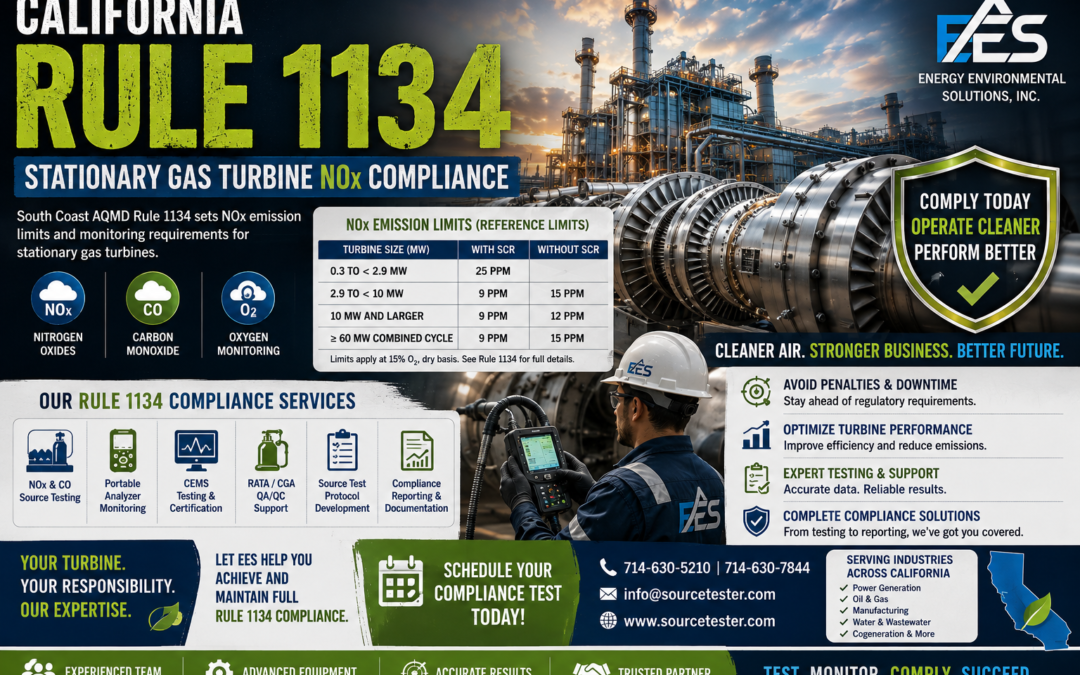
Rule 1134 Compliance in California: Stationary Gas Turbine NOx Testing, Monitoring & Source Testing Guide
Does your facility operate a stationary gas turbine in Southern California?
If yes, South Coast AQMD Rule 1134 – Emissions of Oxides of Nitrogen from Stationary Gas Turbines may be an important part of your air-quality compliance program.
Rule 1134 establishes NOx emission requirements and monitoring/source-testing provisions for applicable stationary gas turbines. The rule is particularly important for facilities operating larger turbines, turbines with catalytic controls, and turbines located at non-RECLAIM NOx facilities.
South Coast AQMD currently lists Rule 1134 as amended February 4, 2022. It also currently lists a Proposed Amended Rule 1134 in its active rulemaking section, meaning facilities should continue monitoring regulatory developments in 2026.
For facility owners, plant managers and EHS professionals, the message is simple:
Don’t wait for a compliance test to reveal an emissions problem.
Rule 1134 California
What Is Rule 1134?
Rule 1134 – Emissions of Oxides of Nitrogen from Stationary Gas Turbines is a South Coast AQMD source-specific rule intended to control NOx emissions from stationary gas turbines.
It is part of South Coast AQMD’s Regulation XI, which contains source-specific standards. The current rule book identifies Rule 1134 as applying to emissions of oxides of nitrogen from stationary gas turbines and shows its latest adopted amendment as February 4, 2022.
Important:
Rule 1134 is not a statewide California rule.
It applies within the South Coast AQMD jurisdiction when the facility/equipment meets the rule’s applicability provisions.
Facilities elsewhere in California may be subject to requirements established by their local air district.
Why Does Rule 1134 Matter?
NOx is a major air pollutant associated with combustion equipment.
NOx can contribute to:
Ozone formation
Smog
Nitrogen dioxide pollution
Fine particulate formation
Regional air-quality problems
South Coast AQMD developed Rule 1134 specifically to reduce NOx emissions from stationary gas turbines.
For businesses, however, compliance is not simply about operating a turbine.
It is about being able to demonstrate that the turbine is operating within the applicable regulatory and permit requirements.
Which Gas Turbines Can Be Subject to Rule 1134?
The rule contains specific applicability provisions and exemptions.
Historically and under the current rule framework, stationary gas turbines rated at 0.3 MW or greater are an important category.
South Coast AQMD’s compliance guidance states that, beginning January 1, 2024, owners/operators of stationary gas turbines rated 0.3 MW or larger must operate within the applicable Table I NOx emission limits, subject to the rule’s provisions.
Potentially affected equipment can include:
Industrial gas turbines
Cogeneration turbines
Combined-cycle turbines
Power-generation turbines
Turbines at wastewater facilities
Natural-gas-fired turbines
Turbines with SCR systems
Turbines at non-RECLAIM NOx facilities
But don’t assume every turbine has identical requirements.
Applicability depends on factors including:
Turbine size + installation history + facility status + fuel + control technology + operating conditions + permit conditions
2026 Update: What Facilities Should Know About Rule 1134
There are two important points for businesses in 2026.
1. The Current Adopted Rule
South Coast AQMD’s official rule book identifies Rule 1134 as amended February 4, 2022.
The 2022 amendment included changes involving:
NOx requirements
Recuperative gas turbines
Selective catalytic reduction (SCR)
CEMS provisions
Monitoring requirements
Startup/shutdown provisions
Liquid-fuel use during natural-gas curtailments at certain health facilities
South Coast AQMD’s February 2022 Governing Board materials describe these amendments and their purpose.
2. Rule 1134 Is Also Listed in Active Rulemaking
South Coast AQMD’s current Active Proposed Rules page lists Proposed Amended Rule 1134 among rules currently in the proposal/amendment process.
The dedicated Rule 1134 proposal page contains the 2021 amendment-development materials, including draft rule language, staff reports and public-hearing documents.
What does this mean for industry?
A proposed amendment is not automatically an adopted requirement.
Facilities should comply with the currently adopted rule and permit conditions while monitoring the rulemaking process for future changes.
Rule 1134 NOx Emission Limits
Rule 1134 contains NOx limits based on turbine size and applicable technology.
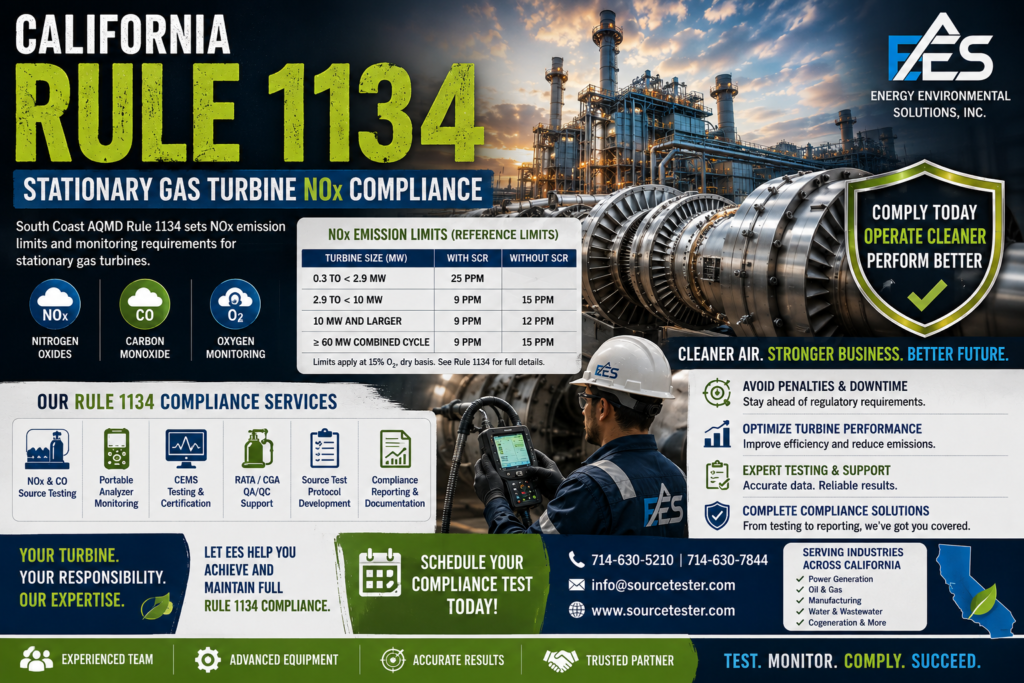
The rule’s reference limits include categories such as:
Stationary Gas Turbine
Reference NOx Limit
0.3 to <2.9 MW
25 ppm
2.9 to <10 MW
9 ppm
2.9 to <10 MW, No SCR
15 ppm
10 MW and larger
9 ppm
10 MW and larger, No SCR
12 ppm
≥60 MW Combined Cycle, No SCR
15 ppm
≥60 MW Combined Cycle
9 ppm
There are additional provisions and special categories, including turbines using qualifying sewage-digester-gas fuel. The applicable compliance calculation can also involve the turbine’s demonstrated or manufacturer-rated efficiency.
Important:
Never determine your compliance obligation from a generic table alone.
The applicable limit can depend on the specific turbine, control technology, permit and rule provisions.
Why NOx Testing Is Important
A gas turbine can appear to operate normally while its NOx emissions change because of:
Combustion conditions
Fuel characteristics
Turbine load
Air/fuel ratio
Burner condition
SCR performance
Catalyst condition
Ammonia injection
Control-system performance
Maintenance condition
Therefore:
Normal operation does not automatically mean compliant emissions.
Professional emissions testing provides objective data.
Rule 1134 Source Testing
For applicable turbines that do not use a CEMS, Rule 1134 includes source-testing requirements.
The rule provides for measurement of parameters including:
NOx concentration
Carbon monoxide concentration
Turbine efficiency, where applicable
NOx and CO concentrations are expressed in ppm by volume and corrected to 15% oxygen on a dry basis, according to the rule’s provisions.
This is where professional source testing becomes critical.
A compliant test requires more than simply taking an emissions reading.
It requires:
Correct sampling location
Correct test method
Proper calibration
Representative operating conditions
Quality assurance
Accurate calculations
Regulatory documentation
CEMS Requirements Under Rule 1134
Large turbines may have additional monitoring obligations.
Under Rule 1134, certain gas turbines 2.9 MW and larger at non-RECLAIM NOx facilities are subject to continuous monitoring provisions.
The rule requires applicable systems to monitor NOx and oxygen and also capture information such as:
Flow rate
Water/steam-to-fuel ratio where applicable
Operating time
Turbine output in MW
The CEMS requirements reference South Coast AQMD Rules 218, 218.1, 218.2 and 218.3.
That means Rule 1134 compliance can connect directly with:
CEMS Certification + QA/QC + RATA + CGA + Data Validation
CEMS vs. Source Testing
CEMS
Source Testing
Continuous monitoring
Periodic testing
Provides ongoing emissions data
Provides test-period emissions data
Used for applicable large turbines
Used where source testing is required
Requires QA/QC
Requires approved test procedures
May require certification
Requires proper field testing
Can identify changes over time
Provides a compliance snapshot
Depending on the turbine and regulatory requirements, a facility may need one or both approaches.
What Happens During a Gas Turbine Emissions Test?
A professional test program may include:
Step 1 — Pre-Test Review
Review:
Air permit
Turbine specifications
Fuel
Control equipment
Previous test results
Applicable Rule 1134 requirements
Step 2 — Test Planning
Determine:
Pollutants
Test methods
Operating conditions
Sampling location
Required test runs
Equipment
QA/QC
Step 3 — Equipment Preparation
Verify:
Calibration
Sampling equipment
Analyzers
Data systems
Gas standards
Flow measurement
Step 4 — Field Testing
Collect representative emissions data under applicable operating conditions.
Step 5 — Data Validation
Review:
Calibration data
Run data
QA/QC
Operating parameters
Calculations
Step 6 — Compliance Evaluation
Compare the results with applicable requirements.
Step 7 — Reporting
Prepare the technical source-test report and required documentation.
Common Rule 1134 Compliance Problems
1. High NOx
Potential causes include:
Combustion problems
Poor tuning
Control-system malfunction
Fuel changes
Catalyst problems
2. SCR Performance Problems
Catalyst degradation or improper ammonia control can affect emissions performance.
3. CEMS Problems
Analyzer drift, calibration issues or sampling-system problems can affect data validity.
4. Incorrect Operating Conditions
Testing at an inappropriate load may produce results that do not represent required compliance conditions.
5. Poor Documentation
Missing calibration, maintenance or testing records can create unnecessary compliance difficulties.
Rule 1134 Compliance Pros
✅ 1. Better NOx Control
Testing and monitoring help identify excessive NOx emissions.
✅ 2. Early Problem Detection
Emission testing can reveal problems before they become larger operational issues.
✅ 3. Improved Combustion Performance
Testing can help facilities understand turbine performance.
✅ 4. Better Compliance Documentation
Professional test reports create useful regulatory records.
✅ 5. Supports Environmental Goals
NOx reductions contribute to improved regional air quality.
✅ 6. Better Maintenance Decisions
Emission trends can provide an additional indicator of equipment condition.
Rule 1134 Compliance Cons / Challenges
❌ Testing Costs
Source testing requires specialized personnel, instruments and laboratory resources.
❌ Operational Coordination
The turbine may need to operate under specified conditions during testing.
❌ CEMS Investment
Large applicable turbines may require continuous monitoring systems.
📍 Facility Location ⚙️ Turbine Manufacturer & Model ⚡ MW Rating 🔥 Fuel Type 🛠️ Control Technology / SCR Information 📄 Current Permit 📊 Previous Test Report
Request a Rule 1134 Compliance Review Today
Test Your Emissions. Verify Your Compliance. Protect Your Operation.
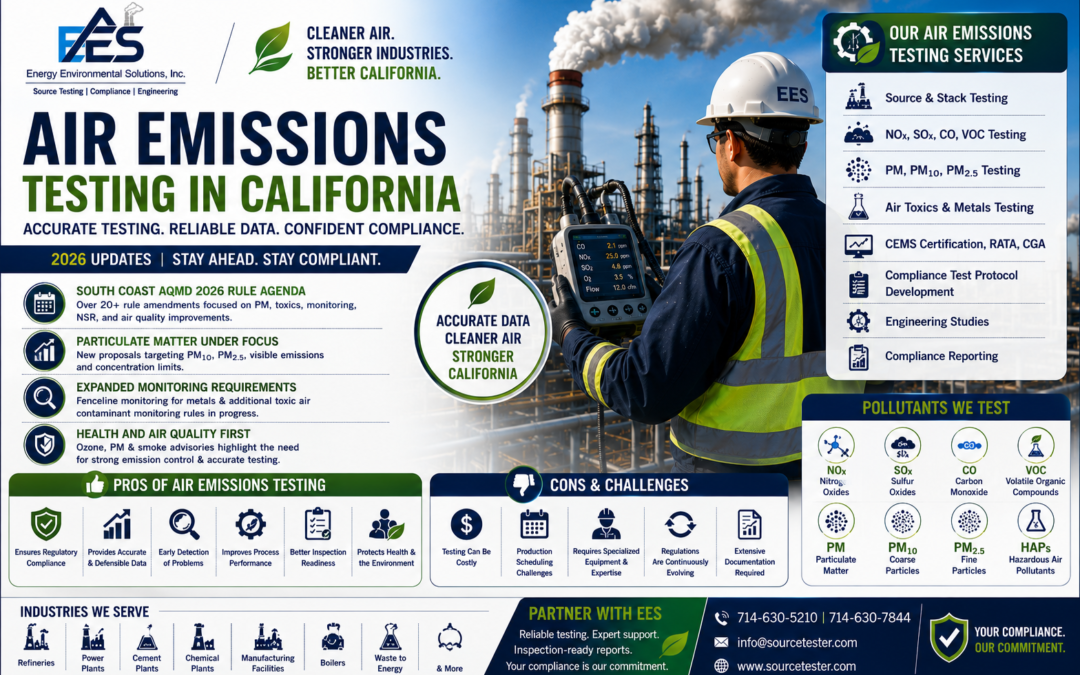
Air Emissions Testing in California (2026): Latest Updates, Pros, Cons & How EES Helps Industries Stay Compliant
California continues to operate one of the most comprehensive air-quality regulatory systems in the United States. In 2026, air emissions testing, source testing, stack testing, emissions monitoring, QA/QC, and compliance reporting remain important tools for industrial facilities demonstrating compliance with air permits and applicable state, federal, and local requirements.
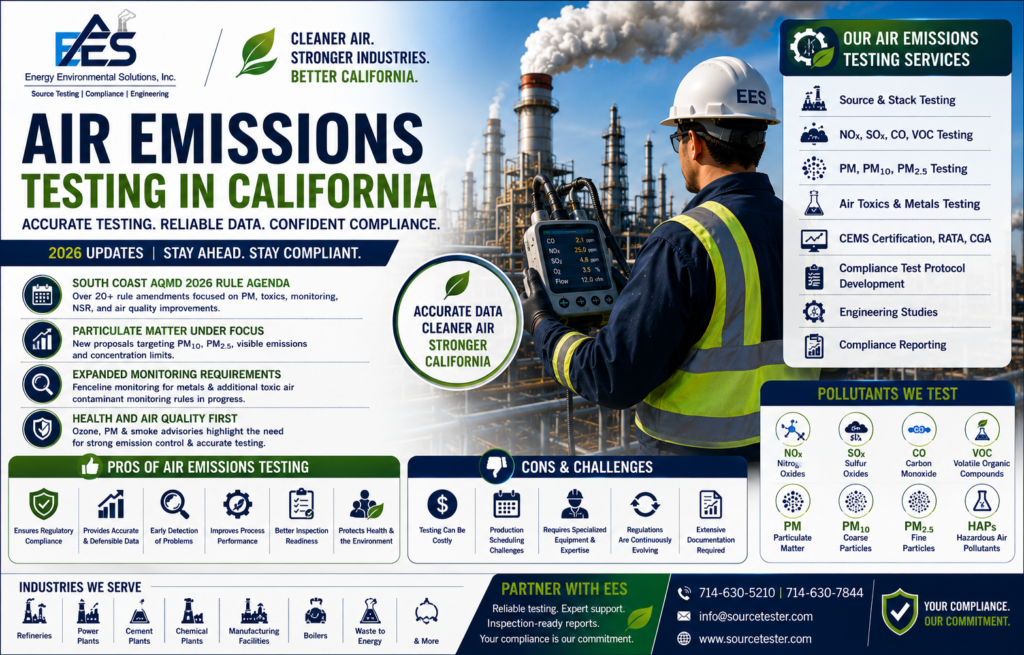
The regulatory environment is also evolving. South Coast AQMD’s 2026 rulemaking calendar includes more than two dozen planned rule amendments and adoptions addressing particulate matter, toxic air contaminants, monitoring, New Source Review, and other air-quality objectives. At the same time, CARB continues updating statewide programs and test methods, while EPA’s current implementation framework continues to rely on emissions inventories, monitoring, modeling, and control strategies to demonstrate progress toward federal air-quality standards.
For industrial operators, this means one thing: accurate emissions data and defensible testing are becoming increasingly important.
Energy Environmental Solutions, Inc. (EES) helps facilities manage this process through professional Air Emissions Testing, Source & Stack Testing, Compliance Test Protocol Development, CEMS Certification, RATA, CGA, QA/QC, Engineering Studies, and Regulatory Reporting.
Emissions Testing
What Is Air Emissions Testing?
Air emissions testing is the measurement and evaluation of pollutants released from industrial processes, combustion equipment, stacks, vents, and other emission sources.
Depending on the facility and permit requirements, testing may address pollutants such as:
NOx – Nitrogen Oxides
SOx – Sulfur Oxides
CO – Carbon Monoxide
VOC – Volatile Organic Compounds
PM – Particulate Matter
PM10
PM2.5
Hazardous Air Pollutants (HAPs)
Air toxics
Metals
Hexavalent chromium
Dioxins and furans
Ammonia
Greenhouse gases
California’s stationary-source testing framework can involve CARB, EPA, and local Air District test methods, with requirements varying according to the applicable agency and regulation. CARB specifically notes that compliance testing requirements can include published CARB, EPA, or other approved test methods.
Why Is Air Emissions Testing Important in California?
California’s air-quality programs are built around controlling emissions from both mobile and stationary sources. CARB identifies stationary point sources such as power plants, oil refineries, manufacturing facilities, and food-processing plants as important categories of permitted emission sources.
For facilities subject to permits, testing provides regulators and operators with information about the actual performance of emission sources. It can also support permit demonstrations, compliance determinations, emissions inventories, engineering evaluations, and corrective actions.
South Coast AQMD’s Annual Emissions Reporting program illustrates the importance of accurate emissions information: facilities meeting specified reporting thresholds must submit annual emissions reports, and the information is used to support air-quality planning and evaluation of clean-air strategies.
Latest California Air Emissions Updates for 2026
1. California’s Regulatory Activity Remains High
South Coast AQMD announced a 2026 rule calendar containing more than two dozen planned rule amendments and adoptions. The planned activities include particulate-matter reductions, toxic-air-contaminant controls, New Source Review changes, and additional monitoring requirements.
This is important for industrial facilities because testing programs designed around yesterday’s requirements may not automatically address tomorrow’s requirements.
2. Particulate Matter Continues to Receive Attention
South Coast AQMD’s 2026 public-hearing schedule includes proposed amendments involving PM10 and particulate matter, including proposed amendments to Rule 1157 and other particulate-related rules.
The agency also scheduled consideration of proposed Rule 444.1 and amendments involving Visible Emissions, Particulate Matter – Concentration, and Solid Particulate Matter – Weight.
For facilities with particulate-emitting processes, these developments reinforce the value of maintaining reliable PM testing and documentation.
3. Monitoring Requirements Are Expanding
South Coast AQMD’s 2026 rule forecast includes proposals concerning fenceline monitoring for metal toxic air contaminants and monitoring/sampling for facilities identified as having significant high-risk levels for gaseous toxic air contaminants.
This reflects a broader regulatory direction toward more detailed emissions information and greater visibility into facility impacts.
4. Air-Quality Conditions Continue to Drive Regulatory Attention
South Coast AQMD’s 2026 news releases have included ozone advisories, particle-pollution advisories, wildfire-smoke advisories, and windblown-dust advisories. In July 2026, for example, the agency issued an ozone advisory associated with a heat wave.
These events don’t mean every industrial facility must automatically perform a particular emissions test. However, they demonstrate why California continues to prioritize air-quality management and emissions-control programs.
EPA’s current guidance explains that implementation of ozone and particulate-matter standards relies on programs including air-quality monitoring, modeling, emissions inventories, and emission-control strategies.
For industrial facilities, reliable source-level emissions information can therefore become an important component of the broader regulatory picture.
Pros of Professional Air Emissions Testing
1. Stronger Regulatory Compliance
Testing provides measurable evidence that an emission source is operating within applicable permit and regulatory requirements.
Rather than relying solely on assumptions or operating conditions, facilities can use documented test results to demonstrate actual performance.
2. Better Emissions Data
Properly designed testing provides traceable and technically defensible emissions data.
This can be particularly important when data is used for:
Permit compliance
Emissions inventories
Regulatory reporting
Engineering evaluations
Corrective actions
Permit renewals
3. Early Identification of Problems
Testing can reveal problems with combustion equipment, pollution-control devices, process conditions, sampling systems, or operating parameters.
Finding a problem early is generally easier than discovering it during an inspection or after a compliance issue develops.
South Coast AQMD states that its inspectors regularly inspect businesses and may issue compliance notices when additional information is required or when minor violations are identified.
4. Improved Process Performance
Emissions testing isn’t only about compliance.
Test results can also help engineers understand how equipment is performing and identify opportunities to improve combustion, pollution-control efficiency, or operating conditions.
That can potentially translate into lower emissions, better efficiency, and improved operational control.
5. Better Inspection Readiness
A facility with organized test protocols, calibration records, field data, QA/QC documentation, laboratory information, calculations, and final reports is generally better prepared when regulators request information.
Cons and Challenges of Air Emissions Testing
Professional testing has significant benefits, but industrial operators should also understand the challenges.
Testing Can Be Expensive
Specialized equipment, qualified personnel, laboratory analysis, engineering support, and reporting can increase project costs.
Production Scheduling Can Be Difficult
Some tests must occur during representative operating conditions, which means production schedules may need to be coordinated around the testing event.
Testing Can Require Specialized Expertise
Different pollutants require different sampling and analytical approaches. Selecting the wrong method or test condition can compromise the usefulness of the results.
Regulations Can Change
California’s regulatory environment is continuously evolving. South Coast AQMD’s 2026 rule calendar itself demonstrates the volume of regulatory activity underway.
Documentation Requirements Can Be Extensive
Testing is not simply about collecting a sample. Facilities may need protocols, calibration information, operating-condition records, QA/QC documentation, calculations, and regulatory reports.
The solution isn’t to avoid testing. The solution is better planning.
What Does a Typical Air Emissions Testing Program Include?
A professional program may include:
Permit and regulatory review
Test-method selection
Compliance test protocol development
Pre-test coordination
Equipment calibration
On-site source or stack testing
QA/QC verification
Laboratory analysis when applicable
Emissions calculations
Technical report preparation
Regulatory submission support
Corrective-action or engineering recommendations when necessary
CARB maintains published stationary-source test methods for criteria pollutants and toxic air contaminants, while local agencies can establish additional requirements.
How Energy Environmental Solutions, Inc. Helps Industries
Energy Environmental Solutions, Inc. (EES) provides end-to-end environmental compliance support for industrial facilities throughout California.
Our Air Emissions Testing Services Include
Source & Stack Testing Testing of industrial emission sources using applicable EPA, CARB, and local Air District methodologies.
NOx Testing Measurement of nitrogen oxide emissions from combustion and industrial processes.
Particulate Matter Testing Testing for Total PM, PM10, PM2.5, filterable particulate matter, and condensable particulate matter where applicable.
VOC Testing Testing and evaluation of volatile organic compound emissions.
Air Toxics Testing Testing for applicable hazardous air pollutants, metals, hexavalent chromium, dioxins/furans, and other regulated contaminants.
CEMS Services
CEMS Certification
RATA
CGA
QA/QC
Monitoring support
Compliance Test Protocol Development Detailed protocols prepared around applicable permits, regulations, test methods, sampling requirements, and operating conditions.
Engineering Studies Technical assessments designed to support emissions compliance, equipment performance, and regulatory decision-making.
Compliance Reporting Clear, organized, inspection-ready reports with supporting technical documentation.
Why Choose EES?
When emissions compliance is on the line, facilities need more than a test result. They need confidence in the entire testing process.
EES helps clients with:
✔ Experienced environmental professionals
✔ EPA & California regulatory expertise
✔ Source and stack testing
✔ Accurate emissions measurements
✔ Customized test protocols
✔ Comprehensive QA/QC
✔ CEMS, RATA & CGA support
✔ Engineering assistance
✔ Compliance reporting
✔ Responsive technical support
✔ Inspection-ready documentation
✔ End-to-end project management
Industries EES Serves
EES supports emissions compliance programs for industries including:
Petroleum Refineries
Power Generation
Chemical Manufacturing
Cement Manufacturing
Manufacturing Facilities
Food Processing
Pharmaceutical Manufacturing
Waste-to-Energy
Industrial Boilers
Metal Processing
Aerospace
Municipal Utilities
Fuel and Petroleum Operations
Partner With EES for California Air Emissions Testing
California’s 2026 regulatory environment demonstrates a continuing emphasis on emissions reductions, monitoring, source testing, particulate matter, toxic air contaminants, and defensible environmental data. South Coast AQMD’s current rulemaking activity includes particulate-matter controls, toxic-air monitoring, and other measures designed to support state and federal air-quality objectives.
For industrial facilities, proactive emissions testing can turn compliance from a reactive exercise into a planned process.
Whether you need Air Emissions Testing, Source Testing, Stack Testing, NOx Testing, PM10/PM2.5 Testing, VOC Testing, Air Toxics Testing, CEMS Certification, RATA, CGA, Compliance Test Protocol Development, Engineering Studies, or Compliance Reporting, Energy Environmental Solutions, Inc. can help you plan, test, document, and respond with confidence.
Don’t wait for an inspection to discover a testing or documentation problem.