VOC Destruction Efficiency California 2026 | Testing & Compliance | Source Tester | EES
VOC Destruction Efficiency in California 2026: Latest Updates, Pros, Cons & How EES Helps Industries
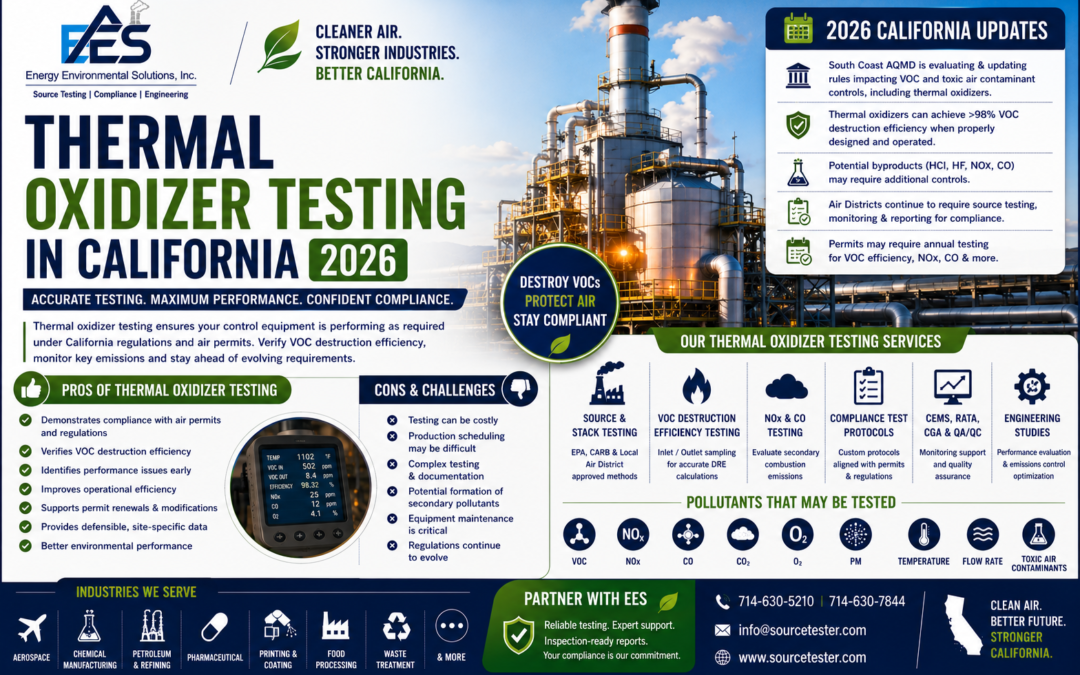
VOC destruction efficiency is a critical performance measure for California facilities that use thermal oxidizers, regenerative thermal oxidizers (RTOs), flares, and other air-pollution control systems to reduce volatile organic compound (VOC) emissions.
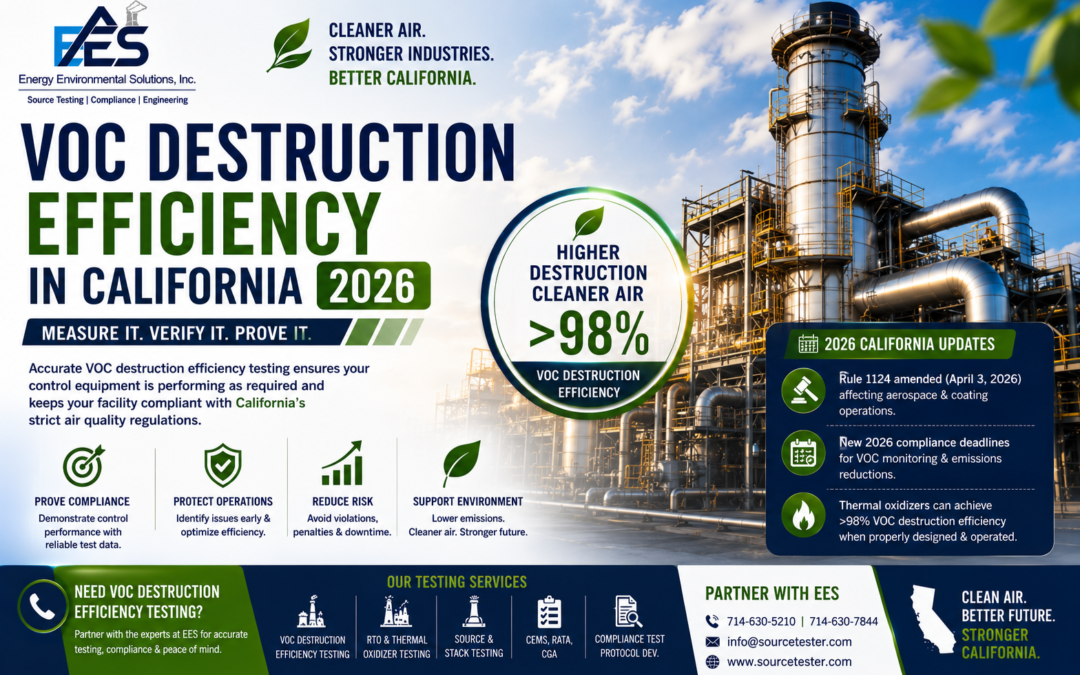
In 2026, California’s air-quality regulatory environment continues to place strong emphasis on emissions reduction, source testing, monitoring, control-device performance, and accurate reporting. South Coast AQMD has active rulemaking involving VOC-generating industries, including aerospace, wood-product coatings, marine coatings, solvents, and other industrial sources. Rule 1124 for aerospace assembly and component manufacturing was amended on April 3, 2026, while additional VOC-related rulemaking remains active during 2026.
For industries using thermal oxidation, the message is straightforward: having a control device installed is not the same as proving that it is achieving the required VOC control performance. Facilities may need reliable testing and documentation showing that their equipment operates within applicable permit and regulatory requirements.
Energy Environmental Solutions, Inc. (EES) helps industries with VOC Destruction Efficiency Testing, RTO Testing, Thermal Oxidizer Testing, VOC Source Testing, Stack Testing, NOx and CO Testing, Compliance Test Protocol Development, CEMS, RATA, CGA, Engineering Studies, QA/QC, and Regulatory Reporting.
What Is VOC Destruction Efficiency?
VOC destruction efficiency describes the percentage of VOC entering a control device that is destroyed before the treated gas leaves the system. A commonly used calculation is Destruction Efficiency (%) = [(VOC Inlet − VOC Outlet) ÷ VOC Inlet] × 100. For example, if a control device receives 100 units of VOC and 1 unit remains at the outlet, the calculated destruction efficiency is 99%.
That sounds simple, but industrial testing is rarely that simple. Inlet and outlet concentrations, gas flow, moisture, oxygen, temperature, production rate, fuel usage, and other operating conditions can all influence the final result. A facility also needs to understand whether its permit requires destruction efficiency, removal efficiency, capture efficiency, overall control efficiency, or a specific outlet concentration, because these measurements are not interchangeable.
South Coast AQMD’s emissions-reporting guidance specifically says that site-specific test results, the applicable permit, or the applicable rule limit should be used when determining vapor destruction efficiency for certain thermal-oxidation applications.
Is VOC Destruction Efficiency Testing Compulsory in California?
There is an important distinction for facility owners and environmental managers.
There is no single statewide VOC destruction-efficiency testing requirement that applies identically to every California facility. The requirement depends on the facility’s Air District, permit conditions, source category, control equipment, pollutants, applicable state and federal requirements, and specific regulatory provisions.
For example, a Bay Area Air Quality Management District permit for thermal oxidizers establishes a minimum VOC destruction efficiency of 95% by weight along with minimum operating temperatures and continuous temperature monitoring.
Another Bay Area permit issued in 2025 for regenerative thermal oxidizers establishes different destruction-efficiency requirements depending on inlet VOC concentration: greater than 98.5% for higher inlet concentrations, greater than 98% for intermediate concentrations, and greater than 90% for lower concentrations, with an alternative outlet concentration limit also specified. The permit also establishes a minimum combustion-zone temperature and continuous temperature monitoring.
This illustrates why companies should not simply advertise or assume that “99% destruction efficiency” is automatically the legal requirement for every California operation.
Your permit determines what your facility must demonstrate.
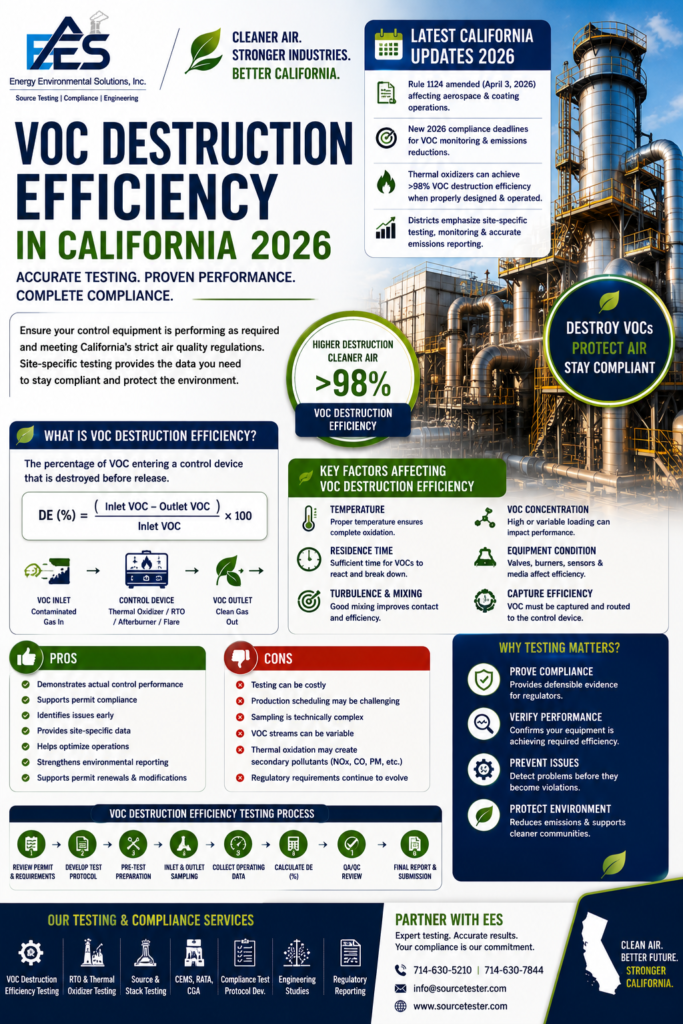
Latest California VOC & Destruction-Efficiency Updates for 2026
1. California Air-District Rulemaking Remains Active
South Coast AQMD’s 2026 regulatory activity includes multiple initiatives affecting VOC-emitting industries and pollution-control requirements. Its current rulemaking pages show active work involving aerospace assembly, wood-product coatings, marine and pleasure-craft coatings, and consumer paint thinners and multipurpose solvents.
This is important because VOC compliance is not static. A facility that designed its emissions-control strategy several years ago may need to reassess whether its current processes, materials, control equipment, testing frequency, and documentation continue to satisfy applicable requirements.
The South Coast AQMD 2026 compliance calendar also includes new or updated deadlines affecting VOC-related operations. For example, Rule 1173 requirements beginning January 1, 2026 require certain petroleum and chemical facilities to expand component monitoring using Optical Gas Imaging (OGI) and maintain specified VOC leak thresholds. The same calendar identifies other 2026 control requirements involving captured fugitive emissions and air-pollution-control systems.
2. Rule 1124 Was Amended in April 2026
One significant 2026 development is the amendment of South Coast AQMD Rule 1124 — Aerospace Assembly and Component Manufacturing Operations, which was amended on April 3, 2026.
The rulemaking process examined control options for VOCs and toxic air contaminants associated with aerospace coating operations.
The March 2026 South Coast AQMD staff report evaluated thermal oxidizers and noted that they can achieve destruction efficiencies exceeding 98% when properly designed and operated. The report identifies temperature, residence time, and turbulence/mixing as important thermal-oxidizer design factors.
But the same analysis also identified an important disadvantage: thermal oxidation of certain chlorinated and fluorinated compounds can generate hydrochloric acid (HCl) and hydrofluoric acid (HF). Additional scrubber controls may therefore be necessary, increasing system complexity and operating costs.
What does this mean for industry?
The lesson is bigger than a single rule.
High VOC destruction efficiency does not automatically mean a control technology is appropriate for every chemical stream.
Facilities need to evaluate the complete emissions profile.
3. Thermal Oxidizers Remain an Important VOC-Control Technology
Thermal oxidizers continue to be used for controlling VOC and certain toxic-air-contaminant emissions. South Coast AQMD’s 2026 technical analysis describes thermal oxidizers as combustion devices that convert applicable organic pollutants primarily into carbon dioxide and water, while identifying temperature, residence time, and mixing as key performance factors.
The technology can provide very high VOC destruction efficiency under appropriate conditions.
However, performance depends on how the system is operated. Changes in VOC concentration, gas flow, process chemistry, temperature, residence time, mixing, equipment condition, and operating cycles can affect performance.
That is why source testing remains an important tool for demonstrating actual performance rather than relying solely on equipment design specifications.
4. California Regulators Are Looking at More Than VOCs
Another important 2026 compliance issue is that destroying VOCs does not mean the control system has no other emissions.
South Coast AQMD’s emissions-reporting guidance explains that thermal oxidation can result in emissions of NOx, SOx, CO, particulate matter, and toxic air contaminants in addition to the controlled VOC emissions. The agency encourages operators to use test results when calculating and reporting these emissions.
This creates a broader compliance challenge.
A facility may achieve excellent VOC destruction efficiency while still needing to address combustion-related emissions.
The right question is not simply:
“How efficiently are we destroying VOCs?”
It is:
“What is our complete emissions profile after the control device operates?”
5. EPA Continues to Emphasize Performance Monitoring
The U.S. EPA’s Compliance Assurance Monitoring guidance for thermal oxidizers demonstrates the importance of connecting performance testing with ongoing monitoring. The EPA’s technical guidance uses real facility case studies involving control-device parameters, long-term monitoring data, and performance/compliance testing. The guidance was updated July 2, 2026.
This reinforces an important compliance principle:
A source test provides a performance snapshot; continuous or periodic monitoring helps demonstrate that operating conditions remain consistent with the conditions under which compliance was established.
For facilities, this means testing and monitoring should work together rather than being treated as completely separate activities.
Why Is VOC Destruction Efficiency Testing Important?
Imagine purchasing an expensive industrial control system that is advertised as capable of destroying 99% of VOCs.
Then production conditions change.
The VOC concentration increases. The process begins operating intermittently. A valve develops leakage. Ceramic media becomes fouled. Temperature drops below the expected range. The process gas flow changes.
Does the system still achieve 99%?
That’s exactly why testing matters.
A manufacturer’s performance specification describes what equipment may achieve under defined conditions. A properly designed compliance test provides evidence of what the system is actually achieving under specified operating conditions.
Key Factors That Affect VOC Destruction Efficiency
Temperature
Thermal oxidation requires sufficient temperature for the targeted organic compounds to oxidize effectively. The appropriate temperature depends on the process, pollutant characteristics, equipment design, and applicable permit requirements.
South Coast AQMD identifies temperature as one of the fundamental design factors affecting thermal-oxidizer performance.
Residence Time
The gas must remain in the appropriate combustion environment long enough for the oxidation reaction to occur.
Insufficient residence time can reduce destruction performance.
Turbulence and Mixing
Effective mixing allows the VOC-containing process gas to interact properly with the combustion environment.
Poor mixing can create localized conditions where oxidation is less complete.
VOC Concentration
A control device may behave differently at low, moderate, or high VOC loading.
This is particularly important when production processes are intermittent or have large concentration swings.
Equipment Condition
Burners, valves, seals, fans, ceramic media, dampers, temperature sensors, controls, and ductwork can influence performance.
Capture Efficiency
There is another crucial issue:
The control device cannot destroy VOC emissions that never reach it.
A facility can therefore have excellent destruction efficiency at the oxidizer while still experiencing uncontrolled emissions because of poor capture or fugitive releases.
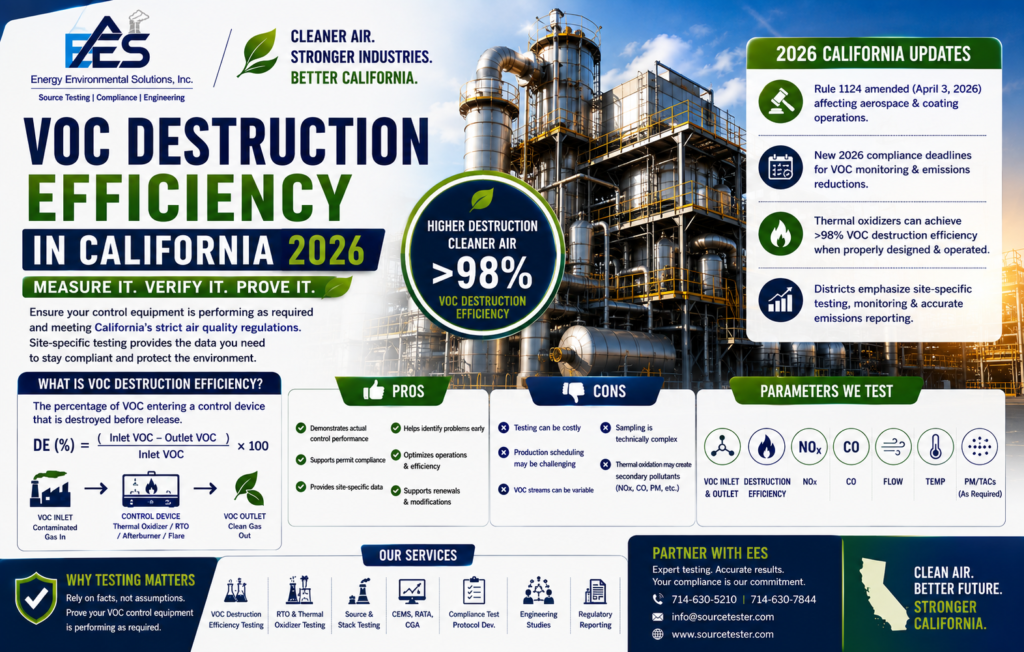
Pros of VOC Destruction Efficiency Testing
1. Demonstrates Actual Control Performance
Testing provides measurable evidence of control-device performance rather than relying solely on theoretical or manufacturer claims.
2. Supports Permit Compliance
Where required, source-test results can demonstrate compliance with applicable destruction-efficiency or outlet-emission requirements.
3. Helps Identify Problems Early
Testing may reveal declining control performance before the facility experiences a more serious compliance issue.
4. Provides Site-Specific Data
South Coast AQMD specifically recognizes site-specific destruction-efficiency test results as an important source of information for certain emissions calculations.
5. Supports Permit Renewals and Modifications
Reliable testing data can strengthen technical documentation for certain permit-related activities.
6. Helps Optimize Operations
Test results can show how temperature, process loading, production conditions, and other operating variables affect emissions-control performance.
7. Strengthens Environmental Reporting
Accurate data can improve emissions inventories and regulatory reporting.
Cons & Challenges of VOC Destruction Efficiency Testing
Testing Can Be Expensive
Professional source testing requires specialized equipment, experienced personnel, calibration, field labor, analytical work, and technical reporting.
Production Scheduling Can Be Difficult
Testing often needs to occur under representative operating conditions. Coordinating a source test with production schedules can therefore be challenging.
VOC Streams Can Be Variable
Intermittent processes, batch operations, changing solvents, changing production rates, and different raw materials can make representative testing more complicated.
Sampling Can Be Technically Complex
Accurate destruction-efficiency testing may require simultaneous inlet and outlet measurements, flow measurements, oxygen or carbon-dioxide measurements, moisture measurements, and detailed operating-condition documentation.
High Destruction Efficiency Can Have Tradeoffs
Thermal oxidation can create secondary pollutants such as NOx, CO, particulate matter, SOx, and potentially toxic or acidic combustion products depending on the process chemistry.
Regulatory Requirements Can Change
A testing program that was appropriate several years ago may need review as applicable rules, permits, source categories, and Air District policies evolve.
VOC Destruction Efficiency vs. Capture Efficiency
These terms are often confused.
| Measurement | What It Means |
|---|---|
| Capture Efficiency | How much of the process-generated VOC is captured and routed to the control device |
| Destruction Efficiency | How much of the captured VOC is destroyed by the control device |
| Removal Efficiency | How much pollutant is removed from the treated stream, depending on the control technology |
| Overall Control Efficiency | The combined effect of capture and control/destruction |
This distinction matters because a facility can have a 99% efficient oxidizer but still release VOCs if only part of the process emissions are captured.
How VOC Destruction Efficiency Testing Is Typically Conducted
A professional testing project generally begins with permit and regulatory review.
The testing team identifies the required pollutants, limits, methods, operating conditions, testing frequency, and reporting requirements.
A compliance test protocol is then developed to establish the sampling locations, test methods, number of runs, operating conditions, QA/QC requirements, calculations, and reporting format.
During testing, the team may measure VOC concentrations at the control-device inlet and outlet while simultaneously documenting operating parameters.
Depending on the applicable method and permit, testing may also involve:
- Gas flow
- Moisture
- Oxygen
- Carbon dioxide
- Temperature
- Fuel consumption
- Production rate
- VOC loading
- Control-device operating parameters
The resulting data are evaluated and used to calculate the applicable destruction/control efficiency.
The final report should clearly document what was tested, how it was tested, under what operating conditions, what the results were, and whether the applicable compliance requirement was met.
What EES Can Test
Energy Environmental Solutions, Inc. (EES) supports facilities with a broad range of emissions-control testing services.
VOC Destruction Efficiency Testing
Evaluation of VOC inlet/outlet concentrations and applicable control efficiency.
RTO Testing
Testing of Regenerative Thermal Oxidizers, including VOC, NOx, CO, and applicable operating parameters.
Thermal Oxidizer Testing
Performance testing for thermal oxidation systems according to applicable requirements.
Source & Stack Testing
Field testing using applicable EPA, CARB, and local Air District methods.
NOx & CO Testing
Evaluation of combustion-related emissions where required.
CEMS / RATA / CGA
Support for continuous emissions monitoring systems and associated certification, relative accuracy testing, and calibration requirements.
Compliance Test Protocol Development
Preparation of testing protocols covering sampling, methods, QA/QC, operating conditions, calculations, and reporting.
Engineering Studies
Technical evaluations of emissions-control systems, operating conditions, and potential compliance strategies.
Regulatory Reporting
Preparation of organized technical reports and supporting documentation for regulatory compliance.
Industries That May Need VOC Destruction Efficiency Testing
Depending on their permit and emissions-control configuration, EES can support facilities in industries such as:
- Aerospace Manufacturing
- Chemical Manufacturing
- Petroleum & Refining
- Pharmaceutical Manufacturing
- Paint & Coating
- Metal Coating
- Printing
- Food Processing
- Composite Manufacturing
- Waste Treatment
- Solvent-Using Operations
- Industrial Manufacturing
- Fuel Processing
- Petroleum Storage and Loading
- Other VOC-emitting industrial operations
The applicable testing requirement is facility-specific.
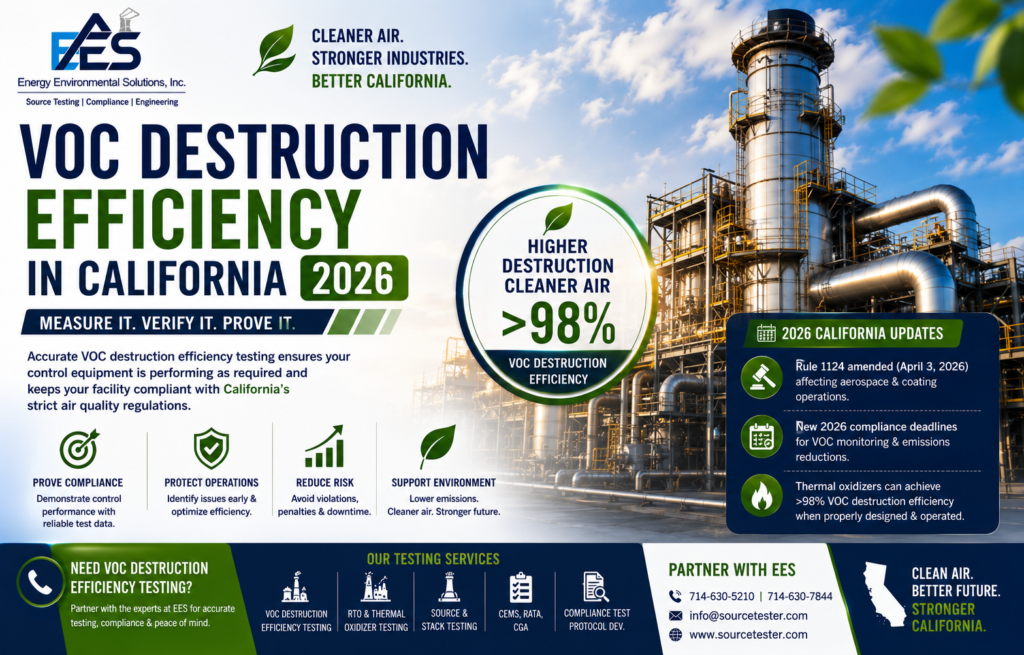
Why Choose EES for VOC Destruction Efficiency Testing?
When an Air District asks:
“How do you know your control device is achieving the required VOC destruction efficiency?”
The answer should be supported by credible technical data.
EES helps facilities build that evidence through:
- VOC Destruction Efficiency Testing
- RTO Testing
- Thermal Oxidizer Testing
- VOC Source Testing
- Stack Testing
- NOx Testing
- CO Testing
- CEMS
- RATA
- CGA
- Compliance Test Protocol Development
- Engineering Studies
- QA/QC
- Emissions Calculations
- Regulatory Reporting
The goal is simple:
Measure it. Verify it. Document it. Stay compliant.
2026 Compliance Checklist for California Facilities
Before your next VOC compliance test, review:
- Your current Air District permit
- Applicable VOC rules
- Required destruction/control efficiency
- Required test frequency
- Approved test methods
- Sampling locations
- Required operating conditions
- Production rate during testing
- VOC inlet concentration
- VOC outlet concentration
- Control-device temperature
- Flow and moisture requirements
- NOx/CO requirements
- QA/QC requirements
- Reporting deadlines
- Continuous-monitoring requirements
Don’t assume that an old source-test protocol automatically remains appropriate.
Review the current requirements before scheduling the test.
The Big 2026 Takeaway
California’s 2026 regulatory activity demonstrates that VOC compliance continues to evolve across multiple industrial sectors. South Coast AQMD has active rulemaking involving aerospace, coatings, solvents, and other VOC-emitting operations, while its current emissions guidance emphasizes the importance of site-specific destruction-efficiency data for applicable thermal-oxidation calculations.
At the same time, regulators and technical guidance continue to emphasize that control-device performance depends on real operating conditions.
A number on a manufacturer’s brochure is not a substitute for a properly conducted compliance demonstration when testing is required.
Is your VOC control device really achieving the efficiency required by your permit?
Are your inlet and outlet measurements defensible?
Are your operating conditions properly documented?
Has your test protocol been reviewed against current requirements?
Are you prepared for your next Air District inspection?
If you are uncertain about any of these questions, a proactive compliance review can help identify potential issues before they become costly problems.
Need VOC Destruction Efficiency Testing in California?
Energy Environmental Solutions, Inc. (EES) helps industrial facilities evaluate and document the performance of VOC control systems.
Our Services
VOC Destruction Efficiency Testing | RTO Testing | Thermal Oxidizer Testing | VOC Testing | Source Testing | Stack Testing | NOx Testing | CO Testing | CEMS | RATA | CGA | Compliance Test Protocol Development | Engineering Studies | Regulatory Reporting
Your Compliance. Our Commitment.
Phone: 714-630-5210 | 714-630-7844
Email: info@sourcetester.com
Website: sourcetester.com