California Rule 1153.1 Compliance in 2026: Is Your Commercial Food Oven Ready for the Next NOx Requirement?
Commercial Food Oven Owners: The Zero-NOx Transition Is Getting Closer
If your facility operates commercial food ovens, bakery ovens, cooking ovens, tortilla ovens, smokehouses, roasters, dryers or other permitted commercial food-oven equipment in the South Coast AQMD jurisdiction, Rule 1153.1 – Emissions of Oxides of Nitrogen from Commercial Food Ovens deserves your attention.
South Coast AQMD adopted the current Rule 1153.1 amendment on August 4, 2023, and the rule establishes progressively tighter NOx requirements, including future zero-emission requirements for certain equipment categories.
And 2026 is an important year.
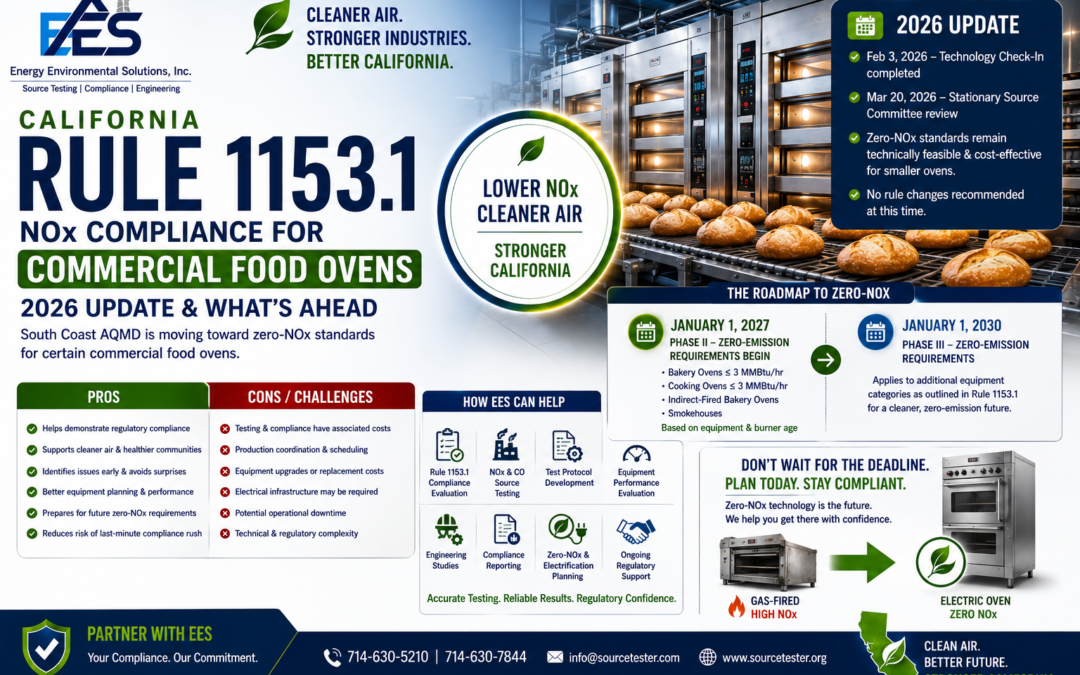
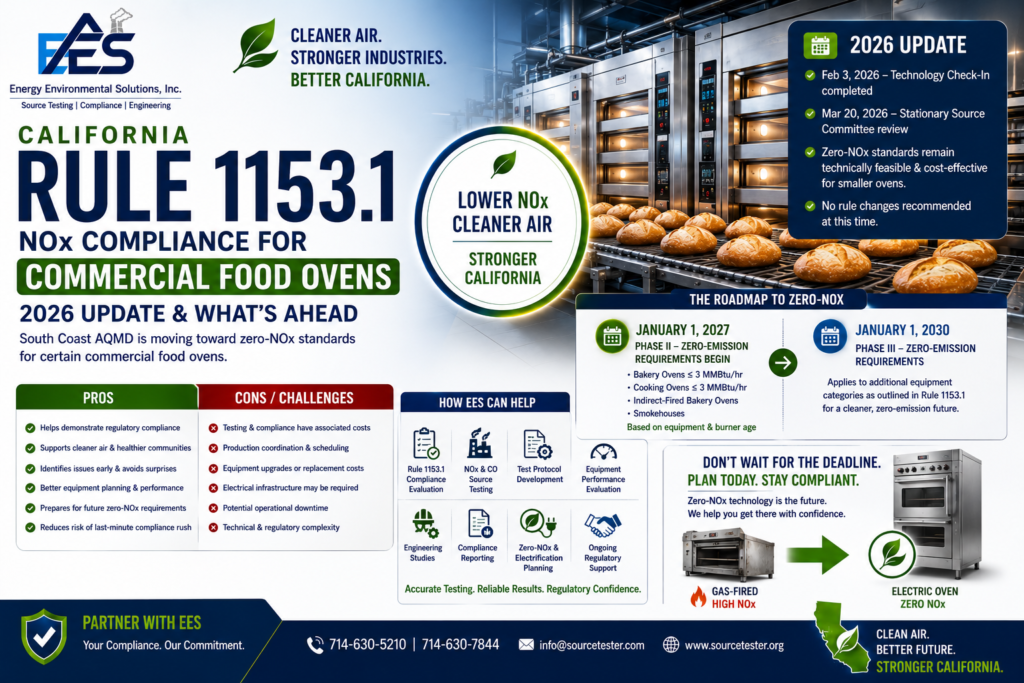
South Coast AQMD held a Rule 1153.1 Technology Check-In on February 3, 2026, followed by a Stationary Source Committee review on March 20, 2026. The District’s 2026 assessment found that zero-NOx standards remain technically feasible and cost-effective for certain smaller equipment categories, while larger units face greater cost and fuel-switching challenges.
The message for facility owners is simple:
Don’t wait until your oven is approaching a compliance trigger to start planning.
What Is California Rule 1153.1?
Rule 1153.1 controls NOx emissions from permitted commercial food ovens used to prepare food or products for making beverages for human consumption within the South Coast AQMD jurisdiction.
The regulated equipment can include:
Bakery ovens
Cooking ovens
Tortilla ovens
Drying ovens
Smokehouses
Roasters
Dryers
Other qualifying commercial food-oven equipment
The current rule establishes Phase I NOx limits, followed by future zero-emission requirements for specified categories.
What Are the Current NOx Requirements?
The 2023 amendment established Phase I limits of 30 ppm NOx for most commercial food-oven categories, while tortilla ovens heated solely by infrared burners have a 15 ppm NOx limit.
The rule then moves toward zero-emission requirements for specified equipment categories.
This is particularly important for equipment planning because a facility may need to consider:
NOx testing → equipment age → burner age → permit requirements → retrofit/replacement → electrification → future compliance
🚨 Major 2026 Rule 1153.1 Update
South Coast AQMD Completed a Technology Check-In
On February 3, 2026, South Coast AQMD held a public technology check-in for Rule 1153.1.
The purpose was to evaluate whether the technology and cost assumptions behind the future zero-NOx requirements remain appropriate.
The March 20, 2026 Stationary Source Committee materials reported an important conclusion:
Zero-NOx standards remain technically feasible and cost-effective for certain smaller units.
The District specifically reported zero-NOx standards as cost-effective for:
Bakery ovens ≤3 MMBtu/hr
Indirect-fired bakery ovens
Cooking ovens ≤3 MMBtu/hr
Smokehouses
For larger equipment, the District concluded that maintaining low-NOx requirements was appropriate because transitioning to zero emissions was not cost-effective at this time, with fuel-switching costs being a major factor.
Current status:
Staff did not recommend a rule change at the March 2026 technology check-in.
That makes the existing compliance roadmap especially important for businesses planning equipment upgrades or replacements.
What Is Coming Next?
The 2023 rule framework established future implementation dates for zero-emission requirements.
January 1, 2027
Phase II zero-emission requirements begin for applicable categories.
These include certain:
Bakery ovens ≤3 MMBtu/hr
Indirect-fired bakery ovens
Cooking ovens
Smokehouses
The specific compliance trigger for existing equipment can depend on the unit’s age and burner age, rather than simply the calendar date.
January 1, 2030
Phase III requirements apply to applicable categories under the rule framework.
The original rule development included additional time for larger equipment where zero-emission technology and electrification presented greater technical and economic challenges.
Important: Facility owners should evaluate the exact rule language, permit conditions, equipment age, burner age and applicable category before assuming a specific deadline applies to their equipment.
Why 2026 Is the Right Time to Start Planning
A major equipment transition cannot always happen overnight.
Zero-emission or electric commercial food ovens can require:
New equipment
Electrical infrastructure
Utility coordination
Facility modifications
Engineering studies
Permit review
Production planning
Installation time
Startup and compliance evaluation
South Coast AQMD has recognized that fuel-switching costs can significantly affect cost-effectiveness, especially for larger equipment.
So waiting until the last moment could create unnecessary operational pressure.
Smart approach:
Evaluate → Test → Plan → Upgrade → Verify → Comply
Rule 1153.1 Compliance Testing: Why It Matters
NOx compliance is not simply about installing a new burner or purchasing an electric oven.
Facilities need reliable information about actual equipment performance.
Depending on the applicable requirements, a compliance program can involve:
NOx emissions testing
CO emissions testing
Fuel-flow measurements
Heat-input calculations
Operating-condition verification
Test protocol preparation
Permit-condition review
Source-test reporting
Equipment certification or documentation
Compliance recordkeeping
Accurate testing provides facility owners with defensible emissions data and helps identify potential problems before they become larger compliance issues.
Pros of Rule 1153.1 Compliance & NOx Testing
✅ 1. Helps Demonstrate Compliance
Professional emissions testing can provide documented data supporting applicable NOx and CO compliance requirements.
✅ 2. Supports Cleaner Operations
Lower NOx emissions contribute to South Coast California’s broader air-quality objectives.
✅ 3. Helps Identify Problems Early
Testing can identify combustion or operational issues before they become more expensive problems.
✅ 4. Supports Equipment Planning
Reliable emissions data can help facility managers decide whether equipment should be maintained, retrofitted or replaced.
✅ 5. Helps Prepare for Zero-NOx Requirements
Early assessment provides more time to evaluate electrification and zero-emission options.
✅ 6. Can Reduce Last-Minute Compliance Risk
Planning ahead can reduce the chance of rushing through testing, permitting or equipment changes near a regulatory trigger.
Cons & Challenges
Compliance also creates real operational challenges.
❌ Testing Costs
Professional source testing requires specialized equipment, personnel and technical reporting.
❌ Production Coordination
Testing may need to be conducted under representative operating conditions, requiring coordination with production.
❌ Equipment Modification Costs
Some facilities may need burner modifications, controls or equipment replacement.
❌ Electrification Costs
For applicable zero-NOx equipment, electrical upgrades and utility infrastructure can become significant expenses.
❌ Potential Production Disruption
Equipment replacement or modification may require planned downtime.
❌ Technical Complexity
Understanding NOx limits, equipment categories, burner age, unit age, permit requirements and compliance schedules can be complicated.
How EES Helps With Rule 1153.1
Energy Environmental Solutions, Inc. — Your Compliance Partner
Rule 1153.1 compliance requires more than simply taking an emissions reading.
EES can help facilities build a practical compliance strategy around testing, documentation and engineering support.
1. Rule 1153.1 Compliance Evaluation
EES can review applicable equipment and help identify the relevant regulatory and testing requirements.
2. NOx Source Testing
EES provides professional source-testing support to measure NOx emissions under applicable test conditions.
3. CO Testing
Where required, EES can support carbon monoxide emissions testing and compliance evaluation.
4. Test Protocol Development
EES can help develop test protocols based on applicable regulatory requirements, permit conditions and facility operations.
5. Equipment Performance Evaluation
Testing data can help determine whether equipment is performing within applicable emission requirements.
6. Regulatory Reporting
EES can support the preparation of technical emissions reports and compliance documentation.
7. Engineering Studies
For facilities evaluating equipment upgrades or future compliance strategies, engineering support can help assess available options.
8. Zero-NOx & Electrification Planning
As facilities move toward future zero-emission requirements, EES can help customers evaluate the emissions-testing and compliance side of equipment transition planning.
Rule 1153.1 + Rule 1153: Don’t Confuse the Two
This is important for commercial bakeries.
Rule 1153
VOC emissions
Commercial Bakery Ovens
Rule 1153.1
NOx emissions
Commercial Food Ovens
A bakery facility may need to consider both rules, depending on its equipment and operations.
EES can help facilities evaluate their applicable air-quality testing requirements rather than treating each requirement in isolation.
Is Your Commercial Food Oven Ready?
Ask your environmental/compliance team:
☑ Do we know which Rule 1153.1 category applies to our oven?
☑ Do we know our current NOx emissions?
☑ When was our last NOx compliance test?
☑ How old is our oven?
☑ How old is the burner?
☑ Are our permits and equipment records current?
☑ Will future zero-NOx requirements affect our equipment?
☑ Will electrical infrastructure be required?
☑ Have we started planning for potential equipment replacement?
☑ Do we have a testing and compliance strategy?
If several answers are “No” or “I’m not sure,” now is the time to investigate.
Don’t Wait for the Deadline
California’s commercial food-oven regulatory landscape is moving toward lower and, for certain equipment categories, zero-NOx emissions.
The 2026 technology check-in confirmed that zero-NOx requirements remain viable for certain smaller equipment categories, while larger equipment continues to face technical and economic challenges.
Your equipment may have years of useful life left—but your compliance planning should start now.
Partner With EES
Accurate Testing. Reliable Results. Regulatory Confidence.
Energy Environmental Solutions, Inc.
Source Testing | Compliance | Engineering
Need Rule 1153.1 NOx Testing or Compliance Support?
Rule 1147.1 in California 2026: Latest Updates, Pros, Cons & How EES Helps Aggregate-Drying Facilities
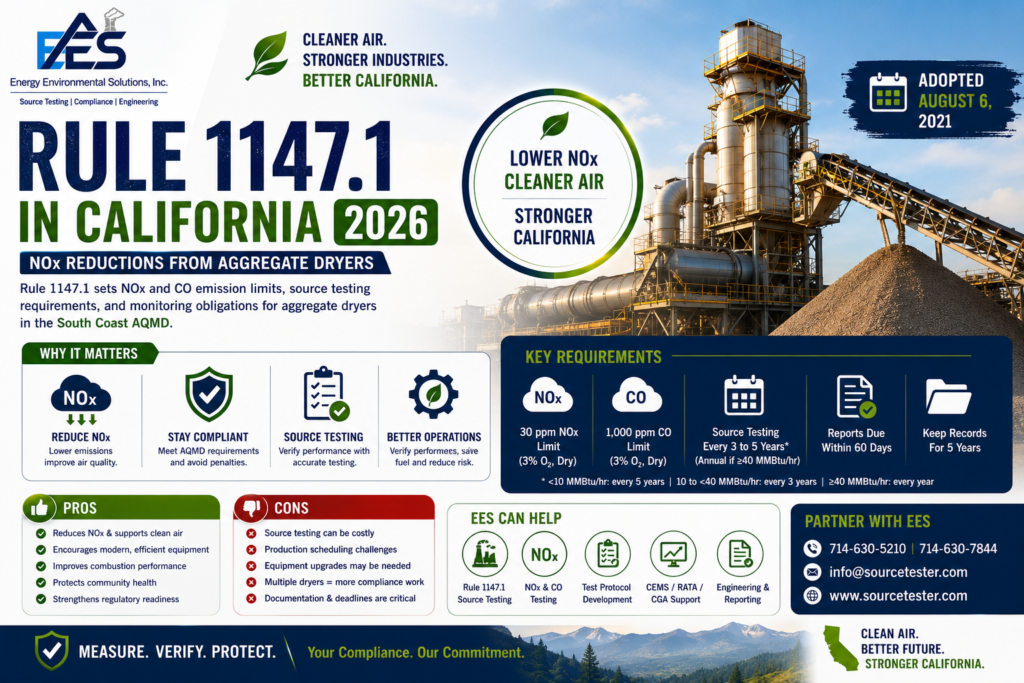
Rule 1147.1 — NOx Reductions from Aggregate Dryers is an important South Coast AQMD regulation affecting certain aggregate-drying operations in Southern California. The rule establishes NOx and CO emission limits, source-testing requirements, monitoring provisions, recordkeeping, and compliance obligations for applicable aggregate dryers.
For 2026, there is an important distinction to make: Rule 1147.1 is not a statewide California regulation. It is a South Coast AQMD rule that applies within the District’s jurisdiction when the equipment meets the rule’s applicability requirements. South Coast AQMD’s current Regulation XI rulebook identifies Rule 1147.1 as “NOx Reductions from Aggregate Dryers,” adopted August 6, 2021.
At the same time, South Coast AQMD’s current proposed-rules pages continue to list Proposed Rule 1147.1 among rules in the proposal process. The dedicated proposal page, however, contains rulemaking documents dating primarily from 2020–2021. Therefore, businesses should not interpret that listing alone as evidence that a new Rule 1147.1 amendment was adopted in 2026.
For aggregate producers, asphalt and construction-material facilities, and other operations using regulated dryers, the practical message is simple:
Know your applicable NOx limit, know your testing deadline, and verify that your aggregate dryer can demonstrate compliance.
Energy Environmental Solutions, Inc. (EES) can help facilities with Rule 1147.1 source testing, NOx testing, CO testing, compliance test protocol development, emissions measurements, CEMS/RATA support, engineering studies, QA/QC and regulatory reporting.
What Is Rule 1147.1?
Rule 1147.1 was adopted by the South Coast AQMD Governing Board on August 6, 2021. It specifically addresses NOx reductions from aggregate dryers and was created as part of South Coast AQMD’s broader strategy to transition NOx sources away from the RECLAIM trading program toward more direct, source-specific controls.
The rule applies to qualifying gaseous-fuel-fired aggregate dryers with more than 1 pound per day of NOx emissions and a rated heat-input capacity greater than 2 million Btu/hour, subject to the rule’s detailed applicability provisions and exemptions.
Aggregate dryers are used to remove moisture from materials such as sand, gravel, crushed stone and other aggregate products. Because the drying process commonly involves high-temperature combustion, the burners can generate NOx.
And here’s the important part:
The larger the combustion system and the higher its emissions, the more important compliance testing becomes.
Why Does Rule 1147.1 Matter in 2026?
NOx is a major air pollutant involved in the formation of ground-level ozone and particulate matter. Southern California has historically faced significant challenges meeting federal and state air-quality standards, so stationary combustion sources remain an important part of regional emission-reduction strategies.
South Coast AQMD specifically developed Rule 1147.1 to establish NOx and CO requirements for aggregate dryers at non-RECLAIM, RECLAIM and former-RECLAIM facilities, together with monitoring, reporting and recordkeeping provisions.
The District’s planning documents estimate that Rule 1147.1 contributes additional NOx reductions as part of the transition from RECLAIM to command-and-control requirements. One South Coast AQMD emissions-inventory document identifies an estimated 0.01 tons/day of NOx reduction by 2030 attributable to Rule 1147.1, with implementation beginning in 2025 and reductions continuing toward 2057.
So while Rule 1147.1 is not a brand-new 2026 regulation, its compliance requirements remain relevant.
Latest 2026 Rule 1147.1 Update: What Facilities Should Know
1. The Current Adopted Rule Is Still Dated August 6, 2021
South Coast AQMD’s current official Regulation XI listing identifies:
Rule 1147.1 — NOx Reductions from Aggregate Dryers Adopted: August 6, 2021
Unlike several other South Coast AQMD rules that received amendments in 2025 or 2026, the current rulebook does not identify a 2026 amendment to Rule 1147.1.
That is an important SEO and compliance point because online articles sometimes describe old proposed-rule documents as if they were new 2026 regulations.
For 2026, facilities should work from:
The currently adopted Rule 1147.1 + their current South Coast AQMD permit + any applicable compliance conditions.
2. Proposed Rule 1147.1 Still Appears on South Coast AQMD’s Proposal Page
There is an unusual point worth highlighting.
South Coast AQMD’s current Active Proposed Rules page lists Proposed Rule 1147.1.
However, the dedicated Rule 1147.1 proposal page presents the original rulemaking materials, including the August 6, 2021 Notice of Public Hearing, July 2021 draft language and 2021 staff documents.
Therefore, companies should be careful when reading search results about “new Rule 1147.1 updates.”
The safest interpretation in 2026 is:
Rule 1147.1 remains an adopted South Coast AQMD rule, while the District’s website also retains/list its proposed-rule project materials. There is no verified evidence in the current official rulebook that a new 2026 amendment has replaced the adopted August 2021 rule.
This distinction is particularly important when preparing a compliance test.
3. NOx and CO Limits Remain Central
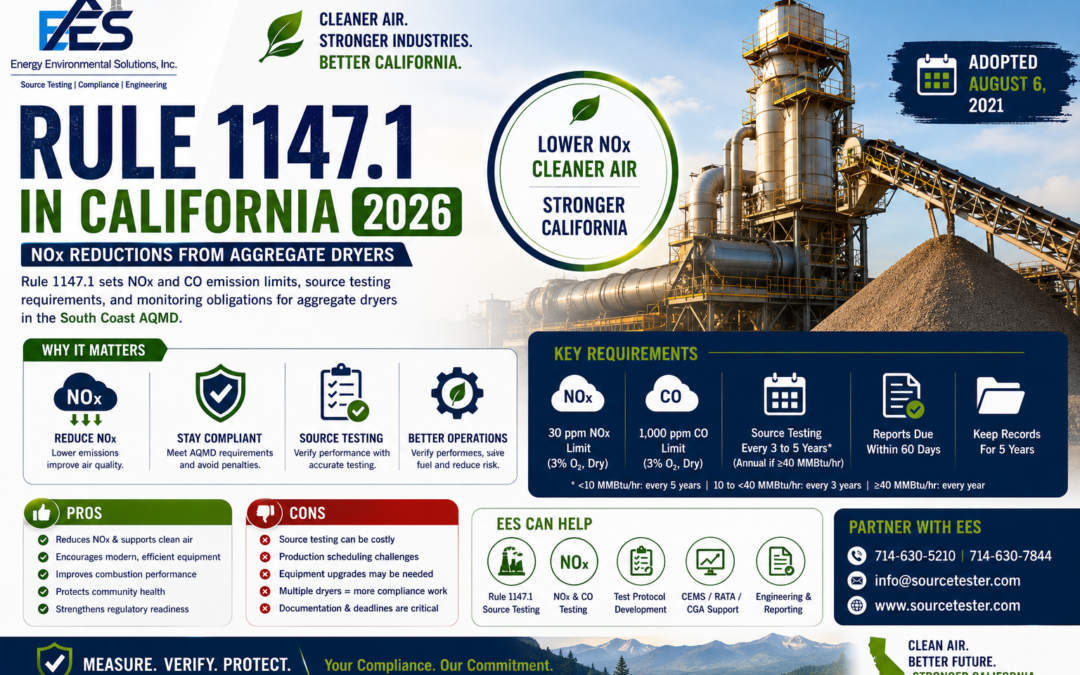
Rule 1147.1 establishes a 30 ppm NOx limit and 1,000 ppm CO limit, corrected to 3% oxygen on a dry basis, for the applicable gaseous-fuel-fired aggregate dryers under the rule’s relevant provisions.
The rule also established interim requirements for certain facilities during implementation.
The 2021 adoption materials identify:
Requirement
Rule 1147.1 Provision
Primary NOx limit
30 ppm
CO limit
1,000 ppm
Oxygen correction
3% O₂, dry
Applicability threshold
>1 lb/day NOx
Rated heat-input threshold
>2 MMBtu/hr
Source testing
Required for applicable units
Large dryers ≥40 MMBtu/hr
Annual testing
The precise applicability and compliance pathway should always be confirmed against the current rule and permit.
4. Source Testing Frequency Depends on Dryer Size
One of the most important Rule 1147.1 requirements for facility managers is the periodic source-testing schedule.
The current rule provides different testing frequencies based on the aggregate dryer’s rated heat-input capacity.
Aggregate dryer below 10 MMBtu/hr
Source testing is required every 5 calendar years, with the rule restricting how early the subsequent test can occur.
Aggregate dryer ≥10 and <40 MMBtu/hr
Source testing is required every 3 calendar years, again subject to the minimum interval specified by the rule.
Aggregate dryer ≥40 MMBtu/hr
Source testing is required every calendar year.
For a large dryer that has not operated for at least six consecutive months, the rule also provides a provision allowing the source test to occur within 90 days after operations resume, subject to the rule’s conditions and fuel-use documentation.
Why This Matters for 2026
Imagine an aggregate dryer operating at 45 MMBtu/hr.
Its operator cannot treat compliance testing as something to think about every three or five years.
The applicable rule calls for annual source testing.
Now consider a facility operating several dryers of different sizes. The testing calendar can become complicated very quickly.
That is why environmental managers should maintain a centralized compliance schedule containing:
Equipment identification
Burner age
Rated heat input
Applicable NOx limit
Applicable CO limit
Last source-test date
Next source-test deadline
Permit conditions
Protocol approval
Test report submission date
Maintenance records
Missing a testing deadline can turn a technical compliance requirement into an operational problem.
5. Source-Test Reports Must Be Submitted
Rule 1147.1 requires source-test reports to be submitted to the Executive Officer within 60 days of completion of the test.
That means the project does not end when the field testing is complete.
The complete compliance cycle is:
Plan → Protocol → Test → QA/QC → Calculations → Report → Submission → Recordkeeping
A technically excellent field test can still create headaches if the final report is incomplete, inaccurate or submitted late.
6. Five-Year Recordkeeping Requirement
Rule 1147.1 requires source-test records to be maintained for five years and made available to South Coast AQMD personnel upon request.
This is especially important for companies with multiple facilities or multiple aggregate dryers.
Environmental records should not be scattered across emails, maintenance folders and individual computers.
A better approach is to maintain a centralized compliance file for every regulated unit.
7. Existing CEMS and Monitoring Systems Matter
Rule 1147.1 does not simply require every aggregate dryer to install a brand-new CEMS.
However, qualifying facilities with existing continuous in-stack emissions monitoring systems or equivalent verification systems must retain and operate them according to the applicable requirements.
The rule also allows certain other required testing or monitoring activities to satisfy a source-test requirement under specified conditions.
For example, qualifying:
Title V periodic monitoring/testing, or
RATA associated with CEMS
may be used to satisfy one instance of periodic source testing when the requirements of the rule are met.
This can potentially reduce duplicate testing—but only when the regulatory conditions are satisfied.
Rule 1147.1 Compliance: Pros
1. Reduces NOx Emissions
The biggest environmental advantage is straightforward: lower NOx emissions from aggregate-drying operations.
NOx reductions support South Coast AQMD’s broader efforts to improve regional air quality.
2. Encourages Modern Combustion Technology
Older burners can have substantially different emissions performance from newer low-NOx systems.
Rule 1147.1 creates an incentive for facilities to evaluate burner technology and combustion performance.
3. Provides Measurable Compliance
Instead of relying entirely on equipment specifications, source testing gives the facility actual emissions data.
4. Identifies Equipment Problems
Testing can uncover issues involving:
Burner performance
Combustion-air ratios
Fuel/air control
Temperature
Draft
Excess oxygen
Maintenance
Instrumentation
5. Improves Regulatory Documentation
A well-prepared test report provides evidence that the facility is monitoring its environmental performance.
6. Supports Long-Term Air-Quality Planning
South Coast AQMD’s Rule 1147.1 strategy is part of the District’s broader transition from RECLAIM to direct emissions limits.
Rule 1147.1 Compliance: Cons & Challenges
1. Source Testing Costs Money
Qualified source testing requires trained personnel, specialized instruments, calibration, field work, calculations and reporting.
2. Production Scheduling Can Be Difficult
Aggregate facilities cannot always stop or modify production simply to accommodate a test.
Testing must often occur under representative operating conditions.
3. Burner Replacement Can Be Expensive
Facilities with older burners may need to evaluate replacement or upgrades to maintain compliance.
4. Multiple Dryers Increase Complexity
A facility operating several aggregate dryers may have different:
Heat-input ratings
Burner ages
Permit conditions
Testing frequencies
Compliance deadlines
5. Compliance Data Must Be Defensible
Incorrect oxygen correction, sampling problems, calibration issues or unsuitable operating conditions can compromise a test.
6. Regulatory Interpretation Can Be Complex
Rule 1147.1 interacts with permits, monitoring requirements and the broader South Coast AQMD regulatory structure.
That is why facilities should not rely solely on a generic internet summary.
What Does an Aggregate Dryer Test Measure?
A Rule 1147.1 compliance test can involve measurement of NOx and CO, along with supporting measurements necessary to establish compliance under the applicable test method and permit.
Depending on the test protocol, testing may involve:
NOx concentration
CO concentration
Oxygen
Carbon dioxide
Stack gas conditions
Gas flow
Moisture
Fuel usage
Production rate
Dryer operating temperature
Burner operating conditions
The data are then evaluated against the applicable regulatory limit.
The goal is not simply to produce numbers.
The goal is to produce defensible compliance evidence.
Why Compliance Test Protocol Development Matters
Before testing begins, facilities should determine exactly how the test will be performed.
A compliance test protocol can identify:
Applicable regulations
Permit conditions
Emission limits
Sampling locations
Test methods
Number of test runs
Operating conditions
QA/QC requirements
Calculations
Reporting requirements
Rule 1147.1 requires applicable source testing and approved testing procedures under its compliance provisions.
A poorly planned test can create unnecessary risk.
Protocol first. Testing second.
How EES Helps Industries With Rule 1147.1
Energy Environmental Solutions, Inc. (EES) provides environmental testing and compliance support for industrial facilities.
Rule 1147.1 Source Testing
EES can support compliance testing for applicable aggregate dryers, including NOx and CO measurements.
NOx Testing
Accurate NOx measurement is at the center of Rule 1147.1 compliance.
CO Testing
The rule also establishes CO requirements, making reliable CO measurement important.
Where applicable, EES can support continuous emissions monitoring and associated performance testing.
Engineering Studies
EES can help facilities evaluate combustion equipment, emissions trends and potential control strategies.
Regulatory Reporting
EES can assist with technical documentation and reporting following source testing.
Industries That May Need Rule 1147.1 Support
Potentially affected operations can include facilities involved in:
Aggregate production
Sand and gravel processing
Crushed stone production
Construction materials
Asphalt-related material production
Mineral processing
Aggregate drying
Other operations using qualifying aggregate dryers
Applicability must be confirmed against the actual equipment and permit.
Rule 1147.1 vs. Rule 1147
These rules are easy to confuse.
Rule
Primary Focus
Rule 1147
NOx reductions from miscellaneous combustion sources
Rule 1147.1
NOx reductions from aggregate dryers
Rule 1147.2
NOx reductions from metal melting and heating furnaces
South Coast AQMD adopted Rule 1147.1 specifically to separate aggregate dryers from the broader miscellaneous-source framework.
This distinction matters when determining the applicable emission limits and testing requirements.
2026 Rule 1147.1 Compliance Checklist
If your facility operates an aggregate dryer in the South Coast AQMD jurisdiction, review:
Is the dryer subject to Rule 1147.1?
What is its rated heat-input capacity?
Is its NOx emission level above the applicability threshold?
What NOx limit applies?
What CO limit applies?
When was the burner installed?
When was the last source test?
When is the next test due?
Is the testing contractor appropriately qualified/approved?
Is the test protocol ready?
Are operating conditions representative?
Are calibration records current?
Are CEMS/RATA requirements applicable?
Are source-test reports submitted within the required timeframe?
Are five years of records available?
The 2026 Takeaway for Aggregate Facilities
The biggest misunderstanding about Rule 1147.1 is thinking:
“It is a 2021 rule, so it isn’t a 2026 issue.”
That’s not how environmental compliance works.
A rule can remain unchanged while its testing deadlines, permit conditions and operational obligations continue year after year.
For applicable aggregate dryers, Rule 1147.1 establishes a structured framework around NOx and CO emissions, periodic source testing, monitoring, reporting and recordkeeping. South Coast AQMD’s current rulebook continues to identify the adopted rule, while the District’s current proposal pages still reference Proposed Rule 1147.1 materials.
Don’t wait for the next compliance deadline.
If your aggregate dryer is approaching its source-test date, now is the time to verify:
Your permit. Your emission limits. Your testing frequency. Your protocol. Your equipment condition. Your records.
Need Rule 1147.1 Testing in California?
Energy Environmental Solutions, Inc. (EES) helps industrial facilities with:
Rule 1147.1 Source Testing | Aggregate Dryer Testing | NOx Testing | CO Testing | Compliance Test Protocol Development | Source Testing | Stack Testing | CEMS | RATA | CGA | Engineering Studies | QA/QC | Regulatory Reporting
Measure Emissions. Verify Compliance. Protect Your Operations.
Thermal Oxidizer Testing in California (2026): Latest Updates, Pros, Cons & How EES Helps Industries Stay Compliant
California continues to maintain some of the nation’s most demanding requirements for controlling VOC and toxic air contaminant emissions from industrial operations. For facilities using thermal oxidizers, regenerative thermal oxidizers (RTOs), catalytic oxidizers, afterburners, or related combustion-control equipment, performance testing can be an important part of demonstrating that the control device is actually achieving the required emissions-control performance.
A key 2026 development is that South Coast AQMD is actively evaluating control technologies and emissions requirements across several industrial sectors. Its March 2026 staff report for aerospace coating operations, for example, discusses thermal oxidizers as VOC and toxic-air-contaminant controls and notes that they can achieve destruction efficiencies above 98% in appropriate applications. At the same time, the report highlights an important challenge: thermal oxidation of certain compounds can create secondary pollutants such as HCl and HF, potentially requiring additional control equipment.
For industrial facilities, this means thermal oxidizer testing should not be viewed simply as a one-time emissions test. Temperature, residence time, combustion conditions, VOC destruction efficiency, NOx, CO, and potentially other pollutants all need to be considered according to the applicable permit and Air District requirements.
Energy Environmental Solutions, Inc. (EES) helps California industries with Thermal Oxidizer Testing, VOC Testing, Source & Stack Testing, NOx and CO Testing, Compliance Test Protocol Development, CEMS/RATA/CGA, Engineering Studies, and Regulatory Reporting.
What Is Thermal Oxidizer Testing?
A thermal oxidizer destroys VOCs and other combustible pollutants by oxidizing them at elevated temperatures.
Testing can be used to determine whether the equipment is achieving the required destruction or removal efficiency (DRE) and whether emissions from the control device comply with applicable permit or regulatory limits.
Depending on the facility and permit, testing may evaluate:
VOC destruction efficiency
VOC concentration
NOx emissions
CO emissions
CO₂
O₂
Flow rate
Temperature
Residence time
Combustion conditions
Particulate matter
Toxic air contaminants, where applicable
The exact testing requirements are facility- and permit-specific. There is no single California-wide thermal-oxidizer test that automatically applies to every facility.
Latest California Thermal Oxidizer Updates for 2026
1. South Coast AQMD Is Actively Evaluating Thermal Oxidizers
One of the clearest 2026 regulatory developments comes from South Coast AQMD’s work on Proposed Amended Rule 1124, covering aerospace assembly and component manufacturing operations.
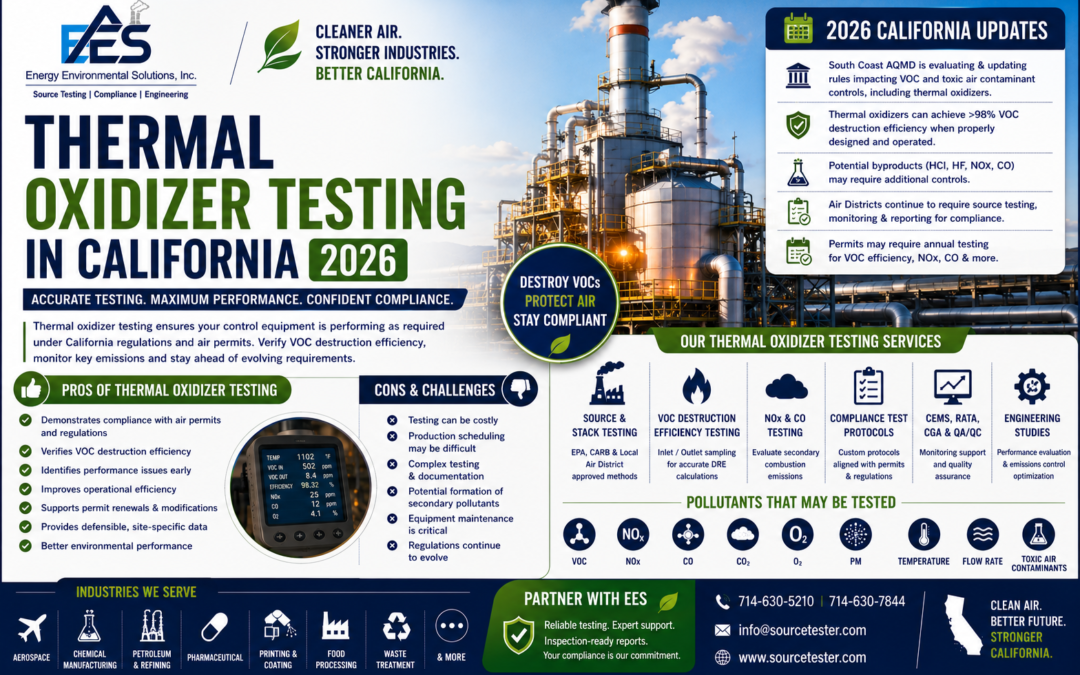
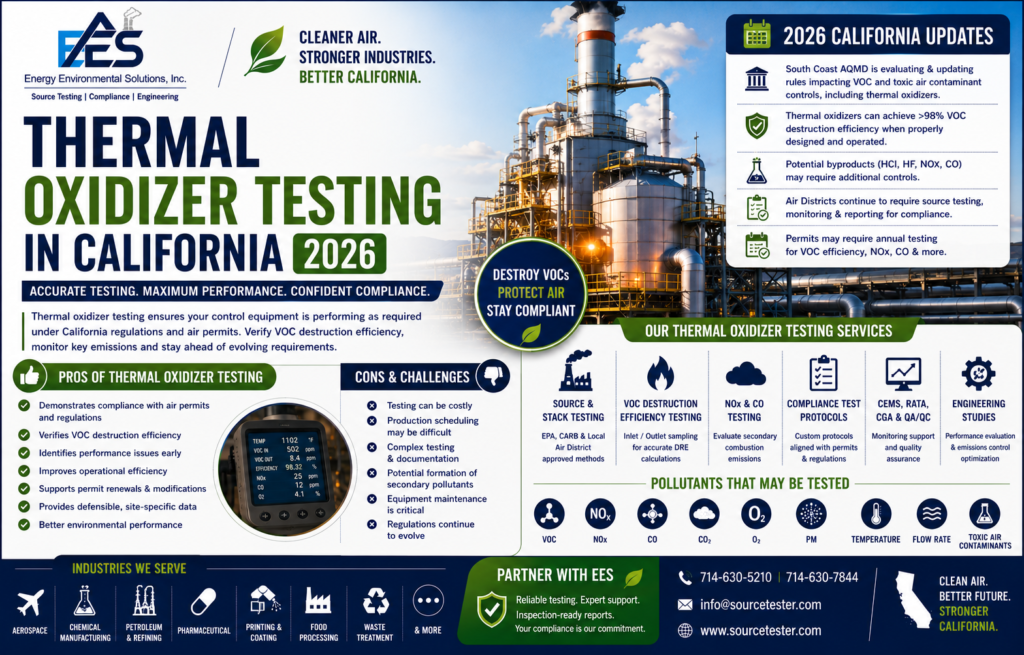
The March 2026 staff report evaluates thermal oxidizers as a potential control technology for VOC and toxic-air-contaminant emissions. South Coast AQMD states that thermal oxidizers can achieve destruction efficiencies exceeding 98% under suitable operating conditions.
However, the agency also identifies limitations for some compounds. For example, thermal oxidation of chlorinated and fluorinated compounds can generate acidic byproducts such as hydrochloric acid and hydrofluoric acid, potentially requiring scrubbers and additional controls.
What this means for industry: choosing a thermal oxidizer is not simply about achieving a high VOC destruction percentage. Facilities must also evaluate the pollutants created by the combustion process.
2. 2026 Rulemaking Continues Across California’s Industrial Air Sector
South Coast AQMD’s 2026 regulatory agenda includes numerous proposed amendments and new rules addressing particulate matter, toxic air contaminants, monitoring, New Source Review, and other air-quality requirements.
This broader regulatory activity matters to facilities operating thermal oxidizers because a control device may address one pollutant while creating or affecting another.
For example, South Coast AQMD’s emissions-reporting guidance for thermal oxidation notes that when VOC vapors are destroyed through thermal oxidation, NOx, SOx, CO, PM, and toxic air contaminants may also be generated. The agency encourages operators to use site-specific test results where available for emissions calculations.
That makes comprehensive testing increasingly valuable.
3. Source Testing Can Be a Permit Requirement
Thermal oxidizer testing requirements are often written directly into individual facility permits.
For example, a Bay Area Air Quality Management District permit requires a thermal oxidizer to be source tested annually for VOC control efficiency as well as NOx and CO emissions, with results reported to the District. The permit also specifies continuous temperature monitoring and recordkeeping requirements.
This demonstrates an important point:
Thermal oxidizer testing frequency and pollutants are determined by the applicable permit and regulatory requirements.
Some facilities may require annual testing; others may have different schedules or testing triggers.
4. California Facilities Continue Using Performance Testing to Demonstrate Control Efficiency
South Coast AQMD Hearing Board documents also show real-world applications of thermal oxidizers.
In a 2025 case involving a petroleum facility, a portable thermal oxidizer was allowed temporarily to replace an afterburner, subject to conditions including a minimum overall VOC control efficiency of 99% and a performance test shortly after startup to demonstrate compliance.
Although that order was issued in 2025, it remains a useful example of how regulators can use performance testing to verify control-device performance during temporary or modified operating conditions.
Why Is Thermal Oxidizer Testing Important?
A thermal oxidizer may look like a simple solution:
VOC-containing gas → high-temperature combustion → cleaner exhaust
But real-world performance depends on several variables.
If the temperature is too low, residence time is inadequate, mixing is poor, or the system is overloaded, destruction efficiency can decline.
Testing helps answer the critical question:
Is the thermal oxidizer actually performing as required under real operating conditions?
Key Parameters That Can Affect Performance
Temperature
Thermal oxidation requires sufficient temperature to initiate and maintain the oxidation reaction.
Temperature requirements vary depending on the equipment, pollutants, permit, and process.
Residence Time
The contaminated gas needs enough time inside the combustion chamber for the oxidation reaction to occur effectively.
Turbulence & Mixing
Good mixing of combustion air and contaminated gas is essential for consistent oxidation.
South Coast AQMD specifically identifies temperature, residence time, and turbulence/mixing as important design factors for thermal oxidizers.
VOC Loading
An oxidizer operating with a highly variable VOC concentration may behave differently from one receiving a stable waste stream.
Testing under representative operating conditions is therefore critical.
Pros of Thermal Oxidizer Testing
1. Demonstrates Compliance
Testing can provide documented evidence that the control device is meeting applicable permit requirements.
2. Verifies VOC Destruction Efficiency
Testing can determine whether the thermal oxidizer is achieving its required VOC control efficiency.
3. Identifies Performance Problems
Testing can reveal declining control efficiency, combustion problems, unusual emissions, or operational conditions requiring investigation.
4. Supports Permit Compliance
Reliable source-test results can support permit renewals, modifications, inspections, and regulatory reporting.
5. Improves Environmental Performance
Properly operated thermal oxidizers can substantially reduce VOC emissions and associated air-quality impacts.
6. Provides Better Emissions Data
Site-specific testing can provide more defensible information than relying exclusively on generic emission factors.
Cons & Challenges of Thermal Oxidizer Testing
Thermal oxidizer testing also comes with challenges.
Testing Costs
Professional source testing requires specialized equipment, trained personnel, laboratory analysis where applicable, and technical reporting.
Production Scheduling
Testing may need to be performed during specific operating conditions, making coordination with production important.
Complex Testing Requirements
VOC destruction efficiency testing can require simultaneous inlet and outlet measurements, operating-condition documentation, and carefully designed sampling procedures.
Secondary Pollutants
Thermal oxidation can produce NOx, CO, SOx, PM, and potentially toxic or acidic combustion byproducts, depending on the waste stream. South Coast AQMD specifically highlights these considerations in its emissions-reporting guidance.
Equipment Maintenance
Burners, combustion chambers, temperature sensors, controls, fans, dampers, and related equipment need appropriate maintenance to maintain performance.
Regulatory Changes
California’s air-quality regulations continue evolving, making it important for facilities to verify current requirements rather than relying on an old test protocol.
Thermal Oxidizer Testing: What May Be Tested?
A facility’s testing program may include:
Parameter
Why It May Be Tested
VOC
Determine emissions and/or destruction efficiency
NOx
Evaluate combustion-related emissions
CO
Identify incomplete combustion
CO₂
Support combustion and emissions calculations
O₂
Support emissions calculations and combustion evaluation
Flow Rate
Determine mass emissions
Temperature
Verify operating conditions
PM
Evaluate particulate emissions where applicable
Toxic Air Contaminants
Evaluate pollutants specific to the process
Inlet/Outlet VOC
Calculate control efficiency
The exact parameters should always be determined from the facility permit, applicable Air District rules, approved test protocol, and regulatory requirements.
How Energy Environmental Solutions, Inc. Helps Industries
Energy Environmental Solutions, Inc. (EES) provides comprehensive testing and engineering support for facilities using thermal oxidizers and other air pollution control devices.
Thermal Oxidizer Performance Testing
EES can help facilities evaluate thermal oxidizer performance through appropriate source-testing programs.
VOC Destruction Efficiency Testing
We can support testing programs designed to determine VOC inlet and outlet concentrations and control efficiency, where required.
NOx & CO Testing
Because combustion can create secondary pollutants, EES can support testing for NOx and CO where required by permits or regulations.
Source & Stack Testing
Our team provides source and stack testing using applicable EPA, CARB, and local Air District methods.
Compliance Test Protocol Development
Before testing begins, a well-developed protocol can define:
Sampling locations
Test methods
Operating conditions
Number of runs
QA/QC requirements
Analytical procedures
Calculations
Reporting requirements
CEMS, RATA & CGA
EES also supports:
CEMS Certification
RATA
CGA
QA/QC programs
Monitoring support
Engineering Studies
Engineering evaluations can help facilities understand equipment performance and identify potential emissions-control improvements.
Regulatory Reporting
After testing, EES can provide technical reports containing emissions calculations, field information, QA/QC documentation, and test results suitable for regulatory review.
Industries That May Use Thermal Oxidizers
Thermal oxidizers are used across many industrial applications, including:
Chemical Manufacturing
Aerospace Manufacturing
Petroleum & Refining
Pharmaceutical Manufacturing
Printing Operations
Coating Operations
Food Processing
Industrial Manufacturing
Waste Treatment
Landfill Gas Control
Solvent-Using Operations
Fuel Processing
Composite Manufacturing
The applicable testing requirements vary significantly by industry and facility.
Why Choose EES for Thermal Oxidizer Testing?
When a thermal oxidizer is part of your compliance strategy, the question isn’t simply “Can it burn VOCs?”
The real questions are:
Is it achieving the required control efficiency?
Are operating conditions documented?
Are secondary emissions being evaluated?
Is the testing performed according to the applicable protocol?
Is the final report defensible during an inspection?
EES helps facilities address these questions through:
✔ Experienced environmental professionals
✔ California regulatory expertise
✔ Source & stack testing
✔ VOC testing
✔ Thermal oxidizer performance testing
✔ NOx & CO testing
✔ Compliance test protocols
✔ CEMS/RATA/CGA support
✔ Engineering studies
✔ QA/QC documentation
✔ Inspection-ready reporting
✔ Responsive technical support
Don’t Wait Until Your Thermal Oxidizer Fails a Test
A thermal oxidizer is a control device, not a guarantee of compliance.
Its performance depends on equipment condition, operating parameters, waste-stream characteristics, combustion conditions, monitoring, and maintenance.
With California continuing to develop and amend air-quality requirements in 2026, proactive testing and compliance planning can help industrial facilities identify potential issues before they become larger regulatory problems. South Coast AQMD’s current rulemaking activity and facility-specific permit requirements demonstrate why companies should review their testing obligations regularly.
Need Thermal Oxidizer Testing in California?
Energy Environmental Solutions, Inc. can help with:
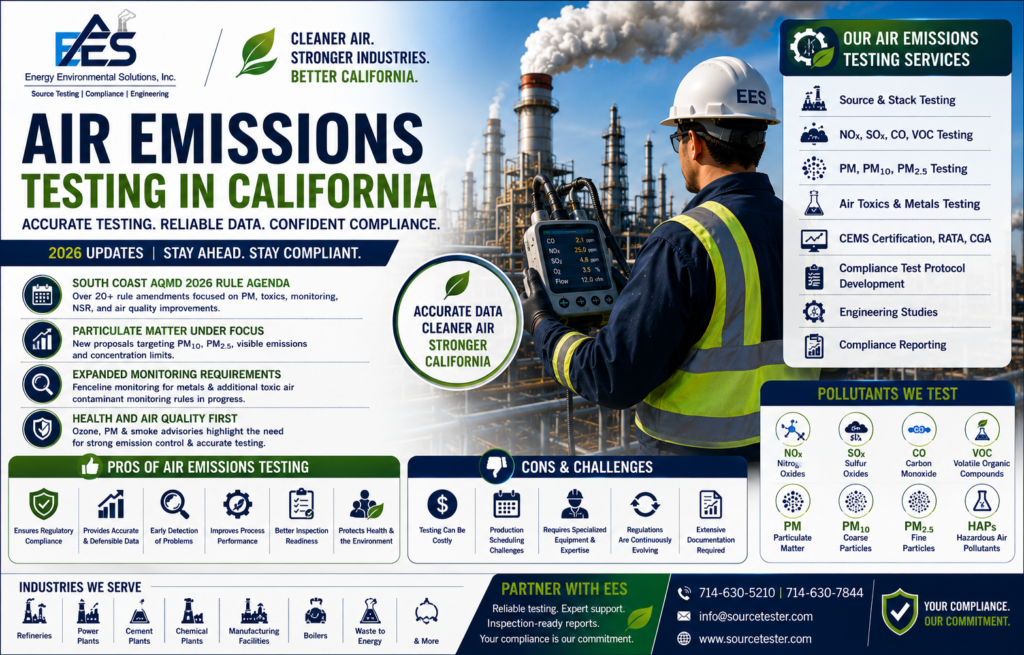
Air Emissions Testing in California (2026): Latest Updates, Pros, Cons & How EES Helps Industries Stay Compliant
California continues to operate one of the most comprehensive air-quality regulatory systems in the United States. In 2026, air emissions testing, source testing, stack testing, emissions monitoring, QA/QC, and compliance reporting remain important tools for industrial facilities demonstrating compliance with air permits and applicable state, federal, and local requirements.
The regulatory environment is also evolving. South Coast AQMD’s 2026 rulemaking calendar includes more than two dozen planned rule amendments and adoptions addressing particulate matter, toxic air contaminants, monitoring, New Source Review, and other air-quality objectives. At the same time, CARB continues updating statewide programs and test methods, while EPA’s current implementation framework continues to rely on emissions inventories, monitoring, modeling, and control strategies to demonstrate progress toward federal air-quality standards.
For industrial operators, this means one thing: accurate emissions data and defensible testing are becoming increasingly important.
Energy Environmental Solutions, Inc. (EES) helps facilities manage this process through professional Air Emissions Testing, Source & Stack Testing, Compliance Test Protocol Development, CEMS Certification, RATA, CGA, QA/QC, Engineering Studies, and Regulatory Reporting.
Emissions Testing
What Is Air Emissions Testing?
Air emissions testing is the measurement and evaluation of pollutants released from industrial processes, combustion equipment, stacks, vents, and other emission sources.
Depending on the facility and permit requirements, testing may address pollutants such as:
NOx – Nitrogen Oxides
SOx – Sulfur Oxides
CO – Carbon Monoxide
VOC – Volatile Organic Compounds
PM – Particulate Matter
PM10
PM2.5
Hazardous Air Pollutants (HAPs)
Air toxics
Metals
Hexavalent chromium
Dioxins and furans
Ammonia
Greenhouse gases
California’s stationary-source testing framework can involve CARB, EPA, and local Air District test methods, with requirements varying according to the applicable agency and regulation. CARB specifically notes that compliance testing requirements can include published CARB, EPA, or other approved test methods.
Why Is Air Emissions Testing Important in California?
California’s air-quality programs are built around controlling emissions from both mobile and stationary sources. CARB identifies stationary point sources such as power plants, oil refineries, manufacturing facilities, and food-processing plants as important categories of permitted emission sources.
For facilities subject to permits, testing provides regulators and operators with information about the actual performance of emission sources. It can also support permit demonstrations, compliance determinations, emissions inventories, engineering evaluations, and corrective actions.
South Coast AQMD’s Annual Emissions Reporting program illustrates the importance of accurate emissions information: facilities meeting specified reporting thresholds must submit annual emissions reports, and the information is used to support air-quality planning and evaluation of clean-air strategies.
Latest California Air Emissions Updates for 2026
1. California’s Regulatory Activity Remains High
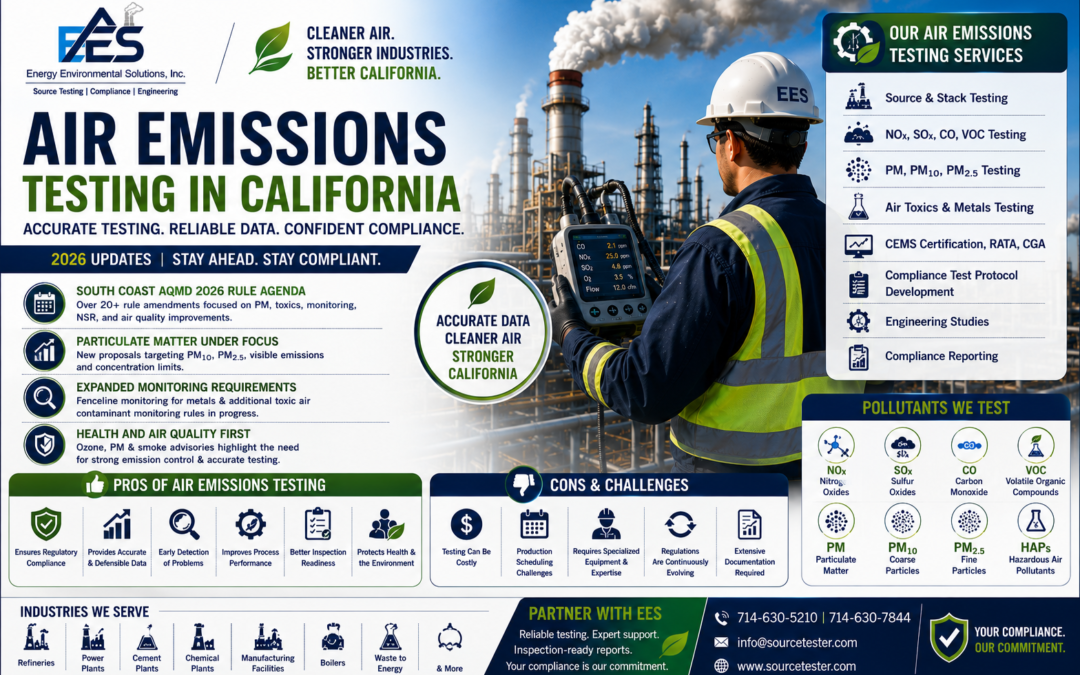
South Coast AQMD announced a 2026 rule calendar containing more than two dozen planned rule amendments and adoptions. The planned activities include particulate-matter reductions, toxic-air-contaminant controls, New Source Review changes, and additional monitoring requirements.
This is important for industrial facilities because testing programs designed around yesterday’s requirements may not automatically address tomorrow’s requirements.
2. Particulate Matter Continues to Receive Attention
South Coast AQMD’s 2026 public-hearing schedule includes proposed amendments involving PM10 and particulate matter, including proposed amendments to Rule 1157 and other particulate-related rules.
The agency also scheduled consideration of proposed Rule 444.1 and amendments involving Visible Emissions, Particulate Matter – Concentration, and Solid Particulate Matter – Weight.
For facilities with particulate-emitting processes, these developments reinforce the value of maintaining reliable PM testing and documentation.
3. Monitoring Requirements Are Expanding
South Coast AQMD’s 2026 rule forecast includes proposals concerning fenceline monitoring for metal toxic air contaminants and monitoring/sampling for facilities identified as having significant high-risk levels for gaseous toxic air contaminants.
This reflects a broader regulatory direction toward more detailed emissions information and greater visibility into facility impacts.
4. Air-Quality Conditions Continue to Drive Regulatory Attention
South Coast AQMD’s 2026 news releases have included ozone advisories, particle-pollution advisories, wildfire-smoke advisories, and windblown-dust advisories. In July 2026, for example, the agency issued an ozone advisory associated with a heat wave.
These events don’t mean every industrial facility must automatically perform a particular emissions test. However, they demonstrate why California continues to prioritize air-quality management and emissions-control programs.
EPA’s current guidance explains that implementation of ozone and particulate-matter standards relies on programs including air-quality monitoring, modeling, emissions inventories, and emission-control strategies.
For industrial facilities, reliable source-level emissions information can therefore become an important component of the broader regulatory picture.
Pros of Professional Air Emissions Testing
1. Stronger Regulatory Compliance
Testing provides measurable evidence that an emission source is operating within applicable permit and regulatory requirements.
Rather than relying solely on assumptions or operating conditions, facilities can use documented test results to demonstrate actual performance.
2. Better Emissions Data
Properly designed testing provides traceable and technically defensible emissions data.
This can be particularly important when data is used for:
Permit compliance
Emissions inventories
Regulatory reporting
Engineering evaluations
Corrective actions
Permit renewals
3. Early Identification of Problems
Testing can reveal problems with combustion equipment, pollution-control devices, process conditions, sampling systems, or operating parameters.
Finding a problem early is generally easier than discovering it during an inspection or after a compliance issue develops.
South Coast AQMD states that its inspectors regularly inspect businesses and may issue compliance notices when additional information is required or when minor violations are identified.
4. Improved Process Performance
Emissions testing isn’t only about compliance.
Test results can also help engineers understand how equipment is performing and identify opportunities to improve combustion, pollution-control efficiency, or operating conditions.
That can potentially translate into lower emissions, better efficiency, and improved operational control.
5. Better Inspection Readiness
A facility with organized test protocols, calibration records, field data, QA/QC documentation, laboratory information, calculations, and final reports is generally better prepared when regulators request information.
Cons and Challenges of Air Emissions Testing
Professional testing has significant benefits, but industrial operators should also understand the challenges.
Testing Can Be Expensive
Specialized equipment, qualified personnel, laboratory analysis, engineering support, and reporting can increase project costs.
Production Scheduling Can Be Difficult
Some tests must occur during representative operating conditions, which means production schedules may need to be coordinated around the testing event.
Testing Can Require Specialized Expertise
Different pollutants require different sampling and analytical approaches. Selecting the wrong method or test condition can compromise the usefulness of the results.
Regulations Can Change
California’s regulatory environment is continuously evolving. South Coast AQMD’s 2026 rule calendar itself demonstrates the volume of regulatory activity underway.
Documentation Requirements Can Be Extensive
Testing is not simply about collecting a sample. Facilities may need protocols, calibration information, operating-condition records, QA/QC documentation, calculations, and regulatory reports.
The solution isn’t to avoid testing. The solution is better planning.
What Does a Typical Air Emissions Testing Program Include?
A professional program may include:
Permit and regulatory review
Test-method selection
Compliance test protocol development
Pre-test coordination
Equipment calibration
On-site source or stack testing
QA/QC verification
Laboratory analysis when applicable
Emissions calculations
Technical report preparation
Regulatory submission support
Corrective-action or engineering recommendations when necessary
CARB maintains published stationary-source test methods for criteria pollutants and toxic air contaminants, while local agencies can establish additional requirements.
How Energy Environmental Solutions, Inc. Helps Industries
Energy Environmental Solutions, Inc. (EES) provides end-to-end environmental compliance support for industrial facilities throughout California.
Our Air Emissions Testing Services Include
Source & Stack Testing Testing of industrial emission sources using applicable EPA, CARB, and local Air District methodologies.
NOx Testing Measurement of nitrogen oxide emissions from combustion and industrial processes.
Particulate Matter Testing Testing for Total PM, PM10, PM2.5, filterable particulate matter, and condensable particulate matter where applicable.
VOC Testing Testing and evaluation of volatile organic compound emissions.
Air Toxics Testing Testing for applicable hazardous air pollutants, metals, hexavalent chromium, dioxins/furans, and other regulated contaminants.
CEMS Services
CEMS Certification
RATA
CGA
QA/QC
Monitoring support
Compliance Test Protocol Development Detailed protocols prepared around applicable permits, regulations, test methods, sampling requirements, and operating conditions.
Engineering Studies Technical assessments designed to support emissions compliance, equipment performance, and regulatory decision-making.
Compliance Reporting Clear, organized, inspection-ready reports with supporting technical documentation.
Why Choose EES?
When emissions compliance is on the line, facilities need more than a test result. They need confidence in the entire testing process.
EES helps clients with:
✔ Experienced environmental professionals
✔ EPA & California regulatory expertise
✔ Source and stack testing
✔ Accurate emissions measurements
✔ Customized test protocols
✔ Comprehensive QA/QC
✔ CEMS, RATA & CGA support
✔ Engineering assistance
✔ Compliance reporting
✔ Responsive technical support
✔ Inspection-ready documentation
✔ End-to-end project management
Industries EES Serves
EES supports emissions compliance programs for industries including:
Petroleum Refineries
Power Generation
Chemical Manufacturing
Cement Manufacturing
Manufacturing Facilities
Food Processing
Pharmaceutical Manufacturing
Waste-to-Energy
Industrial Boilers
Metal Processing
Aerospace
Municipal Utilities
Fuel and Petroleum Operations
Partner With EES for California Air Emissions Testing
California’s 2026 regulatory environment demonstrates a continuing emphasis on emissions reductions, monitoring, source testing, particulate matter, toxic air contaminants, and defensible environmental data. South Coast AQMD’s current rulemaking activity includes particulate-matter controls, toxic-air monitoring, and other measures designed to support state and federal air-quality objectives.
For industrial facilities, proactive emissions testing can turn compliance from a reactive exercise into a planned process.
Whether you need Air Emissions Testing, Source Testing, Stack Testing, NOx Testing, PM10/PM2.5 Testing, VOC Testing, Air Toxics Testing, CEMS Certification, RATA, CGA, Compliance Test Protocol Development, Engineering Studies, or Compliance Reporting, Energy Environmental Solutions, Inc. can help you plan, test, document, and respond with confidence.
Don’t wait for an inspection to discover a testing or documentation problem.
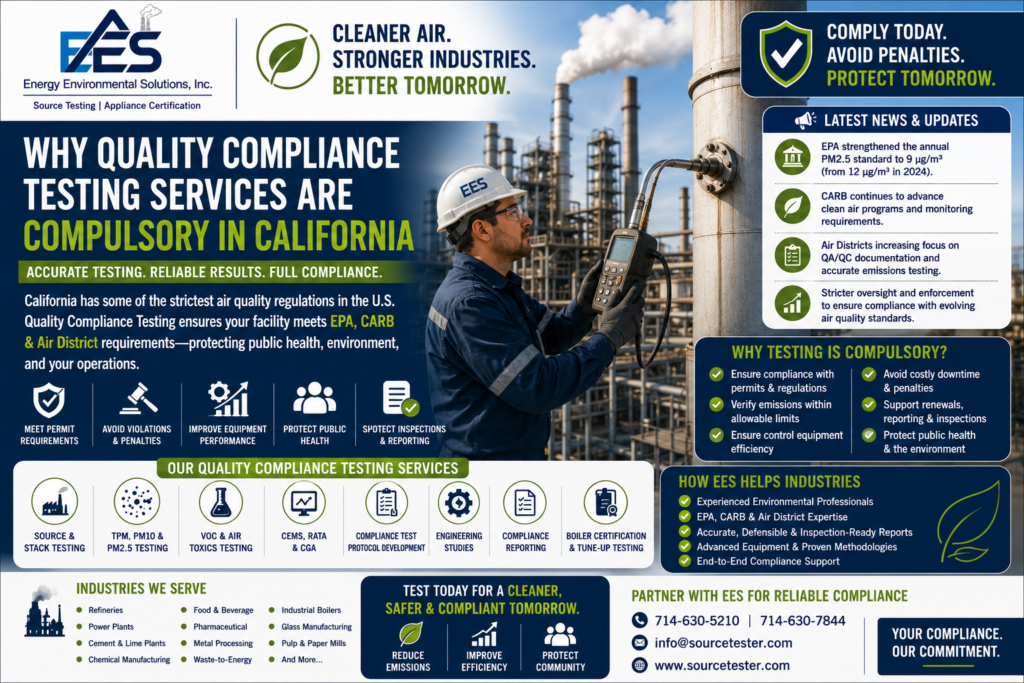
Why Quality Compliance Testing Services Are Critical in California — And How Energy Environmental Solutions, Inc. Helps Industries Stay Ahead
California continues to lead the nation in environmental protection with some of the most stringent air quality regulations in the United States. As federal and state agencies strengthen emissions standards and increase oversight of industrial operations, Quality Compliance Testing Services have become essential for facilities seeking to maintain permit compliance, reduce operational risks, and demonstrate environmental responsibility.
Whether your facility operates a power plant, refinery, manufacturing plant, cement facility, chemical processing plant, or industrial boiler, quality compliance testing ensures your emissions data is accurate, defensible, and ready for regulatory review.
At Energy Environmental Solutions, Inc. (EES), we provide comprehensive Quality Compliance Testing Services, source testing, engineering support, and regulatory reporting that help industries meet EPA, CARB, and California Air District requirements with confidence.
What Are Quality Compliance Testing Services?
Quality Compliance Testing is a systematic process used to verify that industrial emissions meet federal, state, and local environmental regulations while ensuring testing procedures follow approved quality assurance and quality control (QA/QC) standards.
These services typically include:
Source & Stack Testing
Air Quality Compliance Testing
Total Particulate Matter (TPM) Testing
PM10 & PM2.5 Testing
VOC Emissions Testing
Air Toxics Testing
Compliance Test Protocol Development
Continuous Emissions Monitoring Systems (CEMS) Support
Relative Accuracy Test Audits (RATA)
Cylinder Gas Audits (CGA)
Boiler Certification & Tune-Up Testing
Engineering Studies
Quality Assurance / Quality Control (QA/QC)
Regulatory Compliance Reporting
Quality testing ensures emissions data is reliable, repeatable, and accepted by regulatory agencies.
Why Are Quality Compliance Testing Services Compulsory in California?
California has adopted some of the nation’s most rigorous environmental regulations to improve air quality and protect public health. Many industrial facilities are required by permit conditions to conduct periodic emissions testing and maintain detailed records demonstrating compliance.
Quality compliance testing helps facilities:
Demonstrate compliance with permit requirements.
Verify emissions remain within allowable limits.
Confirm pollution control equipment is functioning effectively.
Support permit renewals and regulatory inspections.
Produce accurate and defensible emissions data.
Reduce the risk of enforcement actions and operational disruptions.
Latest Regulatory News & Updates
EPA Strengthened Fine Particulate Matter Standards
The U.S. Environmental Protection Agency (EPA) has strengthened the annual PM2.5 National Ambient Air Quality Standard, increasing the importance of accurate emissions testing and compliance planning for industrial facilities. This change is expected to influence permitting, source testing, and emissions reduction strategies across California.
California Continues Expanding Air Quality Programs
The California Air Resources Board (CARB) continues implementing air quality initiatives aimed at reducing particulate matter, nitrogen oxides (NOx), volatile organic compounds (VOCs), and toxic air contaminants. Facilities are expected to maintain accurate emissions records supported by approved testing methodologies.
Greater Emphasis on QA/QC Documentation
California Air Districts increasingly require emissions testing supported by documented Quality Assurance and Quality Control procedures. Accurate calibration records, test protocols, and inspection-ready documentation are essential during agency reviews.
Increased Regulatory Oversight
Local Air Districts continue reviewing emissions reports, permit compliance records, and testing documentation to ensure facilities meet evolving environmental requirements.
Current Industry Trends
Today’s environmental compliance programs increasingly focus on:
Advanced Emissions Monitoring
Continuous Compliance Verification
Digital Environmental Reporting
Predictive Maintenance
Inspection-Ready Documentation
Enhanced QA/QC Procedures
Real-Time Data Validation
Engineering Performance Studies
Sustainable Manufacturing Practices
Pollution Prevention Programs
Risks of Poor Quality Compliance Testing
Incomplete or inaccurate testing can result in:
Permit Compliance Issues
Regulatory Notices
Additional Source Testing
Increased Compliance Costs
Delayed Permit Approvals
Operational Interruptions
Inspection Findings
Data Quality Concerns
Project Delays
Potential Enforcement Actions
Routine quality compliance testing helps identify issues early while supporting efficient facility operations.
How Energy Environmental Solutions, Inc. Helps Industries
Energy Environmental Solutions, Inc. (EES) provides comprehensive environmental testing and compliance services for industrial facilities throughout California.
Our Services Include
Quality Compliance Testing
Comprehensive testing programs designed to verify emissions compliance and maintain regulatory confidence.
Source & Stack Testing
Accurate emissions measurements using EPA, CARB, and Local Air District-approved methods.
Air Quality Compliance Testing
Professional testing services supporting permit demonstrations and regulatory reporting.
Total Particulate Matter (TPM), PM10 & PM2.5 Testing
Reliable particulate emissions testing to verify compliance with air quality standards.
Air Toxics Testing
Testing for hazardous air pollutants including:
Multimetals
Hexavalent Chromium
Dioxins/Furans
VOC & Low VOC Testing
Professional VOC emissions measurements and spike testing for low-level emissions.
Compliance Test Protocol Development
Preparation of agency-ready testing protocols customized to your facility and permit requirements.
CEMS Services
CEMS Certification
Relative Accuracy Test Audits (RATA)
Cylinder Gas Audits (CGA)
QA/QC Programs
Boiler Certification & Combustion Testing
Performance evaluations to improve combustion efficiency while maintaining emissions compliance.
Engineering Studies
Technical evaluations supporting permitting, emissions reduction, and operational improvements.
Compliance Reporting
Inspection-ready reports with complete QA/QC documentation, emissions calculations, and regulatory summaries.
Regulatory Support
Technical assistance from project planning through final agency submission.
Why Industries Choose EES
Energy Environmental Solutions, Inc. is trusted by industries throughout California because we deliver technically sound, reliable, and efficient environmental compliance solutions.
Our clients benefit from:
✔ Experienced Environmental Professionals
✔ EPA & California Regulatory Expertise
✔ Accurate & Defensible Emissions Data
✔ Advanced Testing Equipment
✔ Comprehensive QA/QC Procedures
✔ Fast Scheduling & Responsive Service
✔ Inspection-Ready Documentation
✔ Reliable Compliance Reporting
✔ Engineering & Regulatory Support
✔ End-to-End Environmental Compliance Solutions
Industries We Serve
EES proudly supports:
Petroleum Refineries
Power Generation Facilities
Cement Plants
Chemical Manufacturing
Food Processing Facilities
Pharmaceutical Manufacturers
Aerospace & Metal Processing
Waste-to-Energy Facilities
Glass Manufacturing
Pulp & Paper Mills
Industrial Boilers
Municipal Utilities
Partner with EES for Reliable Compliance Testing
As California’s environmental regulations continue to evolve, reliable quality compliance testing is more important than ever.
Whether your facility requires Quality Compliance Testing, Source Testing, Stack Testing, Air Quality Compliance Testing, TPM Testing, PM10 & PM2.5 Testing, Air Toxics Testing, VOC Testing, CEMS Services, Engineering Studies, or Compliance Test Protocol Development, Energy Environmental Solutions, Inc. has the expertise to help.
Our experienced team provides technically sound testing, accurate reporting, and responsive support to help your facility maintain compliance, reduce operational risk, and confidently meet EPA, CARB, and California Air District requirements.