Destruction Efficiency in California 2026: Latest Updates, Pros, Cons & How EES Helps Industries Stay Compliant
Destruction efficiency is becoming an increasingly important performance metric for California facilities that use thermal oxidizers, regenerative thermal oxidizers (RTOs), flares, vapor-control systems, and other air-pollution control equipment to reduce VOC and other organic emissions.
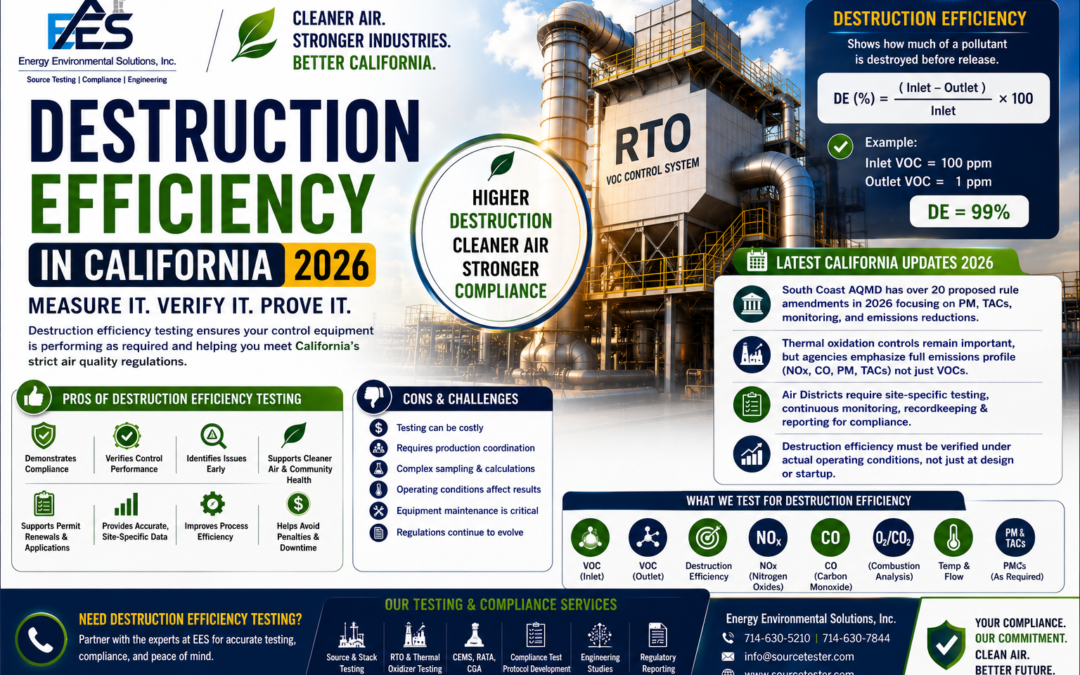
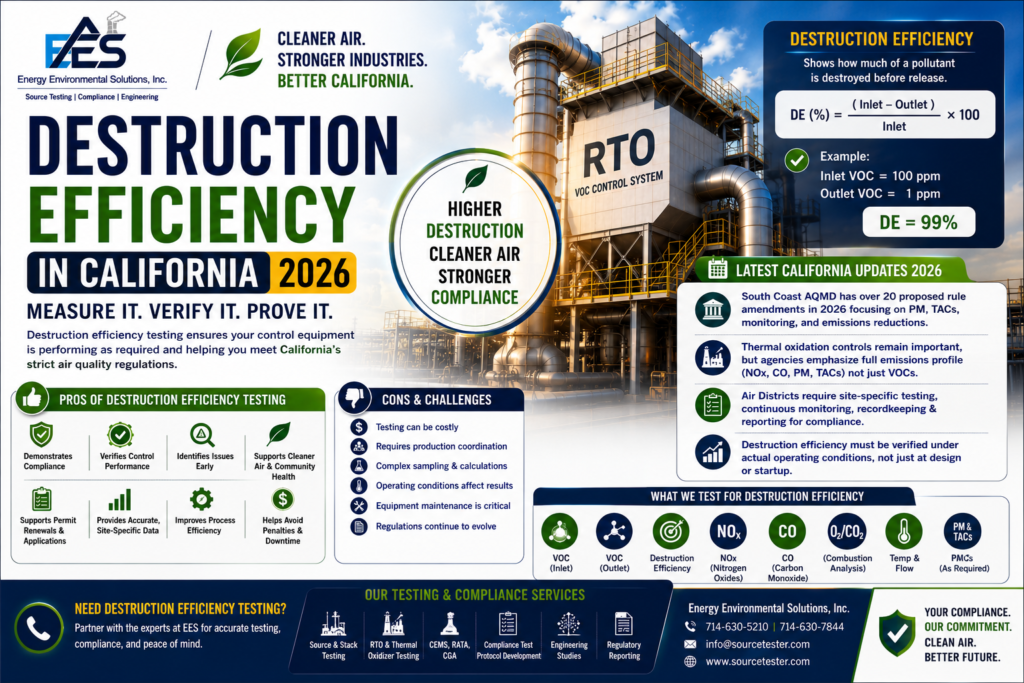
In simple terms, destruction efficiency measures how much of a pollutant entering a control device is actually destroyed before the treated gas is released. A commonly used calculation is:
But achieving a high percentage during one test is not necessarily the same as maintaining compliant performance during everyday operation.
California’s 2026 regulatory environment continues to emphasize emission reductions, monitoring, source testing, toxic-air-contaminant controls, and reliable emissions data. South Coast AQMD’s 2026 rule calendar contains more than two dozen planned rule amendments and adoptions addressing particulate matter, toxic air contaminants, monitoring, New Source Review, and other air-quality objectives.
For facilities using thermal oxidation or other control technologies, that creates a growing need for accurate destruction-efficiency testing and defensible compliance documentation.
Energy Environmental Solutions, Inc. (EES) helps industries with Destruction Efficiency Testing, VOC Testing, RTO Testing, Thermal Oxidizer Testing, Source & Stack Testing, CEMS, RATA, CGA, Compliance Test Protocol Development, Engineering Studies, QA/QC, and Regulatory Reporting.
What Is Destruction Efficiency?
Destruction efficiency, often called Destruction Removal Efficiency (DRE), describes the percentage of a pollutant that a control device removes through destruction.
For example, if a control device receives 100 pounds of VOCs and only 1 pound remains in the outlet gas, the calculated destruction efficiency would be approximately 99%.
This measurement is particularly important for equipment such as:
Regenerative Thermal Oxidizers (RTOs)
Thermal oxidizers
Catalytic oxidizers
Afterburners
Flares
VOC control systems
Certain combustion-based control devices
However, destruction efficiency is not the same as capture efficiency.
A facility can have an excellent control device but still release pollutants if the process exhaust is not effectively captured and routed to the control equipment.
That is why compliance evaluations may need to consider capture efficiency + control/destruction efficiency + operating conditions + actual emissions.
Is Destruction Efficiency Testing Compulsory in California?
There is an important distinction.
California does not have one universal destruction-efficiency testing requirement that applies identically to every industrial facility.
Whether a facility must demonstrate destruction efficiency depends on factors including:
Facility location
Local Air District
Air permit
Applicable regulation
Source category
Pollutant
Control technology
Required control efficiency
Federal requirements
State requirements
Permit-specific testing conditions
A current South Coast AQMD emissions-reporting guideline specifically instructs facilities using thermal oxidation to use site-specific destruction-efficiency test results, the applicable permit, or the applicable rule limit when determining vapor-destruction efficiency.
This is an important compliance message:
Don’t assume your facility’s required destruction efficiency—verify it from the applicable permit and regulation.
Latest California Updates in 2026
1. California Continues Strengthening Air-Quality Controls
South Coast AQMD’s 2026 rulemaking program includes more than two dozen planned rule amendments and adoptions.
The agency’s priorities include:
PM reduction
Toxic-air-contaminant controls
Updated toxic-air-contaminant lists
New Source Review
Monitoring requirements
Community emission-reduction objectives
The agency says these activities support the 2016 and 2022 Air Quality Management Plans, 2024 PM Plan, federal and state air-quality standards, and AB 617 Community Emission Reduction Plans.
For facilities using VOC destruction systems, this reinforces the importance of having reliable performance data.
2. Thermal Oxidation Remains an Important Control Technology
South Coast AQMD continues to evaluate thermal oxidation as an emissions-control option.
A March 2026 South Coast AQMD staff report evaluating aerospace coating controls recognized that thermal oxidizers can technically achieve high destruction efficiencies for certain VOC and toxic compounds. However, the agency also identified limitations for some chlorinated and fluorinated compounds because thermal oxidation can produce HCl and HF, requiring additional controls such as scrubbers.
The lesson for industry is important:
A high destruction-efficiency percentage does not automatically mean a control technology is appropriate for every pollutant.
The entire emissions profile must be evaluated.
3. Regulators Are Looking Beyond a Single Performance Number
South Coast AQMD’s 2026 activities demonstrate a broader focus on monitoring, toxic air contaminants, particulate matter, and emissions data rather than relying on a single compliance measurement.
A control device may destroy VOCs while simultaneously generating other combustion-related pollutants.
South Coast AQMD’s emissions-reporting guidance specifically states that thermal oxidation can generate NOx, SOx, CO, PM, and toxic air contaminants, and encourages operators to use site-specific test results for emissions calculations when available.
Therefore, a strong testing program should evaluate the complete picture.
4. Real-World 2026 Cases Show Why Performance Verification Matters
In June 2026, South Coast AQMD hearing-board documents involving Chiquita Canyon included conditions requiring equipment modifications designed to maintain sufficient flare operation and methane content for destruction efficiency consistent with regulatory requirements.
Earlier 2026 correspondence from South Coast AQMD also discussed the relationship between operating conditions, temperature, equipment design, source-test results, and destruction efficiency at the facility.
Although this example involves landfill-gas combustion rather than a conventional industrial RTO, it illustrates a broader principle:
Regulators can require evidence that operating conditions actually support the required destruction performance.
Why Is Destruction Efficiency Testing Important?
A control device manufacturer’s guarantee may say 98%, 99%, or higher.
But what happens after the equipment has been installed?
What happens when:
VOC loading changes?
Production increases?
Temperature fluctuates?
Ceramic media becomes fouled?
Valves begin leaking?
Airflow changes?
Process chemistry changes?
The burner operates differently?
The capture system develops leaks?
That’s where compliance testing becomes valuable.
Testing converts assumptions into measurable evidence.
Key Factors Affecting Destruction Efficiency
Temperature
Thermal oxidation generally requires sufficient temperature for effective oxidation.
If the temperature falls outside the required operating range, destruction performance may decline.
Residence Time
The contaminated gas needs sufficient time in the appropriate combustion environment.
Insufficient residence time can reduce destruction performance.
Turbulence & Mixing
Effective mixing is essential to expose the pollutant-containing gas to the required oxidation conditions.
VOC Concentration
A control system can perform differently depending on the concentration and composition of the incoming VOC stream.
Equipment Condition
Valves, burners, seals, ceramic media, sensors, ductwork, fans, and controls can all affect system performance.
Capture Efficiency
Even a highly efficient RTO cannot destroy pollutants that never reach it.
This makes capture and destruction efficiency two different but interconnected compliance considerations.
Pros of Destruction Efficiency Testing
1. Demonstrates Control Performance
Testing provides measurable evidence of how effectively the control device is destroying pollutants.
2. Supports Regulatory Compliance
Where required by a permit or regulation, test results can support compliance demonstrations.
3. Identifies Problems Early
Testing may reveal declining control efficiency before the problem becomes a larger compliance issue.
4. Supports Permit Applications
Reliable test data can be useful for permit modifications, renewals, and engineering evaluations.
5. Provides Site-Specific Data
South Coast AQMD specifically encourages the use of site-specific destruction-efficiency test results where available for emissions calculations.
6. Improves Operational Understanding
Testing can help facility engineers understand how production conditions affect control-device performance.
Cons & Challenges of Destruction Efficiency Testing
Professional testing also has challenges.
Testing Costs
Specialized source-testing equipment, qualified personnel, laboratory analysis, and reporting can increase project costs.
Production Coordination
Testing may need to occur under representative operating conditions, requiring coordination with production.
Complex Sampling
Some control-efficiency tests require simultaneous measurements at the inlet and outlet.
Variable VOC Streams
Changing process chemistry can make it difficult to establish representative testing conditions.
Secondary Pollutants
Thermal oxidation can create additional pollutants such as NOx, CO, SOx, PM, and certain toxic or acidic compounds, depending on the material being treated.
Documentation Requirements
A technically correct test can still create compliance problems if the supporting protocol, calibration, operating-condition records, calculations, or report are incomplete.
Destruction Efficiency vs. Removal Efficiency vs. Capture Efficiency
These terms are often confused.
Term
What It Measures
Destruction Efficiency
Percentage of pollutant destroyed by the control device
Removal Efficiency
Percentage of pollutant removed from the treated stream; the exact meaning depends on the control process
Capture Efficiency
Percentage of process emissions successfully captured and routed to the control device
Overall Control Efficiency
Combined effect of capture and control/destruction
A facility should understand exactly which metric its permit or regulation requires.
How Destruction Efficiency Testing Is Typically Performed
A professional testing program can include:
1. Permit Review
Identify the required control efficiency, pollutants, test frequency, and applicable methods.
2. Test Protocol Development
Define sampling locations, methods, operating conditions, number of runs, QA/QC, and calculations.
3. Pre-Test Coordination
Coordinate production and control-device operation to establish representative conditions.
4. Equipment Calibration
Prepare and calibrate sampling and analytical equipment.
5. Inlet Testing
Measure the pollutant concentration entering the control device.
6. Outlet Testing
Measure the pollutant concentration leaving the control device.
7. Operating Data Collection
Document temperature, flow, fuel use, production rate, oxygen, pressure, and other applicable parameters.
8. Calculations
Calculate destruction/control efficiency and mass emissions using the applicable methodology.
9. QA/QC Review
Verify data quality, calibration information, field records, and laboratory results.
10. Final Reporting
Prepare a technically defensible report for the facility and regulatory agency when required.
How EES Helps Industries
Energy Environmental Solutions, Inc. (EES) provides comprehensive emissions-testing and environmental compliance services for California industries.
Destruction Efficiency Testing
EES helps facilities design and perform testing programs to determine whether applicable control devices are achieving required performance.
RTO Testing
For regenerative thermal oxidizers, EES can support:
VOC inlet testing
VOC outlet testing
VOC destruction/control efficiency
NOx testing
CO testing
Operating-condition verification
Thermal Oxidizer Testing
EES can evaluate thermal oxidizer performance according to applicable permit and regulatory requirements.
Source & Stack Testing
Professional source and stack testing using applicable EPA, CARB, and local Air District methods.
Compliance Test Protocol Development
EES develops protocols covering:
Test methods
Sampling locations
Operating conditions
Test runs
QA/QC
Calculations
Reporting
CEMS, RATA & CGA
EES also supports:
CEMS Certification | RATA | CGA | QA/QC | Monitoring
Engineering Studies
Engineering evaluations can help facilities understand emissions-control performance and identify potential improvement opportunities.
Compliance Reporting
EES provides organized technical documentation including field data, calculations, QA/QC records, operating information, and final test results.
Industries That May Need Destruction-Efficiency Testing
Depending on their control technology and permit requirements, EES can support facilities in industries such as:
Aerospace
Chemical Manufacturing
Petroleum & Refining
Pharmaceutical Manufacturing
Paint & Coating
Metal Finishing
Printing
Food Processing
Waste Treatment
Recycling
Composite Manufacturing
Fuel Processing
Solvent-Using Industries
Industrial Manufacturing
Why Choose EES?
When a regulator asks:
“How do you know your control device is achieving the required efficiency?”
A manufacturer’s brochure isn’t always enough.
You need credible, documented, site-specific evidence when your permit or regulation requires it.
The 2026 Compliance Message for California Industry
California’s 2026 regulatory activity shows that air-quality management is continuing to focus on emission reductions, monitoring, toxic-air contaminants, particulate matter, and community exposure.
At the same time, regulators continue to use site-specific data and permit conditions to evaluate whether emission-control equipment is achieving required performance. South Coast AQMD’s current emissions guidance specifically points to site-specific destruction-efficiency testing, permit requirements, or applicable rule limits when determining destruction efficiency for certain thermal-oxidation applications.
That makes proactive testing a smart compliance strategy.
Don’t wait until an underperforming control device becomes a regulatory problem.
Ask:
Is your VOC control efficiency still meeting your permit requirement?
Are your inlet and outlet measurements defensible?
Are your operating conditions properly documented?
Has your control device been tested under representative conditions?
Is your current test protocol aligned with your permit?
If you don’t know the answer, it may be time for a compliance review.
Need Destruction Efficiency Testing in California?
Energy Environmental Solutions, Inc. (EES) helps industrial facilities evaluate, document, and improve emissions-control performance.
RTO Testing in California (2026): Latest Updates, Pros, Cons & How EES Helps Industries Stay Compliant
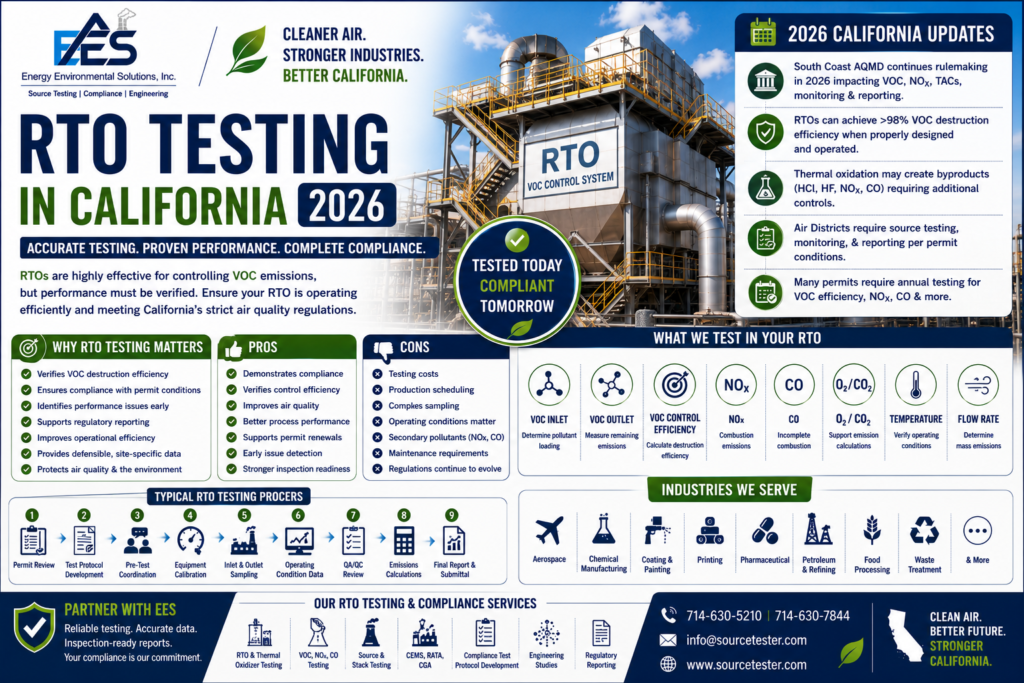
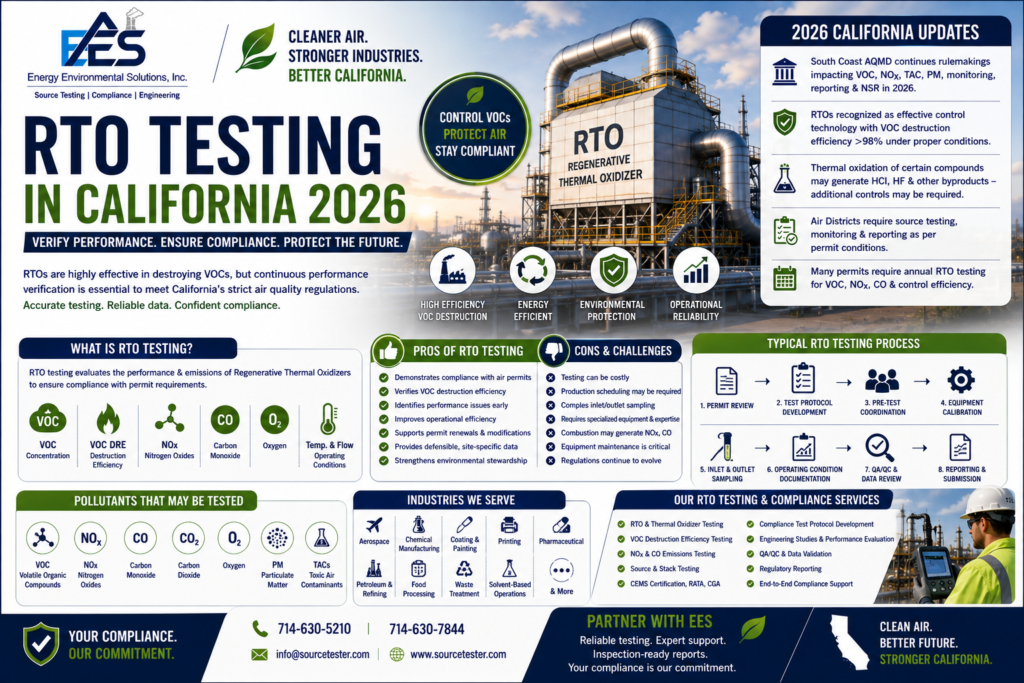
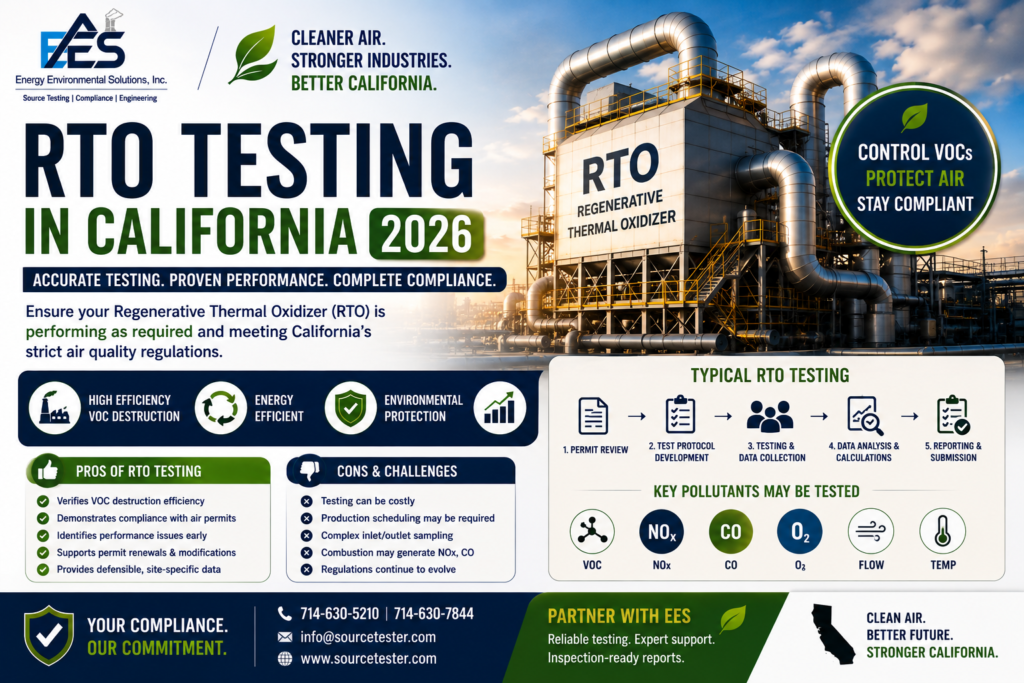
California’s industrial air-quality requirements continue to evolve in 2026, making Regenerative Thermal Oxidizer (RTO) testing an important compliance consideration for facilities using RTOs to control VOCs and other air pollutants.
An RTO is a sophisticated air-pollution control device that uses ceramic heat-recovery media and high-temperature oxidation to destroy combustible pollutants. But installing an RTO does not automatically prove compliance. Facilities may need source testing, operating-condition verification, continuous monitoring, and documentation demonstrating that the system is achieving the performance required by its permit or applicable regulations.
Recent California regulatory activity reinforces this point. South Coast AQMD continues developing and updating rules involving VOC emissions, NOx, toxic air contaminants, particulate matter, monitoring, and New Source Review. Its 2026 work also includes proposed amendments affecting industrial combustion equipment and air-quality controls.
For facilities operating RTOs, this makes proactive testing and compliance planning increasingly valuable.
Energy Environmental Solutions, Inc. (EES) helps industries with RTO Testing, Thermal Oxidizer Testing, VOC Testing, Source & Stack Testing, NOx & CO Testing, CEMS, RATA, CGA, Compliance Test Protocol Development, Engineering Studies, and Regulatory Reporting.
Regenerative Thermal Oxidizer Testing
What Is RTO Testing?
RTO testing evaluates the performance and emissions of a Regenerative Thermal Oxidizer under specified operating conditions.
RTOs are commonly used to control VOC emissions from processes such as:
Coating and painting
Chemical manufacturing
Printing
Solvent-based operations
Aerospace manufacturing
Food and industrial processing
Pharmaceutical manufacturing
Petroleum operations
Waste treatment
Other VOC-generating industrial processes
An RTO generally uses ceramic heat-exchange media to recover heat from the oxidized exhaust and transfer that heat to incoming process gas. This can make the technology highly energy-efficient compared with some conventional thermal oxidizer configurations.
However, the RTO must operate correctly. Testing can help determine whether the system is meeting applicable VOC destruction/control requirements and whether combustion-related emissions such as NOx and CO remain within applicable limits.
Is RTO Testing Compulsory in California?
This is an important distinction.
RTO testing is not automatically compulsory for every facility in California simply because the facility owns an RTO.
Testing requirements depend on factors such as:
Facility location
Air District
Permit conditions
Applicable rules
Type of process
Pollutants being controlled
RTO design
Required control efficiency
Operating conditions
Federal requirements
State requirements
Testing provisions in the facility’s permit
For example, a current San Joaquin Valley Air Pollution Control District permit for a facility using an RTO requires source testing of NOx, VOC at the RTO inlet, VOC at the RTO outlet, and VOC control efficiency within 60 days of startup and annually thereafter. The permit also specifies EPA/ARB test methods, advance notification, an approved source-test plan, and reporting requirements.
This is why facilities should review their individual permit and applicable Air District requirements rather than assuming that one statewide testing schedule applies to every RTO.
Latest California RTO Updates in 2026
1. Air District Rulemaking Remains Active
South Coast AQMD’s 2026 rulemaking agenda shows substantial ongoing regulatory activity involving industrial emissions. Proposed amendments include rules covering NOx from industrial boilers and process heaters, toxic air contaminants, particulate matter, monitoring, reporting, recordkeeping, and New Source Review.
For RTO operators, this matters because an RTO can control VOC emissions while its combustion process may also affect other pollutants.
A compliance program therefore needs to consider the whole emission profile, not only VOC destruction efficiency.
2. South Coast AQMD Continues Evaluating Thermal Oxidizers
A March 2026 South Coast AQMD staff report evaluating controls for aerospace coating operations discusses thermal oxidizers as a technology capable of achieving high destruction efficiencies for applicable VOC and toxic compounds.
The report also highlights an important limitation: thermal oxidation of certain chlorinated and fluorinated compounds can generate HCl and HF, potentially requiring additional scrubbing equipment. South Coast AQMD concluded that thermal oxidation was not the most practical control option for most of the aerospace coating applications evaluated in that particular rulemaking.
What does this mean for RTO operators?
The best control strategy depends on the specific pollutants in the process stream. A high destruction efficiency for VOCs does not necessarily mean the technology is optimal for every chemical mixture.
3. RTOs Remain an Established VOC Control Technology
South Coast AQMD’s BACT materials continue to recognize thermal oxidizers, including RTOs, as established control technologies for certain applications. The District’s BACT records include a regenerative thermal oxidizer determination for a metal-coating operation.
The District has also historically identified RTOs as BACT for certain VOC-control applications.
This means RTO technology remains relevant—but the required performance level is application-specific.
4. RTOs Can Have Strict Operating Conditions
A recent Valley Air District permit provides a useful real-world example.
The permit requires the RTO to operate with:
Minimum combustion-chamber temperature of 1,400°F
Minimum retention time of 0.5 seconds
Continuous temperature monitoring
Annual source testing
Approved testing methods
Advance notification
An approved source-test plan
Regulatory reporting
The permit also establishes pollutant-specific emission limits and requires testing of VOC control efficiency.
This illustrates why RTO testing is more than collecting a stack sample. Operating conditions and documentation can be just as important.
What Does RTO Testing Typically Measure?
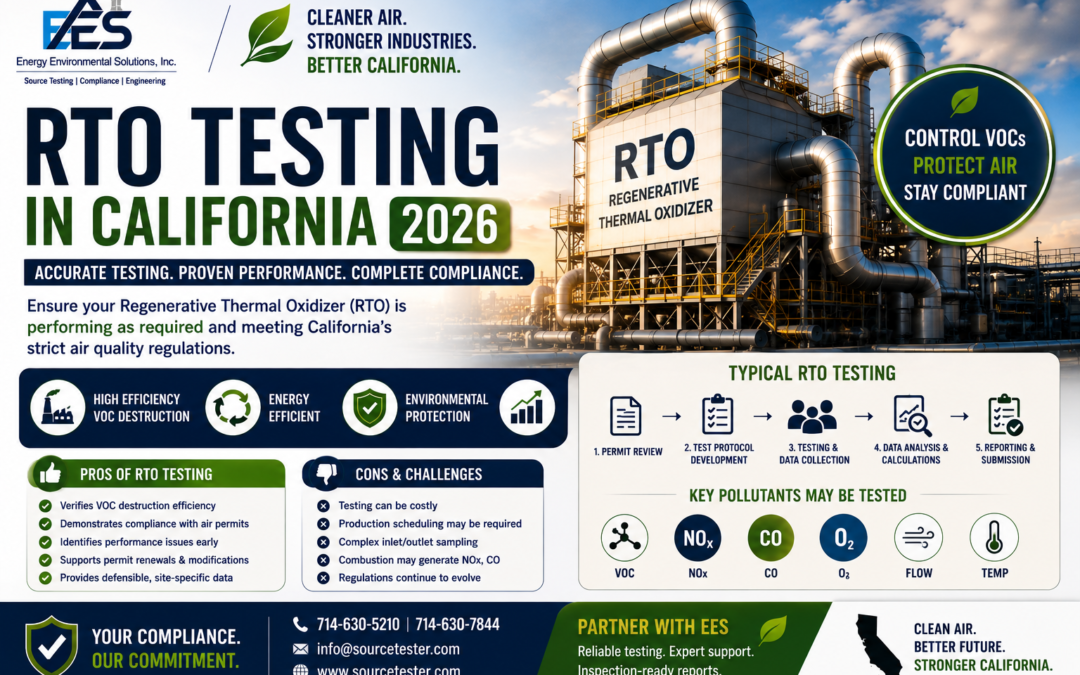
Depending on the applicable permit and test protocol, an RTO testing program may evaluate:
The actual parameters and methods should be established from the applicable permit, Air District requirements, and approved test protocol.
How RTO Testing Works
A typical compliance project may involve several stages.
1. Permit Review
The testing team first reviews the facility’s permit and applicable regulatory requirements.
2. Test Protocol Development
A detailed protocol identifies sampling locations, methods, operating conditions, test runs, QA/QC requirements, and calculations.
3. Pre-Test Coordination
Testing is scheduled around representative production conditions.
4. Equipment Calibration
Sampling and measurement equipment is checked and calibrated according to applicable requirements.
5. Inlet & Outlet Testing
Where control efficiency is required, pollutant concentrations may be measured before and after the RTO.
6. Operating-Condition Documentation
Important parameters such as temperature, flow, production rate, fuel use, and process conditions may be documented.
7. QA/QC Review
Field and laboratory data are reviewed for completeness and technical validity.
8. Emissions Calculations
Results are converted into the units required by the applicable permit or rule.
9. Final Report
A comprehensive technical report is prepared for the facility and, when required, submitted to the applicable Air District.
Pros of RTO Testing
1. Demonstrates Compliance
Professional testing can provide documented evidence that an RTO is meeting applicable permit requirements.
2. Verifies VOC Control Efficiency
Testing can determine whether the RTO is achieving the required VOC destruction or control efficiency.
3. Identifies Equipment Problems
Testing may reveal issues involving:
Burner performance
Temperature control
Valve operation
Heat-recovery media
Airflow
Process loading
Combustion conditions
Early identification can allow operators to address problems before they become larger compliance concerns.
4. Supports Permit Requirements
Testing documentation can support:
Permit renewals
Permit modifications
Initial startup compliance
Periodic compliance demonstrations
Regulatory inspections
5. Improves Emissions Data
Site-specific test results can provide stronger emissions information than relying exclusively on generic assumptions or emission factors.
6. Supports Environmental Performance
An appropriately designed and operated RTO can substantially reduce VOC emissions from applicable industrial processes.
Cons & Challenges of RTO Testing
RTO testing also presents practical challenges.
Cost
Professional source testing requires specialized equipment, trained personnel, field time, laboratory analysis where applicable, and technical reporting.
Production Coordination
Testing often needs representative production conditions. Facilities may therefore need to coordinate testing with production schedules.
Complex Sampling
Measuring VOC concentrations and calculating control efficiency can require simultaneous inlet/outlet measurements and careful process documentation.
Operating Conditions Matter
A test performed under non-representative conditions may not provide a meaningful picture of normal performance and may not satisfy the applicable permit requirements.
Combustion Emissions
An RTO destroys VOCs through combustion, but the process can generate NOx, CO and other combustion-related emissions depending on the fuel, temperature, process gas, and equipment design.
Maintenance Requirements
RTOs contain valves, ceramic media, burners, controls, sensors, blowers, and other components that require appropriate maintenance.
Changing Regulations
California’s regulatory framework continues to change. Facilities need to periodically verify whether their existing testing program remains aligned with current permit and Air District requirements.
RTO Testing vs. Thermal Oxidizer Testing
The terms are related but not identical.
Thermal oxidizer testing is a broad term covering different thermal oxidation technologies.
RTO testing specifically refers to Regenerative Thermal Oxidizers.
An RTO uses regenerative heat recovery, typically through ceramic media and alternating flow paths, to improve energy efficiency.
Therefore, an RTO testing program may have additional operating considerations related to:
Regenerative chambers
Ceramic heat-exchange media
Valve switching
Purge cycles
Temperature profiles
Flow direction
Heat recovery
Pressure balance
Why RTO Testing Is Becoming More Important
California’s regulatory environment is moving toward greater emphasis on emissions reductions, monitoring, documentation, and control technology performance.
South Coast AQMD’s 2026 rulemaking activity includes proposed requirements addressing NOx, toxic air contaminants, particulate matter, monitoring, reporting, and New Source Review.
At the same time, real-world permits demonstrate that RTOs can be subject to detailed requirements for:
CEMS-CGA, RATA & Certification Services in California (2026): Latest Updates, Benefits, Challenges & How Energy Environmental Solutions, Inc. Helps Industries Stay Compliant
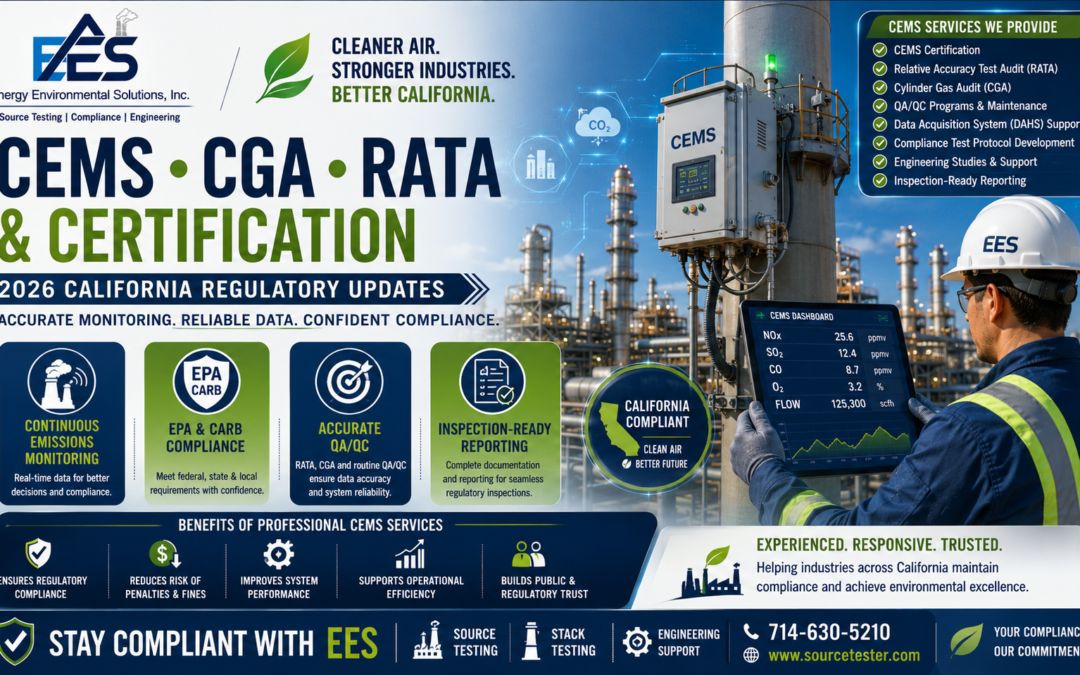
California continues to enforce some of the nation’s most rigorous air quality regulations, making Continuous Emissions Monitoring Systems (CEMS) a critical compliance tool for many industrial facilities. In 2026, regulatory agencies are placing even greater emphasis on Continuous Emissions Monitoring System Certification, Relative Accuracy Test Audits (RATA), Cylinder Gas Audits (CGA), Quality Assurance (QA/QC), and defensible emissions data.
Facilities operating under EPA, CARB, and local Air District permits must ensure their CEMS remain properly certified, calibrated, and maintained to produce reliable emissions data. Failure to perform required audits or certification can result in invalid monitoring data, additional regulatory scrutiny, or permit compliance issues. Recent South Coast AQMD guidance also reinforces documentation, Quality Assurance Plans (QAPs), and certification procedures for new, modified, and recertified CEMS.
At Energy Environmental Solutions, Inc. (EES), we provide complete CEMS Certification, CGA, RATA, QA/QC, and Engineering Support Services to help industries achieve accurate emissions monitoring and regulatory compliance.
RATA Testing Company
What Are CEMS, CGA, RATA & Certification?
A Continuous Emissions Monitoring System (CEMS) continuously measures pollutant concentrations from industrial stacks and process equipment.
To maintain compliance, CEMS typically require:
Initial CEMS Certification
CEMS Recertification
Relative Accuracy Test Audit (RATA)
Cylinder Gas Audit (CGA)
Daily Calibration Drift Checks
Quarterly QA/QC Audits
Preventive Maintenance
Quality Assurance Plan (QAP)
Data Acquisition System (DAHS) Verification
Regulatory Reporting
These activities help ensure emissions data remains accurate, traceable, and acceptable to regulatory agencies.
Latest California News & Updates (2026)
1. South Coast AQMD Updated CEMS Certification Guidance
South Coast AQMD updated its CEMS Application and Certification documentation in 2026, reinforcing requirements for Quality Assurance Plans (QAPs), certification testing, documentation, and recertification procedures for both RECLAIM and non-RECLAIM facilities.
2. Greater Focus on QA/QC Programs
EPA continues to require robust QA/QC programs under 40 CFR Part 60, Appendix F, Procedure 1, including routine calibration drift checks, quarterly audits, and periodic RATA to maintain valid emissions data.
3. Increased Attention to Monitoring Plans
Recent industry guidance highlights the importance of updating monitoring plans and QA/QC documentation whenever CEMS are certified or modified. Clear agency communication and complete documentation help reduce compliance risk and monitoring downtime.
4. California Continues Strengthening Environmental Reporting
California continues expanding emissions reporting and climate compliance programs, increasing the importance of accurate CEMS data for regulatory reporting and long-term environmental planning.
CEMS Certification California
Why CEMS Certification, CGA & RATA Are Important
Routine certification and audits help facilities:
Demonstrate permit compliance.
Maintain valid emissions monitoring data.
Verify analyzer accuracy.
Improve data quality.
Support EPA, CARB, and Air District inspections.
Reduce the risk of invalid emissions records.
Maintain confidence in environmental reporting.
Support operational efficiency.
Benefits of Professional CEMS Services
Accurate Regulatory Compliance
Proper certification helps ensure monitoring systems meet EPA, CARB, and local Air District performance requirements.
Reliable Emissions Data
Routine CGA and RATA verify analyzer performance and improve confidence in reported emissions.
Reduced Compliance Risk
Scheduled audits help identify calibration or performance issues before they affect compliance.
Better Equipment Reliability
Preventive maintenance and QA/QC reduce unexpected downtime and improve system availability.
Inspection Readiness
Well-maintained monitoring systems and complete documentation simplify regulatory inspections.
Challenges Facilities May Face
Facilities operating CEMS commonly encounter:
Complex certification requirements.
Evolving regulatory expectations.
Specialized QA/QC procedures.
Detailed documentation and reporting.
Equipment maintenance and calibration demands.
Production scheduling around certification testing.
Partnering with experienced environmental specialists helps reduce these challenges and keeps projects on schedule.
How Energy Environmental Solutions, Inc. Helps Industries
Energy Environmental Solutions, Inc. provides complete CEMS compliance support throughout California.
Our Services Include
CEMS Certification
Professional certification services supporting EPA, CARB, and Air District compliance.
Relative Accuracy Test Audits (RATA)
Independent performance evaluations comparing CEMS data with EPA reference methods.
Cylinder Gas Audits (CGA)
Routine analyzer accuracy verification using certified calibration gases.
Accurate emissions testing using EPA-approved methodologies.
Air Quality Compliance Testing
Professional testing supporting permit demonstrations and regulatory reporting.
Compliance Test Protocol Development
Preparation of agency-ready testing protocols tailored to facility operations.
Engineering Studies
Technical evaluations supporting emissions reduction, system optimization, and permitting.
Compliance Reporting
Inspection-ready reports with complete QA/QC documentation, calibration records, and technical summaries.
RATA Certification Services
Why Industries Choose EES
Facilities throughout California trust Energy Environmental Solutions, Inc. because we provide:
✔ Experienced Environmental Engineers
✔ EPA & California Regulatory Expertise
✔ Certified CEMS Specialists
✔ Accurate & Defensible Monitoring Data
✔ Comprehensive QA/QC Programs
✔ Advanced Testing Equipment
✔ Fast Scheduling & Responsive Technical Support
✔ Inspection-Ready Documentation
✔ Reliable Compliance Reporting
✔ End-to-End Environmental Compliance Solutions
Industries We Serve
EES supports:
Petroleum Refineries
Power Generation Facilities
Cement Plants
Chemical Manufacturers
Waste-to-Energy Facilities
Food Processing Facilities
Pharmaceutical Manufacturers
Aerospace & Metal Processing
Manufacturing Plants
Industrial Boilers
Glass Manufacturing
Municipal Utilities
Partner with EES for Reliable CEMS Compliance
As California continues strengthening emissions monitoring and reporting requirements, professionally managed CEMS Certification, RATA, CGA, and QA/QC Services are essential for maintaining compliance.
Whether your facility requires CEMS Certification, Relative Accuracy Test Audits (RATA), Cylinder Gas Audits (CGA), Source Testing, Stack Testing, Air Quality Compliance Testing, Compliance Test Protocol Development, Engineering Studies, or Regulatory Reporting, Energy Environmental Solutions, Inc. has the expertise to help.
Our experienced team delivers technically sound certification services, accurate emissions data, and inspection-ready documentation that help facilities reduce compliance risk, improve monitoring reliability, and confidently meet EPA, CARB, and California Air District requirements.
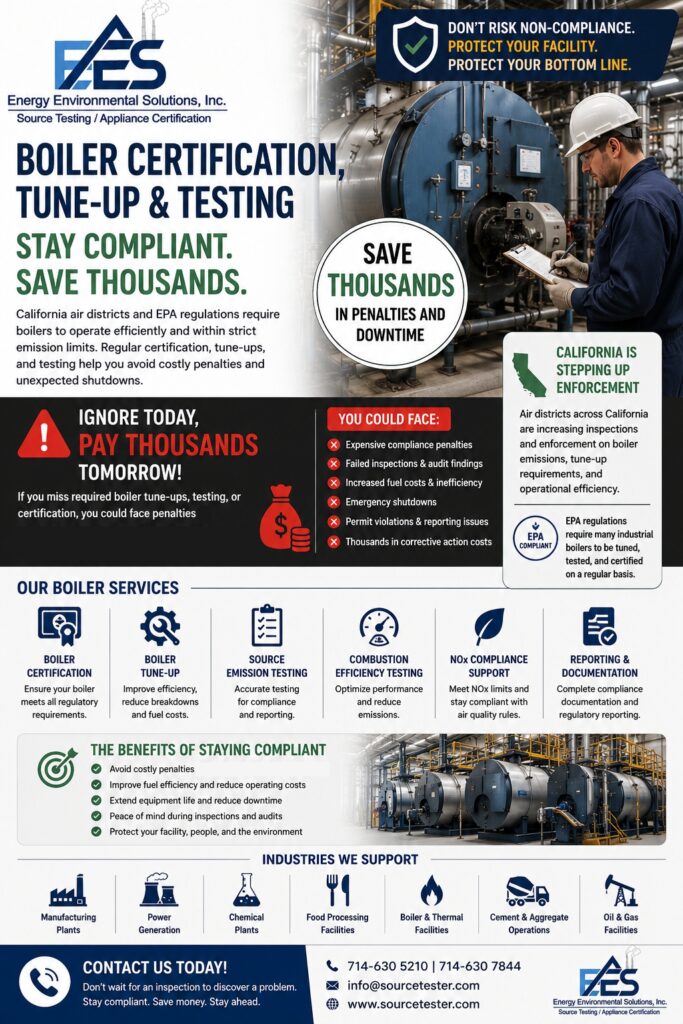
Boiler Certification, Tune-Up & Testing in California (2026): Latest Updates, Benefits, Challenges & How Energy Environmental Solutions, Inc. Helps Industries Stay Compliant
California continues to strengthen air quality regulations, making Boiler Certification, Tune-Up, and Emissions Testing essential for facilities operating industrial, commercial, and utility boilers. In 2026, state and local regulators remain focused on reducing NOx, CO, particulate matter (PM), greenhouse gases (GHGs), and other air pollutants while improving combustion efficiency and public health.
Industrial boilers are significant emission sources, and many facilities are required to perform routine tune-ups, emissions testing, inspections, and certification under permit conditions and applicable Air District rules. Proper boiler maintenance not only supports regulatory compliance but also improves fuel efficiency, equipment reliability, and operating performance.
At Energy Environmental Solutions, Inc. (EES), we provide comprehensive Boiler Certification, Tune-Up, and Testing Services to help industries comply with EPA, CARB, and California Air District requirements through accurate testing, engineering support, and inspection-ready reporting.
Boiler Tune-Up Services
What Are Boiler Certification, Tune-Up & Testing Services?
Boiler compliance services verify that industrial boilers operate safely, efficiently, and within permitted emission limits.
Typical services include:
Boiler Certification
Boiler Emissions Testing
Source & Stack Testing
Burner Tune-Ups
Combustion Efficiency Analysis
NOx & CO Emissions Testing
Oxygen (O₂) Optimization
Air-to-Fuel Ratio Adjustment
Compliance Test Protocol Development
QA/QC Documentation
Regulatory Compliance Reporting
These services help facilities maintain permit compliance while reducing fuel consumption and emissions.
Latest California News & Updates (2026)
Continued Focus on Industrial Emissions
California continues advancing long-term climate and clean-air goals through updated CARB Cap-and-Invest regulations, reinforcing pressure on industrial facilities to improve emissions performance and operational efficiency.
New CARB Test Procedure Development
CARB has released draft Tier 5 test procedures and updated compliance testing documents during 2026 workshops, highlighting California’s continued emphasis on modernized emissions testing, quality assurance, and technically defensible compliance data.
Boiler Inspection Requirements Remain Important
California regulations continue to require inspections, reporting, and safe operation for many permitted boilers. Facilities using qualified inspectors must submit inspection reports within required timelines and maintain permits to operate where applicable.
Why Boiler Certification & Tune-Ups Are Important
Routine certification and tune-ups help facilities:
Demonstrate permit compliance.
Reduce NOx, CO, and particulate emissions.
Improve combustion efficiency.
Lower fuel consumption.
Extend boiler equipment life.
Reduce unplanned downtime.
Support regulatory inspections.
Maintain accurate emissions records.
Benefits of Professional Boiler Testing
Improved Regulatory Compliance
Testing verifies emissions remain within permit limits and supports EPA, CARB, and Air District reporting.
Increased Fuel Efficiency
Proper burner adjustment and combustion optimization can reduce fuel waste and operating costs.
Lower Emissions
Routine tune-ups help reduce NOx, CO, particulate matter, and greenhouse gas emissions.
Better Equipment Reliability
Preventive testing identifies developing issues before they become costly failures.
Inspection Readiness
Complete documentation simplifies agency inspections and permit renewals.
Challenges Facilities May Face
Although boiler compliance delivers significant benefits, facilities also face several challenges:
Frequently changing environmental regulations.
Technical combustion optimization requirements.
Equipment aging and performance degradation.
Production downtime during testing windows.
Detailed documentation and QA/QC requirements.
Working with an experienced environmental testing company helps minimize these challenges.
Boiler Testing Company
How Energy Environmental Solutions, Inc. Helps Industries
EES provides complete environmental compliance support for boiler systems throughout California.
Our Services Include
Boiler Certification
Professional certification services supporting permit compliance and safe operation.
Boiler Tune-Up
Combustion optimization to improve efficiency while reducing emissions.
Boiler Emissions Testing
Measurement of:
NOx
Carbon Monoxide (CO)
Oxygen (O₂)
Carbon Dioxide (CO₂)
Particulate Matter (where applicable)
Source & Stack Testing
Accurate emissions measurements using EPA, CARB, and Local Air District-approved methods.
Air Quality Compliance Testing
Testing services supporting permit demonstrations and environmental reporting.
Compliance Test Protocol Development
Preparation of agency-ready protocols customized for your equipment and permit requirements.
CEMS Support
CEMS Certification
Relative Accuracy Test Audits (RATA)
Cylinder Gas Audits (CGA)
QA/QC Programs
Engineering Studies
Technical evaluations supporting emissions reduction, combustion optimization, and operational efficiency.
Compliance Reporting
Inspection-ready reports with complete QA/QC documentation and emissions calculations.
Why Industries Choose EES
Energy Environmental Solutions, Inc. is trusted by facilities across California because we deliver:
✔ Experienced Environmental Engineers
✔ EPA & California Regulatory Expertise
✔ Accurate & Defensible Emissions Data
✔ Advanced Testing Equipment
✔ Comprehensive QA/QC Procedures
✔ Fast Scheduling & Responsive Technical Support
✔ Inspection-Ready Documentation
✔ Reliable Compliance Reporting
✔ Engineering & Regulatory Assistance
✔ End-to-End Environmental Compliance Solutions
Industries We Serve
EES supports:
Petroleum Refineries
Power Generation Facilities
Chemical Manufacturers
Cement Plants
Food Processing Facilities
Pharmaceutical Manufacturers
Aerospace & Metal Processing
Waste-to-Energy Facilities
Manufacturing Plants
Industrial Boilers
Municipal Utilities
Universities & Institutional Campuses
Partner with EES for Reliable Boiler Compliance
California’s environmental regulations continue to evolve, making professional Boiler Certification, Tune-Up, and Testing more important than ever.
Whether your facility requires Boiler Certification, Combustion Tune-Up, Source Testing, Stack Testing, Air Quality Compliance Testing, CEMS Services, Compliance Test Protocol Development, Engineering Studies, or Regulatory Reporting, Energy Environmental Solutions, Inc. has the expertise to help.
Our experienced team delivers accurate testing, technically sound reporting, and responsive support that helps facilities reduce emissions, improve efficiency, and confidently meet EPA, CARB, and California Air District requirements.
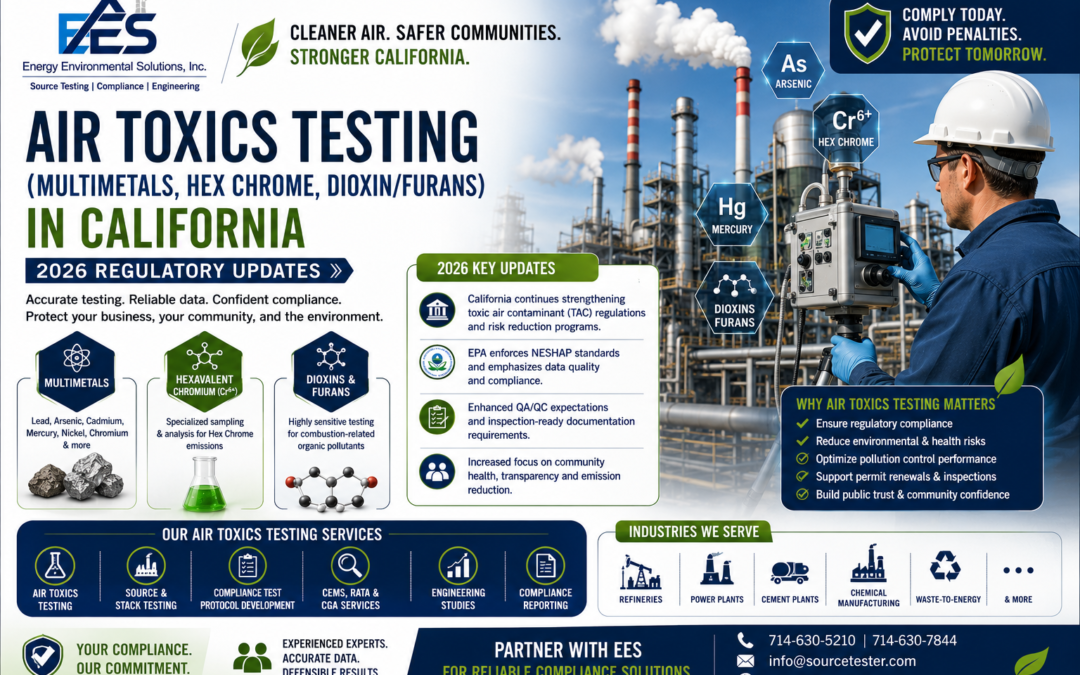
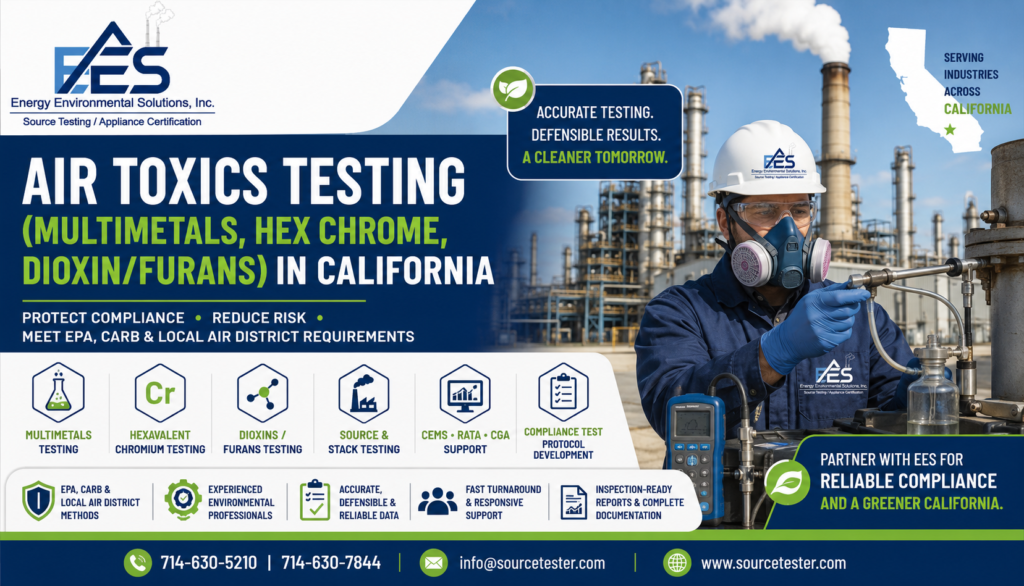
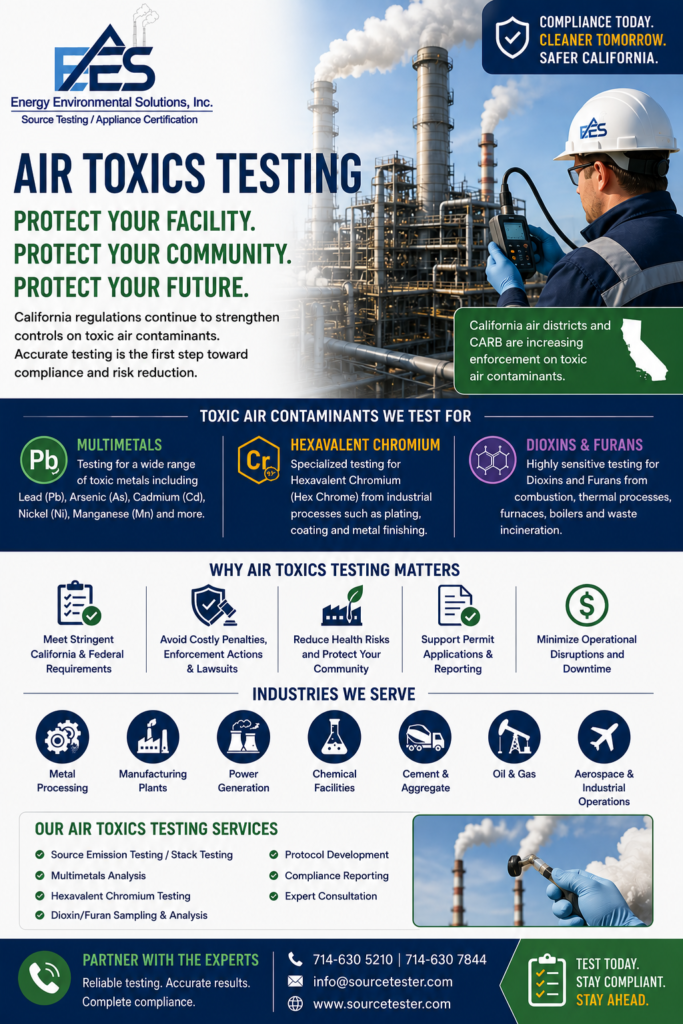
Air Toxics Testing (Multimetals, Hexavalent Chromium & Dioxins/Furans) in California (2026): Latest Updates, Benefits, Challenges & How Energy Environmental Solutions, Inc. Helps Industries Stay Compliant
California continues to maintain some of the most stringent air toxics regulations in the United States. In 2026, industrial facilities are facing increased scrutiny over emissions of Hazardous Air Pollutants (HAPs) and Toxic Air Contaminants (TACs), particularly multimetals, hexavalent chromium (Hex Chrome), and dioxins/furans. Air Districts and regulatory agencies continue emphasizing accurate emissions testing, quality assurance (QA/QC), and defensible data to support permit compliance and public health protection.
For industries operating combustion equipment, metal processing facilities, waste-to-energy plants, refineries, cement plants, and chemical manufacturing operations, Air Toxics Testing is an essential component of environmental compliance and risk management.
At Energy Environmental Solutions, Inc. (EES), we provide comprehensive Air Toxics Testing Services, source testing, engineering support, and regulatory reporting that help industries confidently meet EPA, CARB, and California Air District requirements.
What Is Air Toxics Testing?
Air Toxics Testing measures hazardous pollutants released from industrial sources to verify compliance with federal, state, and local environmental regulations.
Testing is conducted using approved EPA reference methods and applicable California Air District procedures to generate reliable and defensible emissions data.
Air Toxics Testing (Multimetals, Hex Chrome & Dioxin/Furans) in California | Energy Environmental Solutions, Inc.
Latest 2026 California News & Regulatory Updates
1. Increased Focus on Toxic Air Contaminants
California continues implementing risk-reduction programs for Toxic Air Contaminants (TACs) through local Air District rules and state guidance. Industrial facilities are expected to demonstrate accurate emissions data and maintain robust compliance documentation for air toxics where required.
2. EPA Continues Emphasizing Hazardous Air Pollutant Compliance
The U.S. EPA continues implementing National Emission Standards for Hazardous Air Pollutants (NESHAP), requiring affected facilities to verify emissions through approved testing and monitoring methods. Facilities subject to NESHAP rules should ensure testing protocols and reporting remain current.
3. Enhanced QA/QC Expectations
California regulators continue stressing:
Accurate sampling procedures
Certified laboratory analysis
Complete chain-of-custody records
Equipment calibration documentation
Inspection-ready emissions reports
Defensible analytical data
4. Public Health and Community Protection
California continues prioritizing programs aimed at reducing community exposure to toxic air pollutants, particularly in areas with significant industrial activity. This trend reinforces the need for reliable emissions testing and proactive compliance planning.
Why Air Toxics Testing Is Critical in California
Air toxics testing helps facilities:
Demonstrate compliance with permit conditions
Verify hazardous emissions remain within regulatory limits
Support environmental risk assessments
Improve regulatory confidence
Validate pollution control equipment performance
Produce defensible emissions data
Support permit renewals and agency inspections
Protect worker and community health
Pros of Professional Air Toxics Testing
Accurate Regulatory Compliance
Testing provides scientifically valid emissions data that supports compliance with EPA, CARB, and local Air District requirements.
Better Environmental Performance
Identifying and quantifying toxic emissions helps facilities improve pollution control strategies and reduce environmental impacts.
Reduced Compliance Risk
Routine testing helps identify potential issues before they lead to regulatory concerns or operational delays.
Improved Operational Efficiency
Testing results can identify opportunities to optimize combustion processes and pollution control systems.
Stronger Public Confidence
Reliable emissions data demonstrates a facility’s commitment to environmental stewardship and community protection.
Challenges Industries May Face
Complex Sampling Procedures
Air toxics testing often requires specialized sampling trains, laboratory analysis, and strict quality assurance procedures.
Evolving Regulations
California’s environmental regulations continue to evolve, requiring facilities to stay current with testing requirements and permit conditions.
Extensive Documentation
Preparing complete reports with laboratory data, QA/QC documentation, and emissions calculations requires technical expertise.
Scheduling and Coordination
Testing must often be coordinated with production schedules, regulatory deadlines, and laboratory turnaround times.
Partnering with experienced environmental professionals helps facilities overcome these challenges efficiently.
California Air Toxics Testing
How Energy Environmental Solutions, Inc. Helps Industries
Energy Environmental Solutions, Inc. (EES) provides comprehensive air toxics testing and environmental compliance services throughout California.
Our Services Include
Air Toxics Testing
Professional testing for hazardous air pollutants using EPA-approved methods.
Multimetals Testing
Accurate measurement of regulated metal emissions, including:
Lead
Arsenic
Cadmium
Mercury
Nickel
Chromium
Selenium
Beryllium
Hexavalent Chromium (Cr⁶⁺) Testing
Specialized sampling and analysis to support compliance with applicable regulations.
Comprehensive emissions testing using EPA, CARB, and local Air District-approved methodologies.
Air Quality Compliance Testing
Professional testing supporting permit demonstrations and regulatory reporting.
Compliance Test Protocol Development
Preparation of agency-ready testing protocols tailored to your facility and permit conditions.
CEMS Services
CEMS Certification
Relative Accuracy Test Audits (RATA)
Cylinder Gas Audits (CGA)
QA/QC Programs
Engineering Studies
Technical evaluations supporting permitting, emissions reduction, and process optimization.
Compliance Reporting
Inspection-ready reports with complete QA/QC documentation, laboratory results, and technical summaries.
Why Industries Choose EES
Energy Environmental Solutions, Inc. is trusted by industrial facilities across California because we provide technically sound testing, reliable reporting, and responsive customer support.
Our clients benefit from:
✔ Experienced Environmental Professionals
✔ EPA & California Regulatory Expertise
✔ Specialized Air Toxics Testing Capabilities
✔ Accurate & Defensible Laboratory Data
✔ Comprehensive QA/QC Procedures
✔ Fast Scheduling & Responsive Technical Support
✔ Inspection-Ready Documentation
✔ Reliable Compliance Reporting
✔ Engineering & Regulatory Support
✔ End-to-End Environmental Compliance Solutions
Industries We Serve
EES supports:
Petroleum Refineries
Power Generation Facilities
Cement Plants
Chemical Manufacturers
Waste-to-Energy Facilities
Aerospace & Metal Processing
Glass Manufacturing
Pharmaceutical Manufacturers
Food Processing Facilities
Industrial Boilers
Manufacturing Facilities
Municipal Utilities
Partner with EES for Reliable Air Toxics Testing
As California continues strengthening air toxics regulations and environmental compliance programs, professional Multimetals, Hexavalent Chromium, and Dioxins/Furans Testing is more important than ever.
Whether your facility requires Air Toxics Testing, Source Testing, Stack Testing, Compliance Test Protocol Development, TPM Testing, PM₁₀ & PM₂.₅ Testing, CEMS Services, Engineering Studies, or Regulatory Support, Energy Environmental Solutions, Inc. has the expertise to help.
Our experienced team delivers technically sound testing, reliable laboratory analysis, and inspection-ready reporting that helps facilities reduce compliance risks, improve environmental performance, and confidently meet EPA, CARB, and California Air District requirements.