Rule 1430 & 1155 California | Metal Grinding & PM Testing
Rule 1430 & Rule 1155 in California: Metal Grinding, Particulate Matter & Air Quality Compliance Guide
Is Your California Facility Ready for Rule 1430 & Rule 1155 Compliance?
Metal forging, grinding, cutting, machining and other industrial operations can generate particulate matter (PM), metal dust, toxic air contaminants and visible emissions.
For facilities operating within the South Coast Air Quality Management District (South Coast AQMD), two important rules can become especially relevant:
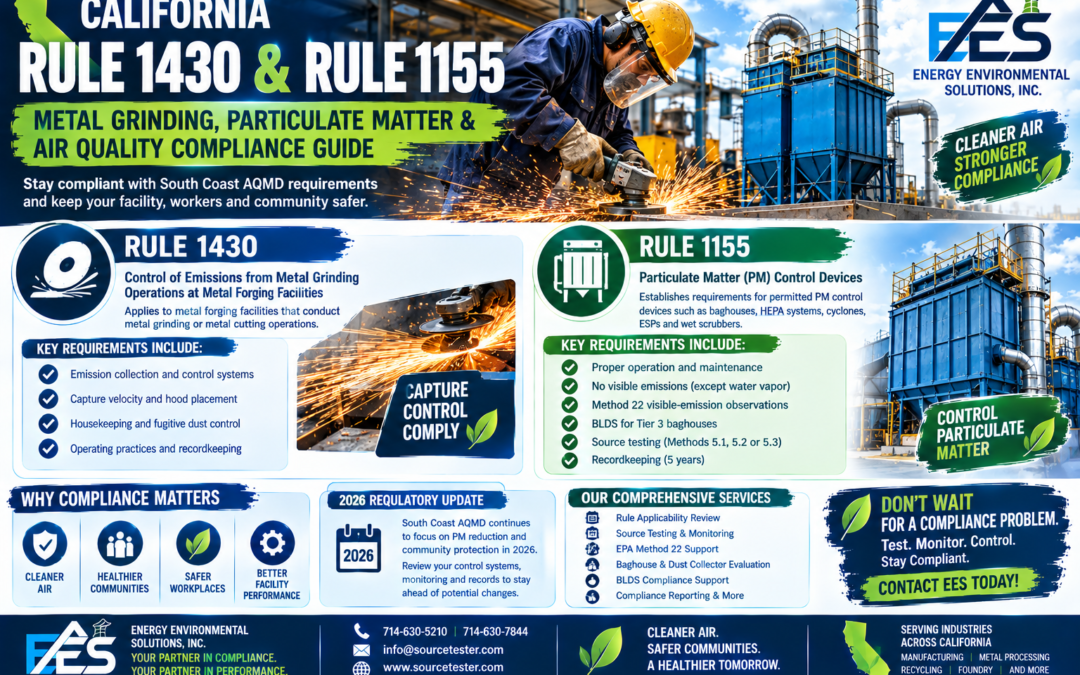
Rule 1430 — Control of Emissions from Metal Grinding Operations at Metal Forging Facilities
and
Rule 1155 — Particulate Matter (PM) Control Devices
Rule 1430 focuses specifically on metal grinding and cutting operations at metal forging facilities, while Rule 1155 establishes requirements for permitted PM control devices, including baghouses, HEPA systems, bin vents, dust collectors, cyclones, electrostatic precipitators and wet scrubbers.
For companies operating these processes, compliance isn’t simply about installing pollution-control equipment.
It is about capturing emissions, maintaining control equipment, monitoring performance, conducting required observations/testing and maintaining defensible records.

What Is South Coast AQMD Rule 1430?
Rule 1430 was adopted on March 3, 2017, to reduce:
- Toxic emissions
- Particulate matter emissions
- Metal dust
- Odors
from metal grinding and metal cutting operations at metal forging facilities.
The rule applies to persons who own or operate a metal forging facility where metal grinding or metal cutting operations are conducted.
Certain activities are excluded, including grinding/cutting performed under a continuous flood of metal-removal fluid and certain grinding activities used for equipment maintenance or repair.
Why Was Rule 1430 Created?
South Coast AQMD developed Rule 1430 after investigations into metal-forging operations identified metal grinding as a potentially significant source of metal particulate emissions, including toxic air contaminants.
The rulemaking included:
- Site visits
- Air-quality sampling
- Emission-control evaluations
- Industry research
- Review of voluntary emission-reduction measures
South Coast AQMD subsequently adopted Rule 1430 to control emissions from metal grinding and cutting at forging facilities.
The objective is simple:
Capture the emissions before they become a community and compliance problem.
What Does Rule 1430 Cover?
Depending on the operation, Rule 1430 can affect facilities conducting:
- Hand grinding
- Stand grinding
- Swing grinding
- Billet grinding
- Metal cutting
- Torch cutting
- Other applicable grinding operations
The rule addresses emission collection systems, control devices, housekeeping and operating practices.
Rule 1430 and Emission Control Systems
A key element of Rule 1430 is controlling emissions generated during grinding and cutting.
Applicable operations must be appropriately captured and vented to emission-control equipment.
The rule also establishes requirements concerning capture velocity and positioning of grinding activity relative to the collection hood.
Why does this matter?
Even an excellent baghouse cannot effectively control emissions if the contaminated air is not properly captured.
The compliance chain is:
Grinding Process
↓
Local Hood / Capture
↓
Ductwork
↓
PM Control Device
↓
Filtered Exhaust
↓
Compliant Operation
A weakness at any point can reduce overall control performance.
Rule 1430: Keep Grinding Operations Within the Capture Zone
Rule 1430 requires permanent visual indicators/markings at applicable grinding and cutting stations to identify the maximum distance from the emission-control device at which grinding may occur.
The rule also requires applicable grinding activity to occur in front of the hood face and within the identified capture area, while airflow between the operation and hood must not be obstructed.
In practical terms:
The hood needs to capture the dust where it is generated.
Simply having a hood somewhere near the grinding machine does not guarantee effective capture.
What Is Rule 1155?
South Coast AQMD Rule 1155 — Particulate Matter (PM) Control Devices establishes requirements for permitted PM air-pollution-control devices serving processes with direct, non-combustion PM emissions.
Covered control equipment can include:
- Baghouses
- HEPA systems
- Bin vents
- Fabric filters
- Dust collectors
- Cyclones
- Electrostatic precipitators
- Wet scrubbers

Rule 1155: Why Your Baghouse Matters
For many industrial facilities, the baghouse is the final line of defense between the process and the atmosphere.
A baghouse problem can result in:
- Visible emissions
- Increased PM emissions
- Filter damage
- Bag leakage
- Control-device alarms
- Production interruptions
- Corrective maintenance
- Potential compliance problems
Rule 1155 therefore establishes requirements for operation, maintenance, monitoring and recordkeeping.
Rule 1155 PM Control Device Requirements
Rule 1155 requires permitted PM control devices to be operated and maintained according to the manufacturer’s instructions or equivalent written procedures.
The rule also prohibits visible emissions from applicable permitted PM control devices, excluding condensed water vapor.
This creates an important operational principle:
Don’t wait for a source test to discover that your control device isn’t performing properly.
Routine monitoring can identify problems much earlier.
Tier 1, Tier 2 & Tier 3 Baghouses
Rule 1155 divides baghouses into three categories based on filter surface area:
Tier 1
≤ 500 square feet
Tier 2
>500 to 7,500 square feet
Tier 3
>7,500 square feet
The applicable requirements vary depending on the type and size of the PM control device.
Rule 1155 and Visible Emissions Monitoring
Rule 1155 requires trained personnel to perform visible-emissions observations using EPA Method 22 for applicable PM control devices.
The standard frequency is generally a five-minute Method 22 observation once per week, with specific provisions and exemptions in the rule.
If visible emissions are observed, corrective action must be taken and the equipment rechecked to verify that the problem has been corrected.
This is why trained personnel matter.
A poorly performed observation can create uncertainty in your compliance records.
Baghouse Leak Detection Systems — BLDS
For applicable Tier 3 baghouses, Rule 1155 requires a Baghouse Leak Detection System (BLDS).
A BLDS monitors changes associated with particulate loading and can provide an alarm when elevated emissions or baghouse problems are detected.
Facilities must:
- Install the required system
- Operate it correctly
- Calibrate it
- Maintain it
- Investigate alarms
- Document corrective actions
Why BLDS Is Important
Imagine a filter begins developing a leak.
Without effective monitoring, the problem may continue until:
- Visible emissions appear
- A routine inspection identifies it
- A source test detects an issue
- An inspector identifies the problem
A functioning BLDS can provide an earlier warning.
That gives facility personnel an opportunity to investigate and correct the issue before emissions become a larger compliance concern.
Rule 1155 Source Testing
Rule 1155 specifies SCAQMD Methods 5.1, 5.2 or 5.3, as applicable, for source tests used to demonstrate compliance with the applicable Tier 3 PM concentration requirement.
For Title V facilities subject to the applicable requirement, the rule provides for an initial source test and subsequent testing every five years. Source tests must be conducted by a laboratory approved through the SCAQMD Laboratory Approval Program.
This makes source-test planning extremely important.
Before scheduling testing, facilities should verify:
- Applicable rule requirements
- Applicable permit conditions
- Correct test method
- Sampling location
- Operating conditions
- Test protocol requirements
- Laboratory qualifications
- Reporting requirements
Rule 1155 Recordkeeping
Compliance is not only about what happens inside the facility.
Documentation matters.
South Coast AQMD provides Rule 1155 forms for:
- PM control-device information
- Visible-emission records
- BLDS records
Records can include:
- Facility information
- Observer information
- Observation date/time
- Process unit
- Observation duration
- Visible-emission findings
- Corrective actions
- BLDS inspections
- Alarm information
- Alarm duration
- Cause of alarm
- Corrective action
- Operating hours
Rule 1155 requires applicable records to be maintained for at least five years and made available to the Executive Officer upon request.
2026 California Air-Quality Update
What Is Happening in 2026?
South Coast AQMD’s 2026 regulatory program continues to emphasize particulate-matter reduction and community exposure reduction.
The agency’s 2026 rule activity overview identifies PM-reduction activities intended to strengthen requirements for operations such as aggregate facilities and reduce particulate matter affecting surrounding communities.
In September 2026, South Coast AQMD also advanced proposed amendments to Rule 1157, addressing PM10 emissions from aggregate and related operations.
Important distinction:
There is not a new 2026 amendment to Rule 1430 or Rule 1155 identified in the current South Coast AQMD sources reviewed for this article.
However, the broader 2026 PM-control environment makes it sensible for facilities to review their existing PM capture, control, monitoring and recordkeeping programs rather than assuming older procedures are sufficient.
South Coast AQMD’s official rule book currently lists Rule 1430 as adopted March 3, 2017 and Rule 1155 as amended May 2, 2014.
Pros of Rule 1430 & Rule 1155 Compliance
✅ 1. Better PM Control
Proper capture and filtration can significantly reduce particulate emissions from industrial processes.
✅ 2. Reduced Toxic Metal Exposure
For metal-processing operations, controlling metal-containing particulate matter can reduce potential exposure.
✅ 3. Improved Equipment Performance
Routine inspections can identify filter, ductwork and baghouse problems before they become major failures.
✅ 4. Early Problem Detection
BLDS and visible-emission monitoring can provide early warning of control-device problems.
✅ 5. Better Compliance Documentation
Well-maintained records demonstrate that the facility is actively managing its control systems.
✅ 6. Stronger Environmental Performance
Effective PM control can contribute to cleaner air around industrial communities.
Cons & Compliance Challenges
❌ 1. Testing Costs
Source testing requires specialized personnel, equipment and laboratories.
❌ 2. Monitoring Requirements
Facilities may need regular Method 22 observations and BLDS monitoring.
❌ 3. Maintenance Expenses
Filters, bags, ducts, fans and control systems require routine maintenance.
❌ 4. Production Disruption
Corrective maintenance or testing may require coordination with production schedules.
❌ 5. Recordkeeping Work
Every observation, alarm, inspection and corrective action needs appropriate documentation.
❌ 6. Equipment Upgrades
Older collection systems may require upgrades to maintain effective capture and filtration.
Common Rule 1430 Mistakes
❌ Grinding Outside the Capture Area
A hood may exist, but the grinding operation may be positioned too far away for effective capture.
❌ Obstructing Airflow
Materials, equipment or other objects can interfere with capture.
❌ Poor Hood Positioning
Incorrect hood placement can reduce capture efficiency.
❌ Ignoring Fugitive Dust
Controlling the exhaust stack does not eliminate all potential fugitive emissions.
❌ Weak Housekeeping
Accumulated metal dust can become an additional environmental and operational concern.
❌ Delayed Maintenance
Waiting until a baghouse or collection system fails can create unnecessary operational and compliance risks.
Common Rule 1155 Mistakes
❌ Skipping Visible-Emission Observations
Applicable Method 22 observations need to be performed and documented.
❌ Ignoring BLDS Alarms
An alarm should trigger investigation and corrective action where required.
❌ Poor Recordkeeping
Missing dates, times, observers, findings or corrective actions can weaken compliance documentation.
❌ Using Unqualified Testing Resources
Applicable source tests must meet the rule’s requirements, including laboratory approval provisions.
❌ Testing Under the Wrong Conditions
Source testing should represent the operating conditions required by the applicable rule and permit.
❌ Ignoring Manufacturer Maintenance Requirements
Control devices need proper operation and maintenance—not just periodic testing.
How EES Helps With Rule 1430 & Rule 1155 Compliance
Energy Environmental Solutions, Inc. (EES) can help industrial facilities develop a practical PM-emissions compliance strategy.
1. Rule Applicability Review
EES can help review your:
- Process
- Equipment
- Control devices
- Permit conditions
- Emission points
and determine which requirements may apply.
2. Source Testing
EES can support applicable source-testing programs for PM emissions and control-device performance.
Testing can help facilities establish whether their equipment is operating within applicable emission requirements.
3. Test Protocol Development
A proper test program should consider:
- Applicable rule
- Applicable test method
- Sampling location
- Operating conditions
- Production rate
- Control-device configuration
- QA/QC
- Laboratory requirements
- Reporting requirements
4. Method 22 Support
For applicable Rule 1155 requirements, EES can help facilities understand and implement visible-emission observation procedures and documentation.
5. Baghouse & PM Control Evaluation
EES can help evaluate potential problems involving:
- Baghouses
- Filter bags
- Ductwork
- Hoods
- Fans
- Cyclones
- Scrubbers
- ESPs
- Dust collectors
- Capture systems
6. BLDS Compliance Support
For applicable Tier 3 baghouses, EES can support programs involving:
- BLDS review
- Monitoring
- Alarm investigation
- Maintenance documentation
- Corrective-action records
7. Compliance Documentation
EES can help organize documentation related to:
- Source tests
- Monitoring
- Corrective actions
- Control-device maintenance
- Emission observations
- Compliance reporting

Who Needs Rule 1430 & Rule 1155 Support?
Potentially relevant industries include:
🏭 Metal Forging Facilities
⚙️ Metal Grinding Facilities
🔩 Metal Cutting Operations
🔥 Forging & Heat-Treatment Facilities
🛠️ Industrial Manufacturing
🪨 Mineral Processing
🏗️ Construction-Material Processing
♻️ Recycling Operations
🏭 Foundries & Metal Processing
🌬️ Facilities Using Baghouses or Dust Collectors
Actual applicability depends on the facility, process, equipment, permit and exemptions contained in the applicable rule.
Rule 1430 & 1155 Compliance Checklist
Before your next compliance review, ask:
- Does my facility conduct metal grinding?
- Does my facility conduct metal cutting?
- Are we a metal forging facility?
- Is Rule 1430 applicable?
- Are grinding operations properly captured?
- Are hood locations properly marked?
- Is airflow unobstructed?
- Is the emission-control device properly sized?
- Is my facility subject to Rule 1155?
- What type of PM control device do we use?
- Is our baghouse Tier 1, Tier 2 or Tier 3?
- Are Method 22 observations being completed?
- Are visible emissions documented?
- Is our BLDS operating correctly?
- Are BLDS alarms investigated?
- Are corrective actions documented?
- Are maintenance records complete?
- Is source testing required?
- Is our test laboratory properly qualified?
- Are our records retained properly?
- Have we reviewed our 2026 PM compliance strategy?
Don’t Wait Until Your Next Inspection
A strong air-quality compliance program should be proactive rather than reactive.
The ideal approach is:
IDENTIFY → CAPTURE → CONTROL → MONITOR → TEST → DOCUMENT → IMPROVE
Your facility’s PM-control system should not be treated as a single piece of equipment.
It is a complete system:
Process + Hood + Ductwork + Fan + Filter + Monitoring + Maintenance + Documentation
If one part fails, the entire compliance strategy can be affected.
Get Your Rule 1430 & Rule 1155 Compliance Reviewed
EES Helps California Industries With:
✔ Rule Applicability Review
✔ Rule 1430 Compliance Support
✔ Rule 1155 Compliance Support
✔ Particulate Matter Testing
✔ Source Testing
✔ EPA Method 22 Support
✔ Baghouse Testing
✔ Dust Collector Evaluation
✔ BLDS Compliance Support
✔ Emission-Control System Evaluation
✔ Compliance Documentation
✔ Corrective-Action Support
Ready to Check Your PM Compliance?
Don’t wait for visible emissions, a failed test or an inspection finding to expose a problem.
Let EES help you identify potential gaps before they become bigger operational and compliance issues.
TEST. MONITOR. CONTROL. STAY COMPLIANT.
Energy Environmental Solutions, Inc. (EES)
Phone: 714-630-5210 | 714-630-7844
Email: info@sourcetester.com
Website: sourcetester.org