Rule 1420, 1420.1 & 1420.2 in California: Lead Emissions Testing, Source Testing & 2026 Compliance Guide
Is Your Facility Ready for California’s Lead Emission Compliance Requirements?
If your facility processes lead-containing materials, recycles lead-acid batteries, or operates metal-melting equipment, environmental compliance should be a top priority.
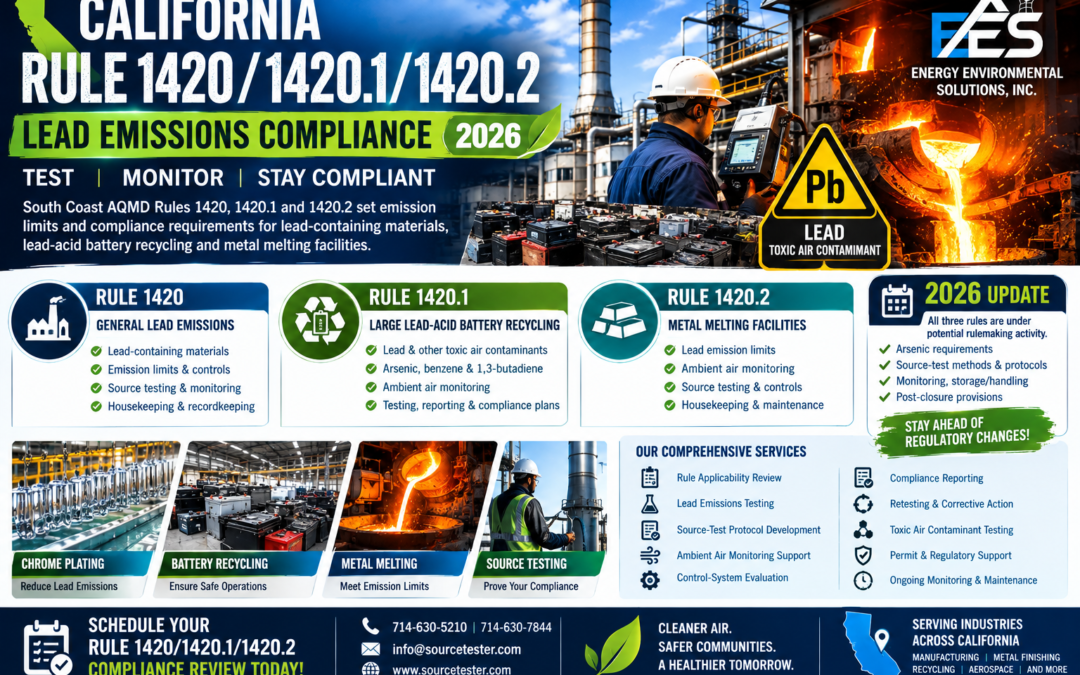
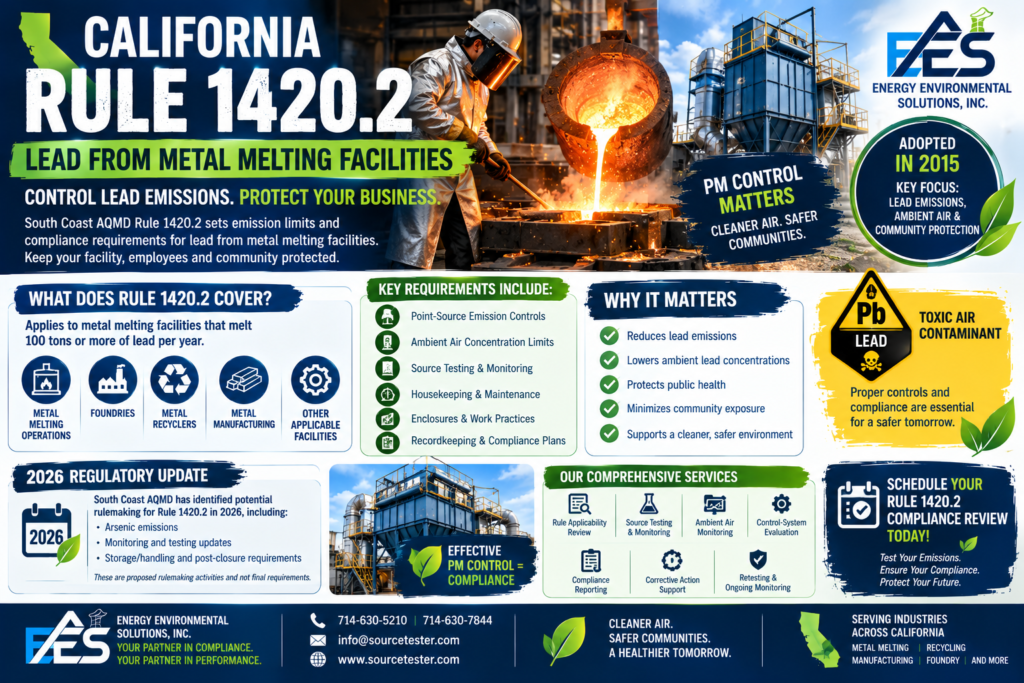
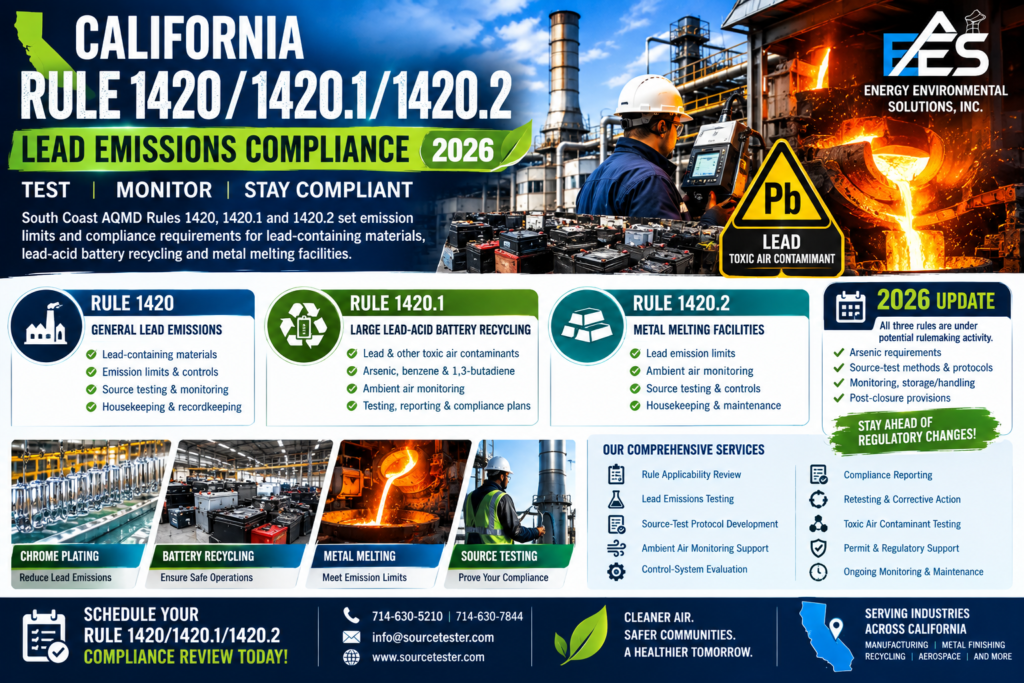
In the South Coast Air Quality Management District (South Coast AQMD), three important lead-emission rules address different categories of facilities:
Rule 1420 – Emission Standard for Lead
Rule 1420.1 – Emission Standards for Lead and Other Toxic Air Contaminants from Large Lead-Acid Battery Recycling Facilities
Rule 1420.2 – Emission Standards for Lead from Metal Melting Facilities
These rules address lead emissions through combinations of emission limits, ambient air monitoring, source testing, control systems, housekeeping, recordkeeping, compliance plans and operational requirements.
And 2026 brings an important reason to review your compliance program.
South Coast AQMD’s 2026 rulemaking forecast identifies potential amendments to all three rules. The proposed work includes arsenic-related requirements, updated testing methods, source-test protocol clarifications, monitoring, storage/handling and post-closure provisions.
For affected facilities, this means that relying on an old compliance checklist may not be enough.
What Are Rules 1420, 1420.1 and 1420.2?
Although these rules are closely related, they do not regulate exactly the same facilities.
Understanding which rule applies to your operation is the first step toward an effective compliance program.
Rule 1420 – Emission Standard for Lead
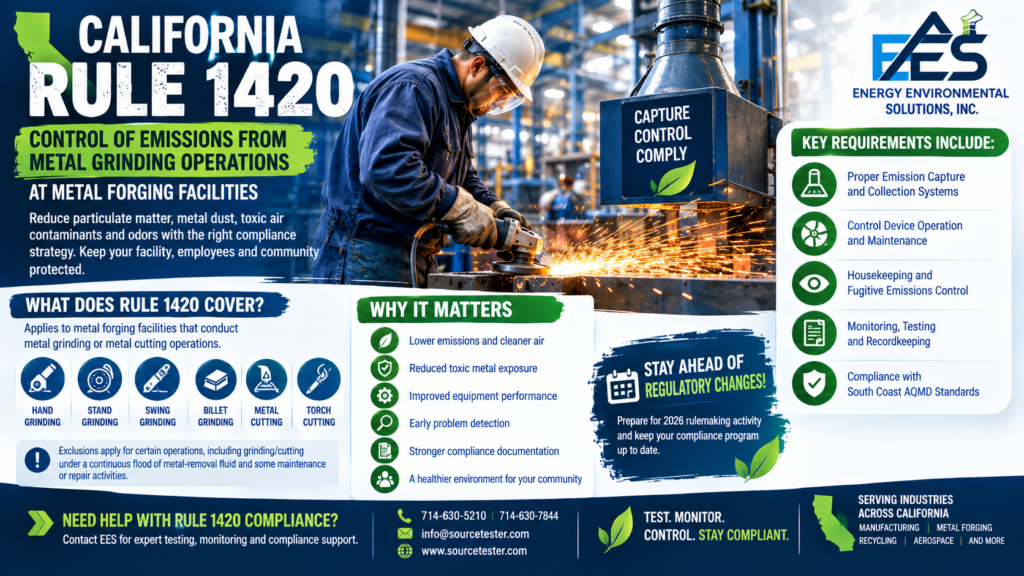
Rule 1420 is the broader lead-emission rule for facilities that use or process lead-containing materials and are not regulated under the more specific Rules 1420.1 or 1420.2.
The rule’s purpose is to reduce lead emissions and protect public health.
Potentially affected operations can include:
Lead-processing facilities
Lead-containing material processors
Foundries
Certain metal-processing operations
Lead-acid battery-related operations not covered by Rule 1420.1
Other facilities processing lead-containing materials
South Coast AQMD’s current rule structure identifies Rule 1420 separately from the specialized rules for large lead-acid battery recyclers and large metal-melting facilities.
Rule 1420.1 – Large Lead-Acid Battery Recycling Facilities
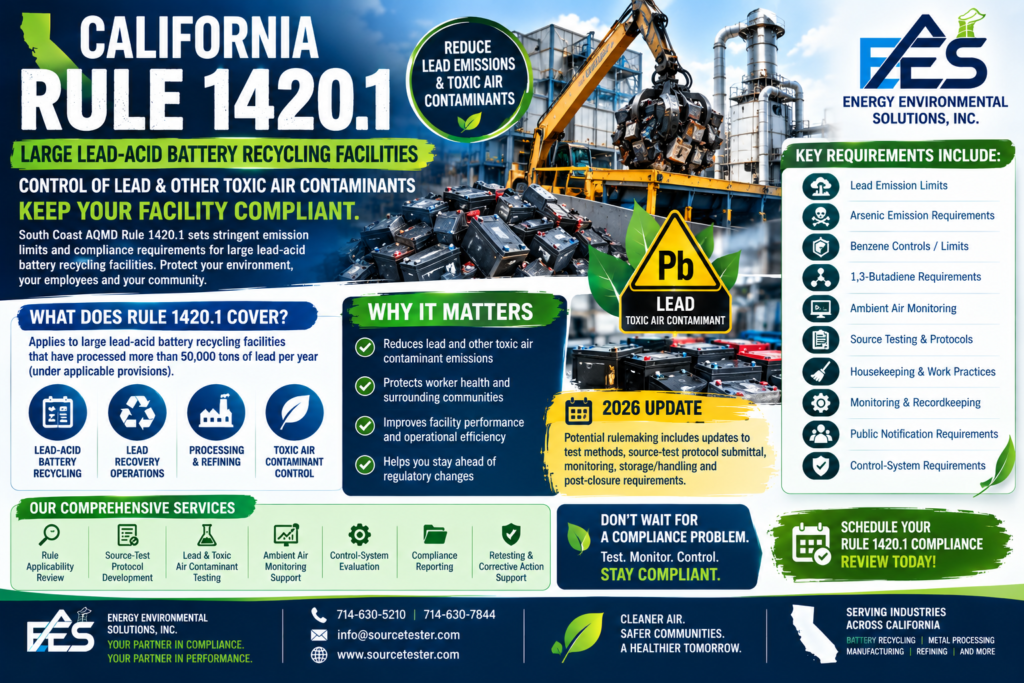
Rule 1420.1 specifically addresses large lead-acid battery recycling facilities.
South Coast AQMD states that the rule applies to large lead-acid battery recycling facilities that have processed more than 50,000 tons of lead per year under the applicable historical/current applicability provisions.
The rule addresses not only lead but also other toxic air contaminants associated with these operations.
Requirements can include:
Lead emission limits
Arsenic emission requirements
Benzene controls/limits
1,3-butadiene requirements
Ambient air monitoring
Stack/source testing
Housekeeping
Work practices
Monitoring and recordkeeping
Public notification requirements
Control-system requirements
South Coast AQMD describes Rule 1420.1 as having some of the most stringent requirements for lead-acid battery recycling facilities in the country.
Rule 1420.2 – Lead from Metal Melting Facilities
Rule 1420.2 focuses on metal melting facilities that melt 100 tons or more of lead per year.
The rule was adopted to reduce:
Lead emissions
Ambient lead concentrations
Public exposure to lead
It includes requirements involving:
Point-source emission controls
Ambient air lead concentration limits
Source testing
Ambient air monitoring
Housekeeping
Maintenance
Enclosures
Recordkeeping
Compliance plans when applicable
🚨 Major 2026 Update: All Three Rules Are Under Regulatory Review
This is one of the most important reasons affected businesses should review their compliance programs in 2026.
South Coast AQMD’s 2026 rulemaking forecast identifies:
Rule 1420
Potential amendments to address:
Arsenic emissions
Storage and handling requirements
Closure requirements
The objective is to close a regulatory gap between Rule 1420 and Rule 1407, which regulates arsenic, cadmium and nickel from non-ferrous metal melting operations.
Rule 1420.1
Potential amendments are planned to:
Update applicable test methods
Clarify source-test protocol submittal
Potentially address monitoring
Potentially address post-closure requirements
Rule 1420.2
Potential amendments are planned to:
Address arsenic emissions
Close a regulatory gap between Rule 1420.2 and Rule 1407
Potentially address monitoring
Potentially address post-closure requirements
Important:
These items are rulemaking plans/proposed activities—not automatically final requirements. Facilities should verify the adopted rule language and permit conditions before making compliance decisions.
Why Lead Emission Testing Matters
Lead is a toxic air contaminant, and controlling emissions is an important component of protecting workers and surrounding communities.
For regulated facilities, emissions testing can provide evidence that:
Testing can also help identify problems before they become more expensive compliance issues.
What Does Lead Source Testing Involve?
Depending on the applicable rule, equipment and approved test method, testing may evaluate:
Lead Emissions
Measurement of lead concentrations or emission rates from applicable exhaust points.
Particulate Matter
Lead can be associated with particulate emissions, making particulate control important in many processes.
Control Device Performance
Testing may help determine whether equipment such as baghouses, scrubbers or other controls is operating effectively.
Capture Efficiency
For applicable sources, testing can evaluate whether emissions are adequately captured.
Operating Parameters
Testing should be performed under representative conditions required by the applicable rule/test protocol.
Ambient Air Monitoring
One of the major components of the lead rules is ambient air monitoring.
Instead of looking only at what leaves a stack, ambient monitoring can evaluate lead concentrations around the facility.
This provides a different compliance perspective:
Stack Testing
What is being emitted from the source?
Ambient Monitoring
What concentration is present in the surrounding air?
Both can be important for facilities subject to applicable requirements.
Rule 1420.2, for example, includes ambient air monitoring and concentration requirements as part of its compliance framework.
Point-Source Controls
Facilities subject to the lead rules may need appropriate controls on emission points.
Depending on the process, controls may include:
Baghouse systems
Fabric filters
Scrubbers
Enclosures
Local exhaust ventilation
Negative-pressure systems
Other approved control technologies
Rule 1420.1, for example, requires large lead-acid battery recycling facilities to maintain building operations under constant negative pressure so emissions can be collected and routed to air-pollution-control equipment.
Baghouse Monitoring Is Critical
For facilities using baghouses or similar particulate-control equipment, monitoring performance is an important component of compliance.
South Coast AQMD’s Rule 1420 materials include requirements concerning:
Pressure-drop monitoring
Calibration
Data acquisition
Recordkeeping
Bag-leak detection
Maintenance
Why this matters:
A source can pass an emissions test but still experience control-system deterioration later.
Continuous or periodic monitoring can provide an early warning.
Rule 1420 Compliance Plans
For certain facilities, a Compliance Plan can be an important part of the regulatory process.
South Coast AQMD’s Rule 1420 framework includes compliance-plan provisions for qualifying lead-processing facilities, including facilities processing more than specified quantities of lead.
A compliance plan can involve information such as:
Material processed
Lead content
Emission sources
Emission estimates
Monitoring
Air-dispersion modeling
Control measures
Compliance strategies
The exact requirement depends on facility applicability and current rule language.
Air Dispersion Modeling
For certain Rule 1420 facilities, air-dispersion modeling can be part of the compliance process.
Modeling helps estimate how emissions from a facility may affect ambient concentrations.
A professional compliance program can therefore involve:
Emission Testing + Ambient Monitoring + Modeling + Control Evaluation
rather than relying on one test alone.
Housekeeping Is Not Optional
Lead dust can become a significant compliance concern.
Rules 1420, 1420.1 and 1420.2 contain requirements addressing housekeeping, maintenance and control of fugitive lead emissions.
Potential areas of concern include:
Floors
Work areas
Material storage
Process areas
Equipment
Conveyors
Dust collection systems
Maintenance activities
Construction/repair work
Rule 1420.2 specifically addresses fugitive lead-dust potential from certain construction and maintenance activities.
The lesson:
Clean facility ≠ automatically compliant.
But poor housekeeping can create additional emissions and regulatory risk.
Rule 1420.1: More Than Lead
Large lead-acid battery recycling facilities should pay attention to more than lead.
Rule 1420.1 also addresses toxic air contaminants including:
Arsenic
Benzene
1,3-Butadiene
South Coast AQMD’s rule activity page identifies additional administrative, monitoring and source-testing requirements associated with these contaminants.
This makes Rule 1420.1 compliance significantly more complex than a simple lead stack test.
Rule 1420.2: Metal Melting Facilities
If your facility melts significant quantities of lead-containing material, Rule 1420.2 deserves special attention.
Potentially affected industries can include:
Metal recyclers
Foundries
Metal manufacturers
Aerospace-related manufacturing
Steel/metal facilities
Lead-acid battery manufacturing
Other lead-melting operations
The original rulemaking documentation identified metal-melting facilities as significant stationary lead-emission sources and established requirements for ambient monitoring, source testing, point-source controls and housekeeping.
2026 Arsenic Regulatory Development
A particularly important development is the planned effort to address arsenic emissions under Rules 1420 and 1420.2.
South Coast AQMD’s 2026 forecast states that proposed amendments would help close a regulatory gap between these rules and Rule 1407 – Control of Emissions of Arsenic, Cadmium, and Nickel from Non-Ferrous Metal Melting Operations.
Why should businesses care?
A facility that has historically focused primarily on lead compliance may need to evaluate whether arsenic requirements could affect:
Testing
Monitoring
Control equipment
Recordkeeping
Permit conditions
Future facility modifications
2026 Source-Test Protocol Update for Rule 1420.1
For large lead-acid battery recyclers, South Coast AQMD specifically identifies potential updates to applicable test methods and clarification of source-test protocol submittal requirements in the 2026 rulemaking forecast.
This is a strong reason to review your testing program before scheduling the next source test.
Don’t simply reuse an old protocol.
Your compliance team should confirm:
Current rule language
Current test methods
Current protocol requirements
Current permit conditions
Current monitoring requirements
Current reporting requirements
Pros of Rule 1420/1420.1/1420.2 Compliance
✅ 1. Better Lead Emission Control
The rules are designed to reduce lead emissions and ambient exposure.
✅ 2. Improved Community Protection
Ambient monitoring and emission controls provide additional protection for surrounding communities.
✅ 3. Early Detection of Problems
Source testing and monitoring can identify deteriorating control-system performance.
✅ 4. Better Regulatory Documentation
Well-organized test reports and monitoring records provide evidence of compliance.
✅ 5. Improved Facility Management
Regular testing can help facilities understand how process changes affect emissions.
✅ 6. Proactive 2026 Planning
Reviewing the rules now gives facilities time to prepare for potential regulatory changes.
Cons & Challenges
❌ 1. Testing Costs
Lead and toxic-air-contaminant testing requires specialized equipment, laboratories and experienced professionals.
❌ 2. Production Coordination
Testing often needs to occur under specific operating conditions.
❌ 3. Control-System Maintenance
Facilities may need ongoing maintenance of baghouses, scrubbers, ventilation and other controls.
❌ 4. Ambient Monitoring Costs
Applicable facilities may need monitoring networks and ongoing data management.
❌ 5. Recordkeeping Burden
Monitoring, testing and maintenance records must be properly maintained.
❌ 6. Potential Capital Investment
Facilities may need control-system upgrades when existing equipment cannot meet applicable requirements.
❌ 7. Regulatory Changes
The 2026 rulemaking activity means businesses should monitor future amendments rather than relying on outdated compliance procedures.
Common Lead-Compliance Mistakes
❌ Mistake #1: Assuming Rule 1420 Applies to Everyone
Rules 1420.1 and 1420.2 address specific facility categories.
❌ Mistake #2: Treating the Three Rules as Identical
They have different applicability, requirements and compliance pathways.
❌ Mistake #3: Using an Old Source-Test Protocol
Rule 1420.1 is specifically identified for potential 2026 test-method and protocol-submittal updates.
❌ Mistake #4: Ignoring Ambient Monitoring
Stack emissions and ambient concentrations are different compliance questions.
❌ Mistake #5: Ignoring Arsenic
The 2026 rulemaking activity specifically highlights arsenic under Rules 1420 and 1420.2.
❌ Mistake #6: Poor Control-Device Records
A baghouse or scrubber needs documented monitoring and maintenance.
❌ Mistake #7: Waiting Until an Inspection
A proactive compliance review gives you more time to correct problems.
How EES Helps Industries With Rule 1420, 1420.1 & 1420.2
Energy Environmental Solutions, Inc. (EES) can help facilities develop a structured emissions-testing and compliance strategy.
1. Rule Applicability Review
EES can help determine whether your operation falls under:
Rule 1420
Rule 1420.1
Rule 1420.2
or another applicable South Coast AQMD requirement.
2. Lead Emissions Source Testing
EES can support applicable testing programs for:
Lead
Particulate-related emissions
Applicable toxic air contaminants
Control-device performance
3. Source-Test Protocol Development
EES can help prepare source-test protocols covering:
Applicable rule
Emission limits
Test methods
Sampling locations
Operating conditions
QA/QC
Analytical requirements
Calculations
Reporting
4. Ambient Air Monitoring Support
For facilities subject to applicable ambient-monitoring requirements, EES can assist with monitoring program planning and compliance documentation.
5. Control-System Evaluation
EES can help evaluate emission-control systems such as:
Baghouses
Scrubbers
Local exhaust systems
Enclosures
Negative-pressure systems
Other pollution-control equipment
6. Compliance Documentation
EES can help organize:
Source-test reports
Monitoring records
Maintenance records
Compliance documentation
Corrective-action records
7. 2026 Regulatory Readiness
With Rules 1420, 1420.1 and 1420.2 identified for potential 2026 amendments, EES can help facilities review their existing compliance program against developing requirements.
If your facility processes lead-containing materials or operates lead-melting/recycling equipment, reviewing your compliance program before your next test can help identify gaps while there is still time to address them.
🚨 Is Your Facility Ready for the 2026 Lead Compliance Requirements?
EES Can Help With:
✔ Rule 1420 Applicability Review
✔ Rule 1420.1 Compliance Support
✔ Rule 1420.2 Compliance Support
✔ Lead Emissions Testing
✔ Source-Test Protocol Development
✔ Ambient Air Monitoring Support
✔ Control-System Evaluation
✔ Toxic Air Contaminant Testing
✔ Compliance Reporting
✔ Retesting & Corrective-Action Support
Request a Lead Emissions Compliance Review
Know Your Emissions. Verify Your Controls. Prepare for Regulatory Changes.
If you operate a lead-processing, battery-recycling or metal-melting facility, contact EES for a professional compliance review.
Send EES:
📍 Facility Location ⚙️ Process Type 🧪 Materials Processed 🔥 Furnace/Process Information 💨 Control Equipment Details 📄 Current Air Permit 📊 Previous Source-Test Report
CEMS-CGA, RATA & Certification in California: 2026 Compliance Guide for Industrial Facilities
Is your Continuous Emissions Monitoring System actually producing data that regulators can rely on?
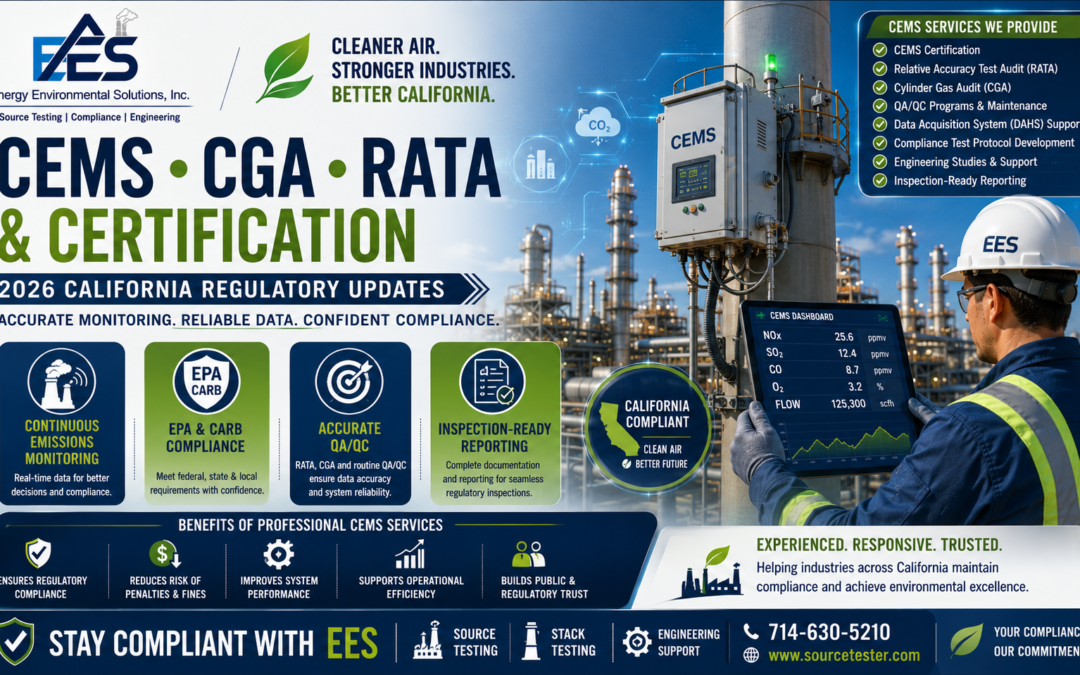
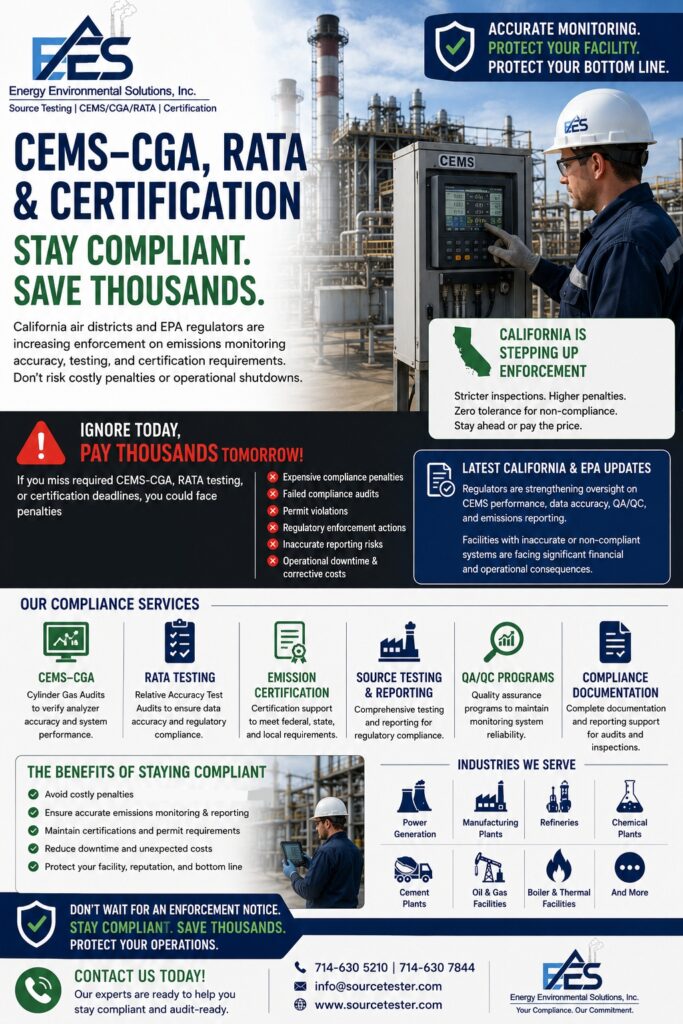
For many industrial facilities in California, having a CEMS (Continuous Emissions Monitoring System) installed is only the beginning. Depending on the applicable permit, air-district rules, and federal requirements, the system may need initial certification, quality assurance testing, Cylinder Gas Audits (CGA), Relative Accuracy Test Audits (RATA), ongoing QA/QC and periodic reporting.
For facilities regulated by the South Coast Air Quality Management District (South Coast AQMD), Rules 218, 218.2 and 218.3 establish important requirements for CEMS administration, certification, performance specifications and QA/QC. South Coast AQMD’s current rule book lists Rule 218 as amended March 5, 2021, and Rules 218.2 and 218.3 as amended September 2, 2022.
This makes professional CEMS Certification, CGA and RATA testing an important part of an industrial facility’s compliance strategy.
CEMS Certification California
What Is CEMS?
CEMS stands for Continuous Emission Monitoring System.
A CEMS continuously measures one or more emission parameters from an industrial source.
Depending on the application, it can monitor:
NOx
SO₂
CO
CO₂
Oxygen (O₂)
Flow rate
Moisture
Other regulated pollutants
A CEMS can continuously generate emissions data that may be used for compliance demonstrations, reporting and regulatory decision-making.
South Coast AQMD explains that CEMS can be required to continuously demonstrate compliance with permitted concentration limits and, for applicable RECLAIM systems, automatically report mass emissions.
The key point:
A CEMS is not automatically a compliance instrument simply because it is installed.
It must meet the applicable certification and performance requirements.
What Are CEMS Certification, RATA and CGA?
These three terms are closely connected but have different purposes.
CEMS Certification
Demonstrates that the monitoring system meets applicable regulatory performance and quality requirements and can function as an official data-reporting instrument.
RATA — Relative Accuracy Test Audit
Compares CEMS measurements against an applicable reference method to determine whether the CEMS is sufficiently accurate.
CGA — Cylinder Gas Audit
Challenges the CEMS with certified calibration/audit gases to verify analyzer response and measurement performance.
Together, they help answer:
Can regulators trust the emissions data being produced by the CEMS?
Why Is CEMS Compliance Important in California?
Industrial facilities may have strict emission limits for pollutants such as NOx, SO₂ and other contaminants.
When CEMS data are used to demonstrate compliance, inaccurate monitoring can create a serious problem.
A facility may believe it is compliant while the monitoring system is:
Drifting
Out of calibration
Producing invalid data
Experiencing excessive downtime
Outside required performance specifications
Operating outside its approved span range
Missing required QA/QC tests
South Coast AQMD Rule 218.3 provides requirements addressing CEMS performance, QA/QC, out-of-control periods and alternative data acquisition.
2026 California CEMS Regulatory Landscape
California’s CEMS requirements continue to evolve through local air-district rules, federal requirements and pollutant-specific monitoring programs.
For South Coast AQMD-regulated facilities, Rules 218, 218.2 and 218.3 remain central to CEMS requirements.
South Coast AQMD’s FY 2026–27 budget and objectives also continue to identify CEMS Certification as a compliance activity, demonstrating that CEMS review and certification remain an active regulatory function.
2026 takeaway:
CEMS should be treated as an ongoing compliance program—not a one-time installation project.
CEMS Certification: What Does the Process Involve?
For a new or modified CEMS, certification can involve multiple stages.
South Coast AQMD’s current CEMS application package describes a certification pathway that includes:
CEMS plan, where applicable
CEMS application
Quality Assurance Plan (QAP)
Initial District approval
Certification source-test protocol
District review/approval of the protocol
Certification source testing
Certification source-test report
District approval/final certification
Continuing QA/QC and periodic testing
Once certified, the CEMS remains subject to requirements involving maintenance, modifications, outages, records and periodic QA/QC testing such as RATAs.
This is why certification should be planned early.
A facility should not wait until the CEMS installation is complete before considering the certification process.
RATA Testing Company
What Is a RATA?
RATA = Relative Accuracy Test Audit.
A RATA evaluates how closely the CEMS measurement agrees with an applicable reference method.
In simple terms:
CEMS Result vs. Reference Method Result
The closer they agree, the more confidence regulators can have in the CEMS data.
South Coast AQMD defines relative accuracy in terms of the difference between CEMS-generated data and reference-method results, including the confidence coefficient.
A typical RATA may involve:
CEMS operating
↓
Reference-method sampling
↓
Simultaneous measurements
↓
Multiple test runs
↓
Statistical evaluation
↓
Relative accuracy calculation
↓
Pass / Fail determination
Why Is RATA Testing So Important?
Imagine your CEMS reports:
NOx = 45 ppm
But an approved reference method produces significantly different results.
Which number should regulators trust?
That’s exactly why RATA exists.
A successful RATA provides evidence that the CEMS is accurately measuring the emissions parameter within the applicable performance specification.
South Coast AQMD provides dedicated technical guidance for RATA-related issues, including RATA outliers and mass-emissions RATA for non-concurrent concentration and flow measurements.
What Is a CGA?
CGA = Cylinder Gas Audit.
During a CGA, the CEMS is challenged using gases with known certified concentrations.
Under federal EPA QA procedures, applicable CGA testing uses a zero-level gas and two upscale audit levels within specified ranges, with repeated injections designed to challenge the measurement system.
The basic concept is:
Known Gas → CEMS → Measured Value → Compare
If the CEMS response is outside the applicable tolerance, corrective action may be required.
RATA vs. CGA
Feature
RATA
CGA
Full Name
Relative Accuracy Test Audit
Cylinder Gas Audit
Main Purpose
Compare CEMS against reference method
Check analyzer response using known gases
Reference Method
Yes
No, uses certified gases
Field Sampling
Usually required
Gas challenge
Statistical Evaluation
Yes
Yes, according to applicable procedure
Frequency
Depends on applicable rule/program
Depends on applicable rule/program
Certification Role
Important
Important QA/QC component
Failure Response
Investigation/correction/retest as required
Calibration/correction/retest as required
Important:
Don’t assume that a CGA replaces a RATA in every regulatory program.
The applicable rule, permit and federal/state monitoring requirements determine what is required.
How Often Is RATA Required?
There is no single testing frequency for every California CEMS.
The interval depends on the applicable program.
For example, EPA’s Procedure 1 for applicable gas CEMS requires a RATA at least once every four calendar quarters, subject to the applicable provisions. It also provides for CGA-based quarterly QA in certain circumstances.
Other programs can have different requirements.
Your facility’s permit and applicable regulation control.
This is especially important for facilities operating under:
Title V
South Coast AQMD rules
RECLAIM-related requirements
Federal NSPS requirements
Federal NESHAP/MACT requirements
40 CFR Part 60
40 CFR Part 75
Pollutant-specific monitoring programs
RATA Certification
What Happens When a CEMS Fails QA/QC?
This is where CEMS compliance becomes particularly important.
A failed QA/QC test can result in an out-of-control period under applicable requirements.
South Coast AQMD Rule 218.3 provides that CEMS data generated during an applicable out-of-control period can be considered invalid for emission quantification in a compliance demonstration.
The facility may then need to:
Identify the problem
Correct the CEMS
Perform the required QA/QC test
Establish when valid data resumes
Evaluate affected data
Use an approved alternative data-acquisition method where applicable
Complete required reporting
This can become expensive if the issue is discovered too late.
Common Reasons CEMS Fail RATA or QA/QC
1. Analyzer Calibration Problems
Incorrect calibration can create measurement bias.
2. Sampling-System Problems
Leaks, condensation, contamination or sample-line problems can affect readings.
3. Span Range Problems
The selected span must be appropriate for the applicable requirements.
4. Moisture Interference
Moisture can affect certain monitoring systems if not properly accounted for.
5. Stratification
Non-uniform pollutant concentrations across the stack can affect comparison between the CEMS and reference method.
6. Flow Issues
Poor flow measurement can affect mass-emission calculations.
7. Aging Components
Sensors, analyzers, pumps and other components can degrade over time.
8. Poor Maintenance
A CEMS requires continuous attention.
CEMS Certification Is Not “Set It and Forget It”
A common mistake is:
Install CEMS → Get certified → Forget about it.
That’s not how an effective compliance program works.
After certification, facilities must continue managing:
Calibration + QA/QC + RATA + CGA + Maintenance + Data Availability + Records + Reporting
South Coast AQMD’s certification materials specifically state that certified CEMS remain subject to scheduled and unscheduled maintenance, outages, modifications, records/reporting and ongoing QA/QC.
2026 Update: CEMS Technology Is Expanding
CEMS requirements are also evolving for specialized pollutants.
A notable example is ethylene oxide (EtO).
South Coast AQMD entered into a July 2025 Memorandum of Understanding with Parter to help develop performance specifications, verification test protocols and implementation guidance for an EtO CEMS certification program. The MOU runs through December 31, 2026 unless extended.
This demonstrates an important industry trend:
Continuous monitoring is expanding beyond traditional NOx/SO₂ applications.
Facilities with specialized toxic-air-contaminant requirements should monitor regulatory developments closely.
CEMS and Environmental Compliance Are Becoming More Data-Driven
Modern air-quality compliance increasingly depends on continuous data.
Instead of relying only on periodic stack tests, regulators can use monitoring systems to evaluate:
Hourly emissions
Daily emissions
Operating conditions
Exceedances
Data availability
Control-device performance
Long-term trends
South Coast AQMD’s CEMS application materials state that applicable CEMS can continuously monitor compliance and automatically signal exceedances, breakdowns and out-of-control periods.
Accurate data is therefore a compliance asset.
Pros of CEMS, RATA, CGA & Certification
✅ 1. Continuous Compliance Visibility
CEMS provides ongoing emissions information rather than occasional snapshots.
✅ 2. Early Problem Detection
Abnormal emissions can potentially be identified faster.
✅ 3. Stronger Compliance Documentation
Certified monitoring data can support regulatory reporting where applicable.
✅ 4. Better Process Control
Operators can use emissions information to improve process operation.
✅ 5. Reduced Compliance Uncertainty
Routine QA/QC helps identify monitoring problems before they become major issues.
✅ 6. Better Long-Term Data
Historical CEMS information can help identify trends.
RATA Testing, Cylinder Gas Audit
Challenges / Cons
❌ Higher Initial Cost
Installing a compliant CEMS can require significant capital investment.
❌ Ongoing Maintenance
Analyzers, sampling systems and data-acquisition equipment require regular attention.
❌ QA/QC Requirements
RATA, CGA and other tests require planning and qualified personnel.
❌ Data Availability Issues
CEMS downtime can create compliance complications.
❌ Technical Complexity
CEMS involve instrumentation, electronics, sampling systems, software and regulatory requirements.
❌ Regulatory Changes
Changes to rules or permits can require modifications to the monitoring program.
But the cost of maintaining a reliable CEMS is usually easier to manage than discovering a monitoring failure during a compliance deadline.
Which Industries May Need CEMS Services?
Potential applications include:
Power & Energy
Power plants
Cogeneration facilities
Distributed generation
Manufacturing
Chemical plants
Metal processing
Cement
Glass
Manufacturing facilities
Petroleum & Chemical
Refineries
Petrochemical plants
Process facilities
Waste & Combustion
Waste-to-energy
Incineration
Thermal processing
Industrial Boilers
Large boilers
Steam generators
Process heaters
Other Regulated Sources
Facilities with permit or regulatory requirements for continuous monitoring.
EES can help bring these pieces together into one coordinated compliance program.
South Coast AQMD maintains a Laboratory Approval Program (LAP) under which laboratories and source-testing firms are evaluated method-by-method for personnel, equipment, documentation, QA and other criteria. Facilities should verify that the testing provider and applicable methods meet the requirements of their specific program.
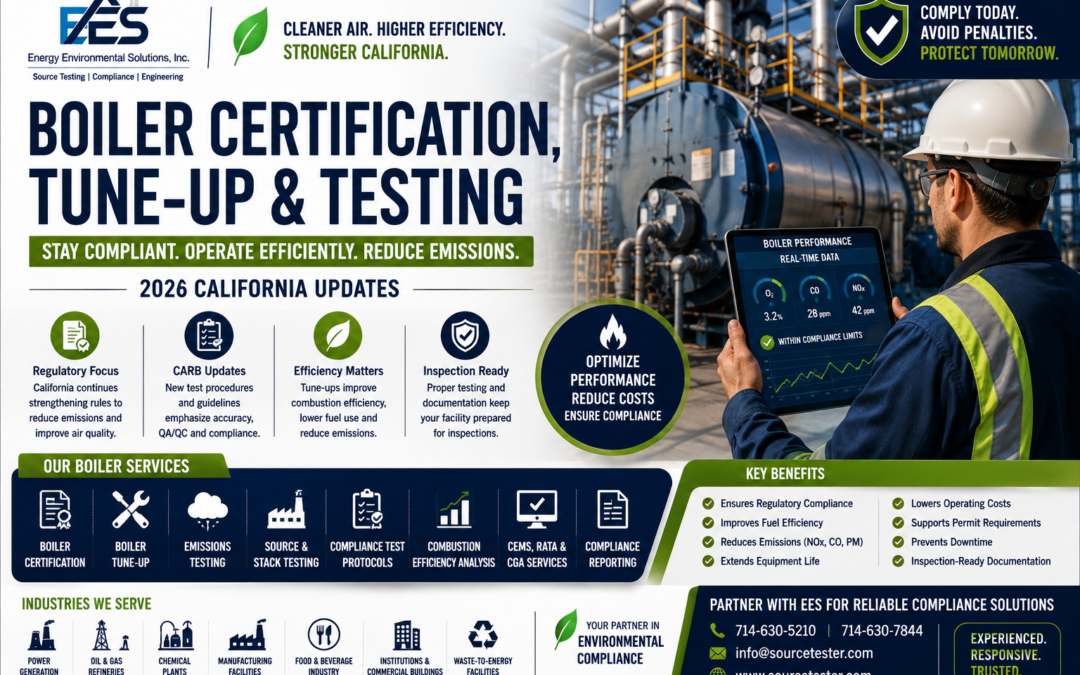
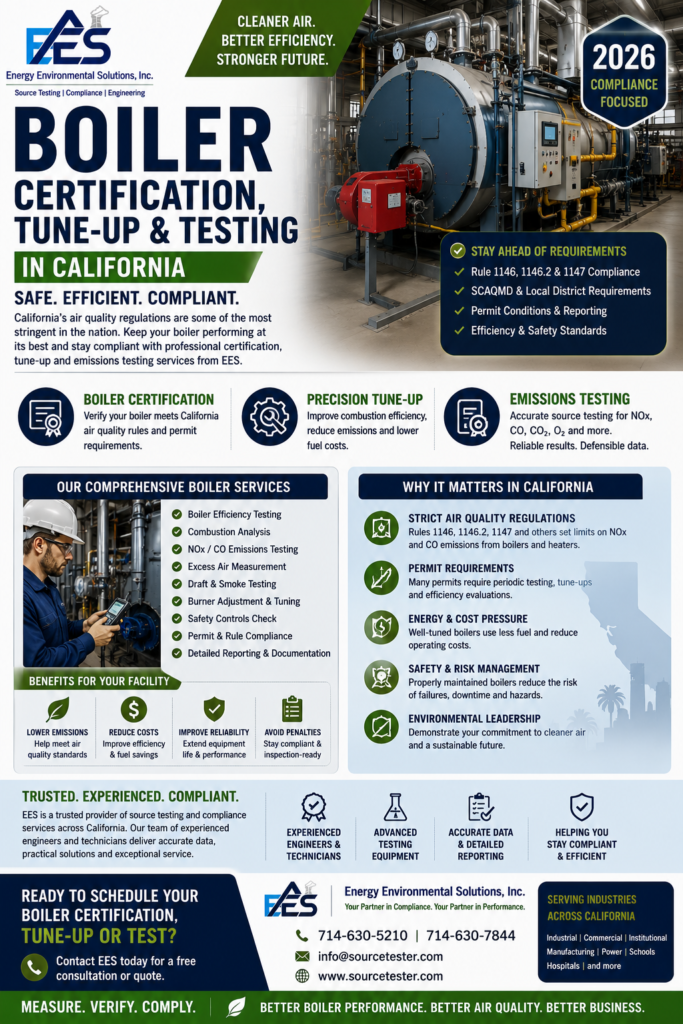
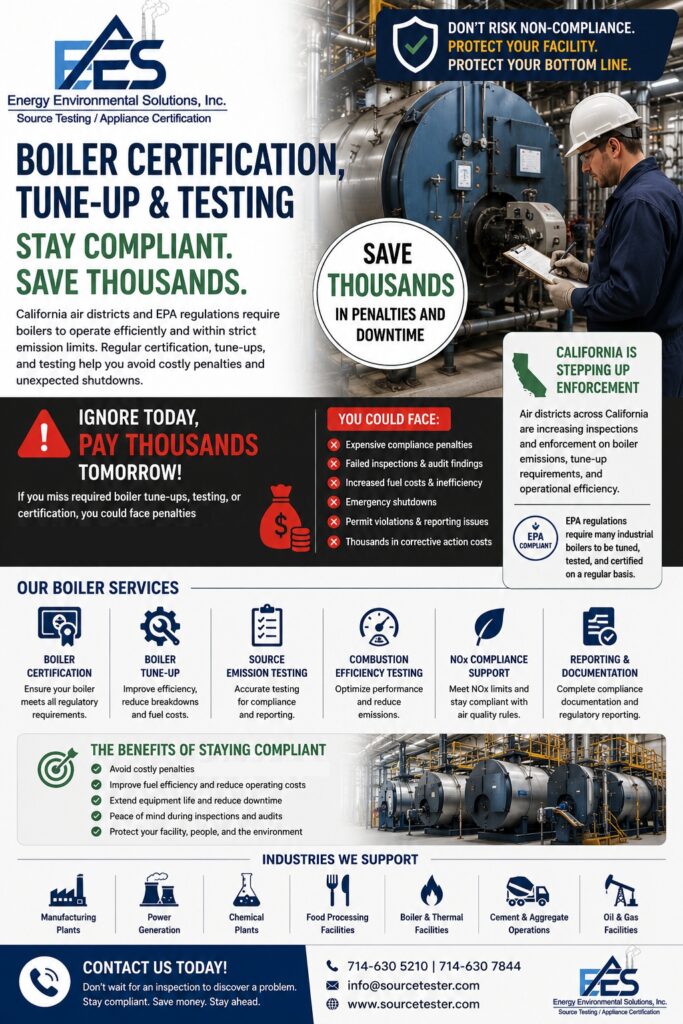
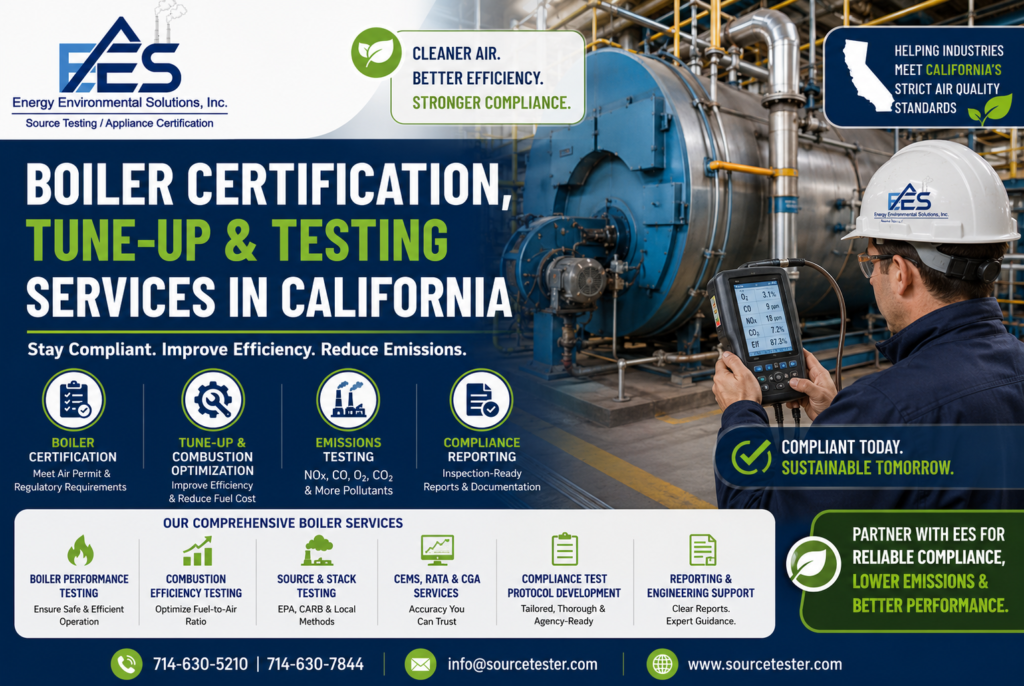
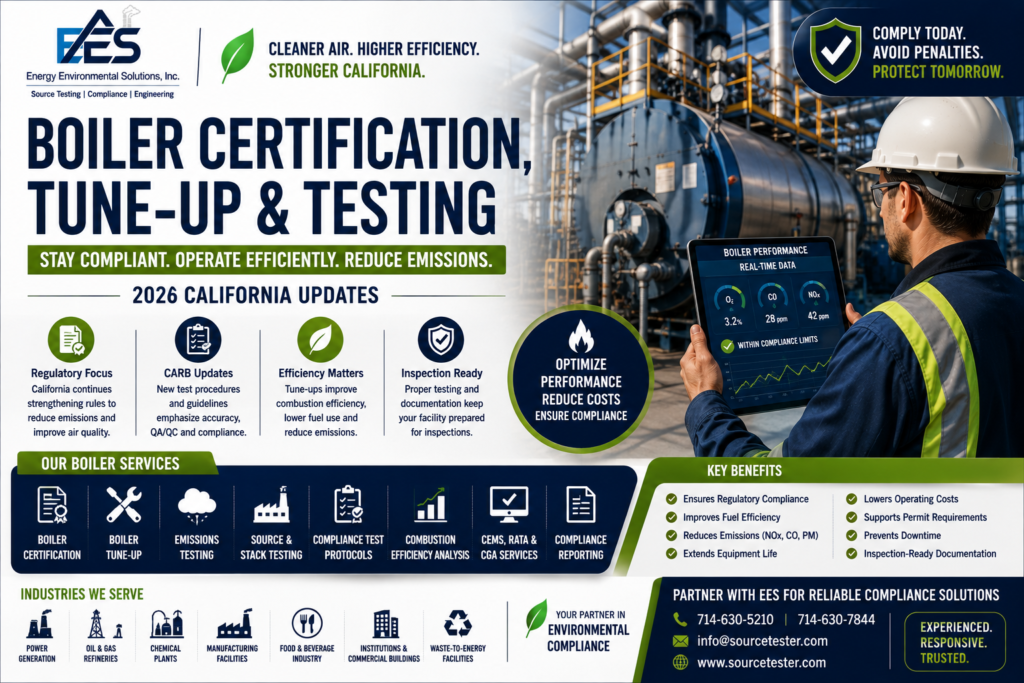
Boiler Certification, Tune-Up & Testing in California: 2026 Compliance Guide for Industrial & Commercial Facilities
Is your boiler operating efficiently—and is it meeting California air-quality requirements?
For industrial, institutional and commercial facilities, boiler compliance is more than keeping equipment running. Depending on the boiler size, fuel, location, permit and applicable air district rules, facilities may need certification, periodic tune-ups, emissions testing, recordkeeping and other compliance activities.
In Southern California, South Coast AQMD Rules 1146, 1146.1 and 1146.2 are particularly important for boilers, steam generators, process heaters and certain water heaters. South Coast AQMD’s current rule book lists Rule 1146 as amended in 2020, Rule 1146.1 as amended in 2018, and Rule 1146.2 as amended in 2024.
For facility owners and EHS managers, the key question is not simply:
“Does my boiler work?”
It is:
“Can my boiler demonstrate compliance with the applicable air-quality requirements?”
This is where professional Boiler Certification, Tune-Up and Testing services become valuable.
What Is Boiler Certification, Tune-Up & Testing?
These are related but different compliance activities.
Boiler Certification
Certification generally involves demonstrating that applicable equipment meets the requirements of the governing air-district rule or certification program.
For example, South Coast AQMD maintains a Certified Boilers List under Rule 1146.2, with the current equipment list updated December 30, 2025.
Boiler Tune-Up
A tune-up evaluates and adjusts combustion performance to help the boiler operate properly while controlling emissions.
Boiler Emissions Testing
Testing measures actual emissions—such as NOx, CO and oxygen—using the applicable regulatory test method.
NOx is particularly important because it contributes to ozone and smog formation.
South Coast AQMD states that combustion sources are among the sources of NOx emissions in the region, and its Rule 1146.2 amendments were designed to achieve significant NOx reductions.
For businesses, this means boiler operation can have both:
Facilities operating older boilers should therefore monitor rule developments rather than assuming today’s requirements will remain unchanged.
Boiler Testing Company
2026 Update: Rule 1146.2 Has Important Zero-Emission Requirements
South Coast AQMD amended Rule 1146.2 on June 7, 2024, establishing a transition toward zero-emission equipment for certain water heaters, boilers and process heaters.
A major 2026 milestone is:
January 1, 2026
South Coast AQMD’s 2026 compliance-deadline guidance states that certain Type 1 units ≤400,000 Btu/hr and qualifying instantaneous water heaters ≤200,000 Btu/hr installed in new buildings must comply with zero-emission limits.
The practical implication is significant:
Boiler and water-heating equipment planning is changing.
Facilities installing or replacing equipment should evaluate applicable requirements before purchasing equipment, rather than discovering a compliance issue after installation.
What Does a Boiler Tune-Up Actually Do?
A professional tune-up focuses on combustion performance.
Depending on the equipment and applicable rule, the process can include checking:
Fuel-to-air ratio
Oxygen concentration
Carbon monoxide
Stack temperature
Flame condition
Burner operation
Draft
Combustion-air supply
Fuel pressure
Operating load
Control settings
South Coast AQMD’s Rule 1146 tuning procedures specifically address operating the equipment at a representative firing rate and recording combustion parameters such as stack temperature, oxygen and CO.
For example, poor combustion can contribute to elevated CO or inefficient operation.
Too much excess air can also reduce combustion efficiency.
Too little combustion air can create incomplete combustion and elevated CO.
A properly performed tune-up seeks an appropriate combustion balance while maintaining safe operation.
South Coast AQMD’s tuning procedures explicitly state that tuning must not create unsafe conditions or violate applicable safety requirements, manufacturer specifications or other relevant regulations.
When Is Boiler Tune-Up Required?
This depends on the applicable rule and the specific unit.
For example, Rule 1146.1 contains a tune-up option for certain qualifying units with annual heat input of 18,000 therms or less. Units using this option must be tuned at least twice per year, at intervals of four to eight months, according to the prescribed or manufacturer’s procedure, with records maintained for a rolling 24-month period.
That does not mean every California boiler requires two tune-ups every year.
This distinction is important.
The applicable:
Rule + Unit Size + Fuel + Operating History + Permit
determine what is required.
Boiler Emissions Testing: What Is Measured?
Depending on the applicable regulatory requirement, testing may include:
NOx
Nitrogen oxides are a major regulatory focus for combustion equipment.
CO
Carbon monoxide helps evaluate combustion performance and may be subject to emission limits.
Oxygen
O₂ measurements can be used for combustion analysis and, depending on the rule, emissions corrections.
Other Parameters
Depending on the source, testing may also evaluate:
Stack temperature
Exhaust flow
Fuel consumption
Heat input
Operating load
Control-device parameters
Boiler Tune-Up Services
How Often Does a Boiler Need Emissions Testing?
There is no single California-wide testing interval.
The frequency depends on the applicable rule and equipment.
For example, South Coast AQMD Rule 1146 provides specific compliance-testing provisions. Under one provision, certain units at or above 10 MMBtu/hr have a three-year compliance determination interval, while certain units from 5 to below 10 MMBtu/hr have a five-year interval.
Other requirements may apply depending on the boiler category, compliance option and regulatory program.
Don’t assume your neighbor’s testing schedule applies to your boiler.
Boiler Certification vs. Boiler Testing
These terms are often confused.
Certification
Testing
Demonstrates equipment meets a certification requirement
Measures actual emissions
Often associated with specific equipment categories
Usually associated with operating equipment
Can apply to equipment models/configurations
Measures field performance
May be required before installation/operation
May be periodic
Documentation-based
Data/measurement-based
South Coast AQMD maintains certified equipment lists to help businesses identify equipment that meets applicable requirements. The current Rule 1146.2 certified-boiler list was updated December 30, 2025.
Why Boiler Testing Can Fail
A boiler doesn’t necessarily fail because it is mechanically broken.
Compliance problems can come from:
1. Incorrect Burner Settings
Improper combustion settings can increase emissions.
2. Excessive CO
Incomplete combustion can produce elevated CO.
3. Excess NOx
Combustion conditions may result in NOx above an applicable limit.
4. Poor Maintenance
Dirty burners, fouled surfaces or degraded components can affect combustion.
5. Incorrect Operating Conditions
A test performed under the wrong load or process conditions may not demonstrate compliance.
6. Aging Equipment
Older boilers may have difficulty meeting newer emissions requirements.
7. Inadequate Documentation
Even when equipment performs properly, missing records can create compliance complications.
The Cost of Ignoring Boiler Compliance
For a facility manager, a boiler compliance problem can quickly become an operational problem.
Potential consequences may include:
Failed emissions test
↓
Investigation
↓
Corrective maintenance
↓
Retesting
↓
Production disruption
↓
Additional engineering expense
↓
Possible regulatory enforcement
The exact consequences depend on the applicable air district, rule, permit and circumstances.
The smarter approach is preventive compliance.
Pros of Professional Boiler Certification, Tune-Up & Testing
✅ 1. Helps Demonstrate Regulatory Compliance
Measured data and proper documentation provide evidence of compliance with applicable requirements.
✅ 2. Improves Combustion Performance
A properly tuned boiler can operate more effectively.
✅ 3. Helps Identify Problems Early
Testing can reveal elevated emissions before they become a larger compliance issue.
✅ 4. Supports Better Maintenance Decisions
Testing data can help identify when burners, controls or other components need attention.
✅ 5. Reduces Compliance Surprises
A planned testing program is safer than waiting for a regulatory deadline.
✅ 6. Supports Equipment Planning
Testing can help determine whether an older boiler can continue operating within applicable limits.
Challenges / Cons
Professional testing also involves costs and planning.
Challenge
Potential Impact
Testing cost
Budget required
Tune-up cost
Technician/engineering expense
Production coordination
Boiler access may require scheduling
Retesting
Additional cost if results are unsatisfactory
Documentation
Requires organized recordkeeping
Regulatory changes
Existing equipment may face future requirements
Equipment upgrades
Older boilers may require modernization
But there is a difference between a compliance cost and an unexpected compliance crisis.
Planning usually gives a facility more options.
Which Industries Need Boiler Compliance Services?
Potential clients include:
Manufacturing
Food processing
Pharmaceutical manufacturing
Chemical manufacturing
Automotive
Aerospace
Textile
Paper
Plastics
Institutional
Hospitals
Universities
Schools
Government facilities
Commercial
Hotels
Large commercial buildings
Laundry facilities
Food-service operations
Industrial
Refineries
Industrial processing plants
Warehouses with process heating
Energy facilities
The exact requirements depend on the equipment and jurisdiction.
Boiler Tune-Up Services
Why Hospitals and Large Facilities Should Pay Special Attention
Hospitals, universities and large commercial buildings often rely heavily on boilers for:
Steam
Hot water
Heating
Sterilization
Laundry
Process applications
A boiler compliance issue can therefore affect more than emissions.
It can affect:
Operations + Energy Use + Maintenance + Compliance
This makes proactive testing particularly valuable.
How EES Helps With Boiler Certification, Tune-Up & Testing
A boiler test should not be treated as an isolated laboratory exercise.
Your testing company should understand:
The boiler → the combustion process → the air district → the rule → the test method → the compliance limit
That’s the difference between simply collecting emissions data and building a useful compliance program.
2026 Boiler Compliance Checklist
Before your next boiler test or tune-up, ask:
Is the boiler properly permitted/registered?
What is the rated heat-input capacity?
What fuel does it use?
Which California air district regulates the facility?
Which boiler rule applies?
Is certification required?
Is a tune-up required?
When was the last tune-up?
When was the last emissions test?
What are the applicable NOx limits?
What are the applicable CO requirements?
Is a source-test protocol required?
Is agency notification/approval required?
Are operating conditions specified?
Are records current?
Has the boiler or burner been modified?
Has the applicable rule changed?
2026: Why Facilities Should Review Their Boiler Compliance Program Now
The regulatory environment is moving toward lower-emission and zero-emission technologies.
South Coast AQMD’s 2026 rule-development work includes proposed amendments to Rules 1146 and 1146.1.
At the same time, Rule 1146.2 has already introduced significant zero-emission requirements for certain equipment categories, including requirements taking effect January 1, 2026.
This creates a strategic question for facility owners:
Should you continue maintaining the existing boiler, upgrade it, replace the burner, or transition to another technology?
Current emissions-testing data can help answer that question.
Don’t Wait for a Failed Boiler Test
A failed compliance test is often the worst time to start investigating your boiler.
Instead:
Test → Analyze → Tune → Verify → Document
This approach gives facility managers a better opportunity to identify problems before they become emergencies.
Need Boiler Certification, Tune-Up & Testing in California?
EES Can Help Your Facility Stay Ahead of Compliance Requirements
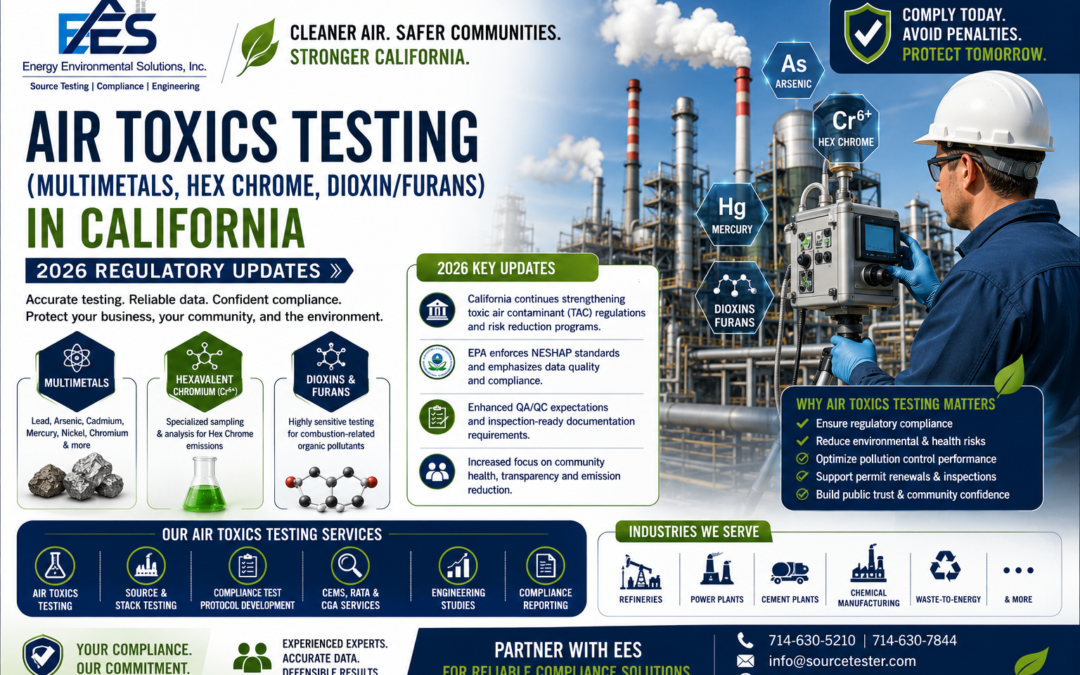
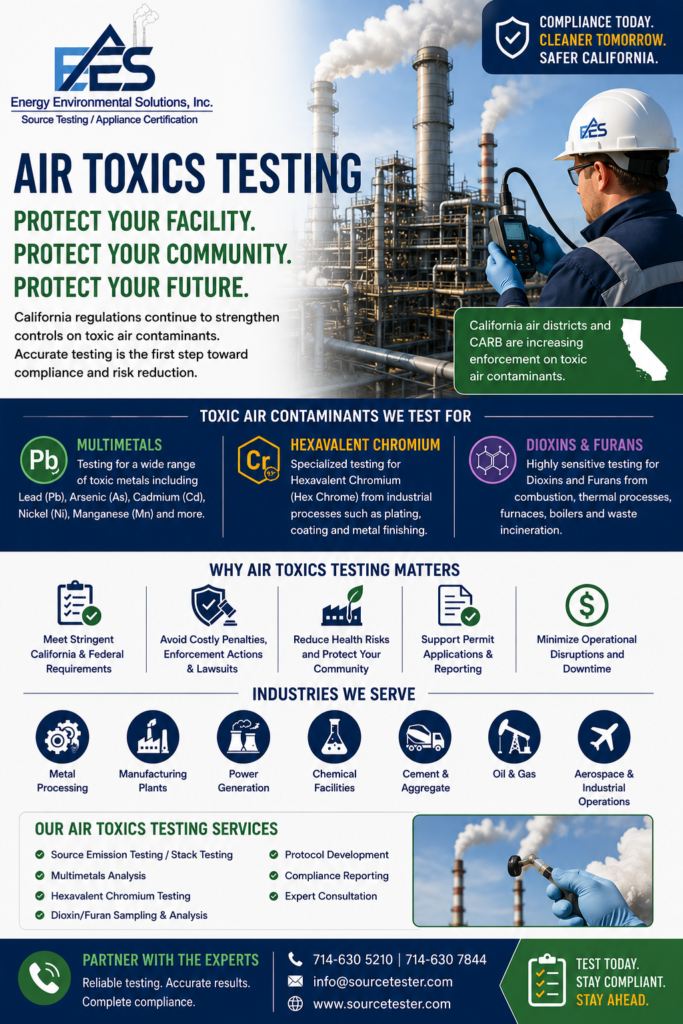
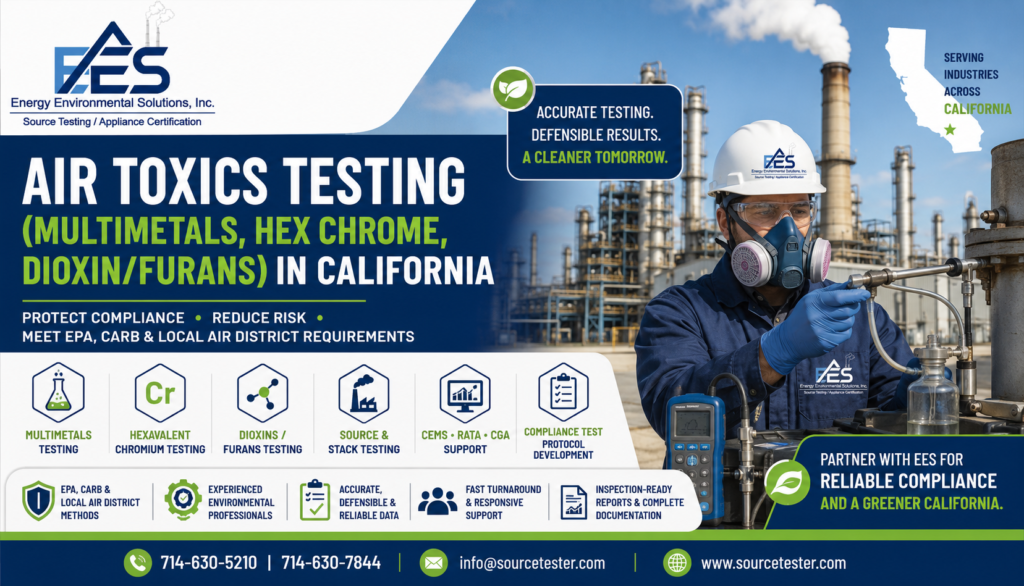
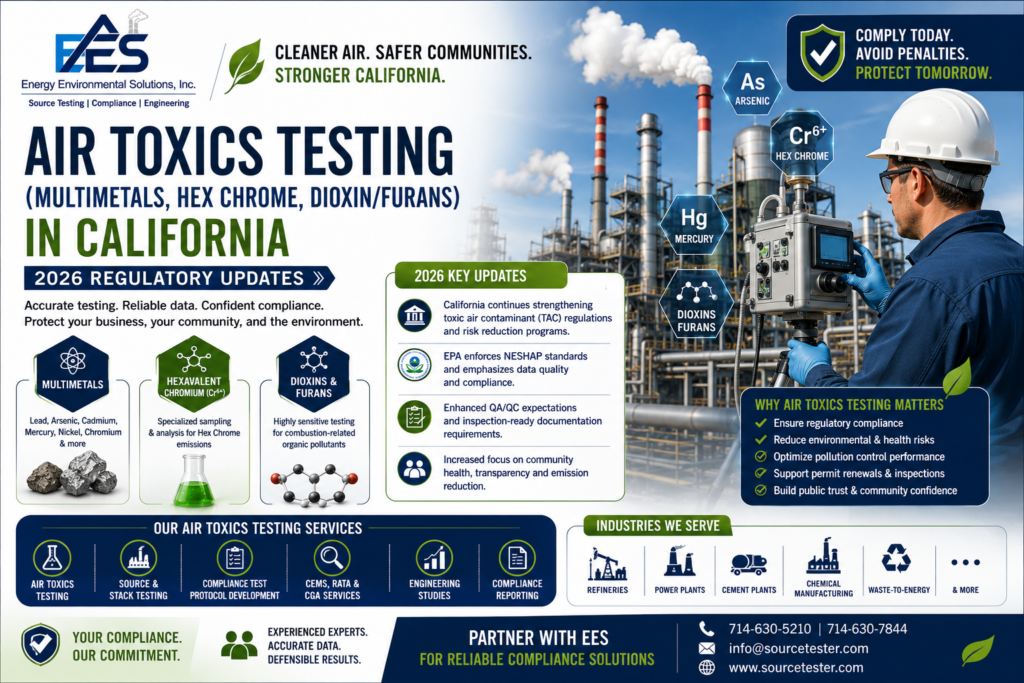
Air Toxics Testing in California: Multimetals, Hexavalent Chromium & Dioxin/Furans — 2026 Compliance Guide
California continues to maintain one of the most comprehensive air-toxics regulatory frameworks in the United States. For facilities that emit or may emit toxic air contaminants (TACs), accurate emissions measurement is increasingly important for permitting, compliance demonstrations, health-risk assessments and regulatory reporting.
For industrial facilities, Air Toxics Testing can involve specialized testing for multimetals, hexavalent chromium (Hex Chrome), dioxins/furans and other toxic pollutants. The exact testing obligation depends on the facility’s permit, applicable air-district rules, source type, pollutant and regulatory program. CARB specifically notes that California compliance-testing requirements vary by local agency and may use CARB, U.S. EPA or other published test methods.
With regulatory activity continuing through 2026, now is an important time for facilities to review their air-toxics testing programs.
Why Is Air Toxics Testing Important in California?
Toxic air contaminants are different from ordinary criteria pollutants because the regulatory focus is strongly connected to potential human-health impacts.
California’s AB 1807 program established a framework for identifying and controlling toxic air contaminants. CARB describes the program as a two-step process involving risk identification and risk management.
California’s identified toxic-air-contaminant list includes substances such as:
Hexavalent chromium
Arsenic compounds
Cadmium compounds
Lead compounds
Nickel compounds
Mercury compounds
Manganese compounds
Dioxins and furans
Benzene
Formaldehyde
Other toxic compounds
CARB’s current TAC information identifies hexavalent chromium and chlorinated dioxins/furans among substances for which no threshold level has been identified in its listing.
That is why reliable emissions data matters.
You cannot effectively manage what you have not accurately measured.
California Air Toxics Testing
What Is Air Toxics Testing?
Air Toxics Testing is the measurement and laboratory analysis of hazardous or toxic pollutants emitted from an industrial process, combustion source, control device or other emission point.
Depending on the facility, testing can include:
Multimetals Testing
Measurement of multiple metals potentially present in industrial emissions, such as:
Arsenic
Cadmium
Chromium
Lead
Nickel
Manganese
Mercury
Antimony
Beryllium
Cobalt
Selenium
Other regulated metals
Hexavalent Chromium Testing
Specialized measurement of Cr(VI) emissions from applicable chromium-related processes.
Dioxin/Furan Testing
Measurement of chlorinated dioxins and furans, which can be associated with certain combustion and industrial processes.
CARB identifies dioxins as toxic air contaminants and notes that they can originate from waste incineration, some chemical manufacturing and other industrial sources that burn fuel.
2026 California Air Toxics Regulatory Updates
1. South Coast AQMD Is Updating Toxic-Air-Contaminant Requirements
One of the most important 2026 developments is continued work on Proposed Amended Rule 1401 — New Source Review of Toxic Air Contaminants.
South Coast AQMD’s 2026 rulemaking materials show workshops and draft rule language during 2026, with proposed changes addressing new toxic air contaminants identified by California’s Office of Environmental Health Hazard Assessment and revisions to health values for existing compounds.
What does this mean for facilities?
A pollutant that previously received little attention could become more important when:
Toxicity information changes → health values change → risk calculations change → permitting/testing requirements may change.
Facilities should therefore avoid assuming that an old emissions profile automatically represents today’s regulatory requirements.
2. Rule 1469 and Hexavalent Chromium Requirements Have Become More Stringent
Hexavalent chromium remains one of California’s most closely scrutinized toxic air contaminants.
South Coast AQMD amended Rule 1469 — Hexavalent Chromium Emissions from Chromium Electroplating and Chromic Acid Anodizing Operations on December 5, 2025. The rule incorporates more stringent requirements associated with CARB’s Chromium ATCM, including lower emission limits and increased source-testing requirements for applicable operations.
South Coast AQMD’s regulatory advisory states that beginning January 1, 2026, functional chrome-plating facilities face more stringent requirements, including lower limits for applicable Tier III tanks and source testing every two years for Tier III tanks.
This makes Hex Chrome source testing particularly important for applicable chrome-plating and chromic-acid-anodizing facilities.
3. Source-Test Protocols Are Becoming More Important
For applicable Rule 1469 facilities, the source-testing process isn’t simply a matter of showing up with sampling equipment.
South Coast AQMD’s Rule 1469 materials specify situations where a source-test protocol must be submitted in advance. For certain Tier III tanks beginning January 1, 2026, the protocol must be submitted at least 60 days before the first applicable source test for approval.
Waiting until the last minute can create avoidable scheduling and compliance problems.
4. Air Toxics “Hot Spots” Activity Continues in 2026
California’s AB 2588 Air Toxics “Hot Spots” Program remains an important part of the regulatory landscape.
South Coast AQMD’s current 2026 AB 2588 activity includes approved health-risk assessments, facility public-notification activity and updated guidance documents. The District lists, for example, a January 2026 update to its emission-factor reference-source template and 2026 health-risk-assessment activity.
For facilities subject to AB 2588 requirements, emissions information can ultimately feed into health-risk assessments and risk-management decisions.
This is another reason why reliable source-test data is valuable.
Air Toxics Testing (Multimetals, Hex Chrome & Dioxin/Furans) in California | Energy Environmental Solutions, Inc.
Multimetals Testing: Why It Matters
Industrial processes can release several metals simultaneously.
A facility might not have a compliance concern involving only one metal. Depending on the source and applicable requirements, the emissions profile could contain multiple regulated metals.
Multimetals testing can therefore provide a more comprehensive picture of emissions.
Potential applications include:
Metal processing
Metal melting
Foundries
Plating
Aerospace manufacturing
Welding-related operations
Chemical manufacturing
Waste processing
Combustion processes
Manufacturing operations
Industrial furnaces
South Coast AQMD’s Regulation XIV contains multiple rules addressing toxic and non-criteria pollutants, including metal-related rules and Rule 1469 for hexavalent chromium.
Hexavalent Chromium Testing
Hexavalent chromium, commonly written as Cr(VI) or Hex Chrome, deserves special attention.
It can be associated with processes including:
Hard chrome plating
Decorative chrome plating
Chromic acid anodizing
Certain chromium-containing coating operations
Other applicable industrial processes
The regulatory environment around chrome operations has tightened.
South Coast AQMD’s 2025 Rule 1469 amendment incorporated the state’s more stringent chromium requirements, including phase-out provisions, lower emission limits and more frequent source testing for applicable operations.
If your facility handles chromium, don’t rely on an old testing schedule without checking the current rule.
Dioxin & Furan Testing
Dioxins and furans are another category where specialized testing is essential.
CARB explains that dioxins can be produced through certain combustion activities and chemical manufacturing processes and identifies dioxins as toxic air contaminants.
Potentially relevant sources can include:
Waste combustion
Incineration
Certain thermal processes
Chemical manufacturing
Industrial combustion
Certain metal-processing activities
Other processes identified by the applicable regulatory program
Dioxin/furan testing generally requires highly specialized sampling and laboratory analysis.
This is not a routine emissions test.
The sampling, sample handling, analytical procedures and quality-control requirements must be carefully planned.
What Can a Professional Air Toxics Test Evaluate?
Depending on the applicable regulation and test method, a testing program may evaluate:
Testing can help determine whether an air-pollution-control device is achieving its intended performance.
5. Improved Regulatory Preparedness
Facilities that maintain current emissions information are better positioned to respond to permit modifications and regulatory changes.
6. Greater Confidence for Management
Facility managers can make decisions using measured data instead of assumptions or outdated emission factors.
Challenges and Cons of Air Toxics Testing
Challenge
What It Can Mean for Facilities
Cost
Specialized testing and laboratory analysis can be expensive
Complexity
Toxic-air-contaminant methods can be technically demanding
Scheduling
Testing may need coordination with production
Downtime
Some tests require specific operating conditions
Protocol Requirements
Certain programs require advance protocol preparation/submission
Laboratory Requirements
Applicable rules may require qualified or approved laboratories
Corrective Action
Elevated results may require investigation or additional testing
South Coast AQMD operates a Laboratory Approval Program under which independent laboratories/source-testing firms are evaluated method-by-method for personnel, equipment, documentation, QA and related criteria.
Why Choosing the Right Testing Company Matters
Air toxics testing is not simply about collecting a sample.
The complete process can involve:
Regulatory Review
↓
Test Protocol Development
↓
Sampling Plan
↓
Field Testing
↓
Sample Handling
↓
Laboratory Analysis
↓
QA/QC Review
↓
Engineering Calculations
↓
Compliance Report
A mistake at any stage can affect the usefulness of the final results.
That’s why industrial facilities should work with an experienced environmental testing provider familiar with California air-district requirements and source-testing procedures.
How EES Helps Industries With Air Toxics Testing
Energy Environmental Solutions, Inc. (EES) can help industrial facilities manage specialized air-toxics testing programs.
1. Multimetals Testing
EES can support testing programs for applicable metal emissions, including multi-metal analysis.
2. Hex Chrome Testing
For applicable chromium-related operations, EES can support hexavalent chromium emissions testing and associated compliance programs.
3. Dioxin/Furan Testing
EES can support specialized testing programs involving dioxins and furans for applicable industrial sources.
4. Test Protocol Development
Before testing begins, EES can help develop a protocol addressing:
Applicable regulations
Sampling methods
Sampling locations
Operating conditions
Analytical methods
QA/QC
Reporting requirements
5. Source Testing
EES can coordinate and perform applicable source-testing services based on the requirements of the relevant air district and permit.
6. Laboratory Coordination
Specialized air-toxics testing requires appropriate analytical capabilities. EES can coordinate applicable laboratory analysis and documentation.
7. Compliance Reporting
The final objective isn’t just a laboratory result.
It is a defensible compliance record.
8. Regulatory Support
EES can help facilities understand how their testing program fits within applicable California air-quality requirements.
Industries That May Need Air Toxics Testing
Potential clients include:
Metal Plating Facilities
Chrome Plating Facilities
Aerospace Manufacturers
Metal Fabrication Facilities
Foundries
Chemical Manufacturers
Waste Processing Facilities
Industrial Combustion Facilities
Manufacturing Plants
Coating Operations
Refineries
Power Generation Facilities
Thermal Processing Facilities
Incineration Operations
Other Facilities Subject to TAC Requirements
CARB’s Air Toxics Tool notes that different industries can be associated with different toxic pollutants and that the listed substances are not necessarily a complete list for every industry.
2026 Air Toxics Compliance Checklist
Before your next test, ask:
☑ What toxic pollutants could my source emit?
☑ What does my current permit require?
☑ Does my air district require source testing?
☑ Is multimetals testing required?
☑ Is Hex Chrome testing applicable?
☑ Are dioxin/furan emissions relevant to my process?
☑ Is a source-test protocol required?
☑ Does the protocol require advance agency approval?
☑ Is a qualified/approved laboratory required?
☑ Is my previous test still representative?
☑ Has the equipment or production process changed?
☑ Have applicable rules changed for 2026?
Why You Should Not Wait Until the Testing Deadline
Imagine discovering two weeks before your regulatory deadline that:
Your sampling ports need modification.
Your old protocol is no longer appropriate.
The applicable test method has changed.
Your laboratory needs advance scheduling.
Your facility cannot achieve the required operating condition.
The air district requires advance protocol submission.
Now your testing deadline becomes a business problem.
Early planning turns regulatory pressure into a manageable project.
For specialized testing such as Hex Chrome or Dioxin/Furan, advance coordination is especially important.
Stack Testing
Why 2026 Is the Right Time to Review Your Air Toxics Program
California’s toxic-air-contaminant regulatory environment continues to evolve.
South Coast AQMD’s 2026 rulemaking schedule includes activity surrounding Rule 1401, toxic-air-contaminant health values and additional toxic-emission controls.
At the same time, Rule 1469 requirements for applicable chromium operations have become more stringent, with increased attention to source testing.
The practical takeaway for facility owners and EHS managers is simple:
Don’t manage today’s emissions with yesterday’s compliance assumptions.
Review your:
Permit + Rules + Equipment + Testing Schedule + Test Methods + Emissions Data
Turn Air Toxics Compliance Into a Competitive Advantage
Compliance is often treated as a cost.
But smart companies can look at it differently.
Reliable emissions testing can help you:
Identify problems early → improve process control → reduce compliance uncertainty → maintain better records → respond faster to regulatory changes
That’s a much stronger position than waiting for an inspection or regulatory deadline.
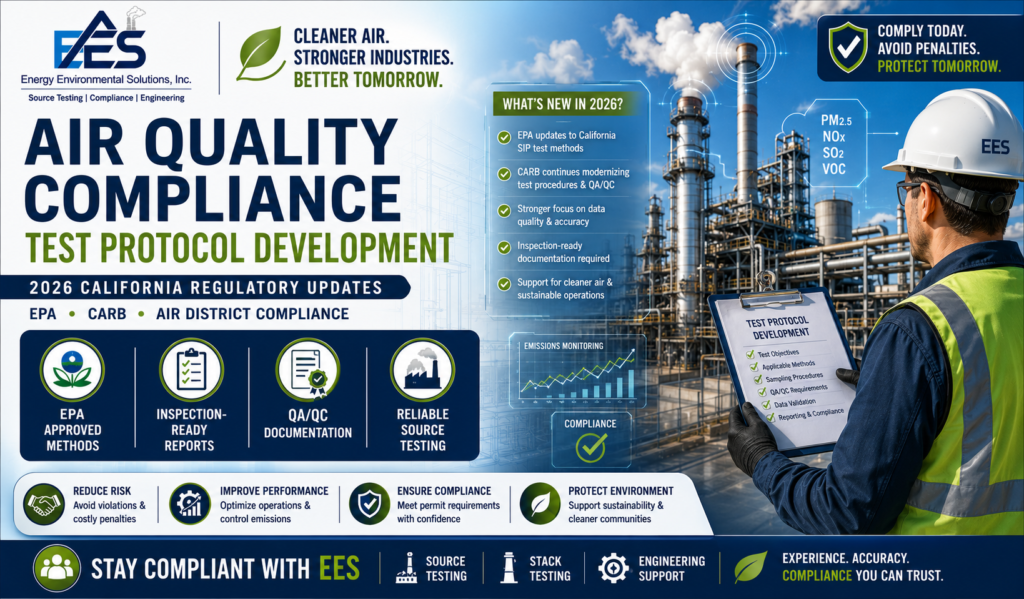
Air Quality Compliance Test Protocol Development in California: 2026 Guide, Latest Updates & How EES Helps Industries
California’s air-quality compliance environment is becoming increasingly technical. For facilities subject to source testing, developing the correct Air Quality Compliance Test Protocol before testing can be just as important as performing the test itself.
A source test is not simply “collect a sample and issue a report.” The protocol establishes what will be tested, how it will be tested, where samples will be collected, what operating conditions must be maintained, which test methods will be used, what quality-control procedures apply, and how compliance will be demonstrated.
California Air Resources Board (CARB) confirms that compliance-testing requirements vary by local agency and may use CARB, U.S. EPA or other published test methods. South Coast AQMD likewise maintains a dedicated collection of source-test methods and protocols for regulated facilities.
For industrial facilities planning a source test in 2026, the message is straightforward:
A poorly prepared protocol can create a poorly defensible compliance test.
Air Quality Compliance Testing Services California
What Is an Air Quality Compliance Test Protocol?
An Air Quality Compliance Test Protocol is a technical testing plan prepared before a regulatory source test.
It translates the applicable rule and permit requirements into a practical testing program.
Depending on the source, a protocol may define:
Source and emission point identification
Equipment and process description
Applicable regulatory requirements
Pollutants to be measured
Test methods
Sampling locations
Sampling ports
Traverse points
Sampling duration
Number of test runs
Operating conditions
Fuel or material usage
Production rate
Control-device operating parameters
Calibration requirements
QA/QC procedures
Laboratory analysis
Calculations
Data reporting
Compliance determination
South Coast AQMD explains that source testing measures actual emissions that may be used to determine compliance with emission limits or, for toxic emissions, to support health-risk assessments. The District also notes that third-party contractors prepare source-test protocols detailing the testing program.
Why Is Test Protocol Development Important in California?
Imagine spending thousands of dollars preparing for a source test, coordinating production, arranging access to the stack, shutting down equipment, collecting samples and waiting for laboratory results—only to discover that the testing conditions did not adequately demonstrate compliance.
If any of these three pieces is disconnected, the final result can become difficult to defend.
California’s regulatory framework recognizes the importance of approved testing procedures. CARB states that local compliance-testing requirements can involve published CARB methods, U.S. EPA methods or other published methods.
2026 California Regulatory Update: Source Testing Remains a Major Compliance Activity
Current 2026 South Coast AQMD materials show that source testing remains an active part of the District’s regulatory program.
The District’s Stationary Source Committee materials describe source testing as a measurement of actual emissions used for compliance determinations and health-risk assessments, with third-party contractors preparing source-test protocols.
South Coast AQMD also maintains an extensive Methods & Procedures program containing source-test methods and protocols, including protocols for combustion sources, VOC capture efficiency and RECLAIM-related boiler testing.
This matters because protocol development is not a generic paperwork exercise. The protocol needs to match the applicable regulatory method and the physical characteristics of the source.
Cement Plant Stack Testing
2026 Update: Toxic-Air-Contaminant Testing Is Increasingly Important
California’s air-quality programs continue to place significant attention on toxic air contaminants.
CARB’s current research priorities include identifying emerging air toxics of concern and developing monitoring protocols for pollutants that may become priorities for future air-toxics monitoring.
At the local level, South Coast AQMD’s ongoing rule-development and enforcement activities also demonstrate the importance of toxic-emission measurements.
For example, South Coast AQMD’s 2026 materials concerning chromium-related sources include source-testing requirements and tighter emission demonstrations for applicable operations.
For facilities handling metals, chromium compounds or other toxic substances, protocol development therefore needs to consider not only what pollutant is being measured, but also the analytical sensitivity, sampling approach and regulatory reporting requirements.
2026 Update: Rule 1469 Shows Why Protocols Matter
One of the clearest examples is South Coast AQMD Rule 1469, addressing hexavalent chromium emissions from chromium electroplating and chromic-acid anodizing operations.
Proposed amendments have included more stringent requirements and increased source-testing frequency for certain operations.
The proposed Rule 1469 language also specifies detailed information that may need to be included in a source-test protocol, including:
Source-test criteria
Assumptions
Required data
Target concentrations
Preliminary analytical information
Sampling parameters
This is a useful example for every facility:
The protocol can be a technical compliance document—not merely a scheduling form.
What Should an Air Quality Test Protocol Include?
The exact contents depend on the rule and source, but a professional protocol commonly addresses the following.
1. Facility and Source Identification
The protocol should clearly identify:
Facility name
Facility location
Permit number
Equipment ID
Emission point
Process
Control device
Test date
This prevents confusion when a facility has multiple similar emission points.
2. Description of the Process
The testing agency needs to understand what is actually happening during the test.
For example, a protocol for a thermal oxidizer might describe:
Production process → VOC-containing exhaust → capture system → oxidizer → stack
The final calculation should correspond to the applicable regulatory standard.
Why Protocol Approval Can Matter
Some California regulations require the source-test protocol to be submitted to the applicable air district before testing.
For example, CARB’s regulatory materials include requirements under certain programs for submitting a pre-test protocol to the air district before conducting a source test.
South Coast AQMD’s regulatory materials likewise contain rules requiring source-test protocols and, in some circumstances, approval before the test is performed.
Therefore:
Never assume that the testing contractor can simply arrive and begin sampling.
The applicable rule and permit should be reviewed first.
California Source Test Protocol Services
Common Problems With Poor Test Protocols
Problem 1: Wrong Test Method
A facility may identify the pollutant correctly but select an inappropriate or outdated method.
Result:
The test may not provide the intended compliance demonstration.
Problem 2: Incorrect Operating Condition
A test performed at the wrong production rate may fail to demonstrate compliance under the required conditions.
Problem 3: Missing Sampling Information
If stack dimensions, port configuration or traverse information are incomplete, the testing team may face problems on test day.
Problem 4: Permit and Rule Do Not Match
Sometimes facility personnel rely on an old permit or historical test report without checking current requirements.
Problem 5: Equipment Has Changed
A burner replacement, process modification, pollution-control upgrade or production change can make an older protocol unsuitable.
Problem 6: Insufficient QA/QC Documentation
Even good measurements can become difficult to defend if required QA/QC information is missing.
Air Quality Compliance Test Protocol Development: Pros & Cons
Pros
Cons / Challenges
Creates a clear testing roadmap
Requires engineering expertise
Reduces testing-day surprises
Requires advance planning
Connects testing to permit requirements
Rule requirements can be complex
Helps select appropriate methods
Some protocols need agency approval
Improves data defensibility
Additional preparation cost
Identifies operating conditions in advance
Facility operations may need coordination
Supports accurate compliance reporting
Changes may require protocol revision
Helps prevent invalid testing
Testing deadlines can be tight
When Should a Facility Develop a Test Protocol?
Don’t wait until the day before the test.
A facility should consider starting protocol development when:
A source-test deadline is approaching
A new permit is issued
A permit is modified
Equipment is installed
A burner is replaced
A control device is modified
Production changes
Fuel changes
A new pollutant becomes regulated
A regulatory amendment changes testing requirements
A previous source test failed
An agency requests additional testing
A health-risk assessment requires updated emissions information
Which California Industries Need Test Protocol Development?
Potentially affected facilities include:
Manufacturing plants
Chemical facilities
Petroleum facilities
Refineries
Metal-processing plants
Aerospace facilities
Automotive facilities
Food-processing plants
Pharmaceutical manufacturing
Power-generation facilities
Waste-management facilities
Landfills
Coating operations
Printing facilities
Boiler operations
Industrial furnaces
Thermal oxidizer operations
RTO facilities
Chrome-plating facilities
The actual testing requirement depends on the applicable air district, permit and source.
How EES Helps With Air Quality Compliance Test Protocol Development
Energy Environmental Solutions, Inc. (EES) can help facilities turn complicated regulatory requirements into a structured testing plan.
1. Regulatory Review
EES can review applicable rules and permit conditions to identify the testing requirements.
EES can coordinate testing requirements with facility personnel to minimize operational disruption.
4. Sampling Location Evaluation
The team can review stack and duct configurations to identify appropriate sampling locations.
5. Operating-Condition Planning
EES can help establish the production/load/fuel conditions required during the test.
6. Method Selection
The testing program can be designed around the applicable CARB, EPA, South Coast AQMD or other approved method.
7. Compliance Testing
After protocol development, EES can support the actual source-testing program.
8. Engineering Calculations
Raw analytical data can be converted into the appropriate emissions units and compliance metrics.
9. Test Report Preparation
EES can prepare technical documentation describing the testing methodology, results, calculations and compliance determination.
10. Corrective-Action Support
If results indicate an emissions problem, EES can help identify potential technical causes and evaluate the need for additional testing or engineering work.
Why Choose a Professional Test Protocol Developer?
The cheapest protocol is not necessarily the least expensive option.
Suppose a facility spends $5,000–$20,000 or more coordinating a complex source test, but the protocol fails to address an important regulatory requirement.
The company may then face:
Retesting + additional laboratory costs + production disruption + engineering time + regulatory delays
A properly developed protocol can reduce that risk by identifying potential problems before the sampling team arrives.
Think of it like an aircraft flight plan.
The test itself is the flight.
The protocol is the flight plan.
You don’t want to discover the route, fuel requirements and destination after takeoff.
Identify pollutants, emission points and applicable methods.
↓
STEP 3 — DEVELOP
Prepare the detailed source-test protocol.
↓
STEP 4 — COORDINATE
Coordinate facility operations, access, production and agency requirements.
↓
STEP 5 — TEST
Conduct the source test according to the approved requirements.
↓
STEP 6 — ANALYZE
Perform laboratory analysis and QA/QC evaluation.
↓
STEP 7 — CALCULATE
Convert measurements into the required emissions units.
↓
STEP 8 — REPORT
Prepare and submit the source-test report as required.
Cement Plant Stack Testing
2026 Compliance Strategy: Test Smarter, Not Just Faster
The regulatory environment is becoming more sophisticated.
South Coast AQMD’s current Methods & Procedures resources include dedicated protocols for different applications, while CARB continues to maintain approved compliance-testing methods and contractor requirements.
At the same time, active regulatory changes—including toxic-air-contaminant programs and source-specific requirements—can affect testing obligations. South Coast AQMD’s 2026 materials show continuing activity around source testing, toxic emissions and compliance evaluation.
For facility managers, this means one thing:
Your old source-test protocol should not automatically be reused for the next test.
Before every significant test, ask:
Has the rule changed?
Has the permit changed?
Has the equipment changed?
Has the process changed?
Has the test method changed?
Has the required operating condition changed?
If the answer to any of these is yes, the protocol should be reviewed.
Air Quality Compliance Test Protocol Checklist
Before submitting or conducting your next source test, verify:
Current facility permit reviewed
Current applicable rule reviewed
Emission points identified
Pollutants identified
Correct test methods selected
Sampling locations confirmed
Stack/duct dimensions verified
Operating conditions established
Production rate documented
Control-device parameters identified
QA/QC requirements established
Laboratory requirements confirmed
Agency notification requirements checked
Protocol approval requirements checked
Test schedule coordinated
Reporting requirements confirmed
The Bottom Line
Air Quality Compliance Test Protocol Development is the foundation of a defensible source-testing program.
California’s regulatory framework gives air districts significant responsibility for implementing and enforcing air-quality requirements, while CARB confirms that compliance-testing requirements vary by local agency and may rely on CARB, EPA or other approved methods.
In 2026, with continuing rule development, source-testing activity and increasing attention to toxic and criteria pollutants, facilities should treat protocol development as a technical compliance function—not administrative paperwork.
The goal isn’t simply to complete a test.
The goal is to produce reliable data that can demonstrate compliance.
Need Air Quality Compliance Test Protocol Development in California?
Energy Environmental Solutions, Inc. (EES) provides professional support for:
Air Emissions Testing in California (2026): Latest Updates, Pros, Cons & How EES Helps Industries Stay Compliant
California continues to operate one of the most comprehensive air-quality regulatory systems in the United States. In 2026, air emissions testing, source testing, stack testing, emissions monitoring, QA/QC, and compliance reporting remain important tools for industrial facilities demonstrating compliance with air permits and applicable state, federal, and local requirements.
The regulatory environment is also evolving. South Coast AQMD’s 2026 rulemaking calendar includes more than two dozen planned rule amendments and adoptions addressing particulate matter, toxic air contaminants, monitoring, New Source Review, and other air-quality objectives. At the same time, CARB continues updating statewide programs and test methods, while EPA’s current implementation framework continues to rely on emissions inventories, monitoring, modeling, and control strategies to demonstrate progress toward federal air-quality standards.
For industrial operators, this means one thing: accurate emissions data and defensible testing are becoming increasingly important.
Energy Environmental Solutions, Inc. (EES) helps facilities manage this process through professional Air Emissions Testing, Source & Stack Testing, Compliance Test Protocol Development, CEMS Certification, RATA, CGA, QA/QC, Engineering Studies, and Regulatory Reporting.
Emissions Testing
What Is Air Emissions Testing?
Air emissions testing is the measurement and evaluation of pollutants released from industrial processes, combustion equipment, stacks, vents, and other emission sources.
Depending on the facility and permit requirements, testing may address pollutants such as:
NOx – Nitrogen Oxides
SOx – Sulfur Oxides
CO – Carbon Monoxide
VOC – Volatile Organic Compounds
PM – Particulate Matter
PM10
PM2.5
Hazardous Air Pollutants (HAPs)
Air toxics
Metals
Hexavalent chromium
Dioxins and furans
Ammonia
Greenhouse gases
California’s stationary-source testing framework can involve CARB, EPA, and local Air District test methods, with requirements varying according to the applicable agency and regulation. CARB specifically notes that compliance testing requirements can include published CARB, EPA, or other approved test methods.
Why Is Air Emissions Testing Important in California?
California’s air-quality programs are built around controlling emissions from both mobile and stationary sources. CARB identifies stationary point sources such as power plants, oil refineries, manufacturing facilities, and food-processing plants as important categories of permitted emission sources.
For facilities subject to permits, testing provides regulators and operators with information about the actual performance of emission sources. It can also support permit demonstrations, compliance determinations, emissions inventories, engineering evaluations, and corrective actions.
South Coast AQMD’s Annual Emissions Reporting program illustrates the importance of accurate emissions information: facilities meeting specified reporting thresholds must submit annual emissions reports, and the information is used to support air-quality planning and evaluation of clean-air strategies.
Latest California Air Emissions Updates for 2026
1. California’s Regulatory Activity Remains High
South Coast AQMD announced a 2026 rule calendar containing more than two dozen planned rule amendments and adoptions. The planned activities include particulate-matter reductions, toxic-air-contaminant controls, New Source Review changes, and additional monitoring requirements.
This is important for industrial facilities because testing programs designed around yesterday’s requirements may not automatically address tomorrow’s requirements.
2. Particulate Matter Continues to Receive Attention
South Coast AQMD’s 2026 public-hearing schedule includes proposed amendments involving PM10 and particulate matter, including proposed amendments to Rule 1157 and other particulate-related rules.
The agency also scheduled consideration of proposed Rule 444.1 and amendments involving Visible Emissions, Particulate Matter – Concentration, and Solid Particulate Matter – Weight.
For facilities with particulate-emitting processes, these developments reinforce the value of maintaining reliable PM testing and documentation.
3. Monitoring Requirements Are Expanding
South Coast AQMD’s 2026 rule forecast includes proposals concerning fenceline monitoring for metal toxic air contaminants and monitoring/sampling for facilities identified as having significant high-risk levels for gaseous toxic air contaminants.
This reflects a broader regulatory direction toward more detailed emissions information and greater visibility into facility impacts.
4. Air-Quality Conditions Continue to Drive Regulatory Attention
South Coast AQMD’s 2026 news releases have included ozone advisories, particle-pollution advisories, wildfire-smoke advisories, and windblown-dust advisories. In July 2026, for example, the agency issued an ozone advisory associated with a heat wave.
These events don’t mean every industrial facility must automatically perform a particular emissions test. However, they demonstrate why California continues to prioritize air-quality management and emissions-control programs.
EPA’s current guidance explains that implementation of ozone and particulate-matter standards relies on programs including air-quality monitoring, modeling, emissions inventories, and emission-control strategies.
For industrial facilities, reliable source-level emissions information can therefore become an important component of the broader regulatory picture.
Pros of Professional Air Emissions Testing
1. Stronger Regulatory Compliance
Testing provides measurable evidence that an emission source is operating within applicable permit and regulatory requirements.
Rather than relying solely on assumptions or operating conditions, facilities can use documented test results to demonstrate actual performance.
2. Better Emissions Data
Properly designed testing provides traceable and technically defensible emissions data.
This can be particularly important when data is used for:
Permit compliance
Emissions inventories
Regulatory reporting
Engineering evaluations
Corrective actions
Permit renewals
3. Early Identification of Problems
Testing can reveal problems with combustion equipment, pollution-control devices, process conditions, sampling systems, or operating parameters.
Finding a problem early is generally easier than discovering it during an inspection or after a compliance issue develops.
South Coast AQMD states that its inspectors regularly inspect businesses and may issue compliance notices when additional information is required or when minor violations are identified.
4. Improved Process Performance
Emissions testing isn’t only about compliance.
Test results can also help engineers understand how equipment is performing and identify opportunities to improve combustion, pollution-control efficiency, or operating conditions.
That can potentially translate into lower emissions, better efficiency, and improved operational control.
5. Better Inspection Readiness
A facility with organized test protocols, calibration records, field data, QA/QC documentation, laboratory information, calculations, and final reports is generally better prepared when regulators request information.
Cons and Challenges of Air Emissions Testing
Professional testing has significant benefits, but industrial operators should also understand the challenges.
Testing Can Be Expensive
Specialized equipment, qualified personnel, laboratory analysis, engineering support, and reporting can increase project costs.
Production Scheduling Can Be Difficult
Some tests must occur during representative operating conditions, which means production schedules may need to be coordinated around the testing event.
Testing Can Require Specialized Expertise
Different pollutants require different sampling and analytical approaches. Selecting the wrong method or test condition can compromise the usefulness of the results.
Regulations Can Change
California’s regulatory environment is continuously evolving. South Coast AQMD’s 2026 rule calendar itself demonstrates the volume of regulatory activity underway.
Documentation Requirements Can Be Extensive
Testing is not simply about collecting a sample. Facilities may need protocols, calibration information, operating-condition records, QA/QC documentation, calculations, and regulatory reports.
The solution isn’t to avoid testing. The solution is better planning.
What Does a Typical Air Emissions Testing Program Include?
A professional program may include:
Permit and regulatory review
Test-method selection
Compliance test protocol development
Pre-test coordination
Equipment calibration
On-site source or stack testing
QA/QC verification
Laboratory analysis when applicable
Emissions calculations
Technical report preparation
Regulatory submission support
Corrective-action or engineering recommendations when necessary
CARB maintains published stationary-source test methods for criteria pollutants and toxic air contaminants, while local agencies can establish additional requirements.
How Energy Environmental Solutions, Inc. Helps Industries
Energy Environmental Solutions, Inc. (EES) provides end-to-end environmental compliance support for industrial facilities throughout California.
Our Air Emissions Testing Services Include
Source & Stack Testing Testing of industrial emission sources using applicable EPA, CARB, and local Air District methodologies.
NOx Testing Measurement of nitrogen oxide emissions from combustion and industrial processes.
Particulate Matter Testing Testing for Total PM, PM10, PM2.5, filterable particulate matter, and condensable particulate matter where applicable.
VOC Testing Testing and evaluation of volatile organic compound emissions.
Air Toxics Testing Testing for applicable hazardous air pollutants, metals, hexavalent chromium, dioxins/furans, and other regulated contaminants.
CEMS Services
CEMS Certification
RATA
CGA
QA/QC
Monitoring support
Compliance Test Protocol Development Detailed protocols prepared around applicable permits, regulations, test methods, sampling requirements, and operating conditions.
Engineering Studies Technical assessments designed to support emissions compliance, equipment performance, and regulatory decision-making.
Compliance Reporting Clear, organized, inspection-ready reports with supporting technical documentation.
Why Choose EES?
When emissions compliance is on the line, facilities need more than a test result. They need confidence in the entire testing process.
EES helps clients with:
✔ Experienced environmental professionals
✔ EPA & California regulatory expertise
✔ Source and stack testing
✔ Accurate emissions measurements
✔ Customized test protocols
✔ Comprehensive QA/QC
✔ CEMS, RATA & CGA support
✔ Engineering assistance
✔ Compliance reporting
✔ Responsive technical support
✔ Inspection-ready documentation
✔ End-to-end project management
Industries EES Serves
EES supports emissions compliance programs for industries including:
Petroleum Refineries
Power Generation
Chemical Manufacturing
Cement Manufacturing
Manufacturing Facilities
Food Processing
Pharmaceutical Manufacturing
Waste-to-Energy
Industrial Boilers
Metal Processing
Aerospace
Municipal Utilities
Fuel and Petroleum Operations
Partner With EES for California Air Emissions Testing
California’s 2026 regulatory environment demonstrates a continuing emphasis on emissions reductions, monitoring, source testing, particulate matter, toxic air contaminants, and defensible environmental data. South Coast AQMD’s current rulemaking activity includes particulate-matter controls, toxic-air monitoring, and other measures designed to support state and federal air-quality objectives.
For industrial facilities, proactive emissions testing can turn compliance from a reactive exercise into a planned process.
Whether you need Air Emissions Testing, Source Testing, Stack Testing, NOx Testing, PM10/PM2.5 Testing, VOC Testing, Air Toxics Testing, CEMS Certification, RATA, CGA, Compliance Test Protocol Development, Engineering Studies, or Compliance Reporting, Energy Environmental Solutions, Inc. can help you plan, test, document, and respond with confidence.
Don’t wait for an inspection to discover a testing or documentation problem.