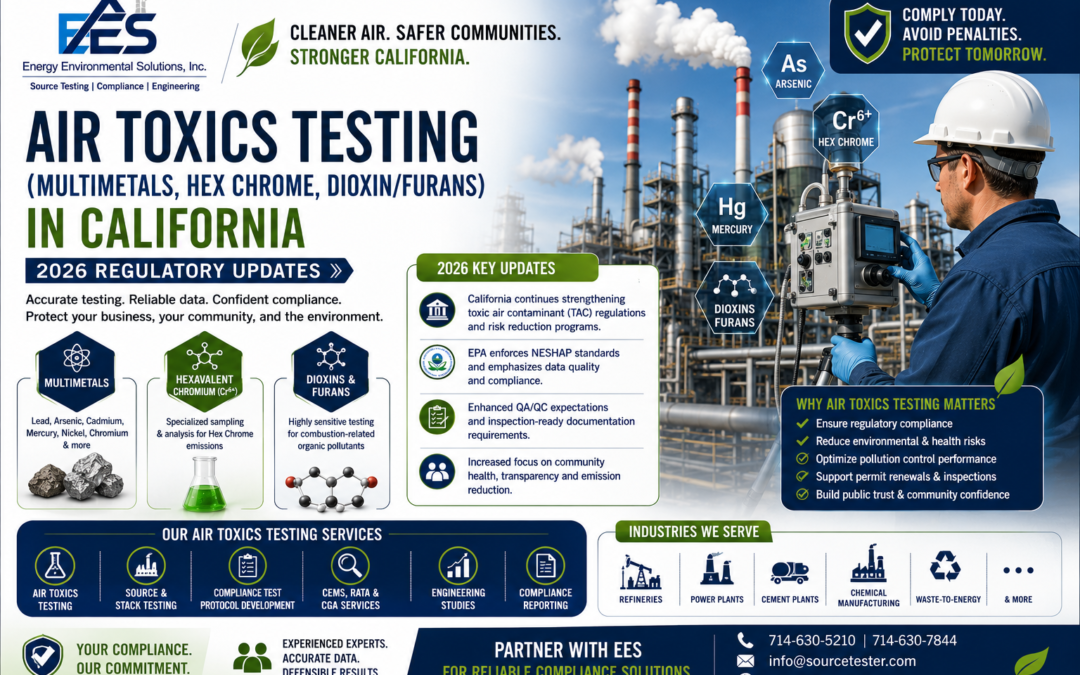
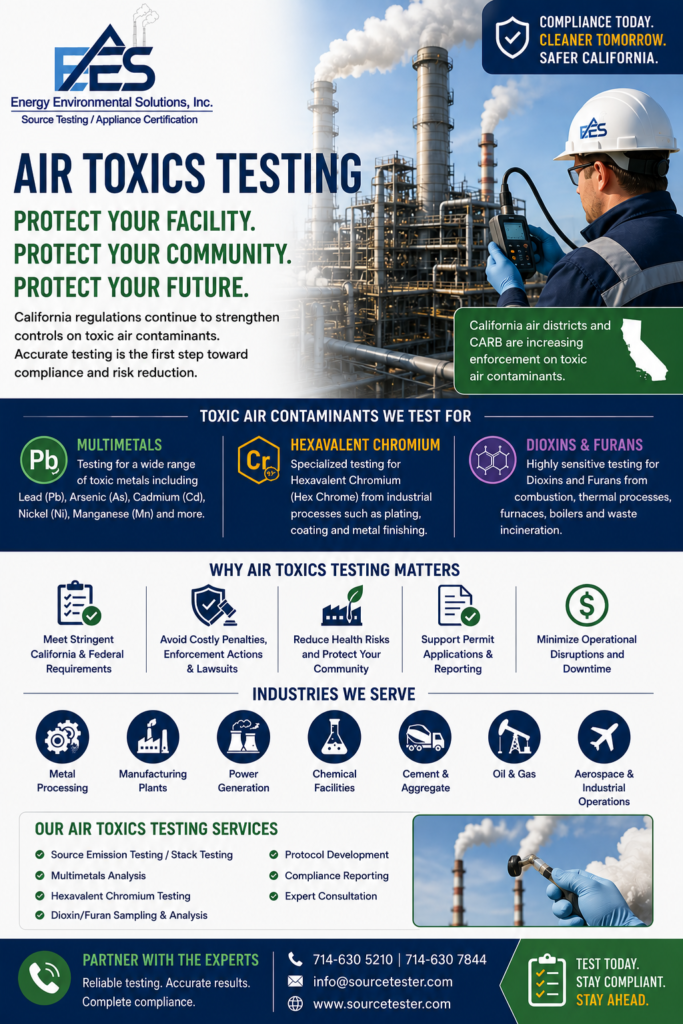
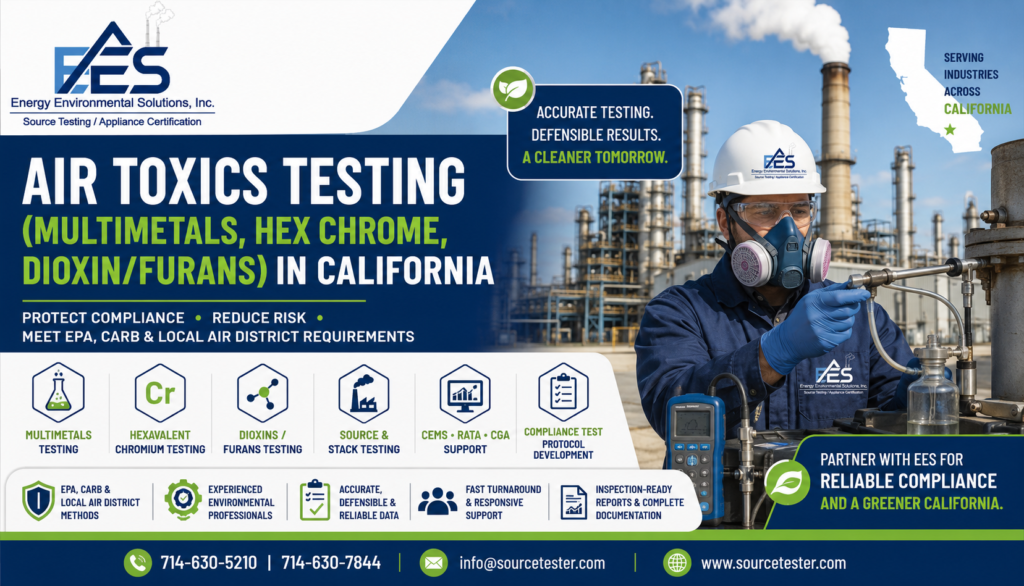
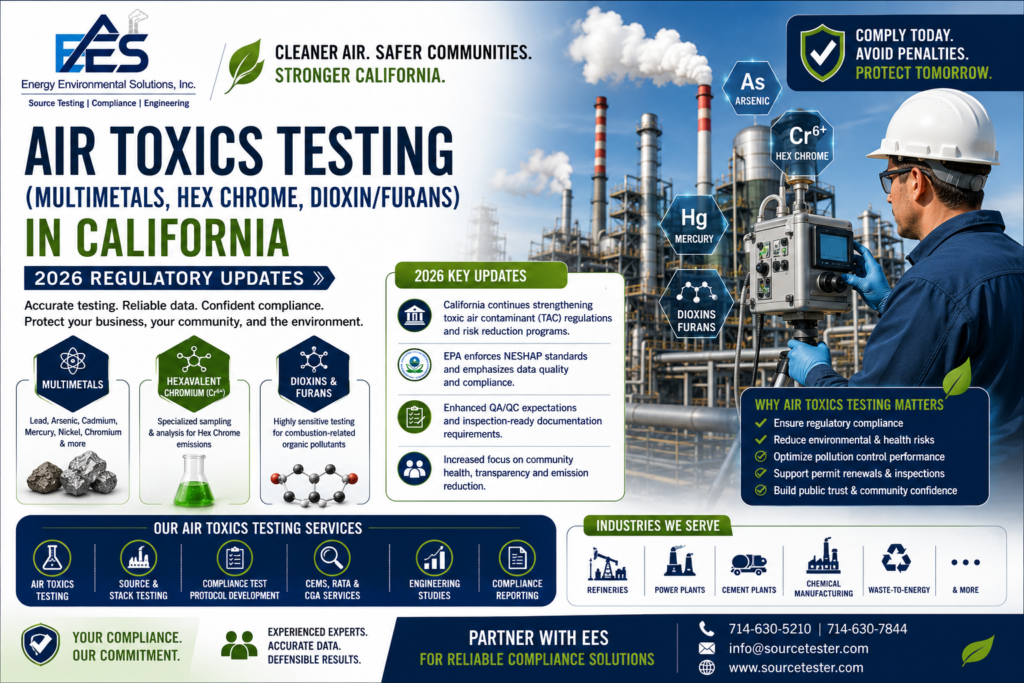
Air Toxics Testing in California: Multimetals, Hexavalent Chromium & Dioxin/Furans — 2026 Compliance Guide
California continues to maintain one of the most comprehensive air-toxics regulatory frameworks in the United States. For facilities that emit or may emit toxic air contaminants (TACs), accurate emissions measurement is increasingly important for permitting, compliance demonstrations, health-risk assessments and regulatory reporting.
For industrial facilities, Air Toxics Testing can involve specialized testing for multimetals, hexavalent chromium (Hex Chrome), dioxins/furans and other toxic pollutants. The exact testing obligation depends on the facility’s permit, applicable air-district rules, source type, pollutant and regulatory program. CARB specifically notes that California compliance-testing requirements vary by local agency and may use CARB, U.S. EPA or other published test methods.
With regulatory activity continuing through 2026, now is an important time for facilities to review their air-toxics testing programs.
Why Is Air Toxics Testing Important in California?
Toxic air contaminants are different from ordinary criteria pollutants because the regulatory focus is strongly connected to potential human-health impacts.
California’s AB 1807 program established a framework for identifying and controlling toxic air contaminants. CARB describes the program as a two-step process involving risk identification and risk management.
California’s identified toxic-air-contaminant list includes substances such as:
Hexavalent chromium
Arsenic compounds
Cadmium compounds
Lead compounds
Nickel compounds
Mercury compounds
Manganese compounds
Dioxins and furans
Benzene
Formaldehyde
Other toxic compounds
CARB’s current TAC information identifies hexavalent chromium and chlorinated dioxins/furans among substances for which no threshold level has been identified in its listing.
That is why reliable emissions data matters.
You cannot effectively manage what you have not accurately measured.
California Air Toxics Testing
What Is Air Toxics Testing?
Air Toxics Testing is the measurement and laboratory analysis of hazardous or toxic pollutants emitted from an industrial process, combustion source, control device or other emission point.
Depending on the facility, testing can include:
Multimetals Testing
Measurement of multiple metals potentially present in industrial emissions, such as:
Arsenic
Cadmium
Chromium
Lead
Nickel
Manganese
Mercury
Antimony
Beryllium
Cobalt
Selenium
Other regulated metals
Hexavalent Chromium Testing
Specialized measurement of Cr(VI) emissions from applicable chromium-related processes.
Dioxin/Furan Testing
Measurement of chlorinated dioxins and furans, which can be associated with certain combustion and industrial processes.
CARB identifies dioxins as toxic air contaminants and notes that they can originate from waste incineration, some chemical manufacturing and other industrial sources that burn fuel.
2026 California Air Toxics Regulatory Updates
1. South Coast AQMD Is Updating Toxic-Air-Contaminant Requirements
One of the most important 2026 developments is continued work on Proposed Amended Rule 1401 — New Source Review of Toxic Air Contaminants.
South Coast AQMD’s 2026 rulemaking materials show workshops and draft rule language during 2026, with proposed changes addressing new toxic air contaminants identified by California’s Office of Environmental Health Hazard Assessment and revisions to health values for existing compounds.
What does this mean for facilities?
A pollutant that previously received little attention could become more important when:
Toxicity information changes → health values change → risk calculations change → permitting/testing requirements may change.
Facilities should therefore avoid assuming that an old emissions profile automatically represents today’s regulatory requirements.
2. Rule 1469 and Hexavalent Chromium Requirements Have Become More Stringent
Hexavalent chromium remains one of California’s most closely scrutinized toxic air contaminants.
South Coast AQMD amended Rule 1469 — Hexavalent Chromium Emissions from Chromium Electroplating and Chromic Acid Anodizing Operations on December 5, 2025. The rule incorporates more stringent requirements associated with CARB’s Chromium ATCM, including lower emission limits and increased source-testing requirements for applicable operations.
South Coast AQMD’s regulatory advisory states that beginning January 1, 2026, functional chrome-plating facilities face more stringent requirements, including lower limits for applicable Tier III tanks and source testing every two years for Tier III tanks.
This makes Hex Chrome source testing particularly important for applicable chrome-plating and chromic-acid-anodizing facilities.
3. Source-Test Protocols Are Becoming More Important
For applicable Rule 1469 facilities, the source-testing process isn’t simply a matter of showing up with sampling equipment.
South Coast AQMD’s Rule 1469 materials specify situations where a source-test protocol must be submitted in advance. For certain Tier III tanks beginning January 1, 2026, the protocol must be submitted at least 60 days before the first applicable source test for approval.
Waiting until the last minute can create avoidable scheduling and compliance problems.
4. Air Toxics “Hot Spots” Activity Continues in 2026
California’s AB 2588 Air Toxics “Hot Spots” Program remains an important part of the regulatory landscape.
South Coast AQMD’s current 2026 AB 2588 activity includes approved health-risk assessments, facility public-notification activity and updated guidance documents. The District lists, for example, a January 2026 update to its emission-factor reference-source template and 2026 health-risk-assessment activity.
For facilities subject to AB 2588 requirements, emissions information can ultimately feed into health-risk assessments and risk-management decisions.
This is another reason why reliable source-test data is valuable.
Air Toxics Testing (Multimetals, Hex Chrome & Dioxin/Furans) in California | Energy Environmental Solutions, Inc.
Multimetals Testing: Why It Matters
Industrial processes can release several metals simultaneously.
A facility might not have a compliance concern involving only one metal. Depending on the source and applicable requirements, the emissions profile could contain multiple regulated metals.
Multimetals testing can therefore provide a more comprehensive picture of emissions.
Potential applications include:
Metal processing
Metal melting
Foundries
Plating
Aerospace manufacturing
Welding-related operations
Chemical manufacturing
Waste processing
Combustion processes
Manufacturing operations
Industrial furnaces
South Coast AQMD’s Regulation XIV contains multiple rules addressing toxic and non-criteria pollutants, including metal-related rules and Rule 1469 for hexavalent chromium.
Hexavalent Chromium Testing
Hexavalent chromium, commonly written as Cr(VI) or Hex Chrome, deserves special attention.
It can be associated with processes including:
Hard chrome plating
Decorative chrome plating
Chromic acid anodizing
Certain chromium-containing coating operations
Other applicable industrial processes
The regulatory environment around chrome operations has tightened.
South Coast AQMD’s 2025 Rule 1469 amendment incorporated the state’s more stringent chromium requirements, including phase-out provisions, lower emission limits and more frequent source testing for applicable operations.
If your facility handles chromium, don’t rely on an old testing schedule without checking the current rule.
Dioxin & Furan Testing
Dioxins and furans are another category where specialized testing is essential.
CARB explains that dioxins can be produced through certain combustion activities and chemical manufacturing processes and identifies dioxins as toxic air contaminants.
Potentially relevant sources can include:
Waste combustion
Incineration
Certain thermal processes
Chemical manufacturing
Industrial combustion
Certain metal-processing activities
Other processes identified by the applicable regulatory program
Dioxin/furan testing generally requires highly specialized sampling and laboratory analysis.
This is not a routine emissions test.
The sampling, sample handling, analytical procedures and quality-control requirements must be carefully planned.
What Can a Professional Air Toxics Test Evaluate?
Depending on the applicable regulation and test method, a testing program may evaluate:
Testing can help determine whether an air-pollution-control device is achieving its intended performance.
5. Improved Regulatory Preparedness
Facilities that maintain current emissions information are better positioned to respond to permit modifications and regulatory changes.
6. Greater Confidence for Management
Facility managers can make decisions using measured data instead of assumptions or outdated emission factors.
Challenges and Cons of Air Toxics Testing
Challenge
What It Can Mean for Facilities
Cost
Specialized testing and laboratory analysis can be expensive
Complexity
Toxic-air-contaminant methods can be technically demanding
Scheduling
Testing may need coordination with production
Downtime
Some tests require specific operating conditions
Protocol Requirements
Certain programs require advance protocol preparation/submission
Laboratory Requirements
Applicable rules may require qualified or approved laboratories
Corrective Action
Elevated results may require investigation or additional testing
South Coast AQMD operates a Laboratory Approval Program under which independent laboratories/source-testing firms are evaluated method-by-method for personnel, equipment, documentation, QA and related criteria.
Why Choosing the Right Testing Company Matters
Air toxics testing is not simply about collecting a sample.
The complete process can involve:
Regulatory Review
↓
Test Protocol Development
↓
Sampling Plan
↓
Field Testing
↓
Sample Handling
↓
Laboratory Analysis
↓
QA/QC Review
↓
Engineering Calculations
↓
Compliance Report
A mistake at any stage can affect the usefulness of the final results.
That’s why industrial facilities should work with an experienced environmental testing provider familiar with California air-district requirements and source-testing procedures.
How EES Helps Industries With Air Toxics Testing
Energy Environmental Solutions, Inc. (EES) can help industrial facilities manage specialized air-toxics testing programs.
1. Multimetals Testing
EES can support testing programs for applicable metal emissions, including multi-metal analysis.
2. Hex Chrome Testing
For applicable chromium-related operations, EES can support hexavalent chromium emissions testing and associated compliance programs.
3. Dioxin/Furan Testing
EES can support specialized testing programs involving dioxins and furans for applicable industrial sources.
4. Test Protocol Development
Before testing begins, EES can help develop a protocol addressing:
Applicable regulations
Sampling methods
Sampling locations
Operating conditions
Analytical methods
QA/QC
Reporting requirements
5. Source Testing
EES can coordinate and perform applicable source-testing services based on the requirements of the relevant air district and permit.
6. Laboratory Coordination
Specialized air-toxics testing requires appropriate analytical capabilities. EES can coordinate applicable laboratory analysis and documentation.
7. Compliance Reporting
The final objective isn’t just a laboratory result.
It is a defensible compliance record.
8. Regulatory Support
EES can help facilities understand how their testing program fits within applicable California air-quality requirements.
Industries That May Need Air Toxics Testing
Potential clients include:
Metal Plating Facilities
Chrome Plating Facilities
Aerospace Manufacturers
Metal Fabrication Facilities
Foundries
Chemical Manufacturers
Waste Processing Facilities
Industrial Combustion Facilities
Manufacturing Plants
Coating Operations
Refineries
Power Generation Facilities
Thermal Processing Facilities
Incineration Operations
Other Facilities Subject to TAC Requirements
CARB’s Air Toxics Tool notes that different industries can be associated with different toxic pollutants and that the listed substances are not necessarily a complete list for every industry.
2026 Air Toxics Compliance Checklist
Before your next test, ask:
☑ What toxic pollutants could my source emit?
☑ What does my current permit require?
☑ Does my air district require source testing?
☑ Is multimetals testing required?
☑ Is Hex Chrome testing applicable?
☑ Are dioxin/furan emissions relevant to my process?
☑ Is a source-test protocol required?
☑ Does the protocol require advance agency approval?
☑ Is a qualified/approved laboratory required?
☑ Is my previous test still representative?
☑ Has the equipment or production process changed?
☑ Have applicable rules changed for 2026?
Why You Should Not Wait Until the Testing Deadline
Imagine discovering two weeks before your regulatory deadline that:
Your sampling ports need modification.
Your old protocol is no longer appropriate.
The applicable test method has changed.
Your laboratory needs advance scheduling.
Your facility cannot achieve the required operating condition.
The air district requires advance protocol submission.
Now your testing deadline becomes a business problem.
Early planning turns regulatory pressure into a manageable project.
For specialized testing such as Hex Chrome or Dioxin/Furan, advance coordination is especially important.
Stack Testing
Why 2026 Is the Right Time to Review Your Air Toxics Program
California’s toxic-air-contaminant regulatory environment continues to evolve.
South Coast AQMD’s 2026 rulemaking schedule includes activity surrounding Rule 1401, toxic-air-contaminant health values and additional toxic-emission controls.
At the same time, Rule 1469 requirements for applicable chromium operations have become more stringent, with increased attention to source testing.
The practical takeaway for facility owners and EHS managers is simple:
Don’t manage today’s emissions with yesterday’s compliance assumptions.
Review your:
Permit + Rules + Equipment + Testing Schedule + Test Methods + Emissions Data
Turn Air Toxics Compliance Into a Competitive Advantage
Compliance is often treated as a cost.
But smart companies can look at it differently.
Reliable emissions testing can help you:
Identify problems early → improve process control → reduce compliance uncertainty → maintain better records → respond faster to regulatory changes
That’s a much stronger position than waiting for an inspection or regulatory deadline.
Air Quality Compliance Test Protocol Development in California: 2026 Guide, Latest Updates & How EES Helps Industries
California’s air-quality compliance environment is becoming increasingly technical. For facilities subject to source testing, developing the correct Air Quality Compliance Test Protocol before testing can be just as important as performing the test itself.
A source test is not simply “collect a sample and issue a report.” The protocol establishes what will be tested, how it will be tested, where samples will be collected, what operating conditions must be maintained, which test methods will be used, what quality-control procedures apply, and how compliance will be demonstrated.
California Air Resources Board (CARB) confirms that compliance-testing requirements vary by local agency and may use CARB, U.S. EPA or other published test methods. South Coast AQMD likewise maintains a dedicated collection of source-test methods and protocols for regulated facilities.
For industrial facilities planning a source test in 2026, the message is straightforward:
A poorly prepared protocol can create a poorly defensible compliance test.
Air Quality Compliance Testing Services California
What Is an Air Quality Compliance Test Protocol?
An Air Quality Compliance Test Protocol is a technical testing plan prepared before a regulatory source test.
It translates the applicable rule and permit requirements into a practical testing program.
Depending on the source, a protocol may define:
Source and emission point identification
Equipment and process description
Applicable regulatory requirements
Pollutants to be measured
Test methods
Sampling locations
Sampling ports
Traverse points
Sampling duration
Number of test runs
Operating conditions
Fuel or material usage
Production rate
Control-device operating parameters
Calibration requirements
QA/QC procedures
Laboratory analysis
Calculations
Data reporting
Compliance determination
South Coast AQMD explains that source testing measures actual emissions that may be used to determine compliance with emission limits or, for toxic emissions, to support health-risk assessments. The District also notes that third-party contractors prepare source-test protocols detailing the testing program.
Why Is Test Protocol Development Important in California?
Imagine spending thousands of dollars preparing for a source test, coordinating production, arranging access to the stack, shutting down equipment, collecting samples and waiting for laboratory results—only to discover that the testing conditions did not adequately demonstrate compliance.
If any of these three pieces is disconnected, the final result can become difficult to defend.
California’s regulatory framework recognizes the importance of approved testing procedures. CARB states that local compliance-testing requirements can involve published CARB methods, U.S. EPA methods or other published methods.
2026 California Regulatory Update: Source Testing Remains a Major Compliance Activity
Current 2026 South Coast AQMD materials show that source testing remains an active part of the District’s regulatory program.
The District’s Stationary Source Committee materials describe source testing as a measurement of actual emissions used for compliance determinations and health-risk assessments, with third-party contractors preparing source-test protocols.
South Coast AQMD also maintains an extensive Methods & Procedures program containing source-test methods and protocols, including protocols for combustion sources, VOC capture efficiency and RECLAIM-related boiler testing.
This matters because protocol development is not a generic paperwork exercise. The protocol needs to match the applicable regulatory method and the physical characteristics of the source.
Cement Plant Stack Testing
2026 Update: Toxic-Air-Contaminant Testing Is Increasingly Important
California’s air-quality programs continue to place significant attention on toxic air contaminants.
CARB’s current research priorities include identifying emerging air toxics of concern and developing monitoring protocols for pollutants that may become priorities for future air-toxics monitoring.
At the local level, South Coast AQMD’s ongoing rule-development and enforcement activities also demonstrate the importance of toxic-emission measurements.
For example, South Coast AQMD’s 2026 materials concerning chromium-related sources include source-testing requirements and tighter emission demonstrations for applicable operations.
For facilities handling metals, chromium compounds or other toxic substances, protocol development therefore needs to consider not only what pollutant is being measured, but also the analytical sensitivity, sampling approach and regulatory reporting requirements.
2026 Update: Rule 1469 Shows Why Protocols Matter
One of the clearest examples is South Coast AQMD Rule 1469, addressing hexavalent chromium emissions from chromium electroplating and chromic-acid anodizing operations.
Proposed amendments have included more stringent requirements and increased source-testing frequency for certain operations.
The proposed Rule 1469 language also specifies detailed information that may need to be included in a source-test protocol, including:
Source-test criteria
Assumptions
Required data
Target concentrations
Preliminary analytical information
Sampling parameters
This is a useful example for every facility:
The protocol can be a technical compliance document—not merely a scheduling form.
What Should an Air Quality Test Protocol Include?
The exact contents depend on the rule and source, but a professional protocol commonly addresses the following.
1. Facility and Source Identification
The protocol should clearly identify:
Facility name
Facility location
Permit number
Equipment ID
Emission point
Process
Control device
Test date
This prevents confusion when a facility has multiple similar emission points.
2. Description of the Process
The testing agency needs to understand what is actually happening during the test.
For example, a protocol for a thermal oxidizer might describe:
Production process → VOC-containing exhaust → capture system → oxidizer → stack
The final calculation should correspond to the applicable regulatory standard.
Why Protocol Approval Can Matter
Some California regulations require the source-test protocol to be submitted to the applicable air district before testing.
For example, CARB’s regulatory materials include requirements under certain programs for submitting a pre-test protocol to the air district before conducting a source test.
South Coast AQMD’s regulatory materials likewise contain rules requiring source-test protocols and, in some circumstances, approval before the test is performed.
Therefore:
Never assume that the testing contractor can simply arrive and begin sampling.
The applicable rule and permit should be reviewed first.
California Source Test Protocol Services
Common Problems With Poor Test Protocols
Problem 1: Wrong Test Method
A facility may identify the pollutant correctly but select an inappropriate or outdated method.
Result:
The test may not provide the intended compliance demonstration.
Problem 2: Incorrect Operating Condition
A test performed at the wrong production rate may fail to demonstrate compliance under the required conditions.
Problem 3: Missing Sampling Information
If stack dimensions, port configuration or traverse information are incomplete, the testing team may face problems on test day.
Problem 4: Permit and Rule Do Not Match
Sometimes facility personnel rely on an old permit or historical test report without checking current requirements.
Problem 5: Equipment Has Changed
A burner replacement, process modification, pollution-control upgrade or production change can make an older protocol unsuitable.
Problem 6: Insufficient QA/QC Documentation
Even good measurements can become difficult to defend if required QA/QC information is missing.
Air Quality Compliance Test Protocol Development: Pros & Cons
Pros
Cons / Challenges
Creates a clear testing roadmap
Requires engineering expertise
Reduces testing-day surprises
Requires advance planning
Connects testing to permit requirements
Rule requirements can be complex
Helps select appropriate methods
Some protocols need agency approval
Improves data defensibility
Additional preparation cost
Identifies operating conditions in advance
Facility operations may need coordination
Supports accurate compliance reporting
Changes may require protocol revision
Helps prevent invalid testing
Testing deadlines can be tight
When Should a Facility Develop a Test Protocol?
Don’t wait until the day before the test.
A facility should consider starting protocol development when:
A source-test deadline is approaching
A new permit is issued
A permit is modified
Equipment is installed
A burner is replaced
A control device is modified
Production changes
Fuel changes
A new pollutant becomes regulated
A regulatory amendment changes testing requirements
A previous source test failed
An agency requests additional testing
A health-risk assessment requires updated emissions information
Which California Industries Need Test Protocol Development?
Potentially affected facilities include:
Manufacturing plants
Chemical facilities
Petroleum facilities
Refineries
Metal-processing plants
Aerospace facilities
Automotive facilities
Food-processing plants
Pharmaceutical manufacturing
Power-generation facilities
Waste-management facilities
Landfills
Coating operations
Printing facilities
Boiler operations
Industrial furnaces
Thermal oxidizer operations
RTO facilities
Chrome-plating facilities
The actual testing requirement depends on the applicable air district, permit and source.
How EES Helps With Air Quality Compliance Test Protocol Development
Energy Environmental Solutions, Inc. (EES) can help facilities turn complicated regulatory requirements into a structured testing plan.
1. Regulatory Review
EES can review applicable rules and permit conditions to identify the testing requirements.
EES can coordinate testing requirements with facility personnel to minimize operational disruption.
4. Sampling Location Evaluation
The team can review stack and duct configurations to identify appropriate sampling locations.
5. Operating-Condition Planning
EES can help establish the production/load/fuel conditions required during the test.
6. Method Selection
The testing program can be designed around the applicable CARB, EPA, South Coast AQMD or other approved method.
7. Compliance Testing
After protocol development, EES can support the actual source-testing program.
8. Engineering Calculations
Raw analytical data can be converted into the appropriate emissions units and compliance metrics.
9. Test Report Preparation
EES can prepare technical documentation describing the testing methodology, results, calculations and compliance determination.
10. Corrective-Action Support
If results indicate an emissions problem, EES can help identify potential technical causes and evaluate the need for additional testing or engineering work.
Why Choose a Professional Test Protocol Developer?
The cheapest protocol is not necessarily the least expensive option.
Suppose a facility spends $5,000–$20,000 or more coordinating a complex source test, but the protocol fails to address an important regulatory requirement.
The company may then face:
Retesting + additional laboratory costs + production disruption + engineering time + regulatory delays
A properly developed protocol can reduce that risk by identifying potential problems before the sampling team arrives.
Think of it like an aircraft flight plan.
The test itself is the flight.
The protocol is the flight plan.
You don’t want to discover the route, fuel requirements and destination after takeoff.
Identify pollutants, emission points and applicable methods.
↓
STEP 3 — DEVELOP
Prepare the detailed source-test protocol.
↓
STEP 4 — COORDINATE
Coordinate facility operations, access, production and agency requirements.
↓
STEP 5 — TEST
Conduct the source test according to the approved requirements.
↓
STEP 6 — ANALYZE
Perform laboratory analysis and QA/QC evaluation.
↓
STEP 7 — CALCULATE
Convert measurements into the required emissions units.
↓
STEP 8 — REPORT
Prepare and submit the source-test report as required.
Cement Plant Stack Testing
2026 Compliance Strategy: Test Smarter, Not Just Faster
The regulatory environment is becoming more sophisticated.
South Coast AQMD’s current Methods & Procedures resources include dedicated protocols for different applications, while CARB continues to maintain approved compliance-testing methods and contractor requirements.
At the same time, active regulatory changes—including toxic-air-contaminant programs and source-specific requirements—can affect testing obligations. South Coast AQMD’s 2026 materials show continuing activity around source testing, toxic emissions and compliance evaluation.
For facility managers, this means one thing:
Your old source-test protocol should not automatically be reused for the next test.
Before every significant test, ask:
Has the rule changed?
Has the permit changed?
Has the equipment changed?
Has the process changed?
Has the test method changed?
Has the required operating condition changed?
If the answer to any of these is yes, the protocol should be reviewed.
Air Quality Compliance Test Protocol Checklist
Before submitting or conducting your next source test, verify:
Current facility permit reviewed
Current applicable rule reviewed
Emission points identified
Pollutants identified
Correct test methods selected
Sampling locations confirmed
Stack/duct dimensions verified
Operating conditions established
Production rate documented
Control-device parameters identified
QA/QC requirements established
Laboratory requirements confirmed
Agency notification requirements checked
Protocol approval requirements checked
Test schedule coordinated
Reporting requirements confirmed
The Bottom Line
Air Quality Compliance Test Protocol Development is the foundation of a defensible source-testing program.
California’s regulatory framework gives air districts significant responsibility for implementing and enforcing air-quality requirements, while CARB confirms that compliance-testing requirements vary by local agency and may rely on CARB, EPA or other approved methods.
In 2026, with continuing rule development, source-testing activity and increasing attention to toxic and criteria pollutants, facilities should treat protocol development as a technical compliance function—not administrative paperwork.
The goal isn’t simply to complete a test.
The goal is to produce reliable data that can demonstrate compliance.
Need Air Quality Compliance Test Protocol Development in California?
Energy Environmental Solutions, Inc. (EES) provides professional support for:
Air Quality Compliance Testing in California: 2026 Latest News, Updates, Pros, Cons & How EES Helps Industries
California continues to maintain some of the most demanding air-quality requirements in the United States. For industrial and commercial facilities, Air Quality Compliance Testing is increasingly important because regulators are relying on measured emissions data to verify that permitted equipment and processes are operating within applicable limits.
One important clarification: there is no single California-wide “Air Quality Compliance Testing” rule that requires every facility to conduct the same test. Testing obligations generally come from a facility’s applicable air district rules, permits, state requirements, federal requirements, source-specific regulations and compliance schedules. South Coast AQMD, San Joaquin Valley APCD, Bay Area AQMD and other California air districts administer many of these requirements locally.
The regulatory environment is particularly active in 2026, with new and amended rules, source-testing requirements, toxic-air-contaminant controls, particulate-matter requirements and increased regulatory attention to emissions monitoring.
2026 Latest California Air Quality Compliance Testing Updates
1. South Coast AQMD continues expanding source-testing activity
South Coast AQMD’s 2026 planning documents specifically identify continued source testing, source-test protocol and report evaluations, CEMS certifications, laboratory approval reviews and source-test observations as ongoing regulatory activities. The District also anticipates increased source-test evaluation volume associated with the transition away from RECLAIM and permit-streamlining efforts.
This is an important signal for industrial facilities: source testing is not becoming less important—it is becoming a more integrated part of regulatory compliance.
2. New and amended air-quality rules are creating additional testing needs
South Coast AQMD’s 2026 rulemaking activity includes amendments involving toxic air contaminants, particulate matter, visible emissions, coatings, aerospace operations and combustion equipment. For example, Proposed Amended Rule 1401 addresses New Source Review of Toxic Air Contaminants, including updates to toxic compounds and health values.
On June 5, 2026, South Coast AQMD also adopted amendments involving Rule 401 Visible Emissions, Rule 404 Particulate Matter—Concentration, and Rule 405 Solid Particulate Matter—Weight, alongside other rule changes.
For facilities, every rule amendment can potentially change what must be measured, how emissions are demonstrated and what documentation must be maintained.
3. Source-test protocols remain critical
South Coast AQMD maintains specific technical procedures for source testing and laboratory analysis. Its Methods & Procedures program provides procedures for ambient-air laboratory methods and source-testing methods to help regulated facilities comply with applicable regulations and policies.
This means a facility cannot simply hire any contractor to perform an informal emissions measurement and assume that it satisfies a regulatory testing requirement.
The test method, sampling location, operating condition, equipment configuration, QA/QC, calculations and reporting format can all matter.
4. 2026 compliance deadlines are increasing testing pressure
South Coast AQMD’s 2026 compliance-deadline guidance includes multiple rules with testing, certification or implementation requirements. One example is the Chrome ATCM/Rule 1469 program, where certain facilities had to complete source testing to demonstrate compliance with January 1, 2026 requirements, with subsequent testing required every two calendar years.
Why Is Air Quality Compliance Testing Important in California?
Air-quality regulations are ultimately about controlling actual emissions—not simply assuming that equipment is operating correctly.
A boiler might appear to be operating normally while producing excessive NOx. A thermal oxidizer may be running at the correct temperature while failing to achieve its required VOC destruction efficiency. A baghouse can appear operational while allowing excessive particulate matter emissions. A process may have changed since its last source test, making an old compliance result less representative of current conditions.
That is why compliance testing provides something regulators and facility owners both need:
Measured evidence.
Testing can establish actual emissions of pollutants such as:
NOx
CO
SOx
VOC
PM10
PM2.5
Total Particulate Matter
Toxic air contaminants
Metals
Hexavalent chromium
Dioxins/furans
Ammonia
Hydrogen chloride
Other regulated pollutants
The exact pollutants depend on the source, permit and applicable regulation.
Is Air Quality Compliance Testing Compulsory?
The answer depends on the facility.
This distinction is extremely important for SEO content as well as regulatory accuracy.
California does not impose one universal testing schedule on every industrial facility.
Instead, testing may become mandatory because of:
Air district rule + facility permit + equipment type + emissions limit + operating conditions + applicable federal/state regulation
For example, a facility may have a permit condition requiring annual testing, while another source may require testing every three years, every two years or only after a modification.
Some facilities may also have:
Continuous Emissions Monitoring Systems (CEMS)
Periodic monitoring
Portable analyzer requirements
Performance testing
Source testing
Compliance demonstrations
Laboratory analysis
RATA
CGA
Visible-emissions evaluations
Therefore, the first question should always be:
“What does my facility’s permit and applicable air-district rule require?”
Cement Plant Stack Testing
Major Areas Covered by Air Quality Compliance Testing
NOx Testing
NOx testing is especially important for combustion equipment such as:
Boilers
Process heaters
Furnaces
Ovens
Engines
Turbines
Thermal oxidizers
NOx remains a major regulatory focus in Southern California because of its contribution to ozone formation.
VOC Testing
VOC testing is commonly associated with:
Coating operations
Printing
Solvent processes
Chemical manufacturing
Storage and loading operations
Thermal oxidizers
RTOs
Process exhaust systems
VOC destruction-efficiency testing can be particularly important when a facility relies on an air-pollution-control device to meet an emission limit.
Particulate Matter Testing
PM testing can involve:
Total PM
PM10
PM2.5
Filterable PM
Condensable PM
California’s 2026 regulatory activity includes continued attention to particulate matter. South Coast AQMD adopted amendments involving Rules 404 and 405 on June 5, 2026.
Air Toxics Testing
Facilities handling toxic substances may need testing for pollutants such as:
Metals
Hexavalent chromium
Dioxins/furans
Specific toxic organic compounds
Acid gases
South Coast AQMD’s 2026 Rule 1401 activity demonstrates continued regulatory attention to toxic air contaminants and health-based thresholds.
Visible Emissions Evaluation
Visible emissions can provide an important indication of particulate or combustion-related problems.
South Coast AQMD adopted amendments involving Rule 401 Visible Emissions in June 2026, demonstrating that visible-emission requirements remain an active part of the regulatory framework.
The 2026 Regulatory Environment: Pros & Cons
Pros of Stronger Compliance Testing
Better Air Quality
More accurate emissions measurement can help regulators identify sources that are exceeding applicable limits.
Greater Accountability
Testing creates documented evidence rather than relying entirely on assumptions or estimates.
Early Problem Detection
Testing can reveal equipment problems before they become major compliance issues.
Better Process Optimization
Emissions testing can help operators understand how burner settings, operating conditions and control equipment affect emissions.
Stronger Regulatory Defensibility
A properly conducted source test can provide valuable documentation during inspections, audits or permit reviews.
Improved Community Confidence
Reliable emissions data can help demonstrate that facilities are actively managing environmental performance.
Cons and Challenges
Testing Costs
Professional source testing can require specialized personnel, equipment, laboratories and engineering resources.
Production Downtime
Some tests must be performed at specific operating loads or conditions, which may require coordination with production.
Complex Test Protocols
Different pollutants and equipment types require different methods.
Potential Equipment Modifications
If testing identifies noncompliance, a facility may need burner adjustments, pollution-control upgrades or process modifications.
Documentation Burden
Facilities must maintain accurate:
Test reports
Operating data
Calibration records
Maintenance records
Permit information
Corrective-action documentation
Regulatory Changes
A facility that complied with an older requirement may need to adjust its testing program after a rule or permit amendment.
A failed source test should not simply be ignored.
Depending on the applicable rule and permit, the facility may need to:
Investigate the cause.
Notify the appropriate agency when required.
Correct the equipment or process.
Perform additional testing.
Submit revised documentation.
Demonstrate compliance within the required timeframe.
South Coast AQMD records from 2026 illustrate that source-test deadlines can become significant compliance matters. For example, a refinery case involved a required annual source test and the need for a variance because operating conditions prevented testing by the regulatory deadline.
The lesson?
Don’t wait until the testing deadline to discover that your equipment cannot reach the required operating condition.
Why Source-Test Protocol Development Matters
One of the most overlooked areas of emissions compliance is test protocol development.
A successful source test starts well before the testing team arrives at the facility.
If the protocol does not accurately reflect the applicable regulation or equipment configuration, the resulting test can create avoidable problems.
South Coast AQMD specifically maintains source-testing procedures and guidance for regulated facilities.
Why 2026 Is a Good Year to Review Your Compliance Program
The regulatory environment is changing quickly.
Facilities should review their testing programs whenever there is:
A new permit
Permit modification
Equipment replacement
Burner replacement
Process modification
Fuel change
Production increase
Pollution-control-device modification
Rule amendment
New pollutant requirement
Testing deadline
The South Coast AQMD 2026 rulemaking agenda demonstrates how active this process is, including changes affecting toxic air contaminants, aerospace operations, wood-product coatings and other stationary-source categories.
How EES Helps Industries With Air Quality Compliance Testing
Energy Environmental Solutions, Inc. (EES) can help industrial facilities manage the technical side of emissions compliance.
EES can provide emissions testing for applicable industrial and commercial sources.
2. Compliance Test Protocol Development
EES can help develop test protocols based on the applicable:
Rule
Permit
Test method
Equipment
Operating condition
Pollutant
3. NOx Testing
Support for boilers, heaters, furnaces, engines and other combustion sources.
4. VOC Testing
Testing support for VOC-emitting processes and control devices.
5. PM10 / PM2.5 / Total PM Testing
Testing support for particulate-emitting industrial processes.
6. Air Toxics Testing
Support for applicable multimetal, hexavalent chromium, dioxin/furan and other toxic-air-contaminant testing programs.
7. CEMS Support
EES can support facilities with applicable continuous emissions monitoring requirements.
8. RATA & CGA
For applicable CEMS programs, EES can assist with:
RATA — Relative Accuracy Test Audit
CGA — Cylinder Gas Audit
9. Destruction Efficiency Testing
For thermal oxidizers, RTOs and other control devices, EES can support testing to determine whether the system is achieving the required destruction/removal efficiency.
10. Regulatory Documentation
A technically correct test is only part of compliance. EES can assist with the documentation and reporting associated with testing.
Industrial Air Quality Testing
Industries That Can Benefit From Compliance Testing
Air-quality compliance testing can be relevant to:
Manufacturing plants
Chemical facilities
Food-processing plants
Pharmaceutical facilities
Aerospace facilities
Automotive operations
Metal-processing facilities
Petroleum/refining operations
Power and energy facilities
Waste-management facilities
Landfills
Printing operations
Coating operations
Textile facilities
Plastics manufacturing
Commercial facilities
Hospitals and institutions
The actual testing requirement depends on the applicable air district, permit and equipment.
2026 Air Quality Compliance Checklist
Before your next regulatory deadline, ask:
☑ What air district regulates my facility?
☑ What rules apply to my equipment?
☑ What pollutants must be tested?
☑ When was the last source test?
☑ When is the next test due?
☑ Is my source-test protocol current?
☑ Has my equipment or process changed?
☑ Does my permit require additional testing?
☑ Is CEMS/RATA/CGA applicable?
☑ Are my testing records complete?
☑ Are upcoming 2026–2027 rule changes likely to affect my facility?
If you cannot answer these questions confidently, a compliance review should be considered before the next testing deadline.
Why Businesses Should Act Before the Deadline
Waiting until the last minute can create unnecessary risk.
Some facilities also need advance notification to the air district.
For example, South Coast AQMD’s Chrome ATCM/Rule 1469 advisory recommends submitting source-test protocols sufficiently in advance and states that certain facilities must provide advance notification before testing.
Smart compliance strategy:
Plan early. Test correctly. Document everything.
The Bottom Line
California’s air-quality compliance environment in 2026 is becoming increasingly data-driven and source-specific.
Regulators are continuing to develop and amend rules affecting NOx, VOCs, particulate matter, toxic air contaminants, visible emissions and other pollutants, while maintaining source-test protocols, CEMS evaluations and compliance monitoring programs.
The biggest mistake an industrial facility can make is assuming that “no visible problem” means “no compliance problem.”
Emissions need to be measured against the applicable regulatory requirements.
Your emissions data is your compliance evidence.
If your facility has an upcoming testing deadline, a new permit, modified equipment or concerns about emissions performance, now is the time to review the testing program.
Need Air Quality Compliance Testing in California?
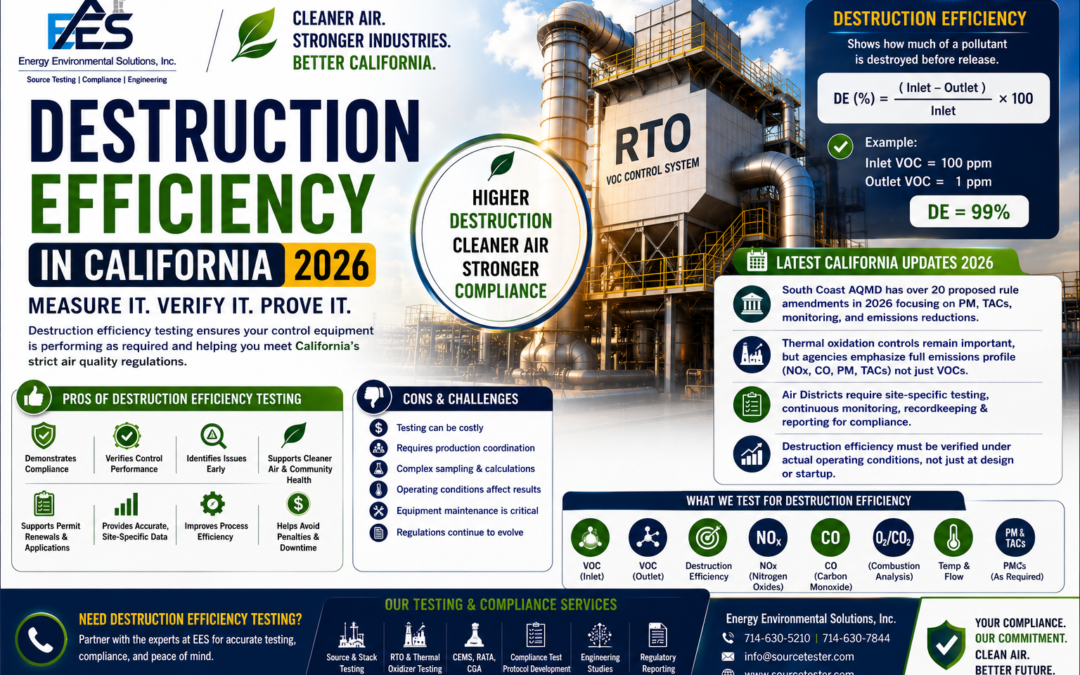
Destruction Efficiency in California 2026: Latest Updates, Pros, Cons & How EES Helps Industries Stay Compliant
Destruction efficiency is becoming an increasingly important performance metric for California facilities that use thermal oxidizers, regenerative thermal oxidizers (RTOs), flares, vapor-control systems, and other air-pollution control equipment to reduce VOC and other organic emissions.
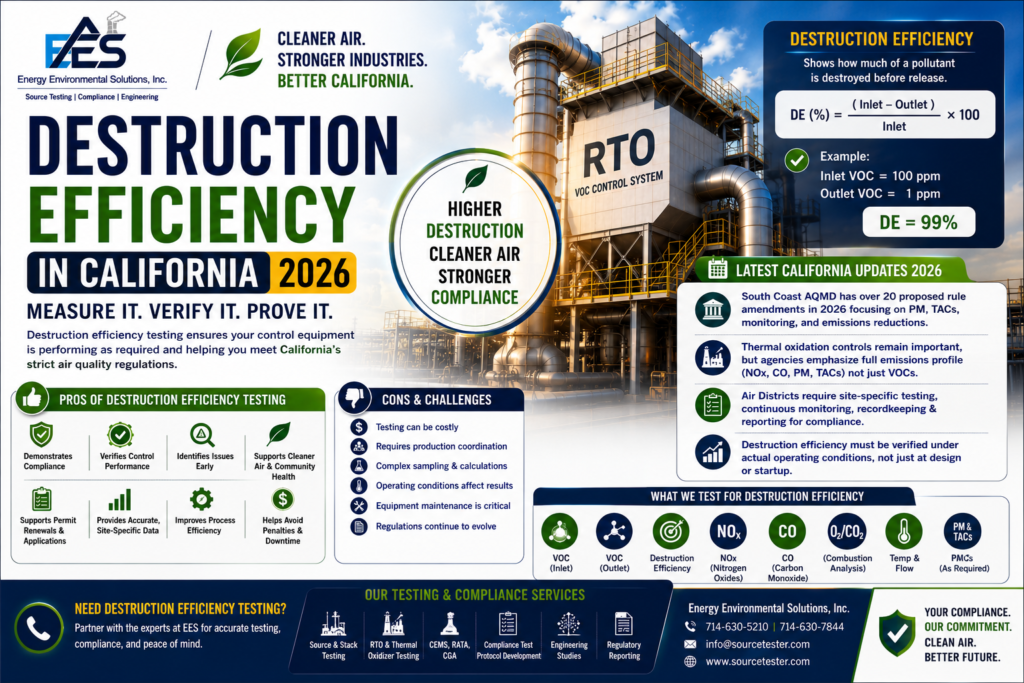
In simple terms, destruction efficiency measures how much of a pollutant entering a control device is actually destroyed before the treated gas is released. A commonly used calculation is:
But achieving a high percentage during one test is not necessarily the same as maintaining compliant performance during everyday operation.
California’s 2026 regulatory environment continues to emphasize emission reductions, monitoring, source testing, toxic-air-contaminant controls, and reliable emissions data. South Coast AQMD’s 2026 rule calendar contains more than two dozen planned rule amendments and adoptions addressing particulate matter, toxic air contaminants, monitoring, New Source Review, and other air-quality objectives.
For facilities using thermal oxidation or other control technologies, that creates a growing need for accurate destruction-efficiency testing and defensible compliance documentation.
Energy Environmental Solutions, Inc. (EES) helps industries with Destruction Efficiency Testing, VOC Testing, RTO Testing, Thermal Oxidizer Testing, Source & Stack Testing, CEMS, RATA, CGA, Compliance Test Protocol Development, Engineering Studies, QA/QC, and Regulatory Reporting.
What Is Destruction Efficiency?
Destruction efficiency, often called Destruction Removal Efficiency (DRE), describes the percentage of a pollutant that a control device removes through destruction.
For example, if a control device receives 100 pounds of VOCs and only 1 pound remains in the outlet gas, the calculated destruction efficiency would be approximately 99%.
This measurement is particularly important for equipment such as:
Regenerative Thermal Oxidizers (RTOs)
Thermal oxidizers
Catalytic oxidizers
Afterburners
Flares
VOC control systems
Certain combustion-based control devices
However, destruction efficiency is not the same as capture efficiency.
A facility can have an excellent control device but still release pollutants if the process exhaust is not effectively captured and routed to the control equipment.
That is why compliance evaluations may need to consider capture efficiency + control/destruction efficiency + operating conditions + actual emissions.
Is Destruction Efficiency Testing Compulsory in California?
There is an important distinction.
California does not have one universal destruction-efficiency testing requirement that applies identically to every industrial facility.
Whether a facility must demonstrate destruction efficiency depends on factors including:
Facility location
Local Air District
Air permit
Applicable regulation
Source category
Pollutant
Control technology
Required control efficiency
Federal requirements
State requirements
Permit-specific testing conditions
A current South Coast AQMD emissions-reporting guideline specifically instructs facilities using thermal oxidation to use site-specific destruction-efficiency test results, the applicable permit, or the applicable rule limit when determining vapor-destruction efficiency.
This is an important compliance message:
Don’t assume your facility’s required destruction efficiency—verify it from the applicable permit and regulation.
Latest California Updates in 2026
1. California Continues Strengthening Air-Quality Controls
South Coast AQMD’s 2026 rulemaking program includes more than two dozen planned rule amendments and adoptions.
The agency’s priorities include:
PM reduction
Toxic-air-contaminant controls
Updated toxic-air-contaminant lists
New Source Review
Monitoring requirements
Community emission-reduction objectives
The agency says these activities support the 2016 and 2022 Air Quality Management Plans, 2024 PM Plan, federal and state air-quality standards, and AB 617 Community Emission Reduction Plans.
For facilities using VOC destruction systems, this reinforces the importance of having reliable performance data.
2. Thermal Oxidation Remains an Important Control Technology
South Coast AQMD continues to evaluate thermal oxidation as an emissions-control option.
A March 2026 South Coast AQMD staff report evaluating aerospace coating controls recognized that thermal oxidizers can technically achieve high destruction efficiencies for certain VOC and toxic compounds. However, the agency also identified limitations for some chlorinated and fluorinated compounds because thermal oxidation can produce HCl and HF, requiring additional controls such as scrubbers.
The lesson for industry is important:
A high destruction-efficiency percentage does not automatically mean a control technology is appropriate for every pollutant.
The entire emissions profile must be evaluated.
3. Regulators Are Looking Beyond a Single Performance Number
South Coast AQMD’s 2026 activities demonstrate a broader focus on monitoring, toxic air contaminants, particulate matter, and emissions data rather than relying on a single compliance measurement.
A control device may destroy VOCs while simultaneously generating other combustion-related pollutants.
South Coast AQMD’s emissions-reporting guidance specifically states that thermal oxidation can generate NOx, SOx, CO, PM, and toxic air contaminants, and encourages operators to use site-specific test results for emissions calculations when available.
Therefore, a strong testing program should evaluate the complete picture.
4. Real-World 2026 Cases Show Why Performance Verification Matters
In June 2026, South Coast AQMD hearing-board documents involving Chiquita Canyon included conditions requiring equipment modifications designed to maintain sufficient flare operation and methane content for destruction efficiency consistent with regulatory requirements.
Earlier 2026 correspondence from South Coast AQMD also discussed the relationship between operating conditions, temperature, equipment design, source-test results, and destruction efficiency at the facility.
Although this example involves landfill-gas combustion rather than a conventional industrial RTO, it illustrates a broader principle:
Regulators can require evidence that operating conditions actually support the required destruction performance.
Why Is Destruction Efficiency Testing Important?
A control device manufacturer’s guarantee may say 98%, 99%, or higher.
But what happens after the equipment has been installed?
What happens when:
VOC loading changes?
Production increases?
Temperature fluctuates?
Ceramic media becomes fouled?
Valves begin leaking?
Airflow changes?
Process chemistry changes?
The burner operates differently?
The capture system develops leaks?
That’s where compliance testing becomes valuable.
Testing converts assumptions into measurable evidence.
Key Factors Affecting Destruction Efficiency
Temperature
Thermal oxidation generally requires sufficient temperature for effective oxidation.
If the temperature falls outside the required operating range, destruction performance may decline.
Residence Time
The contaminated gas needs sufficient time in the appropriate combustion environment.
Insufficient residence time can reduce destruction performance.
Turbulence & Mixing
Effective mixing is essential to expose the pollutant-containing gas to the required oxidation conditions.
VOC Concentration
A control system can perform differently depending on the concentration and composition of the incoming VOC stream.
Equipment Condition
Valves, burners, seals, ceramic media, sensors, ductwork, fans, and controls can all affect system performance.
Capture Efficiency
Even a highly efficient RTO cannot destroy pollutants that never reach it.
This makes capture and destruction efficiency two different but interconnected compliance considerations.
Pros of Destruction Efficiency Testing
1. Demonstrates Control Performance
Testing provides measurable evidence of how effectively the control device is destroying pollutants.
2. Supports Regulatory Compliance
Where required by a permit or regulation, test results can support compliance demonstrations.
3. Identifies Problems Early
Testing may reveal declining control efficiency before the problem becomes a larger compliance issue.
4. Supports Permit Applications
Reliable test data can be useful for permit modifications, renewals, and engineering evaluations.
5. Provides Site-Specific Data
South Coast AQMD specifically encourages the use of site-specific destruction-efficiency test results where available for emissions calculations.
6. Improves Operational Understanding
Testing can help facility engineers understand how production conditions affect control-device performance.
Cons & Challenges of Destruction Efficiency Testing
Professional testing also has challenges.
Testing Costs
Specialized source-testing equipment, qualified personnel, laboratory analysis, and reporting can increase project costs.
Production Coordination
Testing may need to occur under representative operating conditions, requiring coordination with production.
Complex Sampling
Some control-efficiency tests require simultaneous measurements at the inlet and outlet.
Variable VOC Streams
Changing process chemistry can make it difficult to establish representative testing conditions.
Secondary Pollutants
Thermal oxidation can create additional pollutants such as NOx, CO, SOx, PM, and certain toxic or acidic compounds, depending on the material being treated.
Documentation Requirements
A technically correct test can still create compliance problems if the supporting protocol, calibration, operating-condition records, calculations, or report are incomplete.
Destruction Efficiency vs. Removal Efficiency vs. Capture Efficiency
These terms are often confused.
Term
What It Measures
Destruction Efficiency
Percentage of pollutant destroyed by the control device
Removal Efficiency
Percentage of pollutant removed from the treated stream; the exact meaning depends on the control process
Capture Efficiency
Percentage of process emissions successfully captured and routed to the control device
Overall Control Efficiency
Combined effect of capture and control/destruction
A facility should understand exactly which metric its permit or regulation requires.
How Destruction Efficiency Testing Is Typically Performed
A professional testing program can include:
1. Permit Review
Identify the required control efficiency, pollutants, test frequency, and applicable methods.
2. Test Protocol Development
Define sampling locations, methods, operating conditions, number of runs, QA/QC, and calculations.
3. Pre-Test Coordination
Coordinate production and control-device operation to establish representative conditions.
4. Equipment Calibration
Prepare and calibrate sampling and analytical equipment.
5. Inlet Testing
Measure the pollutant concentration entering the control device.
6. Outlet Testing
Measure the pollutant concentration leaving the control device.
7. Operating Data Collection
Document temperature, flow, fuel use, production rate, oxygen, pressure, and other applicable parameters.
8. Calculations
Calculate destruction/control efficiency and mass emissions using the applicable methodology.
9. QA/QC Review
Verify data quality, calibration information, field records, and laboratory results.
10. Final Reporting
Prepare a technically defensible report for the facility and regulatory agency when required.
How EES Helps Industries
Energy Environmental Solutions, Inc. (EES) provides comprehensive emissions-testing and environmental compliance services for California industries.
Destruction Efficiency Testing
EES helps facilities design and perform testing programs to determine whether applicable control devices are achieving required performance.
RTO Testing
For regenerative thermal oxidizers, EES can support:
VOC inlet testing
VOC outlet testing
VOC destruction/control efficiency
NOx testing
CO testing
Operating-condition verification
Thermal Oxidizer Testing
EES can evaluate thermal oxidizer performance according to applicable permit and regulatory requirements.
Source & Stack Testing
Professional source and stack testing using applicable EPA, CARB, and local Air District methods.
Compliance Test Protocol Development
EES develops protocols covering:
Test methods
Sampling locations
Operating conditions
Test runs
QA/QC
Calculations
Reporting
CEMS, RATA & CGA
EES also supports:
CEMS Certification | RATA | CGA | QA/QC | Monitoring
Engineering Studies
Engineering evaluations can help facilities understand emissions-control performance and identify potential improvement opportunities.
Compliance Reporting
EES provides organized technical documentation including field data, calculations, QA/QC records, operating information, and final test results.
Industries That May Need Destruction-Efficiency Testing
Depending on their control technology and permit requirements, EES can support facilities in industries such as:
Aerospace
Chemical Manufacturing
Petroleum & Refining
Pharmaceutical Manufacturing
Paint & Coating
Metal Finishing
Printing
Food Processing
Waste Treatment
Recycling
Composite Manufacturing
Fuel Processing
Solvent-Using Industries
Industrial Manufacturing
Why Choose EES?
When a regulator asks:
“How do you know your control device is achieving the required efficiency?”
A manufacturer’s brochure isn’t always enough.
You need credible, documented, site-specific evidence when your permit or regulation requires it.
The 2026 Compliance Message for California Industry
California’s 2026 regulatory activity shows that air-quality management is continuing to focus on emission reductions, monitoring, toxic-air contaminants, particulate matter, and community exposure.
At the same time, regulators continue to use site-specific data and permit conditions to evaluate whether emission-control equipment is achieving required performance. South Coast AQMD’s current emissions guidance specifically points to site-specific destruction-efficiency testing, permit requirements, or applicable rule limits when determining destruction efficiency for certain thermal-oxidation applications.
That makes proactive testing a smart compliance strategy.
Don’t wait until an underperforming control device becomes a regulatory problem.
Ask:
Is your VOC control efficiency still meeting your permit requirement?
Are your inlet and outlet measurements defensible?
Are your operating conditions properly documented?
Has your control device been tested under representative conditions?
Is your current test protocol aligned with your permit?
If you don’t know the answer, it may be time for a compliance review.
Need Destruction Efficiency Testing in California?
Energy Environmental Solutions, Inc. (EES) helps industrial facilities evaluate, document, and improve emissions-control performance.
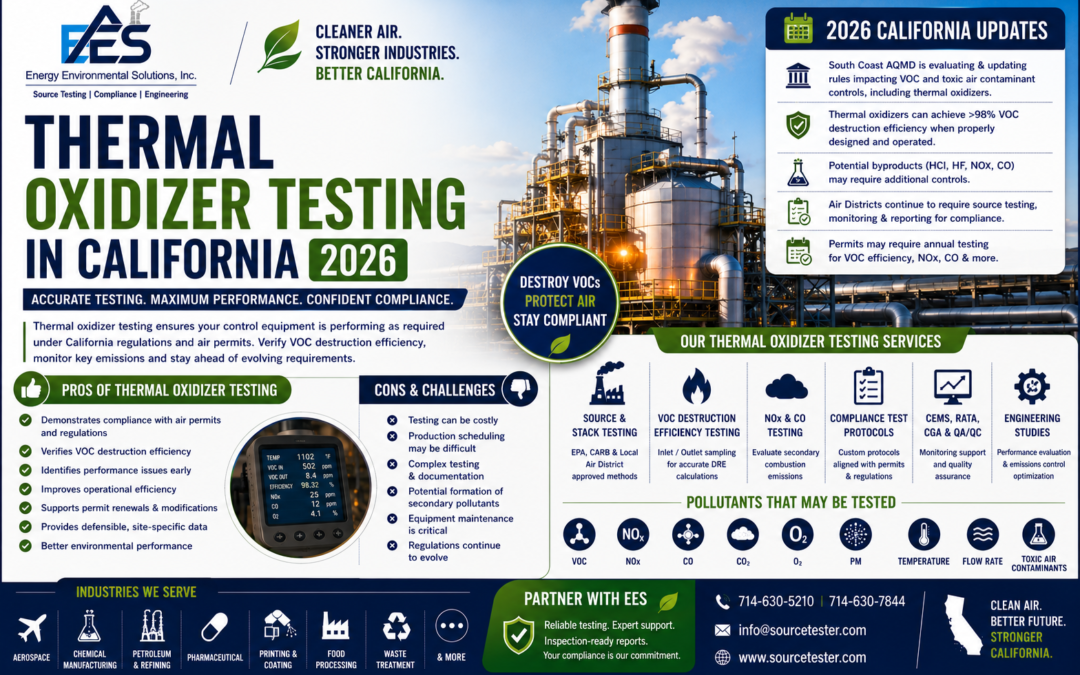
Thermal Oxidizer Testing in California (2026): Latest Updates, Pros, Cons & How EES Helps Industries Stay Compliant
California continues to maintain some of the nation’s most demanding requirements for controlling VOC and toxic air contaminant emissions from industrial operations. For facilities using thermal oxidizers, regenerative thermal oxidizers (RTOs), catalytic oxidizers, afterburners, or related combustion-control equipment, performance testing can be an important part of demonstrating that the control device is actually achieving the required emissions-control performance.
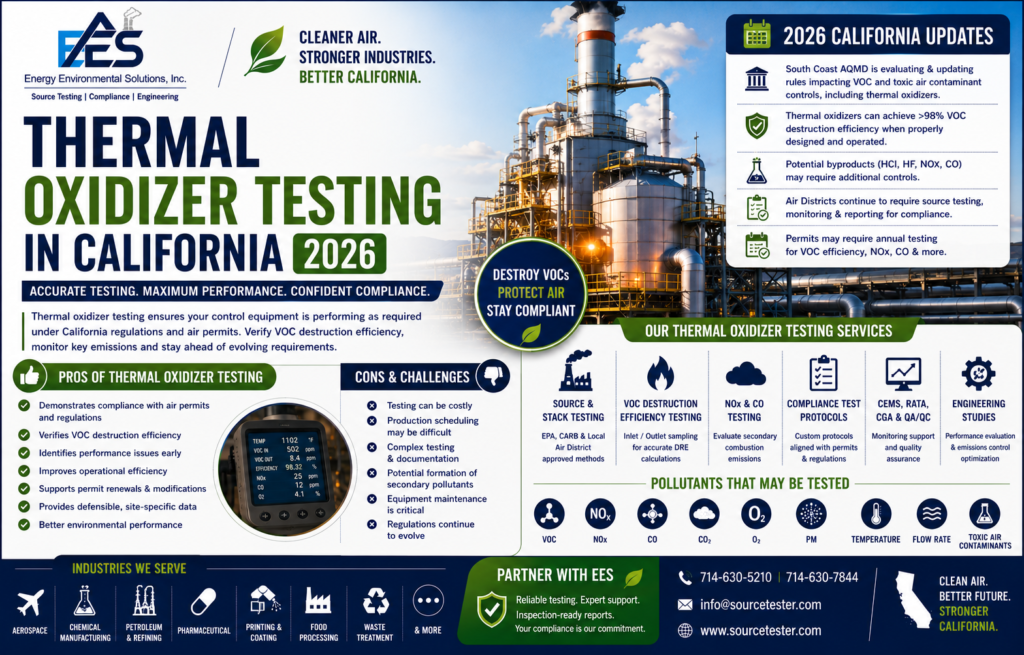
A key 2026 development is that South Coast AQMD is actively evaluating control technologies and emissions requirements across several industrial sectors. Its March 2026 staff report for aerospace coating operations, for example, discusses thermal oxidizers as VOC and toxic-air-contaminant controls and notes that they can achieve destruction efficiencies above 98% in appropriate applications. At the same time, the report highlights an important challenge: thermal oxidation of certain compounds can create secondary pollutants such as HCl and HF, potentially requiring additional control equipment.
For industrial facilities, this means thermal oxidizer testing should not be viewed simply as a one-time emissions test. Temperature, residence time, combustion conditions, VOC destruction efficiency, NOx, CO, and potentially other pollutants all need to be considered according to the applicable permit and Air District requirements.
Energy Environmental Solutions, Inc. (EES) helps California industries with Thermal Oxidizer Testing, VOC Testing, Source & Stack Testing, NOx and CO Testing, Compliance Test Protocol Development, CEMS/RATA/CGA, Engineering Studies, and Regulatory Reporting.
What Is Thermal Oxidizer Testing?
A thermal oxidizer destroys VOCs and other combustible pollutants by oxidizing them at elevated temperatures.
Testing can be used to determine whether the equipment is achieving the required destruction or removal efficiency (DRE) and whether emissions from the control device comply with applicable permit or regulatory limits.
Depending on the facility and permit, testing may evaluate:
VOC destruction efficiency
VOC concentration
NOx emissions
CO emissions
CO₂
O₂
Flow rate
Temperature
Residence time
Combustion conditions
Particulate matter
Toxic air contaminants, where applicable
The exact testing requirements are facility- and permit-specific. There is no single California-wide thermal-oxidizer test that automatically applies to every facility.
Latest California Thermal Oxidizer Updates for 2026
1. South Coast AQMD Is Actively Evaluating Thermal Oxidizers
One of the clearest 2026 regulatory developments comes from South Coast AQMD’s work on Proposed Amended Rule 1124, covering aerospace assembly and component manufacturing operations.
The March 2026 staff report evaluates thermal oxidizers as a potential control technology for VOC and toxic-air-contaminant emissions. South Coast AQMD states that thermal oxidizers can achieve destruction efficiencies exceeding 98% under suitable operating conditions.
However, the agency also identifies limitations for some compounds. For example, thermal oxidation of chlorinated and fluorinated compounds can generate acidic byproducts such as hydrochloric acid and hydrofluoric acid, potentially requiring scrubbers and additional controls.
What this means for industry: choosing a thermal oxidizer is not simply about achieving a high VOC destruction percentage. Facilities must also evaluate the pollutants created by the combustion process.
2. 2026 Rulemaking Continues Across California’s Industrial Air Sector
South Coast AQMD’s 2026 regulatory agenda includes numerous proposed amendments and new rules addressing particulate matter, toxic air contaminants, monitoring, New Source Review, and other air-quality requirements.
This broader regulatory activity matters to facilities operating thermal oxidizers because a control device may address one pollutant while creating or affecting another.
For example, South Coast AQMD’s emissions-reporting guidance for thermal oxidation notes that when VOC vapors are destroyed through thermal oxidation, NOx, SOx, CO, PM, and toxic air contaminants may also be generated. The agency encourages operators to use site-specific test results where available for emissions calculations.
That makes comprehensive testing increasingly valuable.
3. Source Testing Can Be a Permit Requirement
Thermal oxidizer testing requirements are often written directly into individual facility permits.
For example, a Bay Area Air Quality Management District permit requires a thermal oxidizer to be source tested annually for VOC control efficiency as well as NOx and CO emissions, with results reported to the District. The permit also specifies continuous temperature monitoring and recordkeeping requirements.
This demonstrates an important point:
Thermal oxidizer testing frequency and pollutants are determined by the applicable permit and regulatory requirements.
Some facilities may require annual testing; others may have different schedules or testing triggers.
4. California Facilities Continue Using Performance Testing to Demonstrate Control Efficiency
South Coast AQMD Hearing Board documents also show real-world applications of thermal oxidizers.
In a 2025 case involving a petroleum facility, a portable thermal oxidizer was allowed temporarily to replace an afterburner, subject to conditions including a minimum overall VOC control efficiency of 99% and a performance test shortly after startup to demonstrate compliance.
Although that order was issued in 2025, it remains a useful example of how regulators can use performance testing to verify control-device performance during temporary or modified operating conditions.
Why Is Thermal Oxidizer Testing Important?
A thermal oxidizer may look like a simple solution:
VOC-containing gas → high-temperature combustion → cleaner exhaust
But real-world performance depends on several variables.
If the temperature is too low, residence time is inadequate, mixing is poor, or the system is overloaded, destruction efficiency can decline.
Testing helps answer the critical question:
Is the thermal oxidizer actually performing as required under real operating conditions?
Key Parameters That Can Affect Performance
Temperature
Thermal oxidation requires sufficient temperature to initiate and maintain the oxidation reaction.
Temperature requirements vary depending on the equipment, pollutants, permit, and process.
Residence Time
The contaminated gas needs enough time inside the combustion chamber for the oxidation reaction to occur effectively.
Turbulence & Mixing
Good mixing of combustion air and contaminated gas is essential for consistent oxidation.
South Coast AQMD specifically identifies temperature, residence time, and turbulence/mixing as important design factors for thermal oxidizers.
VOC Loading
An oxidizer operating with a highly variable VOC concentration may behave differently from one receiving a stable waste stream.
Testing under representative operating conditions is therefore critical.
Pros of Thermal Oxidizer Testing
1. Demonstrates Compliance
Testing can provide documented evidence that the control device is meeting applicable permit requirements.
2. Verifies VOC Destruction Efficiency
Testing can determine whether the thermal oxidizer is achieving its required VOC control efficiency.
3. Identifies Performance Problems
Testing can reveal declining control efficiency, combustion problems, unusual emissions, or operational conditions requiring investigation.
4. Supports Permit Compliance
Reliable source-test results can support permit renewals, modifications, inspections, and regulatory reporting.
5. Improves Environmental Performance
Properly operated thermal oxidizers can substantially reduce VOC emissions and associated air-quality impacts.
6. Provides Better Emissions Data
Site-specific testing can provide more defensible information than relying exclusively on generic emission factors.
Cons & Challenges of Thermal Oxidizer Testing
Thermal oxidizer testing also comes with challenges.
Testing Costs
Professional source testing requires specialized equipment, trained personnel, laboratory analysis where applicable, and technical reporting.
Production Scheduling
Testing may need to be performed during specific operating conditions, making coordination with production important.
Complex Testing Requirements
VOC destruction efficiency testing can require simultaneous inlet and outlet measurements, operating-condition documentation, and carefully designed sampling procedures.
Secondary Pollutants
Thermal oxidation can produce NOx, CO, SOx, PM, and potentially toxic or acidic combustion byproducts, depending on the waste stream. South Coast AQMD specifically highlights these considerations in its emissions-reporting guidance.
Equipment Maintenance
Burners, combustion chambers, temperature sensors, controls, fans, dampers, and related equipment need appropriate maintenance to maintain performance.
Regulatory Changes
California’s air-quality regulations continue evolving, making it important for facilities to verify current requirements rather than relying on an old test protocol.
Thermal Oxidizer Testing: What May Be Tested?
A facility’s testing program may include:
Parameter
Why It May Be Tested
VOC
Determine emissions and/or destruction efficiency
NOx
Evaluate combustion-related emissions
CO
Identify incomplete combustion
CO₂
Support combustion and emissions calculations
O₂
Support emissions calculations and combustion evaluation
Flow Rate
Determine mass emissions
Temperature
Verify operating conditions
PM
Evaluate particulate emissions where applicable
Toxic Air Contaminants
Evaluate pollutants specific to the process
Inlet/Outlet VOC
Calculate control efficiency
The exact parameters should always be determined from the facility permit, applicable Air District rules, approved test protocol, and regulatory requirements.
How Energy Environmental Solutions, Inc. Helps Industries
Energy Environmental Solutions, Inc. (EES) provides comprehensive testing and engineering support for facilities using thermal oxidizers and other air pollution control devices.
Thermal Oxidizer Performance Testing
EES can help facilities evaluate thermal oxidizer performance through appropriate source-testing programs.
VOC Destruction Efficiency Testing
We can support testing programs designed to determine VOC inlet and outlet concentrations and control efficiency, where required.
NOx & CO Testing
Because combustion can create secondary pollutants, EES can support testing for NOx and CO where required by permits or regulations.
Source & Stack Testing
Our team provides source and stack testing using applicable EPA, CARB, and local Air District methods.
Compliance Test Protocol Development
Before testing begins, a well-developed protocol can define:
Sampling locations
Test methods
Operating conditions
Number of runs
QA/QC requirements
Analytical procedures
Calculations
Reporting requirements
CEMS, RATA & CGA
EES also supports:
CEMS Certification
RATA
CGA
QA/QC programs
Monitoring support
Engineering Studies
Engineering evaluations can help facilities understand equipment performance and identify potential emissions-control improvements.
Regulatory Reporting
After testing, EES can provide technical reports containing emissions calculations, field information, QA/QC documentation, and test results suitable for regulatory review.
Industries That May Use Thermal Oxidizers
Thermal oxidizers are used across many industrial applications, including:
Chemical Manufacturing
Aerospace Manufacturing
Petroleum & Refining
Pharmaceutical Manufacturing
Printing Operations
Coating Operations
Food Processing
Industrial Manufacturing
Waste Treatment
Landfill Gas Control
Solvent-Using Operations
Fuel Processing
Composite Manufacturing
The applicable testing requirements vary significantly by industry and facility.
Why Choose EES for Thermal Oxidizer Testing?
When a thermal oxidizer is part of your compliance strategy, the question isn’t simply “Can it burn VOCs?”
The real questions are:
Is it achieving the required control efficiency?
Are operating conditions documented?
Are secondary emissions being evaluated?
Is the testing performed according to the applicable protocol?
Is the final report defensible during an inspection?
EES helps facilities address these questions through:
✔ Experienced environmental professionals
✔ California regulatory expertise
✔ Source & stack testing
✔ VOC testing
✔ Thermal oxidizer performance testing
✔ NOx & CO testing
✔ Compliance test protocols
✔ CEMS/RATA/CGA support
✔ Engineering studies
✔ QA/QC documentation
✔ Inspection-ready reporting
✔ Responsive technical support
Don’t Wait Until Your Thermal Oxidizer Fails a Test
A thermal oxidizer is a control device, not a guarantee of compliance.
Its performance depends on equipment condition, operating parameters, waste-stream characteristics, combustion conditions, monitoring, and maintenance.
With California continuing to develop and amend air-quality requirements in 2026, proactive testing and compliance planning can help industrial facilities identify potential issues before they become larger regulatory problems. South Coast AQMD’s current rulemaking activity and facility-specific permit requirements demonstrate why companies should review their testing obligations regularly.
Need Thermal Oxidizer Testing in California?
Energy Environmental Solutions, Inc. can help with: